
 Sara Carmen
When suspicion takes over a marriage, the answer isn’t more proof. It’s understanding what your nervous system is actually reacting to.
Key Points
- Couples therapy for jealousy works by calming the nervous system’s fear response, not just refereeing the argument on the surface.
- Digital snooping and constant reassurance-seeking feel protective in the moment, but they train your brain to need more monitoring, not less.
- With the right framework, couples therapy for jealousy helps most couples move from crisis and suspicion into genuine, lasting security.
We know that drop in the stomach. A phone lights up. A name we do not recognize sits on the lock screen. A reply takes forty minutes instead of four. You tell yourself you are simply paying attention. You tell yourself a good partner notices things. What you rarely say out loud is this: you have started living like a detective in a home that used to feel safe.
Someone might think checking a husband’s location is just staying close. But what they don’t see is the way your pulse jumps every time the map pauses at a place you cannot explain.
Someone might think asking about an old girlfriend is harmless curiosity. But what they don’t see is the comparison machine that starts the second a name hits the air. You rank yourself against a past you cannot compete with.
Someone might think reading a partner’s messages is how you finally get peace. But what they don’t see is the ten-minute calm, then the louder doubt, then the next search.
You are not broken for this. You are also not protecting the marriage the way you think you are.
Jealousy that will not quiet down is rarely a logic problem. It is a nervous system problem. Couples therapy for jealousy works because it treats the alarm system both of you are living inside, not the latest fight about a text.
The Detective Trap: When Insecurity Mimics Intuition
Hypervigilance is the clinical name for what you are doing. It means your brain stays on constant scan for threat. A glance. A delayed text. A coworker mentioned too warmly. Ordinary life starts to look like evidence.
You feel exhausted because you are. Your attention is doing two jobs at once. You are trying to live your day and run a private investigation. Sleep gets thin. Focus at work slips. Your body stays tight, as if something bad is always about to happen.
Then comes the false safety loop. You check the phone. You feel a brief drop in panic. Your brain files that check as “the thing that helped.” So it asks you to do it again. Each search buys minutes of relief and then charges interest. The doubt returns louder. You need a bigger dose next time.
That is the breaking point. You stop feeling like a loving partner. You start acting like a suspicious investigator in your own home. Left unexamined, this pattern does not just strain a marriage. It can quietly become the reason it ends.
But here’s what no one tells you.
The checking is not proof that your intuition is sharp. It is proof that your threat system is overactive, under-soothed, or both.
Understanding the Root Causes of Toxic Suspicion

Early Attachment Styles and the Fear of Abandonment
If you have an anxious attachment style, your internal alarm is set very sensitive. Attachment style means the template you learned early in life for how close people stay and how safe it is to need them. An anxious pattern scans hard for signs that someone is pulling away. A slow text stops being a busy afternoon. It becomes a preview of being left.
Research on jealousy and attachment styles shows this clearly. The fear is not always about the present partner. It is often an old alarm firing in a new house.
That alarm does not stay private. It leaks out as protest behaviors. Protest behaviors are the moves we use when we feel ourselves losing connection and try to force it back. Interrogation. Emotional distance. Passive-aggressive tests. “If you really loved me, you would have texted sooner.” You may already hate that you do this. Shame does not stop it. Shame usually makes it worse.
Most people in this situation don’t realize that the protest is a bid for safety wearing an angry costume.
Retroactive Jealousy vs. Betrayal Trauma
Not all jealousy is the same, and treating it as one thing is why so much advice fails.
Retroactive jealousy is an obsessive pull toward a partner’s romantic or sexual past. You want dates, names, details, comparisons. The threat is not happening in the kitchen. It is happening in a story you keep replaying. This often sits next to obsessive thinking. The mind treats uncertainty like danger and tries to solve it with more information. More information almost never closes the file.
Betrayal trauma is different. This is the nervous system after a real infraction. An affair. An emotional entanglement. A confirmed lie. Here, jealousy is not “just insecurity.” It is a trauma response. Everyday scenes start to feel like existential threats because your body already learned that the ordinary can hide a wound.
You need that distinction. If the danger was real, you do not need to be talked out of your fear. You need a trust-rebuilding plan. If the danger is mostly internal, you need a different kind of work. Couples therapy for jealousy is where those two maps get sorted, honestly, without turning you into the villain or the victim by default.
Why Traditional Advice Fails (And Why Therapy Is the Real Solution)
Moving Beyond the “Just Trust Him” Platitude
“Just trust him” is a sentence that makes sense in a calm brain. It does almost nothing in a brain that has already flipped into fight-or-flight. Logic cannot soothe a dysregulated nervous system. Dysregulated means your body has left the window where you can think, listen, and stay kind. You are flooded. Your partner’s calm explanation sounds like a cover story. Your own questions come out like a cross-examination.
That is why reassurance so often backfires. He answers. You feel better for a moment. Then a new hole appears in the story and you need another answer. He starts to feel hunted. You start to feel crazier. Attraction thins. Patience thins. The marriage becomes a courtroom.
In my practice, I have watched this same loop play out more times than I can count. One person is drowning in fear. The other is drowning in the job of proving they are safe. Most advice only speaks to the jealous partner. That is the gap. The burden of constant reassurance is its own injury. Real couples therapy for jealousy treats both people, because both of you are living inside the siren.
Think of jealousy as a smoke alarm wired to toast. The noise is real. The fire often is not. You cannot shout the alarm into silence. You have to recode the wiring. You cannot do that job alone while the siren is still screaming.
Evidence-based couples work is that recoding.
The Gottman Method treats jealousy as a hidden vulnerability and a chance to rebuild connection, not as a character flaw to scold away. The Gottman Institute describes jealousy as something that can point toward deeper needs for attunement. Attunement means actually catching and responding to each other’s inner world, not just winning the argument. The path moves through honesty, repair, and a more secure bond.
Emotionally Focused Therapy, or EFT, goes underneath the fight. Instead of debating the phone, EFT looks at the cycle. One of you pursues. One of you withdraws. Both of you feel alone. The work is to slow that cycle and build a secure attachment bond, which is a felt sense that the other person is reachable when it matters.
This is not wishful thinking. Research summarized across decades of couples treatment, including work associated with the American Psychological Association, finds that evidence-based couples therapy helps about 75 percent of distressed couples move out of serious distress. That number matters because it means you are not asking for a miracle. You are asking for a method.
Maya’s Midnight Checks
Maya was 34 and sure she was losing her mind. Every night after her husband Daniel fell asleep, she took his phone into the bathroom. She knew the passcode. She told herself she was looking for peace. She found nothing. The nothing never lasted. By morning she was already timing his replies. If a woman from work appeared in a story, Maya felt it in her throat before she felt it in her thoughts.
Daniel had not cheated. He had also stopped offering extra warmth because every kind gesture turned into a quiz. In the first session she said she felt crazy. He said he felt hunted. The work was not proving he was faithful. The work was teaching her body that safety does not come from surveillance. And teaching him how to stay present without becoming a 24-hour vending machine for comfort. They banned the nightly search. They practiced a 15-minute pause after a trigger. They learned to say the fear without putting him on trial. It was messy. It was also the first time the house felt like a home again instead of a case file.
You may recognize yourself in Maya. You may recognize yourself in Daniel. Either way, the loop is the same. Fear seeks control. Control starves trust. Trust is what would have calmed the fear.
10 Actionable Steps to Treat Marital Jealousy and Reclaim Confidence
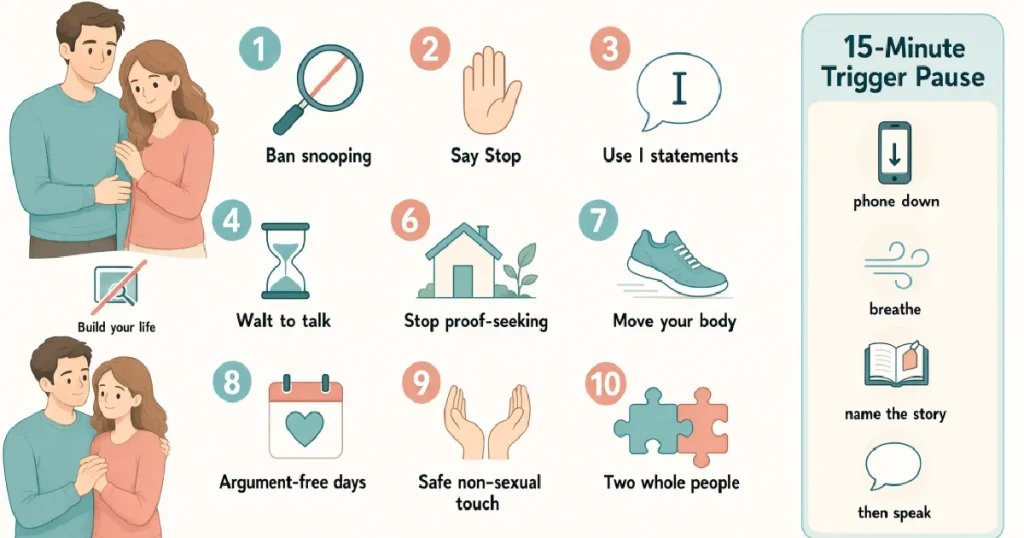
Immediate Behavioral Changes to Halt the Spiral
1. Enforce an explicit ban on digital snooping.
Commit to a full stop on checking his phone, social media, and location history. Snooping feeds the anxiety loop. It offers fake relief and then trains your brain to need another hit.
2. Deploy the “Stop” thought-interruption technique.
The second an irrational scene starts playing in your mind, say “Stop” out loud. Then put your hands on a real task. A dish. A work email. A walk around the block. You are teaching your mind that it does not get to run the movie unchallenged.
3. Own the emotion without projecting blame.
Swap “Why are you acting sketchy?” for “I am feeling an irrational surge of panic right now.” The first sentence makes your partner the enemy. The second sentence makes the fear a shared problem.
4. Practice de-escalation before discussion.
Do not open a jealousy conversation when you are hungry, exhausted, or already spiraling. Wait until you have eaten, rested, and felt your body come down. A flooded talk is not honesty. It is a collision.
5. Build a specialized identity outside the marriage.
Re-engage a hobby, a class, a career goal that is yours. Idle time is jet fuel for overthinking. Competence in your own life quietly raises the floor of your self-worth.
Deeper Relational Shifts for Long-Term Trust
6. Decline compulsive reassurance-seeking.
Stop asking him to prove his love, explain his past, or narrate every interaction with other women. Repeated proof-seeking erodes attraction. It also never satisfies the part of you that is asking.
7. Pivot from mental anxiety to physical competence.
When panic spikes, move your body hard. Lifting. Running. A fast walk. You are burning off adrenaline so your thinking brain can come back online.
8. Set micro-goals for argument-free days.
Gamify it. One full day without a sharp comment or a test. Then three days. Then a week. You are retraining a reflex, not becoming a different person overnight.
9. Separate intimacy from sexual expectation.
If resentment has followed you into the bedroom, take sexual pressure off the table for a few weeks. Keep non-sexual touch. Hands. A massage. Sitting close. Safety has to return before desire can.
10. Establish healthy independent boundaries.
A healthy marriage is two whole people, not two fused halves. He gets friends, family, and a life that is not under your watch. You get the same. Autonomy is not a threat. It is part of adult love.
If you only remember one protocol, remember the 15 minutes after a trigger. Put the phone down. Leave the room if you need to. Say “Stop.” Breathe in for four, hold for four, out for four, hold for four. Name the story: “The story I am telling myself right now is that I am not safe.” Do not start the conversation until your body is quieter. Then use an “I” statement. That small sequence is how you sit with discomfort without starting a war.
One more piece of honesty. Sometimes the environment is not safe. Repeated secrecy, confirmed lies, and a pattern of hiding are not “your anxiety.” If evidence keeps lining up, couples therapy for jealousy still helps. It helps you see clearly, set terms, and stop confusing intuition with panic.
Choosing the Right Therapeutic Path
How to Find the Best Therapist for Your Relationship
Look for a licensed clinician who actually treats high-conflict couples, betrayal trauma, or jealous thinking with a clear method. A general weekly chat is often too soft for this problem. You want Gottman work, EFT, or a cognitive-behavioral approach that can interrupt the mental loop, not just witness it.
Check credentials through a professional body such as the American Association for Marriage and Family Therapy. Ask how they handle digital snooping, retroactive jealousy, and affairs. If they cannot describe a plan, keep looking.
Bringing this up to a defensive partner is its own skill. Do not frame it as “you need to be fixed.” Frame it as “we are both tired and I want us to have peace.” You are inviting a teammate, not opening a trial.
A useful question to ask yourself tonight is simple. Am I trying to feel close, or am I trying to feel in control? The next time the urge to check hits, try the 15-minute pause before you do anything else.
You walked into this like a detective who could not clock out. You now have a different job. Put the badge down long enough to recode the alarm. The toast will still burn sometimes. The siren does not have to run the house.
Peace is not something you extract from a phone. It is a skill you practice together.
My Closing Remarks
I have sat with people who loved their partner and still could not stop searching. I have sat with the other person too, worn thin from answering the same question in a hundred costumes. Neither of you is a monster. You are stuck in a loop that feels like protection and functions like poison. If you take one thing from me, take this: your fear makes sense, and it still does not get to drive. Put the phone down tonight. Say the real sentence out loud. Ask for help as a team. You deserve a home that does not feel like a case file.
More Related Stories for You
- Curious what it actually means when your partner calls you beautiful and why it can feel harder to believe than it should? That piece pairs well with the trust-building work covered here.
About The Author