
 David Wall
Your Body Already Knows How To Heal Itself. The Problem Is You Keep Interrupting It. Here Is How Meditation And Sleep Work Together To Restore What Stress Takes Away.
Key Points
- Meditation and sleep activate the same brain-cleaning system through different biological doors, and combining them creates a continuous detoxification cycle your brain cannot achieve with either practice alone.
- Just 10 minutes of meditation before bed can reduce the time it takes you to fall asleep by up to 40% while increasing the deep sleep stages where your body does its most critical repair work.
- The meditation and sleep combination protects your cells at the DNA level, preserving the telomere caps on your chromosomes that determine how quickly you age biologically.
Contents
Table of Contents
The Night You Stopped Sleeping Well
You are lying in bed at 11:47 p.m. Your body is exhausted. Your mind is not.
It is replaying the conversation you had six hours ago. It is drafting tomorrow’s to-do list. It is asking you, for the third time tonight, whether you remembered to send that email.
You flip your pillow. You check your phone. You tell yourself to just relax, which has never once in human history helped a person relax.
By midnight, you are frustrated. By 1 a.m., you are anxious about being frustrated. And by morning, you are dragging yourself through another day on four or five hours of fractured rest, wondering why everything feels harder than it should.
Here is what nobody told you: the problem is not just your sleep. The problem is what happens in the hours before sleep. And the solution is not a pill, a supplement, or a weighted blanket. It is something your brain already knows how to do. You just need to give it a running start.
Why Your Brain Needs a Double Shift of Cleaning
To understand why meditation and sleep form such a powerful pair, you need to know about a system most people have never heard of: the glymphatic system.
Think of your glymphatic system as your brain’s overnight cleaning crew. While you sleep, cerebrospinal fluid (the clear liquid that surrounds your brain and spinal cord) flows through channels between your brain cells, flushing out metabolic waste. This includes beta-amyloid and tau proteins, the toxic byproducts linked to Alzheimer’s disease and cognitive decline.
During deep sleep, your brain cells actually shrink by about 60%, creating wider channels for this fluid to move through. It is a remarkably efficient system. But it has a limitation: it works best during specific sleep stages, and if you are not reaching those stages, the cleaning crew shows up but cannot do its job.
Here is where meditation changes the equation.
A 2025 study published in PNAS from Vanderbilt University found something remarkable. Researchers measured cerebrospinal fluid flow in 52 participants during focused-attention meditation and discovered that meditation reduces the backward flow of this fluid by 9.3%. In other words, meditation makes the fluid move more efficiently in one direction, mimicking the cleaning patterns usually reserved for deep sleep, while you are still wide awake.
The researchers also observed that low-frequency oscillations in cerebrospinal fluid increased significantly during meditation. These oscillations, in the 0.06 to 0.09 Hz range, are the same frequencies that drive waste clearance during non-REM sleep.
What this means is profound: meditation does not replace sleep. It prepares the plumbing.
Imagine running water through a garden hose that has been kinked and tangled all day. You could turn the water on full blast, but the flow would be weak and inefficient. Now imagine straightening the hose first, then turning on the water. That is what meditation does for your glymphatic system before sleep takes over.
Your Brain’s Healing Operating System Runs on Two Engines
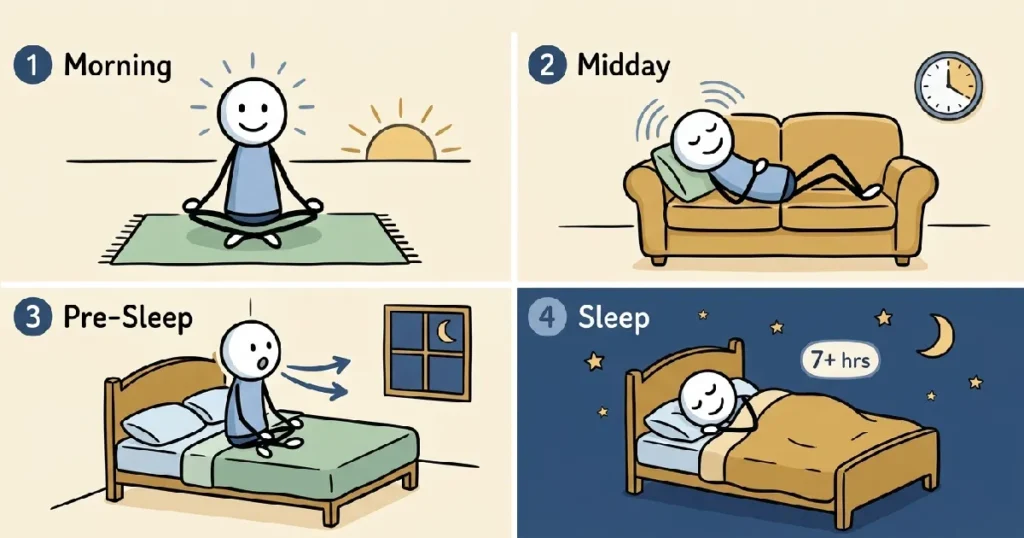
The real power of meditation and sleep is not that they do similar things. It is that they do complementary things in sequence, creating a continuous cycle of repair that neither can accomplish alone.
Let me walk you through the four mechanisms that make this duo so effective.
1. Meditation Quiets the Network That Keeps You Awake
There is a region of your brain called the Default Mode Network, or DMN. It is the neural circuitry responsible for mind-wandering, self-referential thinking, and the kind of mental chatter that fills your head the moment you try to fall asleep.
In people with insomnia, Stanford researchers have found that the DMN remains hyperactive at bedtime. It refuses to quiet down. Your body is in bed, but your brain is still at work, reviewing, planning, worrying.
Meditation trains you to notice when the DMN is running and gently redirect your attention. Over time, this weakens the DMN’s grip. You become better at letting thoughts pass without following them down the hallway.
Here is the part most people miss: this is not just a skill you use during meditation. The neural changes carry over into bedtime. Regular meditators show faster DMN deactivation when transitioning to sleep, which translates to falling asleep more quickly and experiencing fewer nighttime awakenings.
One study from Beijing’s Institute of Geriatric Medicine found that consistent pre-sleep meditation practice reduced sleep-onset latency (the time it takes to fall asleep) by up to 40%.
That is not a marginal improvement. That is the difference between lying in the dark for 45 minutes and drifting off in under 15.
2. The Hormonal Gate That Controls Sleep Entry
Your ability to fall asleep depends on a hormonal handoff. Cortisol, your primary stress hormone, needs to drop. Melatonin, your sleep-signaling hormone, needs to rise. This is the cortisol-melatonin seesaw, and when it works, you barely notice it happening. When it does not, you feel wired and tired at the same time.
Chronic stress flattens this rhythm. Your cortisol stays elevated at night. Your melatonin peak becomes weaker. The hormonal “gate” that is supposed to swing open at bedtime gets stuck.
Meditation directly addresses this. Research shows that a brief meditation session before bed can reduce pre-sleep cortisol levels by up to 40% while simultaneously increasing the peak concentration of melatonin released during the night. This is not just about feeling calmer. It is about changing the chemical environment your brain enters sleep in.
Lower cortisol permits your brain to spend more time in N3 sleep, also known as slow-wave sleep. This is the deepest, most restorative stage, where tissue repair, immune function, and memory consolidation happen. Higher melatonin ensures you get there faster.
The duo effect is clear: meditation opens the gate. Sleep walks through it.
3. Your Immune System Runs on Both Meditation and Sleep

Let me tell you about a woman I will call Rachel.
Rachel came to see me after a year of catching every cold, flu, and stomach bug that circulated through her office. She was 38, otherwise healthy, exercised three times a week, and ate well. But she was sleeping five to six hours most nights and had not taken a genuine mental break in months.
Rachel’s immune system was not broken. It was under-resourced.
A 2025 study published in Communications Biology showed that sleep deprivation triggers an immune response that resembles a low-grade cytokine storm. Inflammatory markers like IL-6 and IL-17 spike. Neutrophils, a type of white blood cell, mobilize as if fighting an infection that is not there. The body enters a state of immune confusion, overreacting to some threats while missing others.
Recovery sleep helps normalize this. But when Rachel added a simple 10-minute body scan meditation before bed, her trajectory shifted faster than sleep alone could account for.
This aligns with research showing that meditation independently reduces inflammatory markers like C-reactive protein and IL-6 while improving the body’s response to vaccines by up to 35%. Meditation lowers the sympathetic nervous system activity that suppresses natural killer cells, your body’s first-line defenders against viruses and abnormal cells.
Sleep restores the immune system’s architecture. Meditation reduces the stress signals that tear it down. Together, they give your body both the repair time and the calm internal environment it needs to actually heal.
Within three months, Rachel was not just sleeping better. She stopped getting sick.
4. Meditation and Sleep Protect Your DNA from Aging
This is the mechanism that surprises most people.
At the tips of your chromosomes sit protective caps called telomeres. Think of them like the plastic tips on shoelaces. They keep your genetic material from fraying. Every time a cell divides, telomeres get a little shorter. When they get too short, the cell stops functioning properly or dies. This is one of the primary drivers of biological aging.
Research pioneered by Nobel laureate Elizabeth Blackburn has shown that sleeping fewer than seven hours per night accelerates telomere shortening equivalent to four to seven years of additional biological aging.
But here is what makes the meditation and sleep combination so striking: meditation activates telomerase, the enzyme that rebuilds and lengthens telomeres. In one study, participants who meditated consistently for 90 days showed a 30% increase in telomere length in 83% of participants.
Sleep provides the raw material for cellular repair. Meditation provides the enzymatic machinery to execute that repair at the DNA level. One without the other is like having lumber but no carpenter, or a carpenter but no lumber.
That is not a wellness trend. That is cellular biology telling you these two practices were designed to work together.
The Part No One Talks About: What Happens Inside Your Brain During the Handoff

Here is the insight that separates this understanding from everything else you have read about meditation and sleep.
Most articles treat meditation and sleep as two separate health habits that happen to share some benefits. But the latest neuroscience suggests they exist on a single continuum.
During meditation, your brainwaves shift from beta (your alert, problem-solving state) down through alpha and into theta, the same transitional frequencies your brain passes through on the way to sleep. A protocol called Non-Sleep Deep Rest, or NSDR, developed by Stanford neurobiologist Andrew Huberman, deliberately targets this transition zone.
NSDR achieves in roughly 10 minutes what a traditional nap requires 60 to 90 minutes to produce: a measurable increase in dopamine (approximately 60%), a significant reduction in cortisol, and a cognitive restoration effect on reaction time and decision accuracy. Crucially, it does this without the grogginess, known as sleep inertia, that makes afternoon naps counterproductive for many people.
What NSDR reveals is that meditation and sleep are not two separate doors to recovery. They are the same door at different depths. Meditation takes you to the threshold. Sleep takes you through.
When you practice meditation before bed, you are not just “relaxing.” You are guiding your brain along the exact neurological path it needs to travel to reach the deep sleep stages where healing happens. You are smoothing the runway.
The Stacked Recovery Protocol: Your Nightly System
If you want to put this science into practice, here is a simple framework you can start tonight. I call it the Stacked Recovery Protocol because it layers these benefits throughout your day rather than cramming everything into the 10 minutes before bed.
Step 1: The Morning Primer (10 minutes)
Start your day with a focused-attention meditation. This means choosing a single point of focus, your breath, a sound, a visual point, and gently returning your attention to it each time your mind wanders. This morning session primes your glymphatic system and begins the day with lower baseline cortisol.
Step 2: The Midday Reset (10 minutes)
After lunch or during an afternoon slump, try a Non-Sleep Deep Rest session. Lie down or sit comfortably. Close your eyes. Follow a guided body scan or breathing protocol designed to drop your brainwaves into the alpha-theta range. You will feel cognitively refreshed without the heaviness of a nap.
Step 3: The Pre-Sleep Transition (10 minutes)
This is the most important step. Within 30 minutes of getting into bed, do a body scan combined with slow, deliberate breathing. Breathe in for four counts. Breathe out for six to eight counts. The extended exhale activates your parasympathetic nervous system, lowering cortisol and signaling to your brain that it is safe to begin the transition to sleep.
Step 4: Protect the Sleep Window (7 or more hours)
The meditation steps above are designed to make your sleep deeper and more restorative. But they cannot replace duration. Aim for at least seven hours. The combination of meditation-primed sleep architecture and adequate duration is what produces the measurable outcomes the research points to: 15% more deep sleep, stronger immune biomarkers, and better morning restoration scores.
A useful question to ask yourself each evening: “Am I giving my brain the runway it needs, or am I asking it to land in the dark?”
Coming Back to That Midnight Ceiling
Remember that version of you at 11:47 p.m., staring at the ceiling, mind spinning, body tired but brain unwilling to cooperate?
You now understand something you did not know then.
Your brain was not malfunctioning. Your Default Mode Network was running unchecked. Your cortisol had not received the signal to stand down. Your glymphatic system was waiting for a state your brain was not ready to enter. The cleaning crew was at the door, but nobody had turned the lights off.
Meditation is not a luxury practice for people with extra time. It is the bridge your biology is already asking for. It is the transition your nervous system needs to cross from the chaos of your waking day into the deep, restorative work your brain can only do when you finally, truly let go.
You do not need to meditate for an hour. You do not need a retreat or a mantra or a special cushion. You need 10 minutes and the willingness to sit with yourself before you ask yourself to sleep.
Healing is not something that happens to you. It is something you stop interrupting.
My Closing Remarks
In my years of working with people who are exhausted, overwhelmed, and running on fumes, I have noticed something consistent. The ones who recover fastest are not the ones with the best supplements or the fanciest sleep trackers. They are the ones who learn to be still before they try to rest. That distinction changed how I approach my own nights. I used to collapse into bed and wonder why sleep felt like a battle. Now I spend 10 quiet minutes beforehand, and the difference is not subtle. It is structural. If you take one thing from this article, let it be this: your brain wants to heal you. Stop skipping the warm-up.
More Related Stories for You
- If you are looking to deepen your understanding of how daily mindfulness practice transforms not just sleep but your entire relationship with stress, start there.
About The Author