
 David Wall
Your Brain Isn’t Broken. It’s Stuck In A Loop. These Nine Neuroscience-Backed Techniques Teach It A New Route.
Key Points
- Mindfulness for overthinking works not by silencing thoughts but by changing your relationship with them. These nine techniques target the brain’s default mode network, the neural circuit responsible for repetitive mental loops, and redirect your attention to the present moment.
- The most effective mindfulness strategies go far beyond deep breathing. They include somatic grounding, cognitive defusion, cold-shock responses, and bilateral movement, all designed to interrupt overthinking at its neurological source.
- You don’t need 30 minutes of meditation to stop spiraling. Some of these mindfulness for overthinking techniques take as little as 30 seconds and can be practiced anywhere, including your desk, your car, or your kitchen sink.
Contents
Table of Contents
When Your Mind Won’t Stop Talking
You are lying in bed at 11:47 PM. Your body is exhausted, but your brain is hosting a board meeting you never agreed to attend. It replays a conversation from Tuesday. It rehearses a confrontation that hasn’t happened. It asks you what you meant by that email and whether your boss noticed.
You flip your pillow to the cool side, as if that will help.
It doesn’t.
If this sounds familiar, you are not fragile, anxious, or weak. You are experiencing what neuroscientists call the default mode network in overdrive. And it is far more common than you think.
Why Your Brain Gets Stuck on Repeat
Here is something most people never learn: overthinking is not a character flaw. It is a neurological pattern.
The default mode network (DMN) is a cluster of brain regions that activate when you are not focused on an external task. It handles self-referential thinking, meaning it processes memories, plans for the future, and evaluates social interactions. In moderation, this is useful. It helps you learn from experience and prepare for what comes next.
But when the DMN stays hyperactive, it becomes a rumination engine. You stop processing and start looping.
A landmark study published in Science by Killingsworth and Gilbert (2010) found that people spend nearly 47% of their waking hours in mind-wandering, and that this mental wandering is consistently associated with lower happiness. Not occasionally. Consistently.
The problem is not that you think too much. The problem is that your brain has learned to default to worry as its resting state. And the longer you let that loop run unchallenged, the deeper the neural pathway becomes. Think of it like a hiking trail. The more you walk it, the more defined it gets. Eventually, your brain doesn’t even choose the path. It just follows the groove.
Mindfulness for overthinking works by building a new trail.
Not by fighting the old one. Not by forcing yourself to “just stop thinking.” But by training your attention to go somewhere else, again and again, until a new default forms. This is neuroplasticity in action: your brain’s ability to rewire itself based on where you consistently direct your focus.
Here are nine specific techniques to do exactly that.
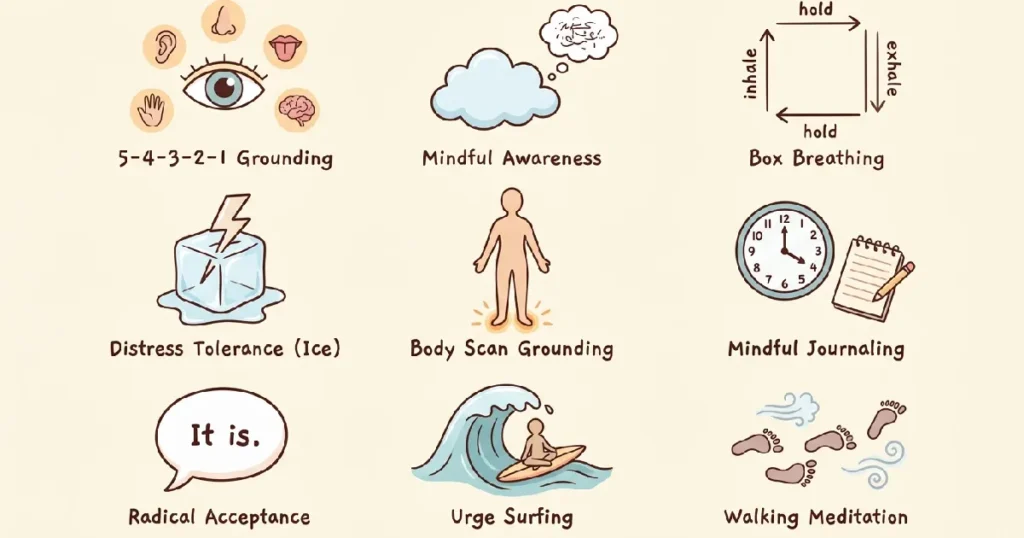
1. The 5-4-3-2-1 Sensory Reset: Pull Your Brain Into the Room
When overthinking hijacks your attention, your brain is essentially living in a different time zone. It is stuck in the past or rehearsing the future. The fastest way to break that spell is to force it back into the present using raw sensory data.
This technique activates your task-positive network, the brain system that handles immediate, real-world engagement. It directly competes with the DMN. When one is on, the other quiets down.
How to practice it: Name five things you can see. Four things you can physically touch right now. Three sounds you hear. Two things you can smell. One thing you can taste.
Do it slowly. Be specific. Not “I see a wall.” Instead, “I see a thin crack in the plaster near the ceiling, shaped like a river.”
The specificity matters. It demands the kind of focused attention that overthinking cannot coexist with.
2. “Thoughts as Clouds” Visualization: You Are the Sky, Not the Storm
This is a technique rooted in cognitive defusion, a concept from Acceptance and Commitment Therapy (ACT). Cognitive defusion means creating distance between you and your thoughts so that you stop treating every mental event as a fact or a command.
Most overthinkers are fused with their thinking. They don’t experience a thought like “I’m going to fail.” They experience themselves as someone who is failing. The thought and the identity become one.
How to practice it: When you notice a spiraling thought, pause and restate it: “I am having the thought that I’m going to fail.” Then imagine that thought as a cloud drifting across a wide sky. You don’t push it. You don’t chase it. You watch it pass.
This is not positive thinking. It is perspective thinking. And research on ACT-based interventions consistently shows it reduces rumination and improves emotional flexibility.
3. Box Breathing With a “Hold” Focus: Reset Your Nervous System in 60 Seconds
You have probably been told to “just breathe” during stressful moments. That advice is incomplete. The key to using breath as a mindfulness tool for overthinking is not the breathing itself. It is the structured pause.
Box breathing regulates your autonomic nervous system by equalizing the ratio of oxygen to carbon dioxide in your bloodstream. This sends a biochemical signal of safety to your brain, specifically to the amygdala, the brain’s threat-detection center.
How to practice it: Inhale through your nose for four seconds. Hold your breath for four seconds. Exhale through your mouth for four seconds. Hold empty for four seconds. Repeat four cycles.
The “hold” phases are what make this different from ordinary deep breathing. They create a moment of stillness your nervous system interprets as “no threat detected.” Navy SEALs use this technique before high-pressure operations. You can use it before a difficult conversation or in the middle of a 2 AM thought spiral.
4. The 30-Second Cold Shock: Interrupt the Loop Instantly

This one sounds strange. It works anyway.
When you splash ice-cold water on your face or hold an ice cube tightly in your hand, you trigger what’s called the mammalian dive reflex. This is an automatic physiological response that immediately lowers your heart rate and redirects blood flow to your core organs. It is your body’s built-in emergency brake.
How to practice it: Fill a bowl with cold water and ice. Lean forward and submerge your face for 15 to 30 seconds while holding your breath. Alternatively, hold an ice cube in your closed fist and focus on the sensation intensely.
This technique is especially useful for people whose overthinking is accompanied by intense physical anxiety, such as a racing heartbeat, chest tightness, or feeling “locked in.” It works fast because it bypasses cognition entirely and acts directly on the vagus nerve.
In my clinical experience, this is the technique clients are most skeptical about and then most surprised by.
5. Somatic Body Scanning: Move the Energy Out of Your Head
Overthinking is, at its core, an attention problem. Your awareness is trapped in the prefrontal cortex, the brain region responsible for analysis and planning. A somatic body scan redistributes that attention across your physical body, which naturally calms mental chatter.
How to practice it: Close your eyes. Direct your attention to the bottoms of your feet. Notice the pressure against the floor, the texture of your socks, any warmth or coolness. Stay there for 60 full seconds.
This is not a relaxation exercise. It is an attention-training drill. You are teaching your brain that it has somewhere else to go besides the thought loop. The feet and palms of the hands are ideal anchor points because they are rich in nerve endings and far from the head, which creates a strong attentional shift.
Think of your awareness like water in a bucket that has been sitting tilted to one side for years. This technique slowly levels it out.
6. Scheduled “Worry Time”: Give Overthinking a Leash
Here is a paradox most overthinkers have never considered: trying to stop worrying actually increases worry. The suppression effort itself keeps the thoughts active.
Scheduled worry time is a technique from cognitive behavioral therapy (CBT) that solves this by containing overthinking rather than eliminating it. You are not telling your brain to stop. You are telling it “not yet.”
How to practice it: Choose a 15-minute window at the same time each day, say, 4:00 PM. When a worry surfaces outside that window, write it on a list and postpone it. When 4:00 arrives, sit down, review your list, and worry deliberately. Most people discover that by the time their worry window arrives, 80% of the items on the list no longer feel urgent.
A composite example: Maya, a 34-year-old project manager I worked with, used to describe her mind as “a browser with 47 tabs open.” She spent most meetings half-listening while mentally rehearsing worst-case scenarios. After three weeks of scheduled worry time, she told me something that stuck: “I didn’t stop worrying. I just stopped letting it crash my whole day.”
That is the goal.
7. Radical Acceptance “Is” Statements: Stop Arguing With Reality

Roughly 90% of overthinking is not problem-solving. It is mentally arguing with something that has already happened or something you cannot control.
Radical acceptance, a concept from Dialectical Behavior Therapy (DBT) developed by Marsha Linehan, does not mean you approve of what happened. It means you stop spending mental energy insisting it should have been different.
How to practice it: When you catch yourself looping, state only the objective facts. Out loud if possible. “The meeting is over. I cannot unsay what I said. I am physically safe in this room right now.”
These “is” statements work because they collapse the gap between what happened and what your brain wishes had happened. That gap is where overthinking lives. Close it, and the loop has nowhere to run.
8. Mindful Urge Surfing: Ride the Wave Without Getting Pulled Under
Most people treat the urge to overthink like an itch that must be scratched. Urge surfing, a technique originally developed for addiction treatment by psychologist Alan Marlatt, treats it like a wave. It rises. It crests. It falls. And the entire cycle typically lasts about 90 seconds.
How to practice it: When you feel the pull to replay, analyze, or mentally rehearse, do not engage. Instead, sit still and observe the physical sensation of the urge. Where is it in your body? Does it feel like pressure, heat, tightness? Watch it without acting on it.
That’s not weakness. That’s neurological training.
You are teaching your brain that an urge does not require a response. Over time, this weakens the automatic connection between “trigger” and “spiral.”
9. Kinesthetic Walking Meditation: Move Your Body, Unstick Your Mind
The final technique uses bilateral stimulation, the alternating activation of both brain hemispheres through rhythmic physical movement. This is the same principle behind EMDR therapy, which is used to process traumatic memories. Walking meditation adapts it for everyday overthinking.
How to practice it: Walk slowly, preferably outdoors. Match each step precisely to the rhythm of your breath. Inhale on the left foot, exhale on the right. Pay close attention to the heel-to-toe roll of each step. Notice how the ground meets your foot.
This works because bilateral movement engages the brain’s processing systems in a way that sitting still does not. It helps metabolize “stuck” mental energy, moving it from rumination into integration. Many people find that the solution to a problem they have been overthinking about for days arrives during a ten-minute walking meditation, not because they forced it but because they finally gave their brain the movement it needed to think differently.
How to Start Without Overwhelming Yourself

Nine techniques is a lot. You do not need all of them.
The “Pick Two” Method: Choose two techniques from this list that felt most resonant as you read. Practice one in the morning and one in the evening for seven days. That is it. No apps. No retreats. No hour-long meditation sessions.
The “Pattern Match” Approach: Notice when your overthinking is worst. If it hits hardest at night, try box breathing or the 5-4-3-2-1 sensory reset. If it spikes during work, try scheduled worry time or “is” statements. Match the technique to the trigger.
A useful question to ask yourself tonight: “When I was overthinking today, what would have happened if I had simply noticed the loop instead of jumping into it?”
You do not have to answer that question perfectly. You just have to start asking it.
You Were Never the Storm
Remember lying in bed at 11:47 PM, your brain running that meeting you never signed up for? You have new options now.
You can name five things you see in your dark bedroom. You can feel the weight of the blanket on your chest. You can tell yourself, “I am having the thought that tomorrow will go badly,” and watch that thought float past like a cloud in a night sky.
Mindfulness for overthinking is not about becoming someone who never worries. It is about becoming someone who notices the worry, chooses not to follow it, and returns to the present moment, one breath, one step, one cold splash of water at a time.
Your mind was never the enemy. It just forgot it had somewhere else to go.
Now it does.
My Closing Remarks
I spent years believing my overthinking made me smarter, more prepared, more responsible. It did none of those things. It made me exhausted. It stole sleep. It stole presence with people I love. The day I realized I could observe a thought without obeying it changed everything for me, not in some dramatic, cinematic way, but in the quiet way that real change always happens. If you are reading this at midnight with a mind that will not shut up, I want you to know: you are not broken. You are just running software that needs an update. And these nine techniques are the update. Start with one. Tonight.
More Related Stories for You
- If these techniques spoke to you, you might also enjoy learning how to build a consistent mindfulness practice that goes beyond individual exercises and becomes part of your daily rhythm.
About The Author