


Your Brain Doesn’t Need A Retreat. It Needs A Reset, And These Seven Strategies Take Less Time Than Your Morning Coffee Order.
Key Points:
- Mindfulness in the workplace is not about meditating for an hour. It is about brief, intentional practices that regulate your nervous system and sharpen your focus throughout the workday.
- Research shows that even 60 seconds of directed attention can interrupt the stress cycle, reduce cognitive fatigue, and improve decision-making under pressure.
- The biggest barrier to workplace mindfulness is not time. It is the belief that you need more of it.
Contents
Table of Contents
You Are Already Overwhelmed, and It Is 9:15 a.m.
You sit down at your desk. Before you have taken a single sip of coffee, three Slack notifications light up your screen, an email marked “urgent” appears in bold, and your calendar reminds you that your first meeting starts in eleven minutes. Your jaw tightens. Your shoulders creep toward your ears. You feel a low hum of tension that never quite leaves, even when you finally close your laptop at night.
You are not imagining it. That feeling has a name.
What you are experiencing is chronic allostatic load, the cumulative wear on your body and brain when your stress response stays activated for extended periods. It is not dramatic. It is not a breakdown. It is a slow erosion of your focus, your patience, and your capacity to think clearly.
And here is the part most people miss: you do not fix this with a vacation. You fix it with moments.
Why Your Brain Craves Micro-Resets More Than Macro-Retreats
The modern workplace is designed for continuous output. But your nervous system was not built for that. Your prefrontal cortex, the part of your brain responsible for planning, reasoning, and impulse control, fatigues like a muscle. Push it without breaks and it starts producing diminishing returns: foggy thinking, reactive emails, poor judgment in meetings.
A 2022 study published in JAMA Internal Medicine found that mindfulness-based programs significantly reduced anxiety, depression, and pain in workplace populations, with effects comparable to those of antidepressant medications. The key finding was that these benefits did not require lengthy meditation retreats. Brief, repeated practices delivered throughout the day were remarkably effective.
This is what mindfulness in the workplace actually looks like. Not incense and silence. Not an app you open once and forget. It looks like deliberate pauses built into the architecture of your day, small enough to be sustainable, powerful enough to change your neurochemistry.
Think of it this way: your attention is like a phone battery. You would never expect your phone to last from 6 a.m. to 11 p.m. without plugging it in. Yet you expect your brain to do exactly that, every day, without a single recharge.
The seven strategies below are your chargers. They are brief, practical, and backed by clinical evidence. None of them require a special room, a subscription, or your manager’s permission.
Let’s start with the one that takes exactly three minutes.
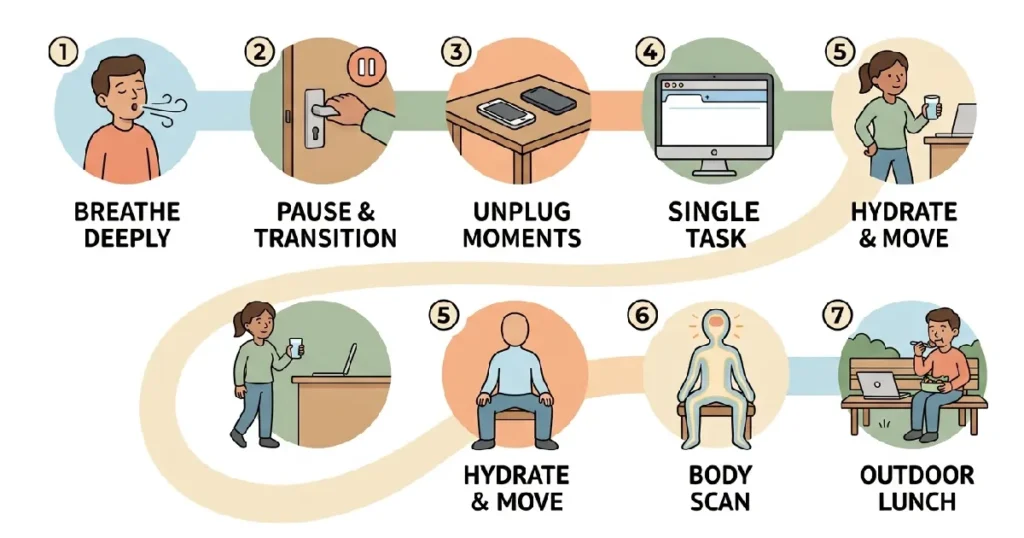
1. The 3-Minute Breathing Space Resets Your Nervous System
This technique was originally developed by Zindel Segal, Mark Williams, and John Teasdale as part of Mindfulness-Based Cognitive Therapy (MBCT), a structured program designed to prevent depression relapse. It works equally well for workplace stress because it targets the same mechanism: a mind stuck in rumination.
Here is how it works:
Minute one. Acknowledge what is happening inside you right now. What thoughts are running? What emotions are present? Where do you feel tension in your body? You are not trying to change anything. You are simply taking inventory without judgment.
Minute two. Narrow your attention to one thing: the physical sensation of breathing. Feel the air enter your nostrils, the rise and fall of your chest, the slight pause between inhale and exhale. When your mind wanders, and it will, gently bring it back.
Minute three. Widen your awareness again. Expand outward from your breath to your entire body, then to the sounds and space around you. You are landing yourself back in the present moment with a calmer nervous system.
Consider someone like Marcus, a project manager at a mid-size tech company. Marcus used to power through his afternoons fueled by anxiety and espresso. He described his mental state after lunch as “running on static.” When he started using the 3-Minute Breathing Space between his two most demanding meetings, something shifted. Not dramatically. But consistently. He noticed he was less reactive in conversations, more deliberate in his word choices, and better able to separate genuine urgency from manufactured panic.
That is the neuroscience at work. Three minutes of directed attention activates your parasympathetic nervous system, the branch responsible for “rest and digest” functions. It lowers cortisol, slows your heart rate, and gives your prefrontal cortex a moment to come back online.
You do not need to be good at this. You just need to do it.
2. Transition Triggers Turn Ordinary Moments Into Mindful Pauses
You probably move through a dozen transitions every workday: walking to a meeting room, opening a new application on your computer, stepping away from your desk. Each of these transitions is an opportunity you are currently wasting.
A transition trigger is a physical action you already perform that you repurpose as a cue to pause. Opening a door becomes a reminder to take one deliberate breath. Washing your hands after a restroom break becomes a moment to notice the temperature of the water, the sensation of soap, the shift in your attention.
This is based on a well-established behavioral psychology principle called habit stacking, the practice of anchoring a new behavior to an existing one. You are not adding time to your day. You are adding awareness to time you are already spending.
The beauty of transition triggers is their invisibility. No one in your office will know you are practicing mindfulness when you pause for a single breath before entering a conference room. But your nervous system will know. And over weeks, these micro-pauses accumulate into something significant: a calmer baseline, a greater sense of agency, and a noticeable reduction in that “always behind” feeling.
3. No-Device Meeting Starts Change the Entire Room

This might be the most counterintuitive practice on this list. Start your next meeting by asking everyone to put their devices away, face down, for 60 seconds of shared silence.
It sounds awkward. It is awkward, the first time.
But here is what happens neurologically when a group of people sits in silence together before diving into an agenda: each person’s brain shifts from the default mode network (the mental chatter network, responsible for rumination and distraction) to the task-positive network (the focused, present-tense, problem-solving network). In plain language, everyone mentally arrives in the same room at the same time.
Online professional communities, including discussions across Reddit and workplace culture forums, have repeatedly identified this practice as a surprisingly effective way to improve meeting quality. Participants report less talking over each other, fewer repeated questions, and a noticeable reduction in post-meeting confusion.
You do not need to be the CEO to try this. You just need to be the person willing to say, “Before we start, let’s take 60 seconds to arrive.” Frame it as a productivity practice, not a spiritual one. Let the results speak.
4. Single-Tasking Protects Your Brain From Cognitive Burnout
You have probably heard that multitasking is a myth. But understanding why it is a myth changes how you work.
When you switch between tasks, your brain does not seamlessly shift gears. It experiences something called attention residue, a term coined by researcher Sophie Leroy. Part of your cognitive resources remain stuck on the previous task even after you have moved to a new one. The result is that you are never fully present for anything. You are partially everywhere and completely nowhere.
Single-tasking is the antidote. Close every browser tab unrelated to what you are working on right now. Set a 25-minute timer (this aligns with the Pomodoro Technique, a time-management method built on focused work intervals). Give one project your undivided attention before moving to the next.
This is mindfulness in the workplace at its most practical. You are not sitting cross-legged. You are closing tabs. And yet the effect on your mental clarity is profound.
If you find yourself resisting this, notice that resistance. It often carries a message: “If I stop monitoring everything, something will fall apart.” That belief is worth examining. Because the evidence suggests the opposite. When you focus fully on one thing, the quality of your output rises, and the time required to complete it drops.
5. The Mindful Hydration Break Is Your Hidden Reset Button
Here is a pattern I have seen repeatedly in my practice: high-performing professionals treat their bodies like accessories to their laptops. They eat at their desks. They drink coffee while typing. They barely register the physical sensations of being alive during the workday.
Your body is not background noise. It is your primary feedback system.
An intentional hydration break means standing up, walking to get water, and drinking it without simultaneously checking your phone, reading a headline, or rehearsing your next email. Just drinking. Feeling the coolness of the water. Noticing your feet on the floor. Allowing your visual field to soften for 30 seconds.
This is not indulgent. It is strategic. When you give your sensory system a break from digital input, you trigger what neuroscientists call attentional restoration, a process by which your brain’s directed attention capacity replenishes itself. Nature does this most effectively, but any shift from screen-based to body-based awareness activates a similar recovery process.
Try it twice today. You will notice the difference by the second time.
6. The 60-Second Desk Body Scan Releases Tension You Did Not Know You Were Carrying

Right now, as you read this, scan your body quickly. Is your jaw clenched? Are your shoulders lifted? Are your hands gripping your phone or mouse more tightly than necessary?
Most people carry stress in their bodies without conscious awareness. This is called somatic tension, physical tightness driven by psychological stress. Over time, unaddressed somatic tension contributes to headaches, back pain, and a persistent sense of exhaustion that sleep alone cannot resolve.
A desk body scan takes 60 seconds. Start at the top of your head and move slowly downward, noticing each area: forehead, jaw, neck, shoulders, chest, stomach, hands, thighs, feet. When you find a pocket of tension, breathe into it. Consciously soften the area as you exhale.
You are not imagining the tension away. You are using your breath to activate the body’s natural relaxation response, the same mechanism that clinical psychologists use in trauma therapy and pain management.
That is not weakness. That is wiring.
Your body keeps a running record of your stress. The desk body scan is your way of reading it before it writes a story you do not want, like a tension headache at 4 p.m. or a sharp word to a colleague you actually like.
7. A Mindful Lunch Hour Is a Productivity Strategy, Not a Luxury
If you eat lunch at your desk while scrolling through emails, you are not saving time. You are borrowing energy from your afternoon self and charging interest.
Research on decision fatigue consistently shows that cognitive performance declines sharply in the afternoon, especially when the brain has not received a genuine recovery period. A mindful lunch hour provides that recovery.
What does this look like in practice? Eat away from your desk. If possible, eat without a screen. Notice the flavors, textures, and temperature of your food. Take a short walk afterward, even if it is just around the building, and pay attention to the sensory details of walking: the feeling of your feet meeting the ground, the temperature of the air, the ambient sounds around you.
This is not about being perfect or serene. It is about giving your brain a window of time where it is not processing information, making decisions, or managing other people’s emotions. That window is what allows you to return to work with clearer thinking and greater emotional regulation.
If you manage a team, advocating for mindful lunch policies signals something powerful: that you value sustainable performance over performative busyness. That distinction changes culture.
How to Start Without Overwhelming Yourself
You do not need to adopt all seven practices at once. That would be the opposite of mindful.
The One-a-Week Method: Choose one practice from this list. Commit to it for five consecutive workdays. At the end of the week, notice what shifted: your stress levels, your focus, your interactions with colleagues. Then decide whether to keep it, modify it, or move on to the next one.
The Anchor Practice: If you prefer simplicity, pick the single practice that resonated most strongly with you while reading this article. Make it your anchor. Do it daily, at the same time, for three weeks. Research on habit formation suggests that consistency of context matters more than duration of effort.
A Question Worth Sitting With: The next time you feel the urge to push through fatigue, pause and ask yourself: “Am I being productive right now, or am I just being busy?” That question, asked honestly, is itself a mindfulness practice.
You do not need more hours. You need more presence within the hours you already have.
You Were Already in That 9:15 a.m. Moment
Remember the opening of this article? The notifications, the tight jaw, the feeling that you were already behind before you had truly begun?
You are going to have that morning again. Probably tomorrow. But now you have something you did not have ten minutes ago: a set of small, concrete tools to interrupt the pattern before it runs your entire day.
Mindfulness in the workplace is not about becoming a different person. It is about becoming more available to the person you already are when stress is not running the show. The calm, focused, creative version of you does not need to be built from scratch. That version just needs more oxygen.
And sometimes, all it takes is one breath to let them in.
My Closing Remarks
I will be honest with you. For years, I thought mindfulness was something other people did, people with quieter lives, slower mornings, and fewer deadlines. I was wrong. The busier my life became, the more I needed these micro-pauses, not less. The day I started treating a glass of water as a two-minute vacation instead of a task to complete while answering emails was the day something quietly shifted in how I moved through my work. I am not asking you to overhaul your life. I am asking you to try one breath before your next meeting. Just one. See what happens.
More Related Stories for You
- If these strategies sparked your curiosity, you might also enjoy learning how a consistent mindfulness practice can reshape your relationships and daily routines beyond the office.