


You Don’t Need To Add Anything New To Your Day. You Need To Wake Up Inside The Day You Already Have.
Key Points:
- Mindfulness for life does not require extra time. It works best when attached to habits you already perform, using a technique psychologists call “habit stacking” to build lasting presence without schedule changes.
- The reason most mindfulness practices fail is not willpower. It is friction. These nine practices eliminate friction entirely by embedding awareness into actions you repeat every single day.
- Brief, intentional micro-moments of awareness change your brain over time. Research shows that even seconds of focused attention can shift your nervous system from reactive to responsive, improving emotional regulation across relationships, work, and sleep.
Contents
Table of Contents
The Mindfulness Lie You Have Been Told
You have tried to meditate. Maybe more than once.
You downloaded the app. You sat on the cushion. You closed your eyes and tried to think about nothing, which of course made you think about everything. The dishes. The email you forgot to send. That comment your partner made three days ago that is still circling in the back of your mind like a fly you cannot swat.
After a few sessions, maybe a few weeks, you stopped. And then came the quiet guilt. The sense that you are somehow not disciplined enough, not calm enough, not spiritual enough to make mindfulness “work.”
Here is what no one told you.
The problem was never you. The problem was the model. Traditional seated meditation is one form of mindfulness, but it is not the only one. And for most people living real, full, complicated lives, it is not even the most effective one.
Why Mindfulness Fails and What Actually Works
The core issue is something psychologists call implementation friction, the gap between your intention to do something and the number of obstacles standing between you and actually doing it. The more steps a behavior requires, the less likely you are to repeat it. This is not a character flaw. It is how your brain is wired.
A 2023 study published in the British Journal of Health Psychology confirmed what behavioral scientists have observed for years: habits form most reliably when a new behavior is attached to an existing, automatic routine. Psychologist B.J. Fogg calls this habit stacking, and it is the engine behind every practice in this article.
Instead of carving out 20 minutes you do not have, you layer a few seconds of conscious awareness onto something you are already doing. Brushing your teeth. Pouring coffee. Stopping at a red light. The behavior is free. The attention is the practice.
And here is the part that matters most: research from Harvard neuroscientist Sara Lazar and her team has shown that even brief, consistent mindfulness practice can produce measurable changes in brain regions associated with self-awareness, compassion, and stress regulation. You do not need an hour. You need a pattern.
That pattern is what transforms a passing interest in mindfulness into mindfulness for life.
9 Mindfulness Practices That Become Part of Who You Are
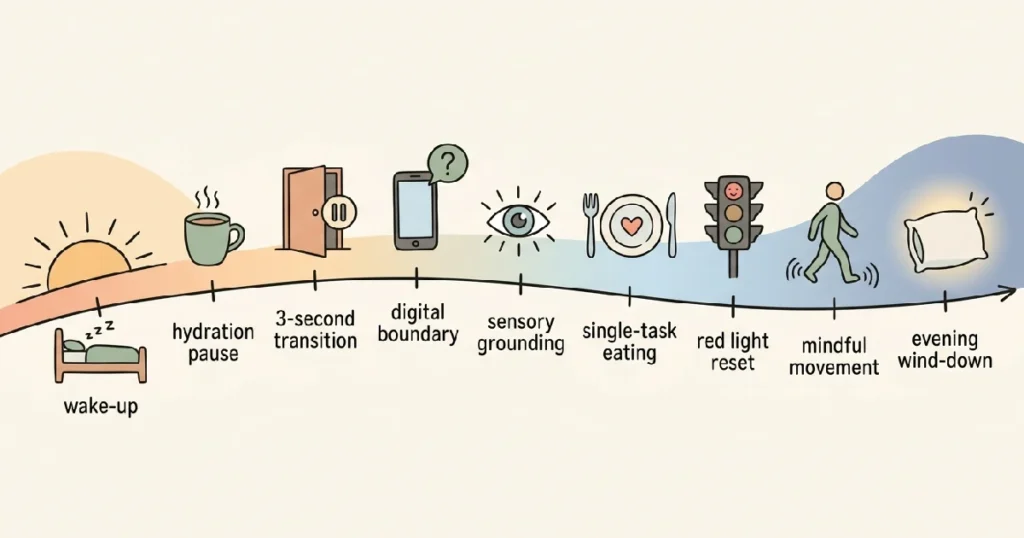
Think of your daily routine as a string of beads. Each bead is an action you already perform on autopilot. These nine practices do not add new beads. They polish the ones you already have.
1. The Mindful Wake-Up: Start Before Your Phone Does
The first 30 seconds of your morning set a neurological tone for the hours that follow. When you reach for your phone before your eyes fully adjust to the light, you hand your attention to someone else’s agenda before you have even consulted your own.
Instead, try this: before you move, take three slow, intentional breaths. Feel the weight of your body against the mattress. Notice the temperature of the air on your skin. Then set one guiding intention for the day. Not a to-do list item. A way of being. Something like, “Today I will respond rather than react.”
A woman I worked with, Mariam, had been waking up anxious for years. She assumed it was just “who she was.” When she began pausing for three breaths before touching her phone, she noticed something surprising. The anxiety was not coming from inside her. It was coming from the flood of notifications she absorbed before her nervous system had fully transitioned from sleep to wakefulness. Three breaths changed the order of operations, and eventually, it changed her mornings entirely.
2. The Hydration Pause: Turn Your First Sip Into a Ritual
You already make coffee or tea or pour a glass of water every morning. You just do not notice it.
The hydration pause asks you to slow down for exactly one moment. Feel the warmth of the mug against your palms. Smell the brew before you taste it. Notice the exact temperature of that first sip as it reaches the back of your throat. Let your mind land in the sensation rather than skipping ahead to the first meeting or the commute.
This is not about making coffee sacred. It is about training your attention to land somewhere real instead of somewhere imagined. That difference, between where you are and where your mind thinks you should be, is the gap where most of your daily stress lives.
3. The 3-Second Transition: The Pause Between Actions

Most of your stress does not come from individual tasks. It comes from the invisible collisions between them.
You end a phone call and immediately open your email. You leave a tense meeting and walk straight into a conversation with your child. You carry the emotional residue of one moment directly into the next without any space in between.
The 3-second transition is your buffer. Before opening a door, starting a meeting, or pressing “send” on an email, pause. Drop your shoulders. Take one conscious breath.
That is not weakness. That is regulation.
This single practice addresses what psychologists call emotional carryover, the tendency to unconsciously transfer the emotional state from one situation into the next. Three seconds is enough to interrupt the transfer.
4. The Digital Boundary: A Micro-Pause Before You Scroll
You check your phone dozens of times a day. Research from the American Psychological Association suggests that constant digital checking is associated with higher reported stress levels, even when the content itself is neutral.
The practice is simple. Every time you reach for your phone, pause before unlocking it. Notice your posture. Notice your breathing. Then ask yourself one honest question: “Do I need this right now, or am I just reaching?”
You will be surprised how often the answer is the second one. And in that surprise, you will find something powerful: choice. The phone did not grab you. You reached for it. And now you can decide whether to continue or to set it back down.
That moment of awareness is mindfulness for life in its purest form.
5. Sensory Grounding: The 5-4-3-2-1 Technique in Motion
This is one of the most well-known grounding techniques in clinical psychology, and it works because it redirects your attention from internal rumination to external reality.
While commuting, walking, or even looking out a window, actively notice:
- 5 things you can see (the texture of a wall, a crack in the sidewalk, the way light falls on a building)
- 4 things you can feel (the fabric of your sleeve, the pressure of your shoes, the air on your face)
- 3 things you can hear (a distant siren, birdsong, the hum of an air conditioner)
- 2 things you can smell (coffee from a nearby shop, rain on pavement)
- 1 thing you can taste (the aftertaste of breakfast, the mint of toothpaste)
This exercise takes less than 60 seconds and activates what neuroscientists call the ventral vagal complex, a branch of the nervous system associated with safety, social engagement, and calm. You are not just distracting yourself from anxiety. You are telling your body, at a biological level, that you are safe right now.
6. Single-Task Eating: Taste What Is Already in Front of You

Here is the unexpected angle on mindful eating: it is not really about food. It is about your relationship with presence itself.
When you eat while scrolling, working, or watching a screen, you are training your brain to split its attention as a default. You are reinforcing the neural habit of never being fully anywhere. This is why many people can finish an entire meal and not remember a single bite.
The practice does not require a silent dining room or a candlelit table. Just dedicate the first three bites of one meal to pure sensory awareness. Put your phone face down. Chew slowly. Try to identify the spices, the textures, the temperature shifts as you chew.
Think of it like this: your attention is a flashlight beam. Most of the time, you are waving it wildly in the dark, illuminating nothing clearly. Mindful eating trains you to hold the beam steady, even if only for a few seconds. That steadiness transfers to everything else you do.
7. The Red Light Reset: Turn Frustration Into a Cue
Traffic lights. Long lines. The spinning wheel on a loading webpage.
These are the moments where most people tighten their jaw, clench their steering wheel, and rehearse their frustration. But what if these unavoidable pauses were not obstacles? What if they were built-in mindfulness cues?
The red light reset is the practice of using any involuntary pause as a trigger to relax. Consciously unclench your jaw. Drop your tongue from the roof of your mouth (you are pressing it there right now, most likely). Follow the rhythm of one full breath cycle: in through your nose, out through your mouth.
You have not lost time. You have reclaimed it.
This is the insight differentiator most articles on mindfulness miss entirely. Mindfulness does not compete with your schedule. It inhabits the dead space your schedule already contains. Every red light, every loading screen, every moment of forced waiting is a gap your awareness can fill. The average person encounters dozens of these gaps daily. They are not interruptions. They are invitations.
8. Mindful Movement: Your Body Already Knows How to Meditate
Exercise is often treated as something you do to your body. Mindful movement flips that. It is something you do with your body.
During a walk, a stretch, or any routine physical activity, dedicate just five minutes to full sensory focus. Notice the rolling mechanics of your feet against the ground. Feel the pendulum swing of your arms. Register the air moving against your skin and the subtle shifts of balance as you move.
This is not about slowing down your workout. It is about arriving inside it. Most people exercise while mentally elsewhere, planning dinner, replaying a conversation, composing a mental email. The body moves. The mind wanders. Mindful movement brings them back together.
In my own practice, I have found that clients who add even brief periods of body-focused awareness during exercise report not just reduced stress but a stronger sense of being “at home” in their own skin. That feeling of embodiment is one of the most underrated outcomes of consistent mindfulness practice.
9. The Evening Wind-Down: Release the Day From Your Body

Your body stores the day’s tension like a sponge absorbs water. If you do not wring it out, you carry it into your sleep.
As you close your bedroom door or turn off the lights, pause for 60 seconds. Starting at the top of your head, slowly scan downward through your body. Notice any areas of tightness: your forehead, your shoulders, your lower back, your calves. Do not try to fix anything. Just notice it.
Then, with each exhale, imagine that tension draining downward and being absorbed into the mattress beneath you. This is not mystical thinking. It is a simple application of progressive body awareness, a technique rooted in Jacobson’s progressive muscle relaxation method that has been used in clinical settings for decades.
The result is not just better sleep. It is a cleaner separation between today and tomorrow. You give yourself permission to stop carrying what is already finished.
How to Make These Practices Actually Stick
Knowing about mindfulness and living it are two different things. Here is how to bridge the gap.
The Anchor Method: Choose just one practice from this list. One. Attach it to the most automatic part of your day, the thing you do without thinking. That is your anchor. Practice only that one until it feels as natural as the habit it is attached to. Then add a second.
The Self-Check Question: Once a day, ask yourself, “Where is my attention right now?” Not to judge it. Not to fix it. Just to notice. This question alone is a form of mindfulness. You cannot ask it without becoming present for the moment it takes to answer.
The Compassion Reset: You will forget. You will spend entire days on autopilot. That is not failure. That is being human. The moment you notice you forgot is the moment you are being mindful again. Every return to awareness counts. Every single one.
Consider writing your chosen anchor practice on a small sticky note and placing it somewhere you will see it during the routine itself, on your coffee maker, your steering wheel, your bathroom mirror. Visual cues reduce implementation friction to almost zero.
You Were Never Missing the Time. You Were Missing the Attention.
Remember the story you told yourself? That you could not meditate. That you did not have the discipline. That mindfulness was for people with quieter lives and emptier schedules.
That story was never true.
You already have a life full of moments that are asking for your presence. The coffee cooling in your hands. The red light holding you still. The pillow meeting the back of your head at the end of a long day. Mindfulness for life does not ask you to become someone else or to build a new routine from scratch. It asks you to show up, fully and briefly, inside the life you already have.
The flashlight beam does not need to be brighter. It just needs to be held steady.
And you can start with the very next breath.
My Closing Remarks
I spent years believing that if I could not sit still for 20 minutes, I was doing mindfulness wrong. I would start strong, abandon the practice within weeks, and then quietly shame myself for lacking follow-through. It was only when I stopped treating mindfulness as a separate activity and started treating it as a way of moving through my existing day that anything changed. The shift was not dramatic. It was quiet and cumulative. And honestly, that is what made it real. If this article gave you even one moment of recognition, one small feeling of “maybe this could actually work for me,” trust that feeling. It is telling you something worth listening to.
More Related Stories for You
- If these practices resonated, you might also enjoy exploring deeper approaches to building a consistent mindfulness practice that fits your real life.