
 David Wall
Most People Don’t Fail at Mindfulness Because They Can’t Focus. They Fail Because They Were Never Taught How to Build the Habit.
Key Points:
- A lasting mindfulness practice has almost nothing to do with willpower and everything to do with designing your environment and expectations to match how your brain actually forms habits.
- The moment you notice your mind has wandered and gently bring it back is not a failure of your mindfulness practice. It is the practice itself, and research shows that single mental gesture rewires how your brain handles stress.
- Starting with just two minutes a day, anchored to a routine you already have, is more powerful than any ambitious 30-minute session you will abandon by week three.
Contents
Table of Contents
You downloaded the app. You bought the cushion. You told yourself, with real conviction, that this time you would finally meditate every single day.
It lasted eleven days. Maybe fourteen.
Then one morning you were running late, and you skipped it. The next day felt harder to start. By the following week, the cushion was collecting dust and the app was sending you notifications you swiped away with a twinge of guilt. You started to wonder if you’re just not the kind of person who can meditate.
You are. You absolutely are.
The problem was never your ability to focus. It was the architecture of the habit itself.
Why Most Mindfulness Habits Collapse Before They Take Root
Here is something that might surprise you: research suggests that roughly 50 percent of people who begin a meditation practice stop within the first few months. That is not because half of the population lacks discipline. It is because most advice about starting a mindfulness practice is quietly designed to fail.
Think about how meditation is usually sold to you. Sit still for 20 minutes. Clear your mind. Find inner peace. That sounds beautiful on a book cover. But for a brain that is already overwhelmed, overworked, and undernourished for rest, that instruction is like telling someone who has never jogged to go run a half-marathon tomorrow morning.
According to research published by Judson Brewer and colleagues at Brown University, the key predictor of whether someone sustains a mindfulness practice is not motivation or personality type. It is whether they experience what psychologists call “self-efficacy” in the early stages. Self-efficacy, in plain language, is the feeling that you can actually do the thing. When you set the bar impossibly high on day one, you crush that feeling before it has a chance to grow.
There is also a neurological reason your mindfulness practice fizzles. Your brain’s default mode network, or DMN, is the system that activates when your mind wanders, replays conversations, worries about the future, or narrates your inner monologue. This network is not broken. It is doing its job. But when you sit down to meditate and your DMN lights up like a pinball machine, you interpret that as failure. You think: I cannot do this.
That interpretation is the real enemy. Not the wandering mind.
What follows is a framework built on habit science and clinical observation, not wishful thinking, that can help you construct a mindfulness practice strong enough to survive real life. The messy, exhausting, unpredictable version of life you actually live.
1. Start So Small Your Brain Cannot Object
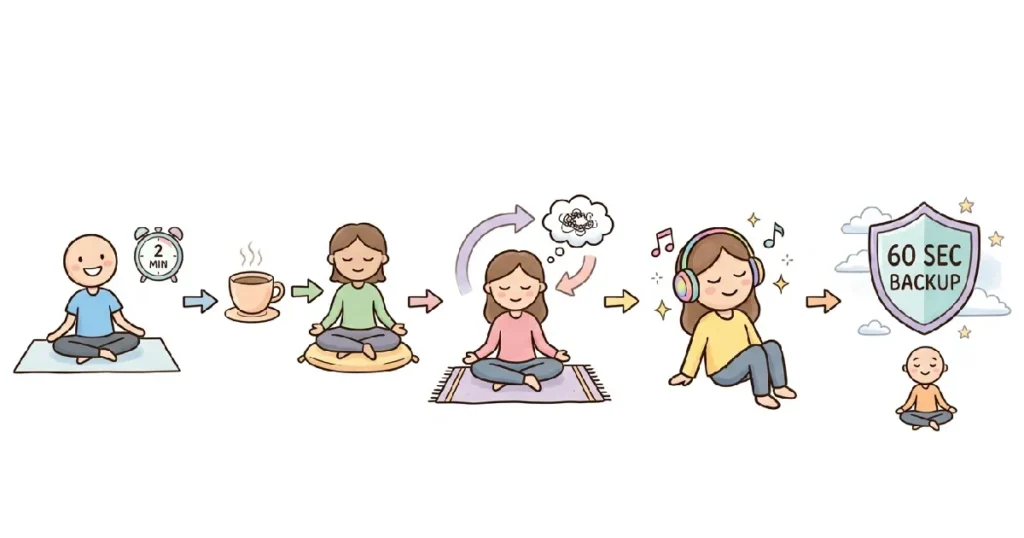
The most common mistake people make when building a mindfulness practice is also the most intuitive one: they try too hard, too soon.
You feel inspired. You read about the benefits of meditation for stress, anxiety, sleep, and emotional regulation. You decide to commit to 20 minutes every morning. Your intentions are genuine. But intention without behavioral design is just hope wearing a plan’s clothing.
Consider someone I worked with years ago. A woman named Priya came to therapy exhausted from juggling a demanding career and two young children. She wanted to start meditating because she had read about how mindfulness reduces cortisol, the stress hormone. She downloaded a guided meditation app and committed to 15 minutes each morning before the kids woke up.
It lasted nine days.
On day ten, her youngest woke up early with a fever. She missed that session. The next morning, she felt behind and guilty. By day twelve, the habit was gone.
When Priya and I redesigned her approach, we did something almost absurdly simple. I asked her to commit to two minutes. Just two. She looked at me like I was wasting her time.
But those two minutes became the seed of a daily practice she still maintains over two years later. She now sits for twelve minutes most mornings. Some days, she does three. And that is perfectly fine.
Here is the psychological principle at work: when a task feels small enough, your brain’s threat-detection system, the amygdala, does not activate resistance. You are not fighting yourself. You are simply sitting down. The habit loop, which consists of a cue, a routine, and a reward, gets reinforced through repetition. Two minutes repeated daily builds a stronger neural pathway than 20 minutes attempted and abandoned.
Start with two to five minutes. Protect those minutes like they matter. They matter more than you think.
2. Anchor Your Mindfulness Practice to Something You Already Do
Willpower is a terrible alarm clock. If you rely on remembering to meditate, or on feeling motivated enough to begin, you will fail on the first stressful Tuesday that swallows your morning.
Instead, use a technique that behavioral scientists call habit stacking. The concept, popularized by researcher BJ Fogg at Stanford University’s Behavior Design Lab, is elegant: attach your new behavior directly to an existing automatic routine. Your established habits become the trigger for your new one.
This is what it looks like in practice. You already pour coffee every morning without thinking about it. That is your anchor. Your new rule becomes: “After I pour my morning coffee, I will take three conscious breaths before the first sip.” You already brush your teeth at night. Your new rule: “After I set my toothbrush down, I will sit on the edge of my bed and do a 90-second body scan.”
The reason this works is neurological. Your existing habits are controlled by the basal ganglia, a brain region that manages automatic behaviors. When you stack a new behavior onto an established one, you borrow the automaticity of the old habit. You are not creating a new routine from scratch. You are grafting a small branch onto a tree that already has deep roots.
One important detail: be specific. “I will meditate sometime in the morning” is a wish. “After I pour my coffee, before I check my phone, I will close my eyes and breathe for two minutes” is a plan. Specificity is the difference between a habit that survives and one that dissolves.
3. The Wandering Mind Is Not the Enemy of Mindfulness. It Is the Entire Point.

This is the reframe that changes everything.
Most people believe they are failing at meditation when their mind wanders. They sit down, close their eyes, and within seconds they are mentally composing an email, reliving a conversation, or planning dinner. They open their eyes, frustrated. They think: I am bad at this.
But here is what no one tells you.
The moment you notice your mind has drifted is the most important moment in the entire practice. That is the “rep.” That is the mental equivalent of lifting the weight. Neuroscientists call this “attentional re-engagement,” and it is the specific cognitive action that strengthens your prefrontal cortex, the brain region responsible for self-regulation, decision-making, and impulse control.
Think of it this way. Imagine your attention is a puppy on a walk. Puppies do not walk in straight lines. They dart toward squirrels, sniff every bush, pull in random directions. Training a puppy is not about preventing it from wandering. It is about gently guiding it back each time it strays. Your mind is that puppy. Mindfulness is the gentle hand on the leash, not a cage.
A 2018 study published in the journal Frontiers in Human Neuroscience found that the act of recognizing mental wandering and redirecting attention is associated with increased gray matter density in the anterior cingulate cortex. This brain region plays a central role in error detection and emotional regulation. In other words, every time your mind wanders and you bring it back, you are literally remodeling your brain’s ability to manage stress and stay present.
So when your thoughts scatter, and they will, try this. Instead of criticizing yourself, try the silent phrase: “Wandered. Noticed. Returning.” No drama. No judgment. Just a quiet redirect.
The practice is not the stillness. The practice is the return.
4. Use Guided Meditation Tools as Training Wheels, Not Crutches
There is an unspoken snobbery in some meditation circles that suggests real practitioners sit in silence. That guided meditations are somehow lesser. That is like saying real swimmers don’t use pools with lane markers.
When you are building a new mindfulness practice, guided tools are extraordinarily helpful. They give your attention something to follow when your own internal compass is spinning. They offer structure when you have none. And they lower the activation energy required to start.
Platforms like the Headspace Guide to Meditation or the Calm app offer sessions specifically designed for beginners, organized by goals like stress relief, better sleep, or improved focus. These are not shortcuts. They are scaffolding that supports you until your own practice can stand on its own.
The key is to use guided sessions as a bridge, not a destination. Over time, as your comfort grows, you might try alternating between guided and unguided sessions. Maybe three guided sessions per week and two where you simply sit with your breath. Eventually, you may find that silence becomes its own kind of guide.
And on days when even a guided session feels like too much, there is a simpler option. You do not need an app or a cushion or silence. You need 60 seconds and your own breathing.
Which brings us to the strategy most people never think to build.
5. Design a Backup Version of Your Mindfulness Practice for Your Worst Days
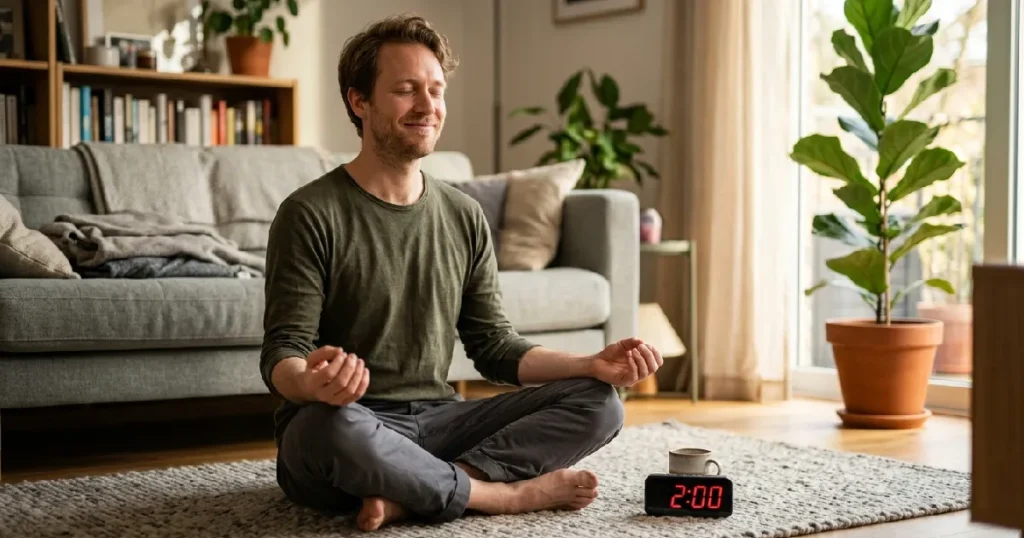
Consistency does not require perfection. It requires a fallback plan.
Most habit frameworks collapse on hard days. You are sick, overwhelmed, emotionally drained, running behind. Your usual 10-minute meditation is not going to happen. So you skip it. Then you skip it again. Then the habit is gone.
The fix is to create what I call a “minimum viable practice.” It is the smallest possible version of your mindfulness habit that still counts as doing it. For most people, this looks like 60 seconds of conscious breathing. Not a full meditation. Not a body scan. Just one minute of deliberate, present-moment awareness.
Here is why this matters psychologically. Your brain does not track whether you meditated for two minutes or twenty. It tracks whether you kept a promise to yourself. Every time you honor that commitment, even in its tiniest form, you reinforce your identity as someone who practices mindfulness. Every time you break the chain, you weaken it.
The rule is simple: never miss two days in a row. One missed day is a rest. Two missed days is the beginning of a new pattern. Your minimum viable practice is the safety net that prevents one bad day from becoming a permanent exit.
Putting It All Together: Your First Week Framework
Here is a simple structure you can begin with this week. It does not require buying anything, downloading anything, or changing your morning by more than a few minutes.
The Coffee Breath Ritual: After you pour your first cup of coffee or tea, hold the mug with both hands. Close your eyes. Take three slow, deliberate breaths, focusing on the warmth of the cup in your hands and the scent of the drink. That is it. That is your morning anchor.
The Two-Minute Sit: At the same time each day, ideally stacked onto another habit, set a timer for two minutes. Sit comfortably. Breathe normally. When your mind wanders, say silently: “Wandered. Noticed. Returning.” When the timer sounds, open your eyes. You are done.
The Evening Check-In Question: Before bed, ask yourself one question: “What did I notice today that I usually miss?” This is not journaling. This is not analysis. It is a five-second reflection that trains your brain to pay attention during the day because it knows it will be asked about it later.
A useful question to ask yourself at the end of each week: “Is this practice something I can imagine doing when everything goes wrong?” If the answer is no, simplify further. The right practice is not the most impressive one. It is the one you will actually do.
You Have Been Training for the Wrong Thing
Let me leave you with this.
You probably picked up this article because you wanted to learn how to meditate consistently. But what you have actually been learning is something bigger. You have been learning how to keep a promise to yourself in a world that constantly invites you to break it.
Every time you sit for two minutes when you wanted to skip it, you are not just practicing mindfulness. You are practicing self-trust. You are telling your own nervous system: I will show up for you, even when it is hard. Even when it is imperfect. Even when no one is watching.
Remember the puppy on the leash? You do not need a perfectly behaved puppy. You need a patient hand. And every single return, every gentle redirect, every quiet moment of noticing that you drifted and choosing to come back is proof that you already have what it takes.
The practice is the return. And you already know how to return.
That is enough. You are enough. Start there.
My Closing Remarks
I will be honest with you. I resisted mindfulness for years. I thought it was soft, impractical, something for people with more patience than I had. Then one winter, during a period of professional burnout so deep I could feel it in my body, I tried two minutes. Just two. Not because I believed in it, but because I had run out of other options. That tiny act of sitting still cracked something open in me. It did not fix my life overnight. But it taught me that I could be kind to myself for 120 seconds, and that changed the trajectory of everything that followed. If you are reading this and thinking you are the exception, that this will not work for you, I want you to know: I thought I was the exception too. Try the two minutes. Just once. See what happens.
More Related Stories for You
- If you are in a season of noticing signs that something meaningful is about to shift in your relationship, that same attentive presence you build through mindfulness is what lets you recognize and receive those moments fully.
About The Author