
 Sara Carmen
Six honest conversations that decide whether your marriage thrives or quietly falls apart.
Key Points Box
- Couples who work through the right things to discuss before marriage cut their divorce risk by nearly a third.
- Money fights aren’t just common. Research shows they’re the most damaging kind of conflict a marriage can face.
- You don’t need a perfect match. You need zero blind spots on the six topics that quietly break marriages years later.
Contents
Table of Contents
You’ve pictured the wedding. You’ve probably pictured the marriage too, the easy mornings, the inside jokes, the feeling of finally being on the same team for good.
Then a stray thought creeps in. Something about his student loans, or her stance on kids, or the fact that his mother expects Christmas dinner every single year without fail. You push it aside. It feels too practical for something that’s supposed to be about love.
Someone might think being in love means you already know each other’s future plans. But what they don’t see is the couple sitting in a lawyer’s office three years in, splitting furniture and arguing about a $40,000 debt neither of them mentioned before the wedding.
Someone might assume that if the relationship feels easy now, it will stay easy forever. But what they don’t see is the exhausted new parent resenting a partner who never agreed to split night feedings, because they never actually agreed on anything.
Someone might believe that real love means never needing to talk logistics. But what they don’t see is the fight at month eight of marriage that isn’t really about the dishes. It’s about two people who never discussed what fairness even looks like.
But here’s what no one tells you.
The couples who make it aren’t the ones who never disagree. They’re the ones who had the hard conversations before the wedding, not after the resentment had years to build. Talking through the things to discuss before marriage isn’t unromantic. It’s one of the clearest forms of love you can offer someone.
Why These Conversations Change Everything
Here’s the psychological mechanism behind this. Relationship researchers call it premarital assessment, the practice of surfacing your values, habits, and expectations before you legally merge your lives. It works because most relationship pain doesn’t come from incompatibility. It comes from assumption.
You assumed he wanted kids by thirty. You assumed she’d want to stay near her family. Nobody said it out loud, so nobody corrected it, and now you’re both blindsided by something that was never actually a secret. It was just never spoken.
According to research cited by ReachLink, couples who go through structured premarital preparation see a 31% decrease in the odds of divorce compared to couples who skip it entirely. That’s not a small number. That’s the difference between a marriage that survives its first real storm and one that doesn’t.
In my practice, I’ve watched couples who seemed wildly compatible unravel over things they never discussed, and I’ve watched couples with very different backgrounds build stable marriages simply because they talked everything through first. Compatibility isn’t fixed. It’s built.
Most people don’t realize that the goal isn’t finding someone who agrees with you on everything. The goal is finding out where you disagree while you still have the calm and curiosity to work through it. Left unexamined, these gaps don’t just cause the occasional argument. They quietly become the reason marriages end.
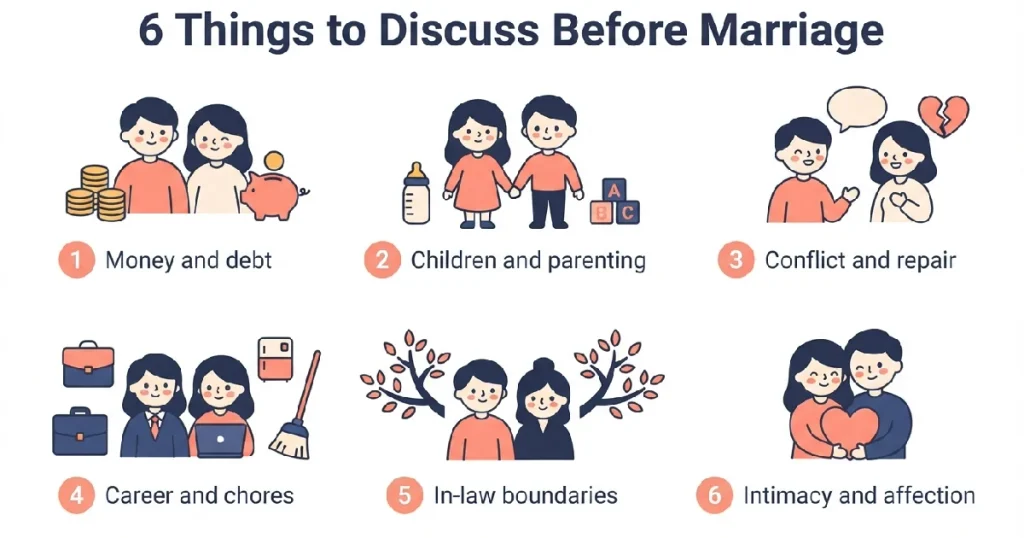
Let’s walk through the six conversations that matter most.
1. Finances and Debt Management Before Marriage
The claim. Money is the topic couples avoid the longest and pay for the most. It’s not just uncomfortable. It’s structurally different from other relationship conflicts.
The evidence. A study published in the National Institutes of Health archive found that marital conflicts about money are more pervasive, harder to resolve, and more likely to recur than arguments about almost anything else, including in-laws or household chores. Money fights aren’t really about money. They’re about security, control, and whether you trust your partner’s judgment.
So what? Before the wedding, sit down for what I call a money date. Lay out every debt, every credit score, every recurring bill, no editing. Decide together whether you’ll merge accounts, keep them separate, or run a hybrid system. Agree on a dollar amount that requires a conversation before spending it.
Left unaddressed, financial secrecy doesn’t just cause arguments. It quietly erodes trust until one partner starts to feel like they married a stranger. You don’t need identical spending habits. You need a shared rulebook, and you need it before financial infidelity becomes a phrase that applies to your marriage.
2. Family Planning and Parenting Philosophy Before Marriage
The claim. Whether and when to have children, and how to raise them, is not a conversation you can improvise mid-marriage.
The evidence. Couples often discover, well after the wedding, that they never actually agreed on a timeline, or that one partner assumed adoption was on the table while the other never considered it. Parenting style tends to default to whatever each person grew up with, unless a conscious decision is made together beforehand.
So what? Ask each other directly: How many kids, if any? By when? What happens if biology doesn’t cooperate? Who’s the primary earner if one of you steps back from work? Look at how you were each raised and decide, on purpose, what you want to keep and what you want to leave behind.
3. Career Trajectories and Living Logistics Before Marriage
The claim. Where you’ll live, how you’ll split labor, and how far you’ll bend for each other’s careers determines whether your marriage feels like a partnership or a competition.
The evidence. A sudden job offer in another city, a promotion that demands sixty-hour weeks, an unspoken expectation that one partner will always be the one to reschedule their life, these are common breaking points precisely because they were never discussed in advance.
So what? Talk about geography now. Are you rooted where you are, or open to relocating? Set boundaries around work travel and after-hours availability. Decide, specifically, who handles what at home, not “we’ll split it evenly,” but an actual list. Vague agreements create very specific resentment.
4. Values, Culture, and Spiritual Alignment Before Marriage
The claim. You don’t need identical beliefs to build a strong marriage. You need mutual respect for the beliefs you don’t share.
The evidence. Couples who never discuss faith, tradition, or in-law boundaries before marriage often find themselves negotiating these things for the first time during a holiday, a funeral, or the birth of a child, which is the worst possible time to discover you’re not aligned.
So what? Talk about how, if at all, religion or spirituality will show up in your home and with your kids. Decide how holidays get split or reinvented. Set boundaries with extended family together, as a united front, before anyone’s mother has an opinion about your Thanksgiving plans.
5. Conflict Resolution and Communication Styles Before Marriage
The claim. Fight-free marriages don’t exist, and chasing one is a waste of energy.
The evidence. According to The Gottman Institute, roughly 69 percent of marital conflicts are perpetual, meaning they never fully resolve. Couples don’t succeed by eliminating disagreement. They succeed by learning to manage it without contempt, stonewalling, or the kind of fights that leave lasting damage.
Here’s the part almost nobody talks about. The way you handle this specific conversation, the one about your future, your money, your family, previews exactly how you’ll handle conflict for the next forty years. If one of you shuts down discussing finances now, that’s not a finance problem. That’s an attachment pattern, your learned way of seeking or avoiding closeness under stress, showing up early, while you still have the chance to name it and work with it.
So what? Identify your own default under tension. Do you raise your voice, or do you go quiet? Name it out loud to your partner before it becomes a mystery they have to solve during a fight. Build a cool-down protocol together, something as simple as saying, “I feel overwhelmed, I need fifteen minutes,” and actually honoring it. That single sentence, used consistently, prevents more damage than most people realize.
Every unspoken expectation works like a stone slipped quietly into a backpack. One stone doesn’t weigh much. But by year five, you’re carrying a boulder and wondering why the marriage suddenly feels so heavy.
6. Intimacy, Affection, and Emotional Needs Before Marriage
The claim. Physical and emotional intimacy naturally shifts over the years, and the couples who struggle most are the ones who never built a safe way to talk about that shift.
The evidence. Desire, frequency, and affection all change with stress, health, and time. That’s not a red flag. It’s biology. What predicts long-term satisfaction is whether both people can name what they need without shame.
So what? Talk honestly about expectations around physical intimacy now, and revisit it later, because it will change. Just as important, define what makes each of you feel emotionally secure outside the bedroom. Sometimes something as small as the way he calls you beautiful in an ordinary, unremarkable moment carries more weight for connection than any grand gesture ever will.
The Coffee Shop Conversation That Changed Everything
Maya and Daniel had been together four years when they got engaged. They assumed they were on the same page about almost everything, until a friend suggested they try a structured premarital conversation before setting a date. Over coffee, Daniel admitted he wanted to move closer to his aging parents within five years. Maya had never once considered leaving her city.
They didn’t resolve it that day. But naming it early gave them eighteen months to actually plan instead of ambush each other later. They married a year after that conversation, and Maya told me the coffee date, not the wedding, was the moment she felt certain.
Now What: Turning Insight Into Action

One place to start is the Weekly Money Date, a standing fifteen-minute check-in where you review spending, savings, and any looming financial decisions before they become surprises.
Consider the Round-Robin Ritual for the bigger topics. Take turns answering the same question, kids, career, faith, without interrupting, then switch. It keeps one partner’s voice from dominating the conversation.
A useful tool for conflict is the 24-Hour Pause Rule. If a disagreement starts to escalate past productivity, agree in advance that either partner can call a pause, with a promise to return to it within a day. This isn’t avoidance. It’s structure.
The next time you’re both free, try the Coffee Date Challenge. Pick one of the six areas above and give it forty-five uninterrupted minutes. Not the whole list. Just one.
You Don’t Need a Perfect Match, You Need Zero Blind Spots
Remember that stray thought you pushed aside at the beginning of this piece, the one about debt, or kids, or his mother’s Christmas expectations? That thought wasn’t a warning sign. It was your intuition doing exactly what it’s supposed to do, pointing you toward the conversation that actually protects your marriage.
These six areas aren’t a test you pass once and forget. They’re an ongoing check-in, a practice you return to every few years as your lives change. The goal was never a flawless match. It was removing the blind spots before they had the chance to become the reason it all fell apart.
You now know exactly which conversations matter, why they matter, and how to start them without it feeling like an interrogation. That’s not a small thing to walk away with.
A strong marriage isn’t built on never disagreeing. It’s built on never being surprised by each other in the ways that count most.
My Closing Remarks
I’ve sat across from couples who thought love alone would carry them, and I’ve watched what happens when it doesn’t. What always strikes me is how relieved people feel once they finally say the hard thing out loud, the debt, the doubt about kids, the fear about family. Relief, not rejection. That’s usually how you know you’re with the right person, they meet the hard conversation with curiosity instead of retreat. Start there.
More Related Stories for You
- If affection and feeling truly seen by your partner is on your mind as you plan your future together, you might also want to read about what it means when a guy calls you beautiful.
About The Author