
 Sara Carmen
Why the man who adores you might still freeze at “marriage,” and how to tell real fear from a comfortable delay.
Key Points
- If he wants to marry you but is scared, his freeze response often traces back to attachment wounds and financial dread, not a lack of love for you.
- A clinical diagnostic test separates genuine commitment anxiety from quiet stalling dressed up as “timing.”
- You’ll walk away with exact scripts, a realistic timeline, and a way to protect your future without issuing a single ultimatum.
Contents
Table of Contents
We’ve all watched a couple who seem years deep into the kind of love most people quietly envy dodge the one question that hovers over every family dinner and every wedding toast. You know this couple. You might be this couple. He remembers how you take your coffee. He introduces you as “my future wife” to his coworkers. He builds a life with you in every way except the one that would make it legally, permanently his choice.
And when you bring up marriage, something in his face closes like a door pulled shut from the inside.
Here’s the honest answer before we go any further: his fear can be completely real, and it still might not be a good enough reason to keep you waiting. Those two facts, his anxiety and your right to a future, are not competing with each other. Untangling them is the whole point of what comes next.
The Psychology of Hesitation: Why Men Freeze When They Love You
Modern marriage asks for something our grandparents never had to think about: a fully voluntary choice made by two financially independent adults who could each walk away and survive just fine. That freedom is a wonderful thing. It also means that a man saying yes to you now is choosing you with complete awareness of everything he’s giving up.
This is where behavioral science gets useful. Researchers Daniel Kahneman and Amos Tversky identified something they called loss aversion, the human tendency to feel the sting of a loss about twice as strongly as the pleasure of an equal gain, even when logic says the two should balance out. When a man stares down the word “marriage,” his brain may not register you as something to gain. It may register his independence, his assets, his sense of self as an unattached man, as things about to disappear.
That’s not a reflection of how much he loves you. It’s a glitch in how the brain weighs risk.
That’s not weakness. That’s wiring.
Financial Anxiety and Legal Vulnerability in the US and UK
Ask most men past 28 why they haven’t proposed, and somewhere in the answer, often buried under something softer, you’ll hear money. This deserves to be taken seriously rather than waved off as cold feet.
Pew Research Center’s demographic data on shifting marriage timelines and cohabitation shows that fewer couples today treat marriage as the starting line of adult life. Instead, many treat it as something you earn once the finances feel solid, a reversal from the generations before them. Add to that the real weight of housing costs in both the US and UK, student debt that follows people into their thirties, and a cultural drumbeat of divorce court horror stories about alimony and asset division, and his silence starts to look less like avoidance and more like dread.
Here’s the piece most people miss: his hesitation is often less about you and more about his own internal scorecard for what it means to be an adequate partner and provider. A man who doesn’t feel financially “ready” may stay quiet rather than admit that fear out loud, because admitting it feels like admitting failure.
The Ghost of Parental Divorce and Fear of Commitment in Men
If his parents split in a way that left scars, you’re dealing with something deeper than a budgeting problem. Psychologists refer to the lasting effects on adult children of divorced parents as a pattern of anticipated relational failure, a subconscious bracing for things to fall apart the way they watched them fall apart once before.
Attachment researchers Mario Mikulincer and Phillip Shaver have spent decades documenting how early relational wounds shape adult bonding styles. A man with a fearful-avoidant attachment style, meaning he genuinely wants closeness but experiences intimacy as threatening at the same time, may pull toward you emotionally while pulling away from anything that makes the bond official. Legal permanence, to this nervous system, doesn’t feel like safety. It feels like exposure.
Here is the part your love cannot fix alone: this kind of fear usually needs a trained therapist to untangle, not a devoted partner. You can be patient, generous, and endlessly reassuring, and it still won’t rewire a defense mechanism that formed before he ever met you.
Genuine Cold Feet or Strategic Stalling? The Diagnostic Rubric
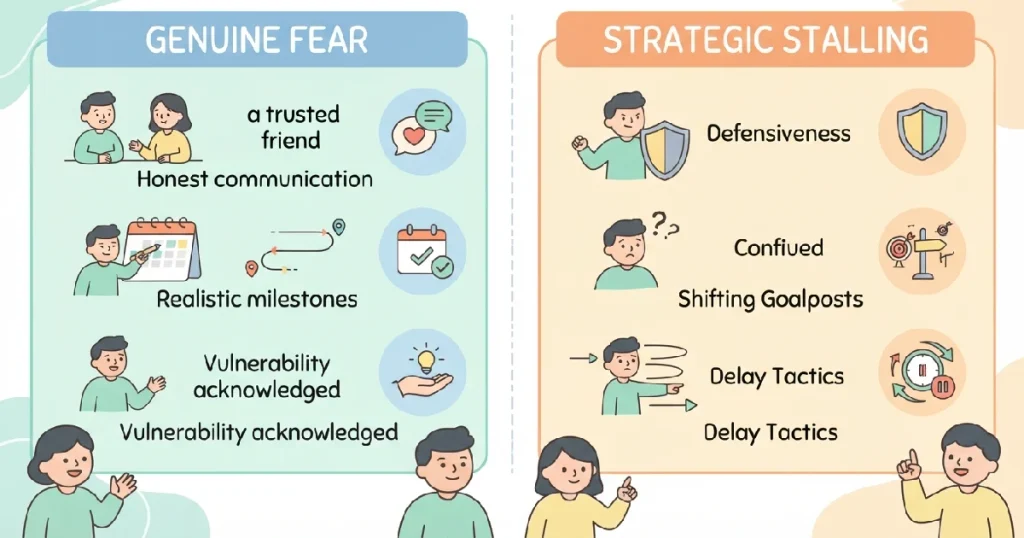
Here’s where most advice fails you. “Give him time” treats every kind of fear the same, as if hesitation only comes in one flavor. It doesn’t.
Picture his fear less like a light switch and more like a dimmer. A man who is genuinely scared still turns the dial toward you, slowly, visibly, even while anxious. A man who is stalling keeps the dial fixed in place and hopes you’ll stop noticing the dark.
Genuine fear looks collaborative. He names his specific worry out loud, even when it’s uncomfortable. He agrees to couples therapy. He’ll sit down and talk through a prenuptial agreement or finances without shutting the conversation down. He offers you something concrete, even if it’s not a date, like “I want to be debt-free by next spring, and then I want us to talk seriously.”
Strategic stalling looks evasive. The goalposts move every time you get close: after the promotion, after the house, after his friend’s wedding. He gets defensive or accuses you of pressuring him the moment the topic comes up. He offers vague reassurance like “it’ll happen when it’s right” with no definition of what “right” would even look like.
This distinction matters because of what’s known among clinicians as the “shut up ring” problem. A proposal that comes purely to end an argument, without real psychological buy-in behind it, rarely resolves anything. It just moves the standoff into an engagement that drags on for years, or ends in a broken engagement that hurts far more than an honest no would have.
Daniel’s Dimmer Switch
Daniel loved Priya for five years before marriage came up seriously, and when it did, he admitted something he’d never said out loud: his parents’ divorce had cost his father almost everything, and he was terrified of repeating it. He didn’t shut the conversation down. He agreed to see a therapist with Priya, and together they discussed a prenuptial agreement, which took the legal fear off the table within a few sessions. Eighteen months later, he proposed, not because Priya pushed, but because his fear finally had somewhere to go. His story is a reminder that these are the real signs he wants to marry you eventually, not just the words, but the willingness to work alongside you on the thing that scares him.
The Hidden Toll of Indefinite Waiting
Staying in limbo costs you something, even if no one around you names it out loud.
Psychologists call it the sunk cost fallacy: the tendency to keep investing in something because of what you’ve already poured into it, rather than where it’s actually headed. Five years in, it feels unbearable to imagine starting over. That feeling is real, and it is also not a good enough reason to stay somewhere your future isn’t being built with you.
Your timeline is not a character flaw. Wanting marriage and children before your fertility window closes, or simply wanting your thirties to look the way you’ve planned, isn’t “demanding” or “needy.” It’s self-knowledge. A boundary around your own time is not a punishment aimed at him. It’s a form of self-respect you’re allowed to hold without apologizing for it.
Your Playbook: Moving From Waiting to Deciding
The goal now is to step out of the anxious-pursuer role and into the seat of someone solving a problem alongside her partner, not chasing a commitment from him.
How to Talk to Your Boyfriend About Marriage Without an Ultimatum
There’s a real difference between an ultimatum and a boundary. “Marry me by June or I’m leaving” invites defensiveness and resentment. A boundary sounds different: “I love building a life with you, and I know I can’t stay in an undefined relationship past this year. I’d like for us to figure out together what that means.”
Try language like this during a calm, sober conversation, not a midnight argument:
“I’m not asking you to fix your fear tonight. I’m asking if you’re willing to work on it with me, with a therapist, with a real conversation about where this goes.”
“I need us to check in every few months about where we actually stand, instead of guessing.”
This kind of structured, low-heat conversation removes the fight-or-flight response that ultimatums trigger, and it gives him something to say yes to besides a deadline.
De-Risking Marriage: Therapy, Prenups, and Joint Financial Audits

If his fear is genuinely financial or legal, there’s a tool built for exactly that: a prenuptial agreement in the US, or a pre-marital contract in the UK. Far from being anti-romantic, these documents exist to protect both people, not just him, and bringing one up can neutralize a fear that’s been living in his head unspoken for years.
Premarital counseling, including approaches grounded in the Gottman Institute’s research on relationship commitment and conflict management, gives couples a structured way to dissect the fear instead of circling it endlessly at home. Pair that with concrete milestones, like a savings target or a debt payoff date, and vague anxiety starts to look like a solvable problem instead of a permanent wall.
Here’s the honest test: if he’s willing to discuss a prenup and still won’t commit to a timeline, his resistance probably isn’t about money anymore. It’s emotional, and it deserves to be named as such.
Where to Start This Week
The Fear Inventory Conversation. Ask him directly, without accusation, “What specifically scares you about marriage?” Not “why won’t you propose,” which invites defense, but a question aimed at his internal experience. Listen for whether his answer is specific (finances, his parents, timing) or vague (just a feeling).
The 90-Day Mirror Test. Set a private, internal checkpoint, not announced to him as a threat, where you honestly assess whether his actions over the last three months moved toward commitment or stayed exactly still. Movement, even slow movement, is information. Stillness is too.
The Collaborative Ask. Instead of waiting for him to bring up therapy or financial planning, propose it as a joint project: “Let’s find a couples therapist” or “Let’s sit down with our finances this weekend.” A partner with genuine fear usually says yes to this. A partner who’s stalling finds a reason to delay it too.
A useful question to ask yourself tonight: if nothing changes in the next twelve months, am I still choosing to stay? Your answer matters more than his timeline does.
Choosing Your Future Over a Fantasy
Marriage takes two people walking toward it, not one person dragging the other across a threshold he never agreed to cross. A man who works through his fear because he values the life you’re building together is worth every bit of patience you give him. A man who lets that same fear quietly cost him you was never actually standing at the door, dimmer dial turned toward you, the way you believed he was.
My Closing Remarks
I’ve sat across from enough couples to know this limbo is one of the loneliest places in a relationship, because you’re grieving a future that hasn’t technically ended yet. My honest take: his fear deserves compassion, but your life doesn’t owe him unlimited time to work through it. The women who come out of this stronger are the ones who stopped asking “when” and started asking “with whom.” I hope you get to be one of them.
More Related Stories for You
If you’re working on strengthening the foundation underneath this relationship while you sort through his hesitation, this guide on building healthy relationships is worth your time next.
About The Author