


You do not need more willpower. You need friction, a new self-image, and a better place to point that floodlight of focus.
Key Points
- How to deal with an addictive personality starts by dropping the life-sentence label and treating the pattern as rewiring, not identity.
- Willpower keeps failing because the problem lives in your reward system, not your character.
- These 7 steps replace empty abstinence with digital friction, urge surfing, and a deliberate identity shift.
Contents
Table of Contents
We treat intensity like a setting we were born with. The same engine that lets us outwork a room can also burn through a paycheck, a night of sleep, or a partner’s trust before Monday morning. You already know this feeling. You are high-functioning in public and quietly wrecked in private.
Someone might think you are just passionate. But what they don’t see is the 14-hour gaming session that started as one match.
Someone might think your partner is careless with money. But what they don’t see is the cart that checked itself out at 1 a.m. and the shame that arrived with the confirmation email.
Someone might think a new hobby is healthy growth. But what they don’t see is $3,000 of gear bought overnight and the crash that follows once the novelty dies.
An addictive personality is not a medical diagnosis. It is a cluster of high impulsivity, sensation-seeking, and a reward system that hits harder and fades faster than most. You deal with it by adding friction, riding out urges, and aiming that same intensity at something that builds you instead of emptying you.
That is the whole map. The rest of this piece shows you how to walk it.
Understanding the Modern Dopamine Trap Behind an Addictive Personality
Here is the part most people get wrong. Clinical psychology has largely retired the phrase “addictive personality.” As the analysis of the myth of the addictive personality makes clear, there is no single personality type that dooms you to addiction. What researchers actually find is a mix of impulsivity (acting before the consequences land), sensation-seeking (a hunger for intense stimulation), and lower conscientiousness (trouble holding a long plan when a short reward appears).
The term still feels true because it names your internal weather. You do not dip a toe in. You flood the room.
That flood is not a moral failure. It is a reward system with the volume stuck on high.
Left unexamined, this pattern does not just drain your weekends. It quietly becomes the reason a relationship ends or a career stalls.
Beyond Substances: Behavioral Addiction and Compulsive Hyperfixation
The modern version rarely starts with a bottle. It starts with a loop.
Short-form video that never ends. A mobile game designed to sell you one more chest. A sudden niche hobby that consumes your savings in 48 hours. Algorithmic feeds that learn your weak hour and meet you there. These are micro-dopamine traps. Each one delivers a small chemical reward, then resets the craving a little higher.
A behavioral addiction is a compulsive loop around an activity rather than a drug. The brain does not care about the difference as much as you wish it did. The hit is the hit.
Most people in this situation do not realize they are not “bad at moderation.” They are running a nervous system that treats ordinary life as under-stimulating. So the system goes hunting.
ADHD, Executive Dysfunction, and the Addictive Personality Overlap
If you have ADHD traits, high anxiety, OCD-style rituals, bipolar mood swings, or a childhood that taught you to soothe yourself alone, this pattern has extra fuel.
Executive dysfunction is the brain’s trouble with starting, stopping, and switching tasks. Hyperfixation is the flip side: attention locks onto one thing with almost physical force. For many neurodivergent adults, the lock is not fun. It is self-soothing. The game, the scroll, the spend, the all-nighter at work. Each one briefly organizes a noisy mind.
That is why “just stop” lands like an insult. You are not choosing chaos. You are borrowing calm from a costly source.
Your attention is a floodlight bolted to a swivel. You cannot dim it. You can only aim it.
When Hyperfixation Wears a Productive Mask
Marcus was 34, a software lead in Manchester, and the person everyone called driven. He shipped products. He ran. He looked fine. Then a photography account appeared in his feed on a Tuesday. By Friday he had spent just over £3,200 on a camera body, two lenses, and a bag he did not need. The following month the camera sat in a closet and a new game held him from 8 p.m. until dawn, three nights in a row. His partner stopped asking where he was. She already knew. He was not a man without discipline. He was a man whose floodlight had swung toward the nearest bright object. The shame made him hide. The hiding made the loop tighter. What finally moved him was not a pep talk. It was one deleted app, one password he no longer held, and a decision to point that same obsessive voltage at a cycling club that met whether he felt like it or not.
Marcus is a composite. I have sat with versions of him more times than I can count. The details change. The wiring does not.
The 7-Step Action Plan to Deal With an Addictive Personality
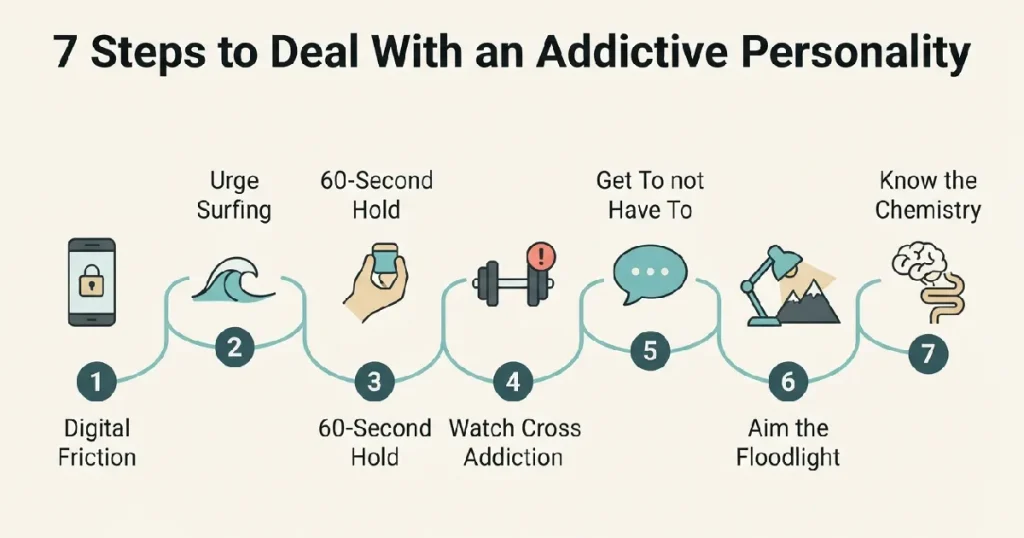
Willpower is a late tool. These steps work earlier, at the level of access, language, and identity.
Step 1: Force Radical Digital Friction Against Compulsive Behavior
Take choices out of your own hands while you still have a clear hour.
Delete the delivery app. Remove every mobile game. Use a physical blocker that needs a password you do not know. Give that password to a trusted person during a moment of clarity, not during a craving. Some people delete the numbers of anyone who makes the loop easier.
This is not punishment. It is architecture. Impulsive brains lose to easy access. They can win against a locked door.
The next time the urge arrives and the app is gone, notice the pause. That pause is the first piece of control you have actually felt in months.
Step 2: Master Urge Surfing to Handle Addictive Cravings
Do not fight the craving as if it were a debate you can win. Treat it like a wave.
Urge surfing is a mindfulness practice. You sit with the body sensation of wanting, name it, and watch it rise, peak, and fall without acting. Most waves crest in 10 to 15 minutes. You are not trying to feel peaceful. You are trying to outlast the peak.
If you need a simple structure for the sitting itself, the Mayo Clinic mindfulness exercises give you a clean starting point. Breathe. Locate the urge in the body. Stay.
The so what is blunt. You prove to your nervous system that a craving can complete itself without a purchase, a drink, a match, or a scroll. That proof is more useful than any pep talk.
Step 3: Use the 60-Second Tactile Interruption for Impulse Control
When the hand is already moving toward the buy button or the fridge or the controller, interrupt the loop with your senses.
Pick the object up. Hold it. Feel its weight for a full 60 seconds. Name the rush out loud if you can. Then put it back and walk to another room.
This tactile delay breaks automaticity, the brain’s habit of completing a sequence it has already started. You are not negotiating with the urge. You are inserting a speed bump in front of a system that only knows how to accelerate.
Try it once on a low-stakes impulse today. A snack. A click. A cart. Learn the shape of 60 seconds before you need it at 1 a.m.
Step 4: Map Cross Addiction Before a Healthy Habit Turns Harmful
Here is the trap almost every generic guide skips.
You quit the game and start training two hours a day. You quit the spending and start collecting a “useful” hobby with the same fever. You quit the scroll and start answering work email at midnight because productivity feels cleaner. That swap is called cross addiction: the reward-seeking simply changes costumes.
Watch for early signs. You train through injury. You cancel people to protect the new habit. Spending on the “good” obsession blows past a monthly cap you already set. Irritability arrives the moment you cannot do the thing. The challenge of cross addiction outlined is a clear field guide for those warning lights.
A useful metric: a healthy pursuit still leaves room for sleep, money, and one relationship that is not about the pursuit. If any of those three collapse, the floodlight did not heal. It only turned.
Step 5: Reframe Addictive Personality Language From Have To to Get To
Executive dysfunction hears “I have to stop gaming and make myself work” as a threat. The brain braces. Then it escapes back into the loop.
Change the sentence. “I get to finish this brief today so I can afford the machine I actually want.” “I get to sleep before midnight so tomorrow’s ride does not feel like punishment.”
This is not fake cheer. It is a cognitive reframe that ties a dull, high-yield task to the same reward tracker that already runs your life. You stop asking a low-conscientiousness brain to love chores. You ask it to fund the thing it already loves.
Write one “get to” sentence tonight for the task you keep dodging. Put it where you will see it at the weak hour.
Step 6: Transmute Obsessive Energy Into Positive Hyperfocus
Do not leave a hole where the habit was. An intense mind will fill a hole with the nearest fire.
Aim the floodlight on purpose. Competitive sport. A skill-heavy career track. A technical hobby with levels you cannot buy, only earn. The target needs complexity, feedback, and a social container that meets without your mood’s permission.
The goal is not balance in the soft sense. The goal is a channel deep enough to hold you. You are not trying to become a moderate person. You are trying to become a directed one.
Ask yourself one question this week. If this energy had to build something I would still respect in a year, where would I point it?
Step 7: Understand Receptor Modulation and Modern Craving Science
A live development in reward science is worth knowing, even if it is not your first move.
GLP-1 receptor agonists are medications first used for blood sugar and weight. They act on gut-brain pathways that also help regulate appetite and reward. Patients and clinicians began noticing something unexpected. Cravings dropped for things that had nothing to do with food. Alcohol. Impulse shopping. Nail-biting. The volume on seeking went down.
A PubMed systematic review of GLP-1 receptor agonists in substance use disorders is tracking this shift in formal research. This is not a suggestion to chase a prescription as a personality fix. It is evidence that reward-seeking is biological, adjustable, and not a verdict on your soul.
If medication is part of your picture, that conversation belongs with a licensed clinician. The point for you today is simpler. Your cravings have a chemistry. Chemistry can move.
How to Deal With an Addictive Personality in a Loved One

You cannot rewire another adult. You can stop living inside their loop.
Establishing Unflinching Boundaries With Compulsive Behavior
Support is not the same as enablement. Enablement removes consequences. Support holds the person and the limit at the same time.
Be specific. “I will not cover the credit card this month.” “The console does not come back into the bedroom.” “I will leave the room if the binge starts and I will not argue about it at 2 a.m.” Write the line down before you need it. Deliver it once, calmly, then act.
You are not the parole officer. You are a person with a nervous system that also deserves sleep.
De-escalating Household Anxiety Around an Addictive Personality
Partners often become unpaid monitors. That role will hollow you out.
Shift the job. Protect the joint account. Keep your own friends. Get structured family recovery tools rather than trying to become the treatment plan. The Hazelden Betty Ford treatment and recovery guide is a solid door into that wider help, including the cross-addiction patterns that confuse households.
Your calm is not abandonment. It is the only climate in which a real boundary can stand.
Rewiring the All-or-Nothing Mind
Go back to Thursday night. The feed is open. The cart is loaded. The match is queued. You used to meet that hour with a lecture about discipline. You now have a different set of moves. Friction. A 60-second hold. A wave you can ride. A sentence that says get to. A place to aim the light.
An intense, high-focus mind is a tool, not a life sentence. The label “addict” as identity keeps you small. The pattern as wiring gives you something to work.
You were never too much. You were just pointed at the wrong thing.
My Closing Remarks
I have sat with people who built companies and still could not close a laptop at midnight. The shame is usually louder than the habit. What I want you to hear is simpler than any protocol. You are not broken for wanting intensity. You are tired of aiming it at things that punish you in the morning. Start with one layer of friction this week. One app gone. One urge ridden out. That is enough to prove the wiring can move.
More Related Stories for You
- If the scroll itself is eating the space between you and the person you love, read more about how constant scrolling affects your closest relationships.