
If you’ve been waiting for your child’s clinginess to pass, you’ve been fed a lie. The school drop-off tears, the refusal to sleep alone, the total meltdown when a device loses its signal ( this isn’t ordinary separation anxiety. It is a generation-specific crisis, and brushing it off as a phase is the fastest way to let it harden into a lifelong pattern.
You have probably tried all the “right” things. You have read the scripts, counted the minutes, and rewarded the brave faces. Yet the panic still comes, raw and real, often by 8 a.m. on a Tuesday. You feel exhausted, frustrated, and maybe a little ashamed.
I need you to hear this: you are not failing. The problem is that the standard advice wasn’t built for a childhood steeped in certainty machines, hyper-predictable algorithms, and the kind of digital cocooning that leaves zero room for manageable discomfort. The old “don’t worry” talk doesn’t work because your child’s nervous system isn’t hearing words; it is screaming for a predictable world that just walked out the door.
That is alpha generation separation anxiety, and it needs urgent action ( not more generic reassurance.
Here is the landscape you’ve likely been navigating:
- You’ve been told to use logic during a panic attack, only to see the crying intensify.
- You have painstakingly removed screens, then watched your child’s fear spike even higher without the one predictable comfort they knew.
- You’ve lengthened goodbyes to soothe them, inadvertently convincing their brain that leaving is actually dangerous.
- You have read a dozen articles that perfectly describe the problem and then leave you with nothing but “build resilience” as an action item.
This article will be different. I am going to walk you through exactly why this moment is harder than anything earlier generations faced, what the science actually tells us, and ( most importantly ( the precise words and steps you can use this afternoon.
A Quick Note Before We Dive In
I’m Sara, a licensed clinical social worker. Every day, I sit with families who feel held hostage by a child’s anxiety. I’ve seen what works, what backfires, and what most well-meaning advice gets tragically wrong. I’ll be candid, sometimes blunt, but never judgmental. Think of this as a conversation between two adults who refuse to let a child drown in preventable fear.
Why Gen Alpha Separation Anxiety Is Different
Alpha Generation Separation Anxiety: a distress response specific to children born after 2010, where panic arises not only from physical distance from a caregiver but from a sudden loss of environmental predictability, amplified by early and constant exposure to algorithm-driven, on-demand digital systems that eliminate the neurological practice of tolerating ambiguity.
That’s the clinical core. But let me put it in plain terms: your child’s brain has been shaped by a world that answers every question instantly, routes every trip without error, and streams comfort on command. When you leave, the world becomes unscripted. For a brain that has not learned to metabolize “maybe,” that silence feels like a threat.
This is not about bad parenting. Researchers at Taylor & Francis Online have documented what they call “digital separation anxiety,” noting that Gen Alpha’s intense attachment to devices mirrors and often intensifies the distress they feel when separated from parents. The dependency on connectivity leaves young children without the internal scaffolding to handle even short periods of offline, unattached reality.
I see this in my practice constantly. A 7-year-old who can navigate an iPad flawlessly falls apart when Mom goes to the bathroom. The panic isn’t about the iPad or even about Mom. It’s about the abrupt removal of a predictable, controllable world.
One public health screening caught my attention: over 53% of primary-aged children in a large-scale assessment displayed mild to severe anxiety symptoms, with separation fears at the top. This isn’t a few sensitive kids. This is a structural shift.
5 Steps to Build Real Security Today
Forget perfection. You don’t need a psychology degree. You need a plan that meets your child’s wired-for-certainty brain exactly where it is. Here are five steps you can use right now, each one tested in real families, not just in theory.
Step 1: Install a Scripted Goodbye (It’s Shorter Than You Think)
The longer you linger, the more danger you signal. I want you to create a goodbye ritual that fits in 90 seconds or less, every single time. It’s not cold; it’s clear. When a child knows exactly what to expect, their threat alarm quiets.
Here’s a sample script you can adapt:
- Walk in together, put down the backpack.
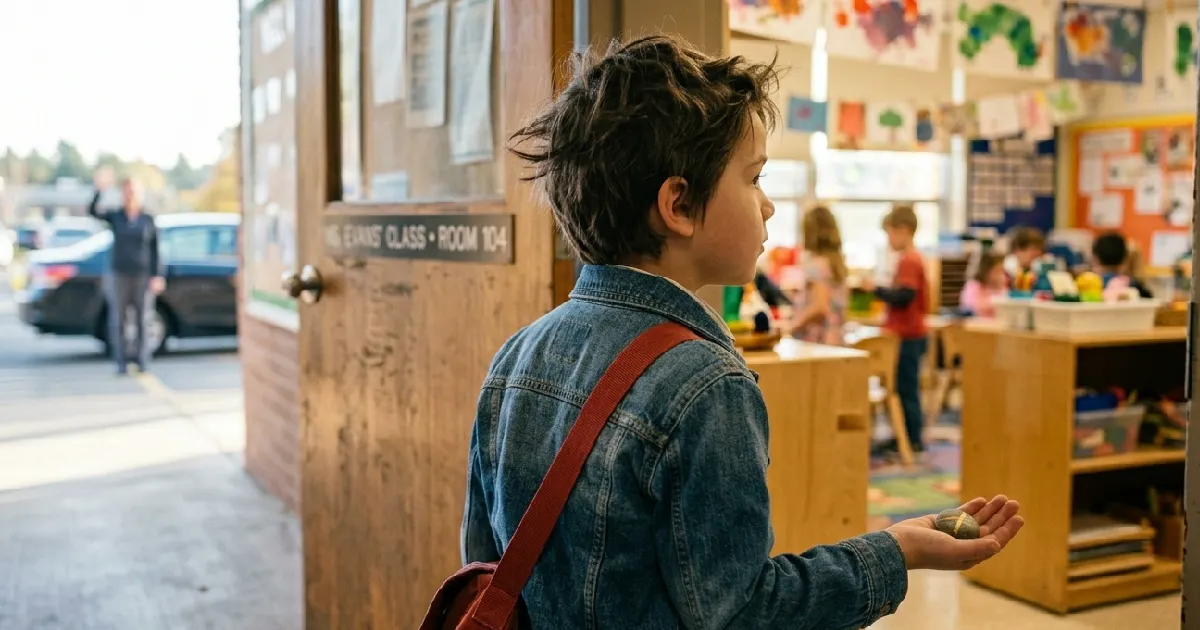
- Get to eye level and say: “I see you’re feeling scared. That’s okay. I’ll be back when the hand on the clock touches three. Your job is to be brave; my job is to return.”
- One deep breath together, a quick hand squeeze, a small transitional object (like a smooth stone they can rub), and you leave. No looking back, no lingering at the door.
This works because it names the emotion without feeding it and gives the brain a concrete, sensory anchor. The scented bead on a bracelet or the tiny note in the pocket becomes the bridge.
Step 2: Practice Predictable Unpredictability at Home
I know that phrase sounds contradictory, but it’s the secret sauce. If your home runs like a rigid algorithm, any crack in the schedule feels catastrophic. You need to serve up small, safe doses of “I don’t know” inside the relationship your child most trusts.
Try these this week:
- Change the breakfast routine without apology. “We’re having lunch foods for breakfast today! Who knows, maybe it’ll be weird and wonderful.”
- Take a new route to the park. Narrate it calmly: “Huh, I’m not sure what’s around this corner, but we’re together.”
- Intentionally make a small mistake and model recovery. “Oops, I forgot my keys. My heart sped up for a second, but I took a breath and now I’m solving it.”
You’re building a muscle. The goal is not to scare your child; it’s to show them that uncertainty can be safe when you’re with someone you trust.
Step 3: Build a Courage Ladder, Not a Cliff
Most of us accidentally throw a child off an emotional cliff. We go from constant contact to a full day apart. A courage ladder breaks the separation into tiny, doable rungs.
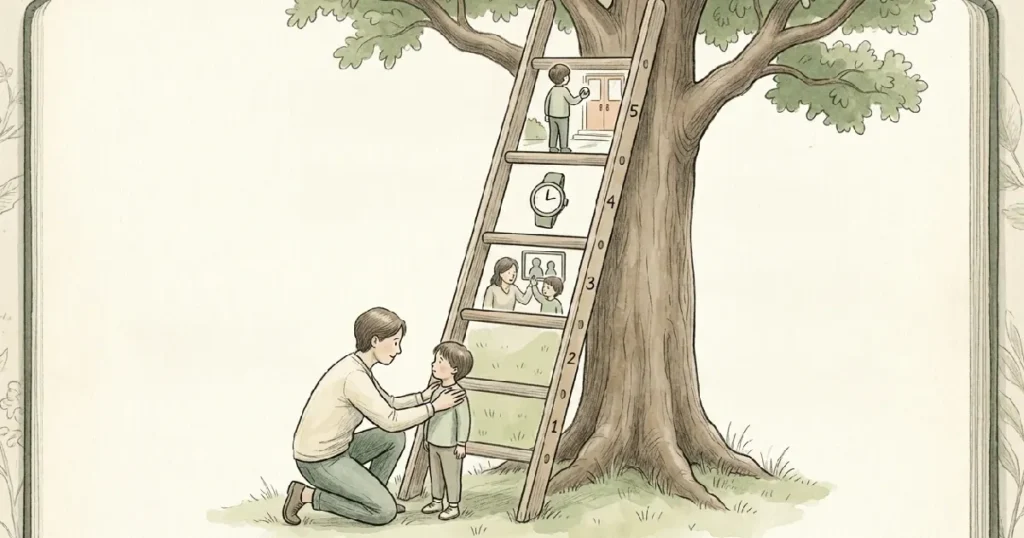
Sit down with your child and draw an actual ladder on paper. Fill it in together:
- Rung 1: Parent in the next room for 3 minutes (door open, child can call out).
- Rung 2: Parent steps outside to get the mail while child watches from the window.
- Rung 3: A 10-minute video call with Grandma while you sit in the driveway.
- Rung 4: Parent goes for a 20-minute walk; child stays home with a trusted adult and uses a pre-agreed timer.
- Rung 5: A full morning at school with the scripted goodbye.
Never push to the next rung until the current one feels boring. Boredom at a step is the signal the brain has integrated the safety.
Step 4: Turn Devices Into Bridges, Not Pacifiers
The call to rip away screens is loud. But for many Gen Alpha kids, abrupt removal triggers the exact digital separation anxiety you’re trying to soothe. Instead, slowly reposition devices as transitional tools.
Instead of a tablet as a distraction, record a 90-second voice memo on it: your voice saying the goodbye script, followed by a guided breath. The child can press play right after you leave. You’re using the very mechanism they trust to deliver your regulated presence.
One mother I worked with set up a smart speaker so her son could say, “Alexa, tell me when Mom has been gone for 6 minutes.” The timer gave him a predictable endpoint that wasn’t Mom’s body, but her planned return. Over time, the need for the timer fades. The brain has practiced waiting.
Step 5: Activate Your Alloparent Network Before the Crisis
One adult cannot be a child’s entire emotional anchor. You need a small team. “Alloparents” are the other trusted adults (a grandparent, an aunt, a neighbor, a consistent teacher) who learn the same goodbye script, the same rhythm, and the same calm tone.
When your child experiences predictability from multiple safe figures, the terrifying story (“Only Mom can keep me safe”) starts to crumble. Invite your alloparent to practice the 90-second drop-off with you. Let your child overhear you saying to them, “We trust Uncle James. He knows exactly how we do this.”
A Simple, Real Turnaround Story

Meet Lena (her name is changed for privacy). Lena is a single mom to an 8-year-old boy named Eli. For months after a school transition, their mornings were a battlefield. At 7:45 a.m., Eli would stand frozen in the hallway, his small fists white, his breath shallow and fast. He would whisper, “What if you don’t come back? I don’t know what to do.” The scent of his lavender hand sanitizer became a trigger for Lena’s own dread.
Lena was drowning in guilt. She had tried rewards, lectures, and finally angry pleading. Nothing moved the panic. When we started working together, I asked her to do the hardest thing: stop explaining. She created a 90-second goodbye with a small, scent-free token (a tiny painted rock Eli could squeeze). The mantra was: “I will come back. Your rock has my hellos and goodbyes.” She left, no matter how his tears sounded.
For two weeks, it felt cruel. Then on Day 12, Eli squeezed the rock and walked to his cubby without clinging. On Day 20, he told his teacher, “My rock has a job.” Lena told me later, through tears of relief, “This morning he waved and turned away first. He turned away first.” That was the moment the spell broke, not because Eli never felt fear again, but because his brain had proof that separation could be survived.
Common Mistakes and How to Avoid Them
Mistake 1: Mistaking Reassurance for Connection
You feel compelled to say, “You’re fine! Nothing bad will happen.” But to an anxious brain, this invalidates the felt experience and teaches the child not to trust their own signals.
What to do instead: Validate first, then shift. “You have butterflies in your belly. I get that. Let’s take three breaths, and then I’ll walk you to Ms. Rivera.” Name the sensation, co-regulate, then act.
Mistake 2: Removing All Uncertainty from Daily Life
Trying to create a 100% predictable world is understandable but backfires. When life inevitably throws a curveball, the child has zero distress-tolerance fitness.
Start small: “I’m not sure if the library is open today. Let’s go see together.” Model excited curiosity. Allow your child to see you handle not-knowing without spiraling.
Mistake 3: Over-Explaining During the Panic
A child in full amygdala hijack cannot process logic. Talking about “why” you have to leave while they hyperventilate is like giving a swimming lesson during a drowning.
Action step: Use less than 10 words. “I see you. I’ll be back.” Touch, breath, presence. Save the conversation for later, when both of you are regulated and can actually connect.
Mistake 4: Neglecting Your Own Nervous System
You cannot lend a calm presence you don’t possess. If your goodbye is driven by your own guilt or anxiety, your child’s brain will mirror it instantly. They are scanning you for danger cues.
Before drop-off, give yourself a 30-second regulation break. Feet on the floor, hand on your chest, exhale longer than you inhale. Resolve that you will be the calmest object in the room. It’s not selfish; it’s the intervention.
Frequently Asked Questions
What do I say in the exact moment my Gen Alpha child starts clinging?
Name the feeling without fixing it. Get low, breathe audibly, and say: “You’re scared, and your body feels wobbly. I’m going to work, and I’m holding your love right here.” Touch your chest. Then follow the scripted goodbye. You are lending your nervous system until theirs can borrow the calm. Logic comes later; connection comes now.
Is it true that too much screen time causes this separation anxiety?
It’s not the sole cause, but it powerfully weakens distress tolerance. When children are raised with constant, on-demand predictability (GPS, streaming, instant answers), the brain’s circuitry for handling ambiguity stays underdeveloped. Physical separation then becomes the first unsolvable “glitch,” triggering an intensity of panic that research now labels digital separation anxiety.
What if my child refuses to let anyone else help them?
This is where your alloparent network becomes medicine. Start absurdly small: Grandma sits in the same room while you walk to the kitchen. The goal is to stack tiny wins until the child’s system learns that safety isn’t stored only in you. Persistence, not pressure, rewires the threat story. Let the other adult use your exact scripts.
When should I seek professional help for my child’s separation anxiety?
Reach out if the panic lasts more than 30 minutes after you leave, causes vomiting or refusal to eat, or prevents normal functioning for weeks. Severe cases often respond well to parent-child interaction therapy (PCIT) or adapted cognitive behavioral work. Over 53% of primary students currently screen positive for mental health risks, so early, expert support is not failure; it’s prevention.
Can parent anxiety really pass to a Gen Alpha kid?
Absolutely. Co-regulation is physiological. If your voice tightens, your shoulders clench, or you hesitate at the door, the child’s survival brain reads threat. That’s why our 90-second script is as much for you as for them. When you regulate first, you offer a silent, potent message: “Whatever happens when we part, my body already believes we can handle it.”
Does this approach work for older Gen Alpha kids, around ages 9 or 10?
Yes. For tweens, increase their sense of agency. Let them design the courage ladder, choose the transitional object, and plan the tiny experiments. Use the same validation and co-regulation, but shift from “do it with me” to “you’re in charge, and I’m your consultant.” The core need ( feeling held by predictability even when you’re absent ( remains the same.
Final Takeaway
You don’t need to be a perfect parent to break this cycle. You need to be a predictable one. The urgent action I keep insisting on isn’t a massive overhaul; it’s the small, daily decision to stop explaining and start scripting, to stop removing uncertainty and start dosing it with connection, and to stop handling this alone.
Here’s your immediate task: tonight, find a small object that fits in your child’s palm (a polished stone, a button from your coat, a simple bead). Charge it with a single sentence: “This holds my hello and goodbye until I’m back.” Put it in their backpack now. That small, sensory bridge is your first brick in a foundation that can hold them steady even when the world feels unscripted. Start with that. The rest will follow.
My Closing Remarks
I’ve seen children who couldn’t be in a different room from their parent for thirty seconds. I’ve watched those same kids, within weeks, wave goodbye with a full chest of air and steady hands. The change wasn’t magic. It was the radical act of embracing predictability in the goodbye, embracing safe uncertainty in the daily rhythm, and refusing to let guilt drive the car. Your child’s anxiety isn’t a verdict on your parenting; it’s a signal that the old playbook needs a rewrite. And you are the only one who can rewrite it. That’s terrifying, I know. But it’s also the most hopeful thing I can tell you.