
 David Wall
A working budget for couples is not one shared pot. It is a structure that lets you pay bills together and spend on your own life without asking permission.
Key Points
- A strong budget for couples protects both the household and each person’s right to spend without interrogation.
- The three-account system plus a proportional split removes the two biggest money fights: unfair bills and watched purchases.
- Fifteen minutes a month is enough to keep the system honest. You do not need a weekend-long money summit.
Contents
Table of Contents
Merging every dollar you earn is not proof of love. It is often the fastest way to start keeping score.
We tell ourselves that one account means one team. Then a $40 game, a salon visit, or a pair of running shoes shows up on a shared statement and the room changes temperature. You were not fighting about forty dollars. You were fighting about being watched.
Someone might think a joint account is the mature choice. But what they do not see is the quiet scan that happens every time the other person buys something small. Someone might think splitting rent down the middle is fair. But what they do not see is the lower earner skipping lunch so the math looks equal. Someone might think “we’ll figure it out as we go” is relaxed and modern. But what they do not see is that informal money is where resentment grows in the dark.
Here is the short version. The budget for couples that actually holds up uses three accounts, splits shared bills by income, and gives each of you a fixed personal allowance that nobody audits. Fairness is the formula. Autonomy is the point.
That last word matters. Autonomy, in plain language, is the feeling that your choices still belong to you. Self-Determination Theory, a well-tested model of human motivation, says people stay healthier and less hostile when they feel competent, connected, and free to choose. Take away the third piece inside a relationship and even a kind partner starts to feel like a supervisor. The American Psychological Association’s Stress in America reports have listed money as a leading stressor for adults for years. Couples who never carve out private spending do not just argue more. They start to experience ordinary purchases as threats.
Left alone, that pattern does not stay small. It becomes the story you tell about each other. Spender. Controller. Irresponsible. Cheap. Those labels are hard to unsay.
Think of your money like a duplex. One foundation. Two front doors. A kitchen you share. Rooms you do not enter without knocking. Most advice still tries to put you in a studio apartment and call it intimacy.
Why the 50/50 Split Fails Most Couples
Equal is not the same as fair. That is the whole problem.
If you both take home the same pay, a 50/50 split can work. The moment incomes diverge, equal math starts to punish the person who earns less. They contribute a larger share of their life to the household. The higher earner often does not notice. The lower earner almost always does.
The Federal Reserve’s Survey of Household Economics and Decisionmaking has shown for years that many partnered households do not earn in lockstep. One person is in school. One is caregiving. One changed careers. One simply works in a field that pays less. A growing share of couples under 40 have already moved toward income-based splits for this reason. They are not being trendy. They are trying to stop a slow leak of dignity.
Equity theory, a social psychology idea about fairness, says people track ratios, not raw dollars. You compare what you put in with what you get back, then you compare your ratio with your partner’s. When the ratios feel off, the mind does not file a polite complaint. It files a grievance.
The fix is not a better spreadsheet personality. The fix is a better account structure.
The Three-Account System: Shared Bills, Two Free-Spend Accounts
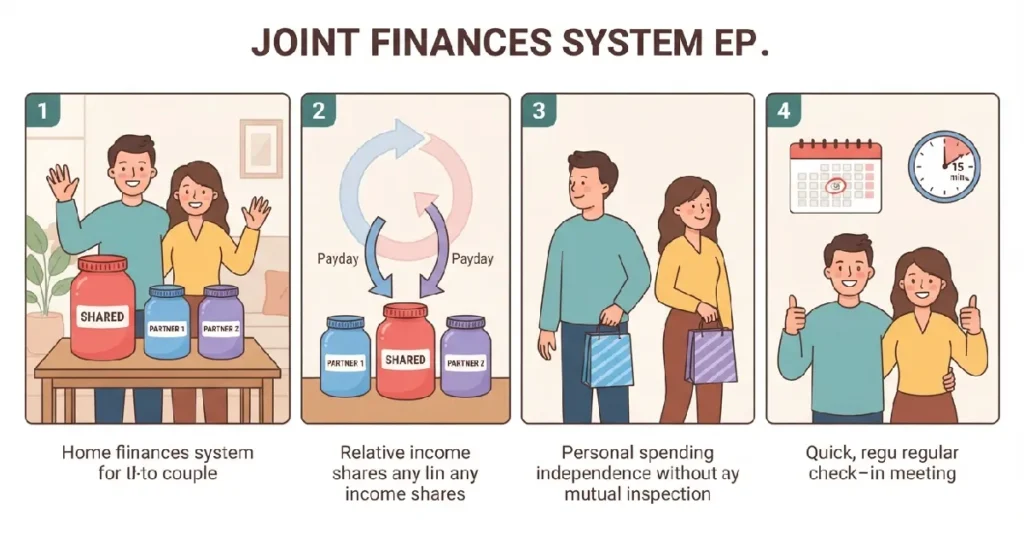
Call the accounts Red, Blue, and Purple if it helps you remember them.
Red is the joint essentials account. Rent or mortgage. Utilities. Groceries. Insurance. Shared streaming you both use. That is it.
Blue is Partner A’s personal account. Purple is Partner B’s. Paychecks land in the personal accounts first. Then an automatic transfer sends each person’s agreed share into Red on payday. What stays behind is yours.
This is the budget for couples that stops the surveillance loop. Shared costs live in one place. Personal joy lives somewhere the other person does not need to open.
Setting Up the Joint Essentials Account Without Merging Identities
You do not need to collapse your financial lives to run a household.
Open one joint checking account used only for Red. Keep your existing personal accounts. Some couples use the same bank for convenience. Unmarried couples often do better at two different banks so the paper trail stays clean if anything goes wrong.
Turn on automatic transfers the day you get paid. If you are paid on different days, schedule two transfers so Red never dips. Put overdraft protection on the joint account only. Do not link personal accounts in a way that lets one person’s hobby swipe drain the rent.
Name the joint account something boring and specific, like “Household Bills.” Boring names reduce the urge to treat it like a slush fund.
Maya and Jordan
Maya and Jordan moved in after two years of dating. Maya takes home $6,000 a month. Jordan takes home $4,000. They opened a joint account “just to make life easier” and routed both paychecks into it. Within six weeks Jordan bought a used camera lens. Maya saw the charge before he got home. She did not yell. She went quiet, which was worse. Jordan started announcing every coffee. Maya started feeling like a parent. Neither of them is irresponsible. The structure made ordinary spending look like a betrayal. They rebuilt the system in one Sunday evening: two personal accounts, one Red account, transfers on payday, and a personal allowance neither of them tracks. The camera lens would not have been a story. That is the point.
How Much Guilt-Free Personal Spending Each Partner Should Get
This is the piece most money advice skips, and it is the piece that saves the relationship.
Each of you sets aside 10 to 15 percent of your own take-home pay as a guilt-free allowance. It is not tracked in a shared app. It does not require a receipt. It does not require a speech.
Call it secret allowed spending if you want. The secrecy is not deception. It is a boundary.
If Jordan takes home $4,000, his free-spend range is $400 to $600. If Maya takes home $6,000, hers is $600 to $900. Hobbies, gifts, a nicer haircut, a game, a class. No interrogation.
Why a percentage and not a matched dollar amount? Because matching dollars recreates the 50/50 problem inside the one place that should feel free. The lower earner’s allowance can still be protected by a floor rule, which you will see in the next section.
The Consumer Financial Protection Bureau’s financial well-being tools treat a sense of control as part of financial health, not a personality trait. Control here does not mean controlling your partner. It means each of you can make a small decision without a committee.
Most people in this situation do not realize they are angry about permission, not about the purchase.
Splitting Bills Proportionally: The Fair Formula for Income-Gap Couples

Add both take-home incomes. Divide each person’s income by the total. That percentage is their share of every shared bill.
Maya: $6,000. Jordan: $4,000. Combined: $10,000. Maya’s share is 60 percent. Jordan’s is 40 percent.
If the shared monthly pool is $4,200, Maya sends $2,520 to Red. Jordan sends $1,680. What remains in Blue and Purple is personal money, including the guilt-free slice.
Recalculate after a raise, a job loss, parental leave, or any change that lasts more than a month. Do not wait for a fight to update the math. Put the trigger in writing so it does not feel like a personal attack when income shifts.
Now the floor rule, which matters when the gap is wide. Agree that the lower earner’s personal allowance never drops below a set minimum, even if the percentage formula would squeeze it. One hundred fifty dollars a month is a workable starting floor in many cities. Adjust for your cost of living. The higher earner absorbs the difference inside the shared pool, not by policing the other person’s fun.
This is not charity. It is how you keep the lower earner from becoming a roommate with fewer rights.
Perceived financial control is one of the quieter ways affection curdles. The Federal Reserve data on household well-being makes the income gap visible. Your job is to keep that gap from becoming a hierarchy at home.
Inflation-Proofing Your Couples Grocery and Household Budget
Groceries are the most watched shared expense because they happen every week and everyone has an opinion about them.
The Bureau of Labor Statistics Consumer Price Index tracks food-at-home costs as they move. Those small yearly jumps are exactly why a vague “we’ll spend less on food” plan fails. You need a number.
The USDA Food Plans give you that number. The Moderate-Cost plan for a two-person household sits near $520 a month, depending on age and eating patterns. Use it as a cap, then add a 5 percent buffer so one birthday dinner does not count as a moral failure.
Run a simple grocery protocol. Keep one shared list in an app you both can edit. Alternate who shops each week so the mental load does not stick to one person. Buy store-brand staples in bulk on a shared trip. Review the month’s total at your money date, not in the cereal aisle.
The fight in the store is rarely about pasta. It is about who feels more careful and who feels more judged.
The 15-Minute Monthly Money Date That Prevents Fights
Most couples only talk about money when something is already wrong. That means the conversation starts in blame before anyone sits down.
Schedule a 15-minute money date the first Sunday of the month, after a meal, phones in another room. Same time every month so it does not become a referendum on whoever brought it up.
Use this script.
Minutes 1 to 3: Look at Red only. Did shared bills stay inside the plan? State facts. No tone.
Minutes 4 to 8: Name next month’s known extras. A trip. A car registration. A gift. Put the dollar amount in Red’s calendar.
Minutes 9 to 12: Each of you shares one financial win or one worry. One. Not a catalog.
Minutes 13 to 15: Agree on one small adjustment. One. Then stop.
Tone rules: “I” statements. No autopsy of a personal purchase. No “you always.” If a feeling spikes, name the feeling and park the topic until the next date unless Red is actually overdrawn.
This is not romance. It is maintenance. Couples who only discuss money in a crisis train their nervous systems to treat every budget talk as danger. A short, boring ritual breaks that pairing.
The receipt is not the problem. The surveillance is.
Managing Subscriptions, Digital Costs, and a Joint Emergency Fund
The average household now carries a pile of streaming, cloud, software, and delivery memberships that never appear in the “real” budget. Twelve or more subscriptions is common. The total often lands near $200 a month, which is a car payment you forgot you were making.
Once a quarter, sit down for a subscription audit. List every recurring charge. Mark each one shared or personal. Split the shared ones with the same income percentage you use for rent. Cancel what neither of you opened this month. Assign one partner as subscription manager for a year, then rotate so the job does not become invisible labor.
Build a joint digital emergency fund in a shared high-yield savings account. Auto-transfer a small proportional amount from each personal account after payday. Aim for three to six months of Red expenses, not three to six months of your entire lifestyles. Individual investing can stay individual. The joint fund exists so a broken water heater does not become a character debate.
The CFPB financial well-being resources keep returning to one idea: a plan you can carry out beats a perfect plan you abandon. Automation is how ordinary people carry a plan out on a tired Tuesday.
Unmarried Couples: Keeping Finances Separate but Fair

If you live together and you are not married, you do not get the default legal net that marriage provides. That is not cynical. It is operational.
Write a one-page cohabitation expense memo. List the split percentages, what Red pays for, what happens to shared furniture or a shared car if you part ways, and how the joint account gets closed. Both of you sign it and keep a copy. It is not a prenup and it does not require a lawyer. It is a map for a day you hope never comes.
Keep the three accounts at institutions that give you clean records. Do not casually add a partner as a full joint owner on an old personal account “for convenience.” Convenience is how money stories get messy.
Separation of accounts is not distrust. It is how two adults share a kitchen without sharing a spine.
If you are still in the talking stage, some of this belongs in the conversations you have before marriage or before you sign a lease. Money talk before the keys is cheaper than money talk after the first overdraft.
Common Budgeting Mistakes Couples Make and the Fixes
Merging every account in the first month. Fix: start with Red only. Let Blue and Purple stay personal.
Skipping the guilt-free allowance because it feels indulgent. Fix: treat it as relationship insurance, not a splurge.
Talking about money only during a fight. Fix: the 15-minute date, on the calendar, even when nothing is wrong.
Ignoring subscriptions until they quietly eat the grocery cap. Fix: the quarterly audit with one named owner.
Never updating the split after a raise or a lost job. Fix: write the recalculation trigger into the memo so the update is a rule, not a confrontation.
Using a shared tracking app to monitor personal spending. Fix: track Red together. Leave Blue and Purple alone.
Most couples in this situation are not bad with money. They are using a structure built for a single person and hoping love will do the accounting.
What You Can Do Tonight
The Payday Split. Open your banking app and set two automatic transfers into the joint essentials account using your income percentages. If you do not have the joint account yet, open it this week and park a small starter amount so the transfers have a destination.
The Allowance Line. Decide your 10 to 15 percent free-spend number and write it down once. Then stop writing it down. The discipline is in leaving it alone.
The Sunday Slot. Put a 15-minute money date on the calendar for the first Sunday that is still coming. Use the script. End on time. Ending on time is part of the trust.
A useful question to ask yourself before the first date: “Am I upset about the dollar amount, or am I upset that I felt I needed permission?” Answer that privately. Bring the cleaner version to the table.
The next time a small purchase would have shown up on a shared statement, it will not. That silence is the system working.
You now have a named structure, a fairness formula, and a ritual short enough to keep. The $40 game can just be a game. The duplex can have a shared kitchen and two closed doors. Independence inside a couple is not a withdrawal of love. It is the infrastructure that keeps love from turning into a ledger.
Love does not require a shared bank statement. It requires a shared plan.
My Closing Remarks
I have sat with couples who could recite each other’s coffee orders and still could not say what “fair” meant with a straight face. The pain was never the latte. It was the feeling of being managed by the person who is supposed to be on your side. Build the three accounts. Protect the allowance like you would protect a confidence. If you do only one thing after reading this, open the transfer screen tonight and move the rent out of the place where your joy lives. You can love someone fully and still keep a door that closes.
More Related Stories for You
- If money is one of the hard talks you have been postponing, start with the things to discuss before marriage so the three-account system has a conversation to sit inside, not a crisis to clean up.
About The Author