Sara Carmen

The silent partner often isn’t cold. Their body hit the brakes mid-sentence, and nobody handed you the manual.
Key Takeaways
- Stonewalling in a relationship is usually a nervous system overflow, and in the Gottman Institute’s Love Lab, 85% of stonewallers were men.
- A break only heals when it carries a named return time; silence without a deadline quietly teaches your partner to panic.
- Who raises the topic predicts who retreats, which means the chasing partner holds more repair power than they think.
Quick answer: Stonewalling in a relationship happens when one partner shuts down and stops responding during conflict because their body feels flooded with stress. Research from the Gottman Institute links it to a racing heart and fight-or-flight arousal, and the reliable repair is a timed break plus a promised return to the conversation.
Contents
Table of Contents
You bring up the credit card bill, and your partner’s face goes blank. Eyes down, shoulders up. “It’s fine.” Ten minutes later you’re arguing with someone who left the building while still sitting on your couch.
The question underneath that silence hurts: is this indifference, or is this overload? From the outside they look identical, and most advice picks a villain. The research picks a mechanism.
Gottman’s lab calls it flooding, a stress surge that hijacks the ability to listen. Once you can spot the flood, stonewalling in a relationship stops reading as a verdict on your love life. Here’s how to tell overwhelm apart from punishment, plus seven field-tested moves: three for the moment of silence, four for the days between.
What Stonewalling in a Relationship Actually Signals
Stonewalling is the last of the Gottman Institute’s four horsemen, the conflict patterns that predict breakup: criticism, contempt, defensiveness, then withdrawal. It usually shows up after months of the other three. Your partner didn’t suddenly change. Negativity piled up until checking out became the only exit their body could find.
The part most advice skips: flooding is physical. The Gottman Institute describes a climbing heart rate, stress hormones pouring into the bloodstream, and a full fight-or-flight response. Hearing narrows, peripheral vision dims, and problem-solving drops offline. A flooded partner often can’t take in your sentence, no matter how calmly you say it.
In the Institute’s Love Lab, 85% of observed stonewallers were men, and male withdrawal measurably raised their partners’ heart rates. Two flooded nervous systems, one conversation. Both defending, neither listening.
A pattern I see on repeat: the emotional shutdown starts before the fight does. It starts in the sigh, the tone, the topic that predicts a losing argument. (Couples in this piece are composites; the patterns are real.)
Tip 1: Learn your flood signals before the words disappear
In a calm moment, each of you names three body tells: clenched jaw, hot ears, tunnel vision, the urge to say “whatever.” Then agree on one neutral break signal, as the Gottman team recommends: a word like “pause,” a raised hand, even something silly. Silly works; it can deflate tension on contact.
The rule that makes the signal real: whoever calls it gets it honored, no last word allowed. If you wear a smartwatch, check it mid-argument. Gottman’s clinical guidance puts the flood line around 100 beats per minute at rest. Above that line, talking harder buys nothing.
Shutdown, Healthy Space, or Silent Treatment? Run the 3-Way Check

The same silence can mean three different things, and your best move flips with each one. Here’s the field guide I use with couples.
| What you’re seeing | Flooded shutdown | Healthy pause | Silent treatment |
|---|---|---|---|
| Trigger | Conflict overload | Self-awareness: “I’m getting heated” | A grievance; wants payback |
| Body state | Racing heart, checked out | Tense but settling | Often calm, watchful |
| Goal | Escape the overwhelm | Protect the conversation | Make you feel the cost |
| Words | Few or none; “fine,” “whatever” | Names the break and return time | Deliberate ignoring, sometimes days |
| The return | Drifts back, dodges the topic | Arrives when promised | Ends when you concede |
| How it lands on you | Confusing, lonely | Oddly reassuring | Punished, walking on eggshells |
Two edge cases fool almost everyone. A trauma-linked freeze response looks like stonewalling from outside, and the body chooses it about as much as a deer chooses headlights. Autistic or ADHD shutdowns can look the same too: words become unreachable while feelings stay loud. If either fits your partner, pressure deepens the freeze, while slower pacing, dimmer stimulation, and a text asking for “a number from 1 to 10” work better than “look at me and talk.”
Watch for masked stonewalling as well: your partner stays in the room, nods, says “sure,” and is gone behind the eyes. Presence without response still counts as a wall. One question separates flood from punishment: does the silence end when you back off, or when you surrender? Flooding recedes with safety; punishment recedes with submission.
Tip 2: Call the break with a clock attached
The Gottman prescription is at least 20 minutes, roughly how long a flooded body needs to come down. Walking out wordless reads as bigger stonewalling, so script it: “I’m flooded and I want to get this right. Can we pick it up at 8:15?” Then treat 8:15 like a flight departure.
Two rules most couples miss. No replaying the fight during the break: the Gottman team warns that “righteous indignation” and “innocent victim” thoughts keep your pulse up while masquerading as rest. Walk, shower, music, slow breathing: that’s real self-soothing. And cap the pause: my working ceiling with couples is 24 hours, because past a day, a break curdles into abandonment with better branding.
Tip 3: Come back even if you feel awkward
The return is the medicine. A break without a return teaches your partner that silence means loss, so next time they chase harder and you flood faster.
Re-entry can be one sentence: “I’m back, I got overwhelmed, and you were right to bring it up.” Still flooded at the agreed time? Renegotiate out loud, once, with a new specific time. The fastest-improving couples in my notes keep at least nine of ten return appointments. Trust rebuilds on kept clocks.
If You’re the One Facing the Wall, Stop Pushing on It
Stonewalling in a relationship runs in a loop researchers call demand-withdraw: one partner presses, the other retreats, and each move feeds the next. Christensen and Heavey’s classic 1990 study found the detail that reframes everything: both partners demanded more when discussing a change they wanted, and withdrew more when discussing a change their partner wanted.
Sit with that. Your quiet partner likely pursues plenty, on their own topics. The wall marks a position in the conversation: the same person who retreats on your issue will chase you on theirs. That reframe drains contempt out of the room, and contempt is the horseman that feeds the wall.
Your side of the loop has physiology too. Gottman’s team found that male stonewalling raised women’s heart rates and intensified their pursuit. The chase runs on protest, the attachment system’s alarm when connection feels threatened. Two alarms, ringing at each other.
The trade-off stings: pressing harder buys a minute of relief and costs the conversation, while timed space feels like losing and usually returns your partner within the hour. If the baseline between fights feels shaky, shore it up with the qualities that quietly hold healthy relationships together while you test the moves below.
Practical What-To-Do-Next: Four Moves That Reopen the Door
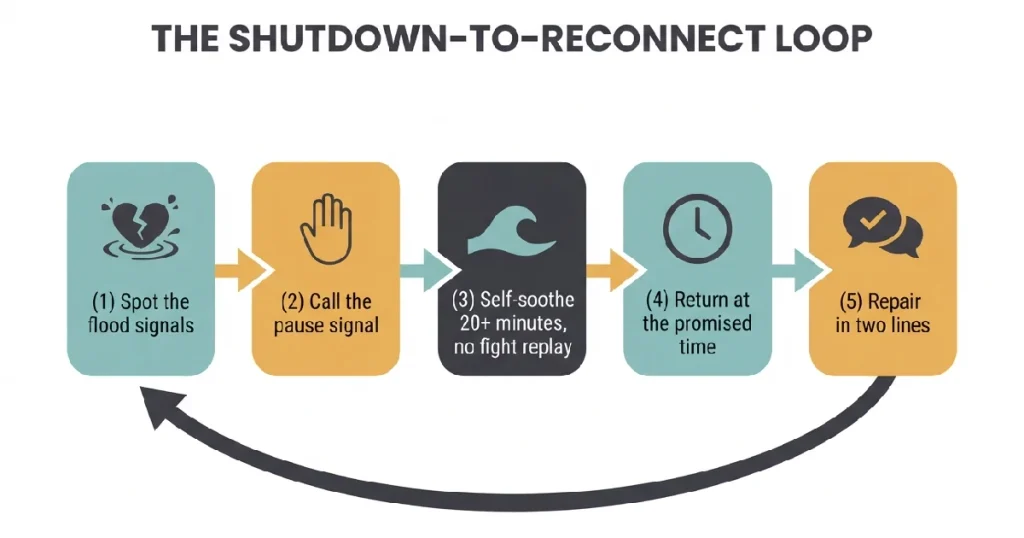
Tips 1 through 3 handle the moment of silence. These four strategies, your tips 4 through 7, rebuild connection between storms. Test one a week; all four at once turns repair into homework.
4. The Two-Line Repair
For the pursuing partner. Line one owns your delivery: “I came in hot about the money talk.” Line two makes a small, finishable ask: “Could we try five minutes after dinner?”
Stop at two. The pitfall I see constantly is a third line that reopens the case (“…but you always do this”), which burns the bridge the first two built.
5. The Shoulder-to-Shoulder Rule
Move hard talks out of the face-to-face firing line: walk, drive, wash dishes together. Shut-down partners tell me again and again that side-by-side talks feel survivable where kitchen-table talks feel like court. Consider testing two 15-minute walk-and-talks a week, phones in pockets. Notice what shifts when nobody sits pinned across a table.
6. The Friday Shutdown Audit
Ten minutes, same time weekly, three questions:
- What tipped us toward silence this week?
- Which return times got kept?
- What’s one tweak for next week?
Keep the answers in a shared note and track two numbers: return promises kept, and repair attempts accepted (a joke that landed, a touch that was welcomed). Gottman’s research found that stable couples hold roughly five positive moments for every negative one during conflict, which is why tiny accepted repairs outrank perfect arguments. Run the audit in good weeks too, so it never becomes a ritual that only spells trouble.
7. The Red-Line Check
Once a month, ask honestly: is the silence shrinking? Flooding usually responds to these tools within weeks. If the quiet stretches for days, ends only when you apologize for things you didn’t do, or arrives with contempt and fear, you’re facing control, and these seven tips stop being the right tool.
Individual therapy first makes sense when sharing a room feels unsafe; Gottman Method or emotionally focused couples therapy fits when both of you are willing. If you’re afraid of your partner, a confidential domestic violence hotline can help you think clearly.
Frequently Asked Questions
Is stonewalling in a relationship emotional abuse?
Flooding-driven shutdown is involuntary and usually brief, so no. Deliberate silence used to punish for days is a different pattern that belongs in the abuse conversation. Watch what ends the quiet: safety, or your surrender.
How long should a stonewalling break last?
At least 20 minutes, since flooded bodies need that long to settle. Keep it under a day and attach a specific return time so space never slides into abandonment.
Can a relationship survive years of stonewalling?
Yes, when both partners treat the wall as a shared loop with years of practice behind it. That’s also why long-standing patterns usually move faster with a couples therapist in the room.
Back to that couch, the credit card bill, the blank face. You can read the dashboard now: the jaw, the breath, the watch on the wrist. You have a signal word, a 20-minute clock, a one-sentence return, and a Friday ritual that scores kept promises instead of old resentments. The door that felt locked has a handle on both sides.
The wall comes down one kept promise at a time.
My Closing Remarks
Early on, I kept handing couples better scripts and watching them fail. The scripts were fine; the timing was wrong. Words only land in a body that feels safe, and safety gets built in small, boring units: a kept return time, an honored pause, a repair without a hidden jab.
Start with the clock. Least romantic tool here, and the one that works first.
More Related Stories for You
Once the door reopens, the next quiet skill is noticing what already works: why being happy with what you have might be the repair tool nobody talks about.
About The Author