Sara Carmen

Why does joy go quiet after a hard season, and what actually switches it back on?
Key Takeaways
- How to be happy again follows a strange order: action first, motivation second, feelings third.
- The “nothing feels good” state has a name (anhedonia), and it lies to you about what you’ll enjoy.
- A 14-day written test beats a year of vague advice, because it shows you exactly when self-help should hand off to professional care.
Quick answer: To be happy again, act before you feel ready: repeat small, meaningful actions daily (movement, one real conversation, one absorbing task) even when they feel flat. Mood follows behavior with a lag, so track completed actions for two weeks while joy catches up.
Contents
Table of Contents
We’ve all had the moment. Everyone at the birthday dinner laughs, you laugh too, the sound comes out right, and nothing inside moves. You drive home wondering when you became a spectator of your own life. Underneath sits the real fear: what if this flat version is permanent?
Psychologists call the “nothing feels good” setting anhedonia. It shows up in depression, grief, burnout, and breakups, and it runs on a cruel loop. Low mood drains motivation, low motivation cancels the activities that feed mood, and the dial drops another notch.
What follows: nine field-tested tips, a two-week experiment, and clear signals for when to bring in professional care. Everything runs in minutes, on ordinary days.
Why Joy Goes Quiet: The Loop Behind “How Can I Be Happy Again”
When readers ask us “how can I be happy again,” the honest first response is a question back: what kind of flat is this? Emotional numbness has at least five common drivers, and each responds to a different first move. Generic advice treats grief, burnout, and depression as one problem.
Tip 1: Name the kind of flat you’re in
| What it feels like | Likely driver | First move that fits |
|---|---|---|
| Waves of sadness tied to one loss | Grief | Keep two anchor routines; let the waves pass |
| Numb, exhausted, cynical about work | Burnout | Subtract one obligation before adding any habit |
| Nothing interests you, most days, 2+ weeks | Possible depression | Start the two-week plan and book a screening |
| Craving one person, checking their feeds | Attachment withdrawal | A no-contact window plus daily replacement contact |
| Life looks fine on paper, just beige | Hedonic adaptation | Introduce novelty and mild challenge |
Mixed pictures are normal. Grief often sits on top of burnout. Pick the row that describes 60% of your days and start there.
One exception stands outside this table: if flatness comes with hopelessness or thoughts of harming yourself, skip the experiments and reach a professional or crisis line today (988 in the U.S.). That step outranks everything else here.
Tip 2: Act first, feel second

The loop has one weak link: behavior. You can’t summon motivation on command, but you can schedule a 10-minute walk for 8:15 a.m.
That move is the engine of behavioral activation, a structured therapy built on scheduling action ahead of desire. In a landmark trial of 241 adults, behavioral activation matched antidepressant medication among the most severely depressed patients, and both outperformed standard cognitive therapy (Dimidjian et al., 2006). If you’re searching how to feel happy again at 2 a.m., this is the least glamorous, most evidence-backed answer we know.
Practical version: pick one activity from your “before” life and write it into the calendar with a time. Aim for five of seven days each week. Perfect streaks collapse; five-of-seven survives a bad Tuesday.
Tip 3: Shrink the dose until it feels almost silly
A common pitfall we see: the ambitious Monday restart. Gym hour, 20-minute meditation, journaling, green smoothies. By Thursday it’s gone, and the collapse feels like proof that nothing works.
Habit research points the other way. A University College London study of 96 adults put the median time to an automatic habit at 66 days, ranging from 18 to 254. Week-one intensity predicts almost nothing; repetition predicts most of it.
So cut every planned activity to its five-minute version. Walk to the corner. Text one friend. Play one song with full attention.
Tiny doses feel pointless; that feeling is the trap talking. Set a floor you can hit on your worst day. Missed days call for self-compassion and a next rep.
How To Be Happy Again After Depression: Retrain the Reward System
Depression lowers mood and corrupts forecasting at the same time. Your brain predicts that nothing will feel good, you act on the forecast, and the forecast never gets tested. Learning how to be happy again after depression means catching that prediction error in writing.
Tip 4: Score your predictions against reality
Cognitive behavioral therapy has used this tool for decades. Before an activity, rate expected enjoyment from 0 to 10; after, rate actual enjoyment. The gap does the work.
Here’s a composite log from the kind of week our readers report:
| Activity | Predicted (0 to 10) | Actual (0 to 10) |
|---|---|---|
| 10-minute walk | 2 | 4 |
| Call with an old friend | 3 | 6 |
| Cooking a real dinner | 4 | 5 |
In the logs we’ve reviewed, actual scores beat predictions roughly eight times out of ten in the first two weeks. The mechanism: dopamine cells fire hardest when rewards beat expectations, so a low forecast plus a decent reality teaches the brain more than a predicted pleasure.
Three logged activities a week is enough. After ten entries, compare columns: predictions climbing toward actuals means the reward system is waking up.
Tip 5: Guard one absorption window a day
Flat brains confuse relief with reward. Scrolling, snacking, and impulse shopping lower discomfort for minutes. Making, moving, and connecting leave satisfaction that lasts hours. Relief is louder up front, so it wins the moment and loses the week.
The fix is one daily window of absorbed attention: 25 to 45 minutes on a single task with visible progress (cooking, sketching, repairs, an instrument). Mihaly Csikszentmihalyi’s flow research shows absorption needs clear goals and instant feedback, which a recipe or chord chart supplies. Keep the phone in another room; even a silent phone nearby taxes attention, an effect researchers nicknamed “brain drain.”
Edge case: new parents and caregivers rarely get 45 uninterrupted minutes. A protected 10-minute window counts. The boundary matters more than the length.
How To Find Joy in Life Again: Why People Are the Multiplier
Figuring out how to be happy again in life is rarely a solo project. The Harvard Study of Adult Development, running since 1938, keeps finding that relationship quality predicts later health and happiness better than money or fame.
Small moments carry most of the weight. John Gottman’s lab calls them “bids”: a shared meme, a sigh, a “look at this bird.” In his newlywed research, couples who stayed married turned toward those bids far more often than couples who later divorced. Friendship runs on the same currency.
If your flat season started with a split, the map for how to be happy again after a breakup adds one step. Bowlby’s attachment work calls the craving and checking after a loss the protest phase. It behaves like withdrawal, and it fades as new routines and steady contacts replace the old bond.
In our reader tests, the social version of any habit outlasts the solo version. Walks with a friend survive weeks that solo walks don’t.
Your Next Two Weeks: Four Named Moves (Tips 6 to 9)
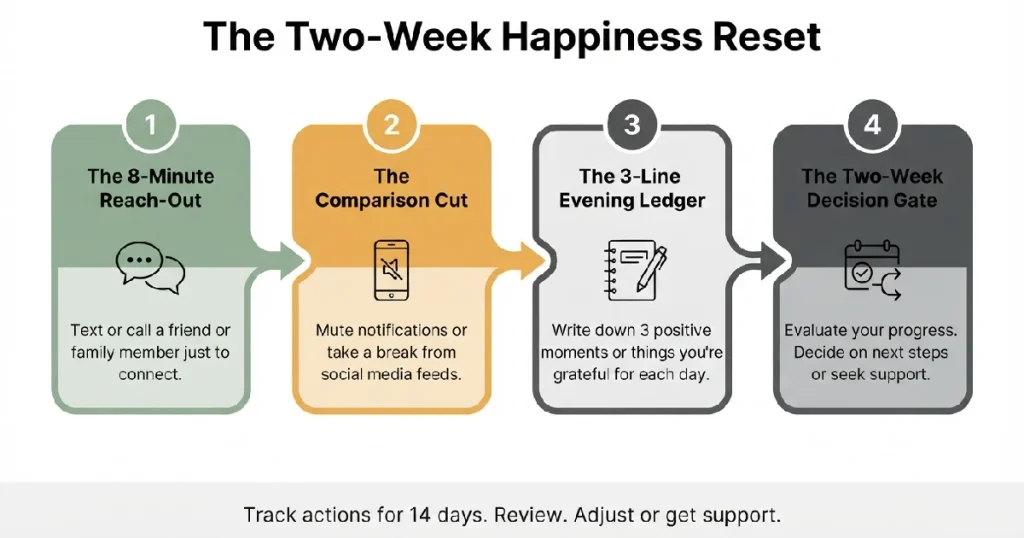
One place to begin: a 14-day test. Consider running all four; each takes under ten minutes a day.
Tip 6: The 8-Minute Reach-Out
Once a day, send one honest invitation to one person. Word-for-word: “Hey, I’ve been in a flat patch and I’m trying to climb out. Free for a 10-minute walk Saturday? No agenda, just company.”
Low-energy version: a 60-second voice memo instead of a call. Notice what shifts when the message admits the flat patch. Honesty gives them a role (helper); vague cheerfulness leaves them guessing.
Metric: one real exchange a day is the minimum dose of social connection. Count conversations. Notifications don’t count.
Tip 7: The Comparison Cut
For seven days, mute (don’t unfollow) the five accounts that leave you feeling behind. Muting is reversible, which prevents a dramatic delete-and-return cycle.
Then swap 20 minutes of passive scrolling for one active message to a real person. After each app session, ask: “Do I feel more like joining my life or auditing it?” Keep the accounts that make you want to try things; mute the ones that make you count what you lack. Research links upward comparison against curated highlights with lower mood; our guide to being happy with what you already have covers the deeper shift.
Tip 8: The 3-Line Evening Ledger
Sixty seconds before sleep, on paper, three lines:
- “Today I actually did: ___”
- “For a moment I felt ___ (a 1 out of 10 counts).”
- “Tomorrow I want one small thing: ___”
Why paper and why nightly: memory is mood-congruent, so a flat evening deletes the day’s bright spots before morning. Barbara Fredrickson’s broaden-and-build research shows that noticing small positive moments widens attention and builds lasting resources over time (Fredrickson, 2001). Specific entries (“the coffee on the porch”) train detection; generic gratitude (“my health”) slides off.
Tip 9: The Two-Week Decision Gate
Before day one, circle a review date 14 days out. Write two numbers: average mood this week (0 to 10), completion target (10 of 14 days).
On the review date, read the data the way a scientist would. Actions done and mood climbing: extend the plan two weeks. Actions done and mood still flat, especially with sleep or appetite changes: book a depression screening, because two weeks of daily flatness is the threshold clinicians take seriously.
Script for the appointment: “For about [X] weeks, most things feel flat, including things I used to love. I’ve walked daily and seen people regularly, and it hasn’t shifted. I’d like to be screened for depression.”
A “get support” result means the experiment worked: it caught something self-help can’t fix, early, with evidence in hand.
Frequently Asked Questions
Why do I feel happy for a moment, then empty again?
Brief sparks with a fast fade are typical while your reward system resets; psychologists call the fade hedonic adaptation. Treat each spark as proof the wiring still works, and log it.
How long does it take to feel happy again?
Behavioral activation research shows mood shifts over weeks of repeated action, not days. Give any routine a fair 14-day trial, and expect uneven days inside an improving trend.
Can you be happy again after a breakup?
Yes. Attachment research frames the worst phase as withdrawal from a bond, and it eases as new routines and steady contacts replace the old ones. Most people improve steadily over months, faster with active social rebuilding.
Back to That Dinner Table
Picture the same birthday dinner a month from now. You named your kind of flat, so burnout stopped masquerading as a personality flaw. You walked before you felt like walking, scored the walks, and watched your forecasts get caught lying. You sent the awkward honest text, and someone said yes.
The laugh may still arrive late some nights. Now you can read the delay correctly: a reward system under repair, with the receipts to prove it. You have a map, a mood log, and a review date.
Joy comes back on the rails you lay, one ordinary day at a time.
My Closing Remarks
I keep a version of that three-line ledger on my own nightstand, and some nights the honest entry is “felt 2 out of 10, did the walk anyway.” Those entries matter more than the good ones. If this season has been long, I hope you treat yourself like someone worth showing up for: slowly, daily, without demanding fireworks. You deserve steady company, starting with your own.
More Related Stories for You
Curious what actually lifts people on plain, unremarkable days? See the small, surprising things that make people genuinely happy, and steal one for tomorrow’s five-minute experiment.
About The Author