Sara Carmen

When does “we’re just close” quietly turn into “I don’t exist without you”?
Key Takeaways
- The loudest sign of a codependent relationship is quiet: resentment that shows up after every “yes” you never meant.
- Caretaking often works as anxiety management, which is why white-knuckled willpower rarely breaks the loop.
- Four small experiments, including a 20-minute rescue pause, rebuild a separate self without demanding a dramatic breakup.
Quick answer: A codependent relationship is a one-sided bond in which your needs, moods, and identity orbit around pleasing or rescuing someone else. Their approval becomes your self-worth, boundaries feel dangerous, and closeness costs you yourself. The pattern is learned, so it can be unlearned.
Contents
Table of Contents
We joke about being clingy. Then you catch yourself rewriting a two-line text six times, all because his voice went flat at breakfast. The joke stops being funny. Somewhere along the way, love became a shift with no clock-out time.
The quiet fear underneath: being needed is the only rent you can pay for staying close. Psychologists trace this to anxious attachment. Your nervous system treats distance as danger, and soothing someone else feels like the fastest way to soothe itself.
That’s the engine of a codependent relationship, and engines can be worked on. Below: seven signs with real thresholds, the moments they’re false alarms, and four experiments small enough to start this week.
Codependent Relationship Definition: Where Closeness Turns to Fusion
Type “codependent define” into a search bar and you get clinical fog. The APA Dictionary of Psychology calls codependency a dysfunctional pattern: one person depends on, or is controlled by, a partner with an addiction or related disorder (American Psychological Association, 2023). The term grew out of late-1970s addiction treatment. Everyday use has widened it to any bond where managing another person replaces having a self.
Family therapists have a sharper word for that merger: enmeshment. Two people share one emotional skin. This kind of emotional dependency is sneaky because it photographs as devotion. The tell is what happens inside you when they’re unhappy.
Run any recent week through this filter:
| Situation | Healthy closeness | Codependent pattern |
|---|---|---|
| They’re upset | You feel for them and stay steady | Their mood decides your whole day |
| You disagree | You say it and stay connected | You rehearse it, then swallow it |
| A free Saturday | You each refill your own cup | You wait for their plans to exist |
| They hit a problem | You support the plan they make | You take over, then feel used |
| Time apart | You miss them and enjoy yourself | Panic, phone-checking, story-spinning |
7 Signs of a Codependent Relationship (With Real Thresholds)

Most lists of signs of codependency read like job descriptions for saints. Real life is messier. A new baby, a layoff, or a partner’s chemo week will scramble any couple’s balance.
These patterns come from composite coaching cases (details changed). A sign counts when it’s your default across months; one hard week doesn’t qualify.
1. You scan their mood before you check your own
You walk in and read the room like weather radar: jaw tension, sigh count, how the door closed. Then you rebuild your evening around the forecast. Walking on eggshells gets so normal you rehearse plain sentences (“Can we grab milk?”) before saying them. False alarm: one brutal week at their job; signal: six months of default radar mode.
2. Their approval sets your worth for the day
A warm “thanks” makes you light. A distracted grunt sends you auditing your whole personality. Self-worth outsourced this way turns every interaction into a grade. If your checking lives mostly in read receipts and story views, our piece on how social media quietly reshapes relationship expectations explains why the feed turns the volume up.
3. Your calendar has no you on it
Try a two-week audit. Out of 168 hours in a week, how many went to something you chose, alone, that refills you? In the composite cases behind this piece, the answer is under two, and the hobbies died so slowly nobody held a funeral. Psychologists call this slow erasure self-abandonment: you canceled yourself one Tuesday at a time.
4. “Sorry” is your reflex, even when you did nothing
Count your apologies for 48 hours, including the ones for weather, traffic, and taking up space. One audit I ran hit 31 in two days, almost none for real wrongdoing. Reflexive people-pleasing trains both people to treat your needs as an inconvenience. The number tells the story.
5. Yes comes out fast, resentment arrives later
You agree before they finish the question, then seethe halfway through the favor. Resentment is the receipt for a boundary you skipped. Track every flare for a week; each one points at a yes you never meant. Care that’s chosen leaves you warm.
6. You help in ways nobody asked for
You rewrite his résumé, call her sister, pre-solve problems three exits away. Over-functioning feels like love and lands as control. It quietly trains a partner into under-functioning: the more you carry, the weaker their carrying muscles get. Indispensable is a lonely kind of loved.
7. You’re dating their potential
The relationship you defend in arguments exists mostly in the future: after the job, after the therapy, after they finally see it. Count your “if only” sentences for a week. Fear of abandonment keeps you funding a version of someone who has never shown up. The actual Tuesday nights go unlived.
Why Willpower Fails: The Anxiety Loop Under the Fixing
Here’s the reframe that changed how I work with codependent behavior. The fixing works as anxiety management with a halo. When their mood dips, your alarm spikes, and rescuing is the fastest lever you know for switching it off. You get relief, they get managed, and the loop tightens.
Cindy Hazan and Phillip Shaver ran a classic study in 1987. Anxiously attached adults described love in terms of obsession, jealousy, and emotional highs and lows (Hazan & Shaver, 1987). That’s an attachment alarm doing its job, aimed at a grown-up target.
Add intermittent reinforcement: the behaviorist finding that unpredictable rewards hook harder than steady ones. A partner’s inconsistent warmth becomes strangely addictive. Attachment theory calls a reliable partner a secure base. When the base flickers, you grip.
Two honest trade-offs before the how-to. Early boundaries usually feel worse before they feel better: guilt spikes, and the other person may protest louder for a few weeks. Some codependent relationships rebalance beautifully once the over-functioning stops. Some reveal they only worked while you disappeared.
One edge case deserves daylight. If a no triggers threats, monitoring, or punishment, you’re dealing with coercive control rather than codependency alone. A confidential call to the National Domestic Violence Hotline (1-800-799-7233) can help you plan safely, at your own pace.
How to Break Free: Four Experiments to Run This Week
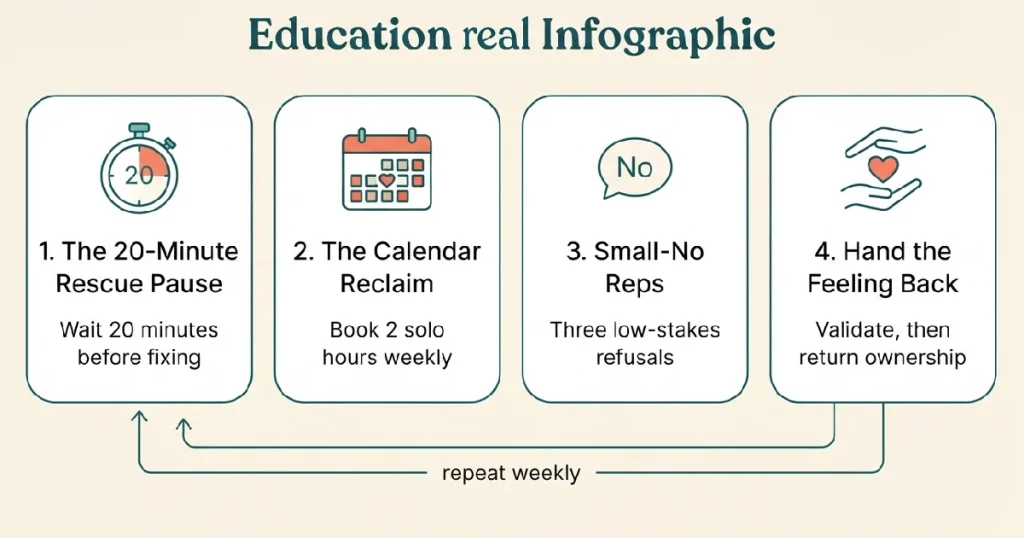
If you’ve searched “how to stop being codependent” at 2 a.m., you’ve met the advice “set boundaries” a hundred times. Useless without actual reps. A codependent relationship shifts through small, tolerated experiments. Codependency recovery works like weight training: small loads, repeated.
Consider these four, each with a script and a way to measure what happens.
Experiment 1: The 20-Minute Rescue Pause
When the urge to fix, soothe, or triple-text hits, set a timer for 20 minutes. Name the feeling out loud: “I’m scared they’ll pull away.” Urges crest and fall like waves; you’re practicing riding them. If you owe an answer, try: “I want to give you a real answer instead of a reflex, so can I get back to you after dinner?”
Pitfall: a pause that punishes. Silence as payback keeps the loop; a pause to settle yourself loosens it.
Experiment 2: The Calendar Reclaim
Book two hours this week for something you chose, alone. Protect it like a dentist appointment. Script: “Thursday at seven is my class, and I’ll be home by nine.” No apology attached, no essay of reasons.
Notice what shifts around minute forty. In my experience the guilt often eases, and something rusty and unfamiliar shows up. That’s autonomy warming back up.
Experiment 3: Small-No Reps
Pick three low-stakes refusals this week: a movie, a restaurant, a small favor. Keep the script boring: “That doesn’t work for me tonight.” Rate your guilt from 0 to 10 before saying it and fifteen minutes after. The drop teaches your nervous system that no is survivable.
Skip the over-explaining. Every extra reason hands over a negotiation lever.
Experiment 4: Hand the Feeling Back
When they vent, validate once, then return ownership: “That sounds rough. What are you thinking of doing about it?” Internally, keep one line handy: I can care without carrying.
At bedtime, count how many of their problems you’re still holding. Aim to hand back one per week. Their discomfort is information for them, and surviving it is how their carrying muscles grow.
Frequently Asked Questions
Can a codependent relationship be saved, or do we have to break up?
Plenty of couples rebalance once one person stops over-functioning, especially when the partner welcomes the new space. Couples therapy speeds it up. If your growth gets punished instead, that reaction is your answer.
Am I codependent or just a really caring person?
Check the aftertaste of your last ten favors. Chosen generosity leaves you full; codependency leaves you drained and quietly resentful. Kindness that requires self-erasure is a different animal.
Is codependency an actual diagnosis?
No. It’s absent from the DSM-5, and clinicians use it as a descriptive pattern. Behavior-based signs serve you better than the label.
Back to that flat voice at breakfast. You can hear it, feel the old alarm start its climb, and let the twenty minutes do their work. His weather stays his weather. The text goes out once, unrehearsed, and the morning belongs to you again.
You hold the seven signals, their false alarms, and four doors that open from your side.
You can love someone deeply and still belong to yourself.
My Closing Remarks
People apologize for taking up space in my office, then apologize for apologizing. (The cases here are composites; the pattern is real.) What still moves me is how fast the room changes after one honest no survives contact with the world. Start smaller than feels impressive: one kept Thursday class teaches your nervous system more than any flawless speech about your needs.
More Related Stories for You
Reclaimed hours can feel oddly blank after years of outsourcing your preferences. Treat that blankness as a fresh menu, and start with the small, research-backed list of what actually makes people happy.
About The Author