
 Nicole Adkins
Your body is going to sound a false alarm the moment you stand up, and every tactic here is built for speaking straight through it.
Key Points
- The most useful public speaking tips for students with anxiety are not about feeling calm. They are about staying upright and talking while your nervous system panics for about 60 seconds.
- Your classmates see a fraction of what you feel. Research on the “illusion of transparency” shows an internal 8 out of 10 usually reads as a 2 or 3 from the seats.
- You can pass a mandatory presentation with a shaking voice, cue cards, and zero real eye contact. Polish is optional. Survival is the assignment.
Contents
Table of Contents
We all know the exact moment a syllabus turns on us. It is the line that says “oral presentation, 20 percent of final grade,” and for most students it is a mild annoyance. For some of us it is a countdown clock that starts ticking inside the chest. If you are reading this, you already know which group you belong to. Your hands know it. Your voice knows it. The week before a presentation you sleep badly, and on the morning of it you quietly calculate whether a zero might be worth it.
Someone might think you are just shy and need to “put yourself out there.” But what they don’t see is your heart hitting 120 beats per minute while you sit at your desk waiting for your name, long before you have said a single word.
Someone might think you didn’t prepare because you kept losing your place. But what they don’t see is that you rehearsed eleven times in your dorm bathroom, and the second thirty faces turned toward you, your working memory emptied like a dropped call.
Someone might think you are fine because you got through it. But what they don’t see is the two hours afterward spent replaying every crack in your voice.
The short answer: The most effective public speaking tips for students with severe anxiety focus on getting through the first 60 seconds, when adrenaline peaks. Use cue words instead of scripts, look just above eye level, ground your body, relabel the racing heart as excitement, and aim for good enough rather than flawless.
This guide skips “just practice more.” What follows are 20 field-tested triage tactics gathered from student communities, counseling centers, and the research on performance anxiety. First, though, you need to understand what your body is actually doing up there. Once you see the mechanism, the tactics stop feeling like tricks and start feeling like tools.
The Physiology of Presentation Panic (And Why Public Speaking Anxiety Happens)
Standing in front of a class triggers your sympathetic nervous system, the branch of your nervous system that prepares the body to fight or run. It floods you with adrenaline (also called epinephrine). Adrenaline speeds the heart, pulls blood away from the gut toward the large muscles, and tightens the small muscles in your hands and throat. That is the racing pulse, the dry mouth, the tremor, and the voice that suddenly belongs to a stranger.
Here is the part that matters. Your brain cannot tell the difference between a predator and a rubric. What Mayo Clinic’s analysis of public speaking fear describes as a form of performance anxiety is a threat response aimed at social evaluation. The “frozen at the podium” feeling is not a failure of nerve. It is the freeze branch of fight, flight, or freeze, and it is neurologically ordinary.
Now the good news, and it comes with data. Psychologists Kenneth Savitsky and Thomas Gilovich (2003) studied the illusion of transparency, the belief that other people can read your inner state as clearly as you feel it. They can’t. Speakers rated their own nervousness far higher than observers did. Even better, students who were simply told about this illusion before speaking felt less anxious and were rated as better speakers afterward. Your internal 8 out of 10 usually lands as a 2 or 3 from the seats.
So the real question is not how to switch the alarm off. It is how to keep talking while it rings.
20 Practical Public Speaking Tips for Students
Presentation Preparation Tips for Anxious Students (The Week Before)
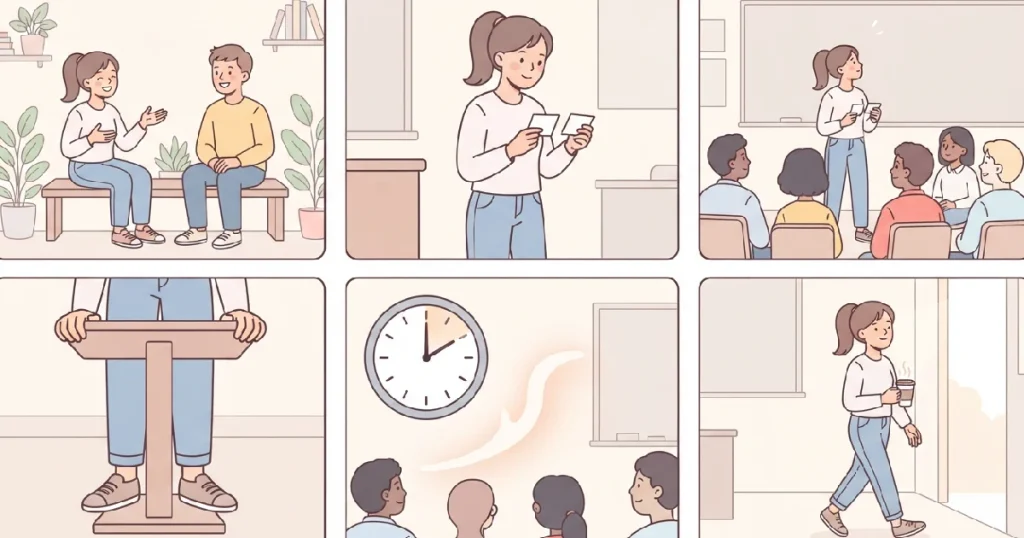
1. Never memorize a script word for word. Verbatim memorization gives anxiety a single point of failure. Lose one sentence and the whole chain collapses, because you rehearsed the order of words rather than the order of ideas. Memorize the macro structure instead: three or four headline points and the bridge between each. If someone coughs and you blank, you only need to find the next idea, not the next word.
2. Build 3×5 cue cards with single words. Write one cue word or a five-word phrase per point in large marker. Not paragraphs. Under stress your eyes skim, and a dense card becomes a wall of text you cannot parse. A card that reads “LOAN DEBT / 1.7 trillion / ask the room” is readable at a glance while your pulse sits at 130.
3. Strip your slide deck down. Text-heavy slides split the room’s attention between reading and listening, and they tempt you into a monotone read-aloud. Cut each slide to one image or one line. The slides become a cue card the whole room can see, which quietly takes weight off your memory.
4. Rehearse in the real classroom. Ask to spend five minutes at the podium during an empty period. Stand where you will stand. Touch the clicker. This is habituation in miniature, the process by which your nervous system stops treating a repeated situation as a threat. A room you have already stood in is less alarming than a room you are meeting for the first time.
5. Record a rehearsal on your laptop. Play it back with the sound off and watch your hands and feet. Then listen with the screen closed. Most anxious students discover they look far calmer than they felt. That is the illusion of transparency caught on video, and it is oddly comforting evidence.
6. Practice fast structured answers online. Spontaneous questions are the part anxious students dread most, so build the muscle where nothing is at stake. Spend ten minutes a few times a week answering questions on Quora or a class discussion board using three sentences: claim, reason, example. You are training your mind to organize under time pressure.
7. Use your professor’s office hours. Go a week early and say the plain truth: “I have severe presentation anxiety and I want to do well in your class.” In my experience most instructors respond with flexibility, whether that means letting you go first to shorten the dreaded wait, presenting to a smaller group, or simply grading content over polish. Silence gets you nothing. Disclosure often gets you a runway.
8. Plant one obvious omission. Leave a clear, easy point off one slide on purpose. When a classmate asks about it, you have a confident answer ready, and the room watches you handle a question smoothly. You have engineered the Q&A instead of bracing for it.
9. Set a self-reward before you walk in. Decide on a specific treat that happens the moment you sit down: the overpriced coffee, the episode you have been saving, a nap with your phone off. Your brain is far more willing to walk toward a threat when it can see the finish line. This is basic reinforcement, and it works on anxious adults exactly as it works on everyone else.
Maya and the Class Presentation She Almost Skipped
Maya was a second-year nursing student who had never failed anything until Comm 101 required a seven-minute talk. She skipped the first scheduled date with a fake migraine and spent the makeup week convinced her voice would give out in front of everyone. Her counselor did not tell her to relax. She told her to plan for the shaking rather than against it. Maya cut her script to nine cue words, rehearsed twice in the empty classroom, and kept a paperclip in her pocket. On the day, her hands trembled through the first minute exactly as she feared. Then her third cue word came into focus and she noticed she was still talking. She earned a B-plus, and the only comment from a classmate was “you seemed so chill.”
Delivery Tips for Speaking Through Presentation Anxiety (The Moment You Stand Up)
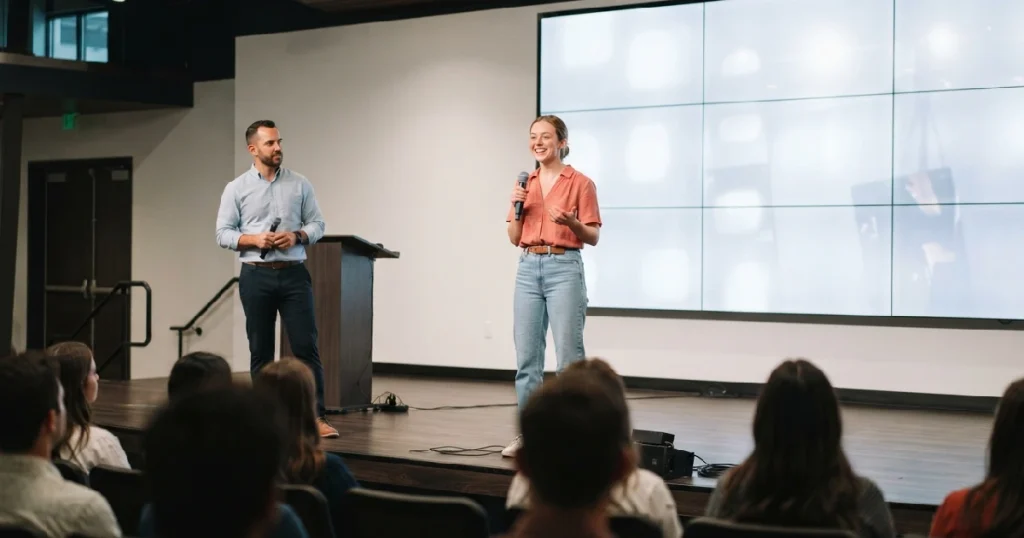
10. Treat it like a conversation, not a performance. Here is a reframe that changes the whole room. Your classmates are not an audience. They are a waiting room. Half of them are rehearsing their own talk in their heads, and the other half are hoping you run long so they don’t have to go today. Nobody in that room grades you the way you grade yourself. Talk to them the way you would explain your topic to a friend who missed class.
11. Rename the jitters as excitement. Harvard researcher Alison Wood Brooks (2014) found that people who said “I am excited” before a speech were rated as more persuasive and confident than people who tried to calm down. Anxiety and excitement share the same biology: fast heart, shallow breath, alert mind. This is anxiety reappraisal, and it works because you stop fighting the arousal and simply relabel it.
Think of your fear response as a smoke alarm that goes off every time you make toast. The alarm is loud, real, and completely wrong about the size of the fire. You do not need to rip it off the ceiling. You need to keep buttering the toast.
12. Look just above eye level. If direct eye contact tips you into panic, aim at the back wall a few inches above the last row of heads. From the seats it reads as steady, confident gaze. You get the credit for eye contact without paying the cost.
13. Carry a tactile anchor. Keep a paperclip or a smooth stone in your pocket and press it with your thumb. This is grounding, a technique that pulls attention out of anxious prediction and into present physical sensation. It routes nervous energy to a hand nobody can see rather than a face everyone can.
14. Give the adrenaline a job through your hands. Adrenaline wants movement. Purposeful gestures vent that pressure and hold attention at the same time. Count your points on your fingers. Shape the size of a number with your palms. Still hands trap the energy, and trapped energy leaks out as tremor.
15. Walk on purpose. Take two or three deliberate steps when you move to a new point, then plant. Movement burns adrenaline and signals ease even when you feel none. Frozen at the podium is the posture of fear, and your body reads your own posture back to your brain.
16. Over-enunciate slightly. Anxiety compresses speech. Exaggerating your mouth movements a touch forces a slower cadence, gives you more oxygen per sentence, and steadies the voice. Nobody will notice the exaggeration. They will notice that you sound clear.
17. Match the room’s energy before you shift it. A flat 8 a.m. class recoils from forced enthusiasm. Start at their level, calm and even, then raise the energy one notch by your second point. You are leading a room, not performing at one.
18. Use What, So What, Now What for questions. When a question lands, answer in three beats: what the fact is, why it matters, and what should happen next. The structure does the thinking while your nervous system catches up. It stops the rambling and makes you sound like you have taught this material before.
19. Aim for good enough before you start. Decide privately that this will be a C-plus delivery of A-level content, and that this is acceptable. Perfectionism keeps the threat system running because any slip registers as failure. Lowering the bar to “pass and survive” drops your baseline arousal before you ever stand up.
20. Breathe, then laugh off the slip. When you mispronounce a word or lose your place, stop, take one breath, and say “let me try that again.” A small smile at your own stumble reads as confidence to a room full of people terrified of stumbling themselves. Recovery earns more respect than perfection ever does.
How to Stop Shaking While Speaking in Class

Shaking is the symptom anxious students fear most because it feels visible. Physically, adrenaline raises muscle tone in the small muscles of the hands, the knees, and the larynx, which is your voice box. A quivering voice is not weakness. It is the throat and chest clenched so tightly that air pushes past them unevenly.
That’s not a personality problem. That’s plumbing.
Three silent moves can change it in real time.
The Podium Clamp. Grip the edges of the podium or the back of a chair firmly with both hands for five seconds. This creates isometric tension, meaning muscle contraction without visible movement, and it gives the tremor somewhere to go. Release slowly, then hold your cue card with two hands rather than one so a small shake has nowhere to show.
The Floor Press. Press both feet flat into the ground as if you are trying to push the floor down. Let your knees soften. The large leg muscles absorb the shake that would otherwise gather in your knees. The Baruch College Student Affairs resource on grounding techniques lists this kind of physical anchoring among its counselor recommendations for exactly this reason.
The Shoulder Drop. Exhale and consciously drop your shoulders an inch. Then slow your first sentence by half. Voice tremor lives in a raised, locked chest. Lower shoulders loosen the throat, and slower speech gives each vowel enough air to come out steady.
One more honest note. If your tremor is severe enough that it has already cost you grades, that deserves a conversation with a physician. Some students are prescribed a beta blocker such as propranolol, a medication that blunts adrenaline’s effect on the heart and hands without dulling your thinking. The University of Colorado Anschutz Medical Campus has a plain-language overview of why people are turning to beta blockers for high-stress moments. This is a medical decision, not a hack, and it belongs with a doctor who knows your history.
Peer-Recommended Workarounds vs. Classical Public Speaking Techniques
Open any speech textbook and you will find the same demands: square posture, sustained eye contact with individuals, hands relaxed at your sides, no notes if possible. That advice was written for people whose nervous systems cooperate. Yours is running a false alarm, and telling you to make warm eye contact with thirty peers is like telling someone with a sprained ankle to sprint with better form.
Student communities have quietly built a second playbook. The back-wall look. Two-handed cue cards. Treating classmates as neutral observers instead of judges. These are compromises, and they are smart ones. Formal texts like the LibreTexts communication studies guide on cognitive restructuring actually agree with the students on the core point: changing how you interpret the situation matters more than perfecting your stance. Cognitive restructuring simply means catching the thought “they can all see me falling apart” and replacing it with the more accurate “they see a slightly nervous person giving a talk.”
The University of Iowa’s counseling service makes the same case in its list of 30 ways to manage speaking anxiety, which reads far more like a survival kit than a style guide. That is the right frame. You are not preparing a keynote. You are getting through a required module with your GPA and your dignity intact. Situational survival skills are the assignment. Mastery can come later, if you ever want it to.
Conclusion: The 60-Second Peak Rule for Presentation Anxiety
Here is the single most useful fact in this guide. Physiological panic peaks in the first minute of speaking and then declines, sometimes sharply. The Stanford Graduate School of Business communication analysis by lecturer Matt Abrahams makes the same point: the anticipation and the opening are the worst of it, and the body settles once it realizes no predator is coming. Your job is not to be calm for seven minutes. It is to execute one rehearsed opening line while the smoke alarm screams about toast.
So rehearse that first sentence until it is automatic. Grip the podium. Press your feet into the floor. Say the line. Sixty seconds later you will notice, as Maya did, that you are still talking and the room has not caught fire.
Then collect your coffee. You earned it.
The alarm was never proof of danger. It was proof that you showed up anyway.
My Closing Remarks
I have sat across from a lot of students who believed their anxiety made them unfit for anything that involves being seen. What I have learned is that the students who shake are usually the ones who care most about doing the topic justice, and that caring is the raw material of a good speaker. You do not need to become someone else before your next presentation. You need a plan for the first minute and permission to be imperfect after it. You already have more courage than the person who finds this easy.
More Related Stories for You
- If the thought of presenting makes you consider taking the zero, this piece on the roots of fear of public speaking explains why the dread starts days before you ever stand up.
About The Author