
 Sara Carmen
These are not soft, polite prayers. They are active spiritual interventions built for couples whose distance has grown quiet, cold, and dangerously comfortable.
KEY POINTS
- The most effective prayers for a troubled marriage don’t just ask God to fix your spouse. They interrupt your own reactivity in the exact moment it matters.
- Research suggests that praying for your partner (not just about your problems) measurably increases forgiveness and lowers the urge to retaliate.
- Five core prayers plus two emergency breakthrough petitions, each paired with one small, doable action you can take in the next 24 hours.
Contents
Table of Contents
We rarely admit the moment we knew. It isn’t the screaming fight or the slammed door. It’s something quieter: the night you both went to bed and neither of you asked what was wrong, because you already knew, and you were both too tired to say it out loud.
You’ve prayed. Probably a lot. You’ve whispered in the car, cried in the shower, begged God at 3 a.m. while your spouse slept three feet away and felt like a stranger.
And nothing changed.
So now you’re wondering whether prayer works at all, or whether you’ve just been talking to the ceiling. That question deserves an honest answer,
Why Most Prayers For A Troubled Marriage Stop Working
Here’s the uncomfortable part. Most of us pray about our marriage rather than praying within it. We petition God at a distance, hoping He’ll rewire our spouse overnight while we stay exactly the same.
The research points somewhere more interesting.
A well-known 2010 study by Nathaniel Lambert, Frank Fincham, and colleagues, published in Psychological Science, found that people who prayed specifically for their partner’s wellbeing over four weeks showed significantly higher forgiveness and lower desire for revenge than those who simply prayed generally or thought positively about the relationship. The prayer wasn’t magic. It shifted the person praying from a self-protective stance into a relational one.
Fincham’s earlier work found something similar: prayer for a partner predicted relationship satisfaction even after accounting for general religiousness. In other words, the type of prayer mattered more than how religious someone was.
That’s the mechanism. Prayer, done a certain way, functions as an attention intervention. It pulls your focus off the ledger of grievances and onto the human being you married.
And attention is exactly what modern marriages are starving for.
Pew Research Center found that roughly half of partnered adults say their partner is at least sometimes distracted by their phone while they’re trying to have a conversation. Researchers call this “phubbing,” or phone snubbing. It’s a small wound that repeats a hundred times a week until it stops feeling like a wound at all.
That’s what makes this stage so dangerous. Left unnamed, this pattern doesn’t just strain a marriage. It becomes the quiet reason it ends.
The 5 Core Prayers For A Troubled Marriage (Plus 2 Emergency Petitions)
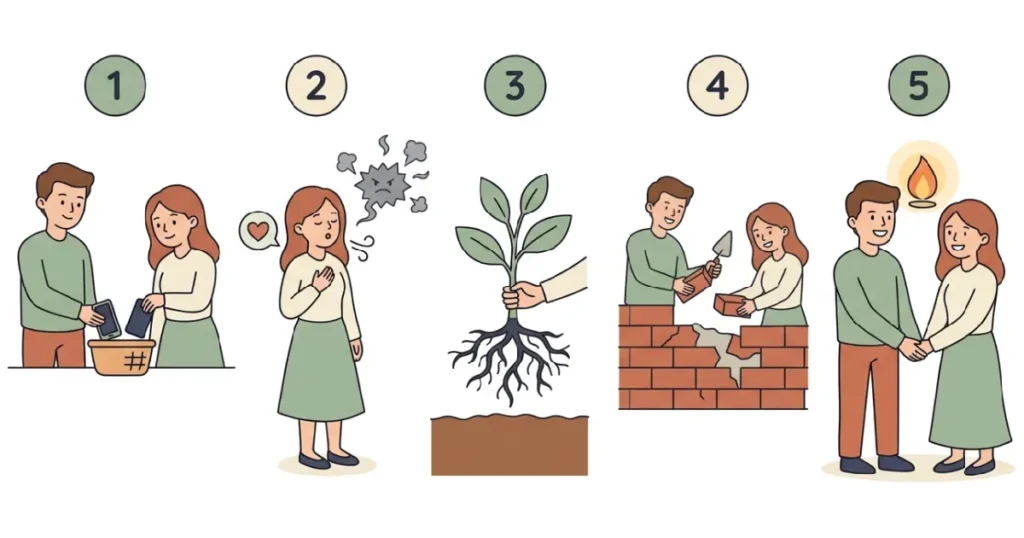
I’m giving you five core prayers and two emergency breakthrough petitions for the nights when everything is on fire. Each one comes with a scriptural anchor, a short prayer you can actually remember, and one action, because faith without action tends to stay theoretical.
1. The Prayer For Digital Detox and Reconnection
Scriptural anchor: “Be very careful, then, how you live, making the most of every opportunity.” (Ephesians 5:15-16)
The focus: Breaking the invisible glass wall of screens and emotional absence.
You are not competing with another person. You are competing with an algorithm engineered by thousands of people to be more interesting than your face. That’s not a fair fight, and pretending otherwise keeps you feeling crazy.
The prayer: God, I’ve let a screen become the third person in my marriage. Convict me before I convict my spouse. Make me hungry for their actual face again. Give us back the ordinary hours we’ve been giving away.
The action: One phone-free 20-minute window tonight. Not a conversation about your marriage. Just presence.
2. The Prayer For De-escalation and Nervous System Peace
Scriptural anchor: “A gentle answer turns away wrath, but a harsh word stirs up anger.” (Proverbs 15:1)
The focus: Interrupting fight-or-flight before it hijacks your mouth.
John Gottman’s research documented a state he called flooding, sometimes described as diffuse physiological arousal. In plain terms: when your heart rate climbs past about 100 beats per minute during conflict, your body enters threat mode. Your access to empathy, humor, and problem-solving drops sharply. Gottman found couples need at least 20 minutes to physiologically recover before productive conversation is even possible.
You are not a bad Christian for saying cruel things while flooded. You’re a mammal with an alarm system.
The prayer (pray it while breathing out): Holy Spirit, be the half-second between what I feel and what I say.
The action: When your chest tightens, name it out loud: “I’m flooded. Give me twenty minutes.” Then actually come back. The American Psychological Association notes that slow, deliberate breathing directly lowers the body’s stress response, so use those minutes to breathe, not to rehearse your rebuttal.
3. The Prayer To Expose and Uproot Silent Resentment
Scriptural anchor: “See to it that no one falls short of the grace of God and that no bitter root grows up to cause trouble.” (Hebrews 12:15)
The focus: The quiet withdrawal phase, which is far more predictive of divorce than loud fighting.
Here’s the image I want you to keep.
Silent resentment operates like carbon monoxide in a house. It’s odorless. It doesn’t set off any alarms. Everything looks fine, the dishes get done, the kids get to school, and nobody realizes anything is wrong until one person simply can’t get up anymore.
Loud marriages get help. Quiet ones get sympathy cards.
The prayer: Lord, show me what I’ve buried. Give me the courage to say the hard thing kindly instead of storing it. I’d rather have one honest argument than ten polite years.
The action: Write down the three grievances you’ve never said out loud. Choose one. Say it this week using nine words or fewer, starting with “I feel,” not “You always.”
The Insight Most Prayer Guides Miss
Stop praying for your marriage. Start praying for the next ninety seconds.
That sounds almost irreverent, so let me explain what I mean. In my practice, the couples who recover are almost never the ones who prayed the longest prayers. They’re the ones who learned to pray at the exact right moment, usually for about twenty seconds, usually with their eyes open.
A stress surge in the body moves fast. The physiological wave of anger crests and begins to fall within a couple of minutes if you don’t keep feeding it with rehearsed thoughts. Most marital damage happens inside that narrow window, in the sentence you fire off before your prefrontal cortex, the thinking part of your brain, comes back online.
So the prayer that saves a marriage usually isn’t the tearful one at midnight. It’s the seven-word one you pray while your spouse is mid-sentence and you can feel your jaw locking.
Prayer, in that moment, isn’t persuasion. It’s timing.
Renee’s story. Renee, 43, came in convinced she’d been praying for her marriage for six years with nothing to show for it. Her husband had gone quiet years earlier, and her prayers had become long, detailed complaints delivered to God about him. We changed one thing. She started praying a five-word prayer, silently, while looking at his face during conflict: God, let me see him. Nothing else changed for three weeks. Then one night he said, “You’ve been different. Softer.” That was the first real conversation they’d had since their daughter was born. Six months later they weren’t healed, but they were talking. The prayer didn’t fix him. It stopped her from confirming his worst fear about her.
4. The Prayer For Intergenerational Healing
Scriptural anchor: “You will be called Repairer of Broken Walls.” (Isaiah 58:12)
The focus: Naming inherited patterns you never chose but keep repeating.
The way you handle money, silence, anger, and apology was largely installed before you turned twelve. The CDC’s research on adverse childhood experiences shows how early family stress shapes adult relationship functioning decades later. You may be fighting your father’s fight in your husband’s kitchen.
The prayer: God, help me tell the difference between my spouse and my history. Let this pattern die in my generation. Make me the repairer, not the repeater.
The action: Ask yourself one question: “Whose voice comes out of me when I’m angry?” Sit with the answer before you share it.
5. The Prayer For the Resurrection of Dead Intimacy
Scriptural anchor: “Many waters cannot quench love; rivers cannot sweep it away.” (Song of Solomon 8:7)
The focus: Warmth, desire, and affection when the room has gone cold.
Desire rarely dies from lack of attraction. It dies from lack of safety. Bodies do not open toward people who feel unpredictable.
The prayer: Lord, I can’t manufacture warmth. Give me back the ability to want and to be wanted. Make our home safe enough for desire to return.
The action: Six seconds of non-sexual physical contact daily. A hand on the back. A real hug, not the pat-pat kind. Touch rebuilds trust faster than talking does.
The 2 Emergency Breakthrough Petitions For A Marriage On the Brink

Emergency Petition One: The Willingness Prayer. For the days you don’t want to stay. God, I don’t have love right now. I’m bringing you my willingness instead. Work with that. Honesty is more useful to God than performance.
Emergency Petition Two: The Clarity and Safety Prayer. This one matters, and I won’t soften it. If your marriage involves physical violence, coercive control, or ongoing unrepentant betrayal, prayer is not a substitute for protection. God, give me clarity that isn’t clouded by fear or false guilt. Show me what love requires and what safety requires. Sometimes the most faithful prayer leads to a boundary, not a reconciliation.
How To Actually Use These Prayers: The Micro-Prayer Protocol
If you’re on the brink, you’re likely dealing with spiritual burnout too. You don’t have an hour. You barely have a sentence. That’s fine. Short prayers work.
Anchor them to three moments.
The Threshold Prayer. Before you walk into your house, sit in the car for thirty seconds. Pray: Let me bring peace through this door. You’re deciding who walks in before you walk in.
The Trigger Prayer. The moment your body signals conflict, tight jaw, hot chest, fast breath, pray one line with your eyes open: God, let me see them. Five words. Mid-argument. This is the highest-leverage prayer in the entire article.
The Touch Prayer. When your hand is on your spouse’s shoulder or back, pray silently: Bless them today. You cannot easily hold contempt for someone you are actively blessing.
One invitation to consider this week: instead of asking God to change your spouse’s heart, ask what He might be trying to change in the way you enter a room.
You Are Not Praying Into an Empty Room
Go back to that night. Both of you awake, backs turned, neither one asking.
You now know something you didn’t know an hour ago. That silence was not proof that your prayers failed. It was carbon monoxide, and you just installed the detector.
The goal was never a marriage without conflict. It’s a marriage where nobody quietly falls asleep in the poison.
Pray short. Pray at the right second. Pray like someone who intends to stay awake.
My Closing Remarks
I’ll be honest with you, because you’ve earned honesty by reading this far. I’ve sat with people who prayed beautifully and still got divorced, and I’ve sat with people who prayed clumsily, angrily, barely, and watched their marriage come back to life. The difference was almost never the eloquence. It was whether the prayer changed what they did in the next five minutes. If tonight all you can manage is God, help, that counts. It has always counted. Say it and then go touch their shoulder.
More Related Stories for You
- Looking for practical habits that hold a marriage together long term? Read our guide to successful marriage tips.
About The Author