
 Sara Carmen
The word you say to him fifty times a day may be the most overlooked measure of how closely you are still watching him.
KEY POINTS
- Most generic nicknames for boyfriend survive not because they are meaningful, but because they cost your tired brain almost nothing to say.
- Soft, baby-toned pet names quietly shift your dynamic from romantic to caretaking, and the sound itself is part of the problem.
- A nickname built around his specific competence, quirk, or private memory works like a receipt that proves you are still paying attention.
Contents
Table of Contents
We all reach a point in a relationship where the words start running themselves. You say “babe” while handing him the car keys. You say “babe” when you are annoyed. You say “babe” in a text, in bed, at his mother’s house, and while asking him to take the trash out. One syllable, endlessly recycled, doing the work of a hundred different emotions.
And somewhere in the back of your mind, a small thought pokes you: this used to feel like something.
Someone watching you two might think you sound sweet and easy with each other. What they do not see is that you have not chosen a new word for him in two years.
Someone might think the nickname is proof of comfort. What they do not see is the moment you tried something new, felt it land awkwardly in the air, and quietly retreated back to “babe” because it was safer.
Someone might assume the spark faded on its own. What they do not see is that the language faded first.
The Psychology of the “Babe” Loop: Why Your Brain Defaults to Boring Nicknames for Boyfriend
Here is the part almost nobody says out loud. Your boring pet name is not a character flaw. It is a habit loop, and habit loops are what your brain builds when it wants to stop spending energy.
Research on habit formation by Wendy Wood and colleagues found that a large share of daily behavior gets repeated in the same context, day after day, with very little conscious decision-making behind it. Language works the same way. A word you say hundreds of times becomes what psychologists call an overlearned response, meaning it has been repeated so often it fires automatically before you have time to pick something better. You can read more about how this kind of automatic behavior takes root in Psychology Today’s overview of habit formation.
Then add the state most couples live in now. You are managing notifications, group chats, work pings, and a low hum of mental noise that never fully switches off. Cognitive load that high pushes your brain toward the cheapest available option in every small decision, including what you call the man sleeping next to you.
That’s not laziness. That’s your brain conserving fuel.
The trouble is what the generic word does to attention. When you use his real name or a highly specific nickname, your brain treats it as a distinct emotional file with details attached. “Babe” is a placeholder. It points at a category, not a person. Over months, that placeholder starts doing something subtle: it lets you speak to him without actually looking at him.
Left unexamined, this pattern does not just make your dialogue dull. It becomes one of the quiet ways two people stop noticing each other while still living in the same house.
The Intimacy Killers: How Generic Nicknames for Boyfriend Desexualize Your Vibe
There is a well-documented reason couples drift toward soft, rounded, childlike sounds. In a study published in the Journal of Social and Personal Relationships, Bombar and Littig described how baby talk between adult partners functions as an attachment signal, a way to activate safety and closeness the same way early caregiving language does.
It works. It genuinely lowers stress. It says you are safe with me.
But safety and desire do not run on the same circuit. When your primary verbal signal to him is a soothing, diminutive sound, you are repeatedly triggering the caretaking frame rather than the romantic one. “Sweetie,” “baby,” “bubba,” and “honey bun” all share the same acoustic DNA: small, soft, protected.
Notice what you never hear in the early, electric stage of a relationship. Nobody calls a man they are desperate to impress “bubba” in month one.
Consider the sound itself. The bouba/kiki effect, one of the most replicated findings in the study of sound symbolism, shows that people reliably match rounded, soft sounds to soft shapes and sharp, hard consonants to angular shapes. Our brains read sound as texture. English adds another layer with the diminutive suffix, that “ee” ending we tack onto words to make them smaller and gentler. Sweet becomes sweetie. Baby stays baby.
So when you tell me nothing feels charged anymore, my first question in session is rarely about sex. It is about vocabulary.
The Hyper-Symmetric Trap: When Matching Nicknames Erase Him
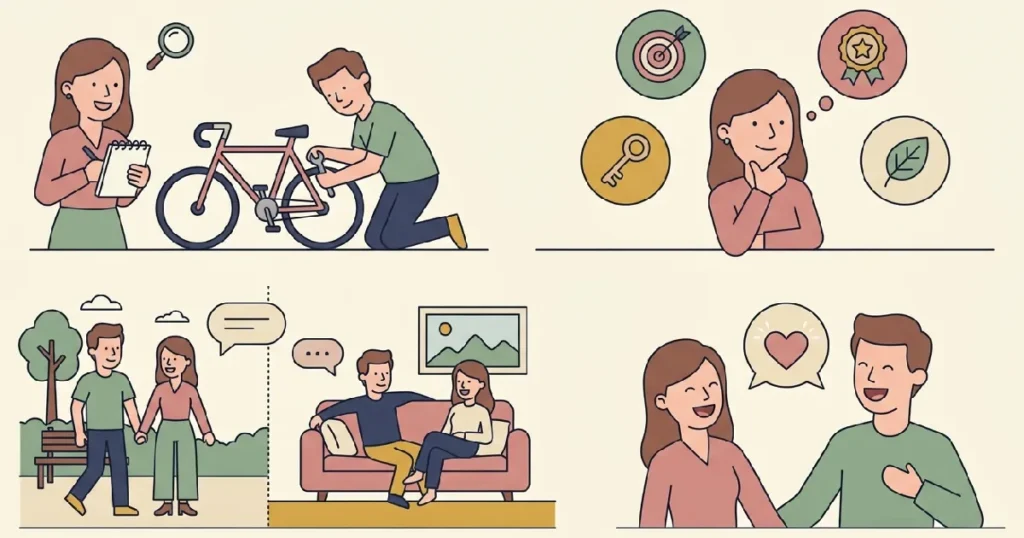
There is a second pattern I see constantly, and couples are usually proud of it. Both partners use the exact same word for each other. He says “bub,” she says “bub.” He says “love,” she says “love.” It feels egalitarian and cozy.
It also flattens him.
A mirrored name carries no information. It tells him you are in a relationship. It tells him nothing about what he specifically brings into it. Symmetric naming turns your daily dialogue into an echo, where the word bounces back unchanged and neither person is described by it.
Asymmetric naming does the opposite. When the name you give him could not possibly apply to you, it functions as recognition. It says: this word exists because you exist. You do not need his permission or a matching term in return. You need a word that is uniquely load-bearing for him.
Most people in long relationships have never once considered this, so if your matching nickname suddenly feels a little thin, that is not a sign of a broken relationship. It is a sign you just learned something.
A Nickname Is a Receipt for Attention
Here is the reframe that changes everything, and it is the part most articles on pet names miss entirely.
A nickname is not a decoration. It is evidence.
Every specific name you give him is proof that you observed something. It proves you noticed how he squints when he is doing math in his head, or the way he handles a crisis without raising his voice, or the ridiculous thing he said at his cousin’s wedding in 2019. A tailored name is a receipt. It documents attention.
A generic name proves nothing. Anyone could have said it. Your ex said it. His ex said it. Strangers in a coffee shop say it.
Think of it like your phone’s default ringtone. It functions perfectly. It makes noise at the right time. But nobody’s heart has ever jumped at the sound of a default ringtone, because it was assigned, not chosen.
This is also why the fix is not about finding a cuter word. It is about restarting the observation. The name is downstream of the noticing.
Baumeister and Bratslavsky argued in their work on passionate love that passion is driven not by the level of intimacy but by the change in intimacy, the movement upward. A new, accurate, slightly daring name is a small upward move. It is a micro-dose of novelty inside a routine that had stopped producing any.
Beyond “Honey”: Decoding His Vibe Archetype for Nicknames for Boyfriend That Fit

Men, in my clinical experience, respond far more strongly to identity-affirming language than to generic affection. Being called sweet is pleasant. Being called seen is something else.
So instead of scrolling a list of five hundred pet names, start with his archetype. What is the energy he actually carries?
The Stoic Protector. He is the calm one in an emergency. He fixes the tire, calls the insurance company, and does not narrate his stress. Names that fit his frame lean solid and grounded rather than sugary.
The Chaotic Intellectual. He has nine tabs open in his brain at all times, a theory about everything, and a wildly specific hobby. Names built on his obsessions, his jokes, or his signature phrase will hit harder than any endearment.
The Effortless Fixer. He builds, repairs, troubleshoots, and makes problems disappear without announcing it. A name tied to his competence lands like admiration, because it is.
The Golden Retriever. Warm, social, physically expressive, the person everyone likes within four minutes. His names can be playful and loud, because he already is.
The Slow Burn. Quiet, observant, dry humor, says one sentence that reframes the whole conversation. His name should feel private and understated, almost like a secret.
Naomi came to me convinced she and Theo had simply “gone flat” after four years. They were kind to each other. Nothing was wrong. She called him “bub” roughly forty times a day. When I asked her to describe him without using a single soft adjective, she went quiet, then said he was the only person who had ever made her feel physically safe in a crisis, and that he had once carried her entire flooded apartment’s furniture up a flight of stairs alone. She started calling him a name built from that night. It was two syllables and meant nothing to anyone else. She told me later that the first time she used it, he looked up from his laptop like she had walked into the room for the first time in a year.
The Public vs. Private Rule: Designing Inside-Joke Nicknames With Hidden Meanings
A lot of women sanitize their pet names for one reason: fear of the public moment. Saying something intimate in front of coworkers, his friends, or your mother feels exposing, so you settle on a bland word that is socially invisible and then you use that bland word everywhere, including in bed.
That is the real cost. You optimized your private language for strangers.
Research by Carol Bruess and Judy Pearson, published in the Journal of Social and Personal Relationships, found that couples who used more personal idioms, meaning private words, phrases, and inside references, reported higher marital satisfaction, particularly in the earlier years of the relationship. Private language marks a boundary. It draws a small circle with two people inside it.
The solution is what I call the Chameleon Nickname: a name that is completely unremarkable to outsiders and loaded with meaning to you two.
To anyone in the room, it sounds like a random word. To him, it references the night in Lisbon, the terrible waiter, the thing he said at 3 a.m. that made you snort water out of your nose. It passes through public space undetected and detonates only for him.
That is how you get intimacy that travels.
15 Bold Nicknames for Boyfriend That Actually Fit His Vibe

You do not need a generic placeholder. You need a word that matches his specific energy and brings a little spark back into your daily conversations.
Here are 15 options broken down by the archetype they fit best.
- Captain: Perfect for the stoic, steady man who naturally takes the lead when things get chaotic.
- Anchor: For the partner who keeps you grounded and calm when your own mind is racing.
- Ace: A sharp, punchy sound that highlights his competence and quick thinking.
- Compass: A great chameleon name that sounds like a cool surname in public but means he always points you in the right direction.
- Maverick: For the independent, slightly rebellious guy who does things his own way.
- Flint: Uses hard consonants to create an audio upgrade, perfect for a man who sparks your interest and keeps things exciting.
- Rook: A strategic, chess-inspired name for the intellectual who is always three steps ahead.
- North: Another excellent public-private name that sounds normal to outsiders but secretly means he is your true direction.
- Chief: A playful but respectful nod to the guy who loves to fix things and take charge of a project.
- Atlas: For the man who carries a lot of weight and holds your world together without complaining.
- Rogue: Ideal for the charming, rule-bending partner who keeps you on your toes.
- Knox: The hard “x” sound provides a great auditory shift from soft, passive vowel names.
- Scout: For the observant, curious guy who always notices the little details everyone else misses.
- Haze: A relaxed, easygoing name for the partner who helps you unwind and slow down.
- Shift: For the man who constantly moves, adapts, and completely shifted your perspective on love.
Pick the one that makes you think of him the most. Say it out loud. If it feels right, use it tonight.
The Audio Upgrade: Swapping Soft Vowels for Nicknames That Spark Attraction
Now run the Auditory Audit. This takes about ninety seconds.
Say your current nickname for him out loud, alone, three times. Then answer honestly: does it sound like something you would say to a partner, a toddler, or a golden retriever?
Listen for three things. Does it end in the “ee” diminutive sound? Is it built entirely from soft, rounded consonants like m, w, and b? Would it sound at home in a nursery?
If you got three yeses, you have a caretaking name, not a romantic one.
The upgrade is not about being harsh. It is about adding definition. Sharper consonants like k, t, d, and g carry more edge. Shorter, harder names tend to read as confident. Using his actual surname, or a clipped version of his real name that only you use, often lands with startling force precisely because it is specific and adult.
Try both versions in your head and notice which one changes your posture slightly. Your body knows before your brain does.
How to Actually Change the Nicknames for Boyfriend You Use
Changing a name is a small act with a strange amount of resistance attached, so make it easy on yourself. Four moves, and you can start today.
One: run the Observation Sweep. For twenty-four hours, watch him like you did in month two. Write down three specific things: something he did competently, something he said that no one else would say, and one physical detail you have never mentioned out loud. Your next nickname is hiding in that list.
Two: build it with the S.E.E.N. test. A strong name is Specific to him, Earned through something real, Exclusive to the two of you, and Natural to say out loud. If it fails any of the four, it will not survive the week.
Three: use the Two-Tier system. Keep one warm public name for the grocery store and family dinners. Build one private name that only exists behind a closed door. Different rooms, different registers. The mistake is letting the public one colonize everything.
Four: introduce it at high emotion, not low. Do not debut a new nickname while unloading the dishwasher. Use it in a moment that already has charge, gratitude, laughter, or desire. Emotional intensity is what makes a word stick.
A useful question to sit with: if he never heard the word “babe” again, what would I call him?
Whatever comes to mind first is probably worth saying out loud.
The Word Is Small. The Signal Is Not.
Go back to that moment with the car keys. Same kitchen, same hurry, same hand reaching out. Only this time the word you use is one that could only ever belong to him, and he hears it, and something small flickers behind his eyes.
Nothing about your relationship has to be rebuilt. You are not starting over. You are just retiring a default ringtone that has been playing for years and choosing a sound you actually picked on purpose.
A name is the cheapest, fastest way to tell someone you are still looking at them.
So look. Then say it.
My Closing Remarks
I will be blunt about something I rarely admit in print. I once went eighteen months calling my partner a name I had used for a previous relationship, and I did not notice until he pointed it out with a laugh that did not quite reach his eyes. That landed hard. It taught me that recycled language is a quiet form of absence. You can be loyal, present, and fully committed, and still be speaking to a category instead of a person. Change the word. It is the smallest brave thing you will do this week.
More Related Stories for You
- If the pattern in your relationship goes deeper than language, learn to recognize narcissistic personality traits before you explain them away.
About The Author



Boring nicknames can be surprisingly comforting, huh? I wonder if it’s a way to keep things casual even after all this time.