
 Sara Carmen
The words come out. The silence that follows tells you everything.
Key Points
- Your apology fails not because you lack sincerity, but because it is designed to relieve your guilt instead of rebuilding their emotional safety.
- How to apologize to someone you hurt deeply requires shifting from a verbal event to sustained behavioral repair that restores their nervous system’s sense of predictability.
- A research-backed blueprint can help you move past empty words and into the kind of accountability that earns back trust over time.
Contents
Table of Contents
You have rehearsed it. Maybe in the shower. Maybe at 2 a.m. staring at the ceiling while they sleep with their back to you. You have chosen the right words. You have timed the moment carefully. And still, when you finally say “I’m sorry,” their face does not soften. Their eyes stay guarded. The air between you stays thick.
You walk away wondering what you did wrong this time. You said the words. You meant them. Why is it never enough?
Here is what no one tells you. The reason your apologies keep failing is not that you are saying them badly. It is that you are saying them for the wrong reason. You are apologizing to make the discomfort stop. To get the relief. To hear “it’s okay” so you can finally breathe again.
And the person sitting across from you? They can feel that. Not because they are cruel. Because their nervous system is wired to detect it.
Why “I’m Sorry” Isn’t Working: The Psychology of a Broken Apology
Most people treat an apology like a transaction. You say the words. You expect forgiveness in return. It is the same instinct that drives you to check your phone after sending a vulnerable text. You are not really focused on the other person. You are waiting for the payout.
Research published through Harvard Health Publishing makes this clear. An effective apology requires you to let go of your own need to be absolved and instead focus entirely on understanding the other person’s experience. That shift is not intuitive. It goes against every anxious impulse in your body.
Take Maya. She discovered that her husband had been hiding financial debt for over a year. When he finally sat her down and apologized, he spent twenty minutes explaining the economic pressure he was under, how he planned to fix it, and how worried he had been. Maya sat there in silence. She was not moved. She was exhausted.
Someone might think he was being thorough. But what Maya heard was: This is really about him. His explanation felt like a wall between them, not a bridge.
What he did not realize is that when deep hurt occurs, the injured person’s brain processes the event as a threat to their survival. This is called betrayal trauma, a state in which the amygdala, the brain’s threat-detection center, becomes hyperactive. Every word you say is being scanned not for sincerity, but for safety. Does this person understand what they did? Or are they still protecting themselves?
According to a study on apologies and trust repair published in Frontiers in Psychology, for individuals who experience strong negative emotions after a trust violation, a simple verbal apology cannot repair trust perceptions on its own. The brain needs more than words. It needs evidence.
This is the real reason your apologies fall flat. You are offering language to someone whose brain is asking for proof.
The 3 Linguistic Mistakes That Destroy Trust During Repair
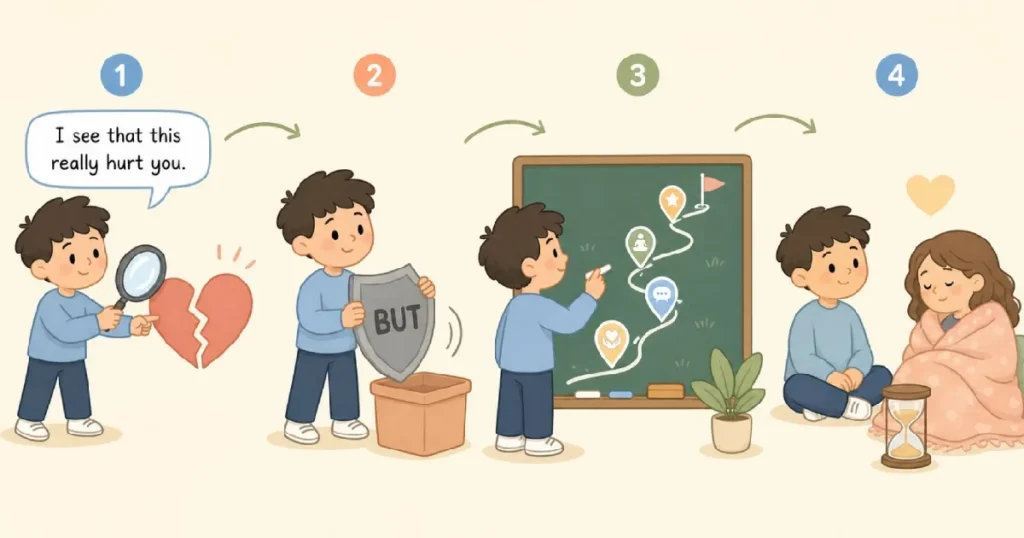
Most people sabotage their apologies without even knowing it. The damage happens at the level of grammar and word choice, tiny linguistic patterns that signal defensiveness even when your intentions are pure.
Mistake 1: The “But” Eraser
You say: “I’m sorry I hurt you, but I was under so much stress.”
The moment you add “but,” everything before it gets deleted in the listener’s brain. Linguistic research confirms that the word “but” functions as a defensive shield. It transforms your apology from an act of accountability into a justification. What the person hears is not regret. They hear an excuse wearing an apology’s clothing.
You can see this pattern clearly in a detailed analysis of apology language, which shows that adding qualifiers after “I’m sorry” actively shifts blame back to the hurt person.
The fix: Remove “but” entirely. Replace it with “and” if you need to add context. Or better yet, remove the context altogether.
Mistake 2: The “If” Dodge
You say: “I’m sorry if I made you feel bad.”
That little word “if” does something devastating. It makes the harm conditional. It suggests the injury might have happened in their imagination, not in reality. The psychologist Gary Chapman warns that phrases like “I’m sorry if you misinterpreted what I said” put the entire burden on the hurt person. You are essentially asking them to question their own experience.
Sarah told me once in a session that when her partner said “I’m sorry if you felt abandoned,” she felt more alone than before the apology. The “if” made her feel like her pain was a rumor.
The fix: Name what you did. Not what they felt. Say: “I’m sorry I didn’t come home when I said I would.” Facts. No conditions.
Mistake 3: The Intentionality Shield
You say: “It was never my intention to hurt you.”
This one feels like kindness. You are telling them you did not mean harm. But according to a piece from Psychology Today on relationship repair after betrayal, poor apologies often shift focus to the wrongdoer’s intentions rather than the victim’s experience. Your intent is irrelevant to the wound.
Think of it this way. If someone accidentally steps on your foot and breaks your toe, their good intentions do not un-break the bone. The injury exists regardless of what they meant.
The fix: Replace “it wasn’t my intent” with “I understand the impact my actions had on you.” Center their experience. Not your character.
How to Apologize to Someone You Hurt Deeply: A Step-by-Step Blueprint

Now that you understand why your old approach has failed, here is a different path. This is not about finding the perfect sentence. It is about building a process that earns back what your words alone cannot.
Step 1: Name the Specific Harm
Do not say “I’m sorry for what I did.” That is too vague. The hurt person needs to hear you name the exact behavior. Say: “I’m sorry I lied about where I was on Friday night.” Specificity tells their brain that you actually understand what happened.
A useful model comes from research on apology components , which identifies admitting fault and naming the specific error as the foundation of any apology that rebuilds trust.
Example: Instead of “I’m sorry for being a bad partner,” try: “I’m sorry I dismissed your feelings in front of your friends last weekend. I can see how that made you feel small and unsupported.”
Step 2: Drop All Context
This is the hardest step. You will want to explain. You will want them to understand the stress you were under, the reasons behind your behavior, the full picture. Do not do this. Not yet. Context feels like accountability, but it is actually self-protection disguised as transparency.
The person you hurt does not need your reasons right now. They need to know that you can hold the weight of what you did without immediately reaching for a shield.
Example: Resist the urge to say “I’ve been working 60-hour weeks and I was exhausted.” Instead say: “I was short with you and that was wrong. You deserved better from me.”
Step 3: Make a Behavioral Forecast
This is the step almost everyone skips. A behavioral forecast is when you map out, in concrete terms, what you will do differently going forward. Not a vague promise like “I’ll do better.” A specific plan with triggers and guardrails.
Example: “I know I shut down during arguments. Here is what I am going to do differently. When I feel myself pulling away, I will say ‘I need ten minutes but I am coming back to this conversation.’ I will not leave the house. I will not go silent for hours.”
This works because it gives the hurt person something they can actually observe. They no longer have to guess whether you have changed. They have a roadmap to hold you accountable against.
Step 4: Give Up Your Timeline
This might be the most important step. You want resolution now. You want them to say “it’s okay” so the tension dissolves. But demanding a quick response restarts their trauma loop.
A 2026 study in the Journal of Service Theory and Practice found that for high-severity trust violations, only sustained, structured repair efforts work. Quick-fix apologies actually accelerate the erosion of trust. This applies directly to intimate relationships.
Example: Instead of asking “Are we okay now?” try saying: “I understand if you need time. I am not going anywhere. Take what you need.”
Rebuilding Safety: What to Do When Your Words Aren’t Enough

Here is the truth that separates people who repair from people who merely apologize. The apology is not the finish line. It is the starting line.
Think of trust like a bank account. Every broken promise is a massive withdrawal. Your apology is the first small deposit after years of deficit. One deposit does not bring the balance back. What brings it back is a long, consistent pattern of reliable behavior.
Consider David and Lena. David had an emotional affair with a coworker. When it was discovered, he apologized. Lena accepted the apology. But three months later, she was still checking his phone. Still asking who he was texting. Still waking up at 3 a.m. with her heart pounding.
David started to get frustrated. “I already said I was sorry. What more do you want?”
What he did not understand is that Lena’s nervous system was still in survival mode. Her brain had learned that David was capable of betrayal, and no single apology could overwrite that data point. Her hypervigilance was not punishment. It was biology.
The concept of emotional predictability is what matters here. Trust is not a feeling. It is a calculation. Your partner’s brain is constantly running a silent equation: Can I predict this person’s behavior? Are they who they say they are?
Every time you follow through on a small promise, you add a data point to their calculation. Every time you are transparent without being asked, you shift the equation in your favor. But it takes months. Not days.
Example: David started telling Lena proactively who he was meeting for lunch. He shared his calendar. He came home at the time he said he would. Not because she demanded it, but because he understood that predictability was the foundation of her feeling safe again. Six months later, she stopped checking his phone. Not because she decided to trust him. Because the evidence had become overwhelming.
Managing Hypervigilance: How to Respond When They Won’t Let It Go
This is the part of the process that most wrongdoers find unbearable. You have apologized. You have changed your behavior. You have been transparent for weeks. And still, they bring it up. Still, they seem unable to move on.
You start to think: When is this going to be over?
That question, as natural as it feels, is the wrong one. The right question is: What does their nervous system need from me right now?
When someone experiences a deep relational wound, their body enters a state called hypervigilance, which is a persistent, involuntary scanning for signs of danger. They may reread old messages. They may watch your face for micro-expressions. They may ask the same question three different ways, trying to find the version that does not hurt.
This is not them being difficult. This is their body doing exactly what it was designed to do after the person they depended on became a source of harm.
What you must do, and this takes enormous emotional discipline, is meet their hypervigilance with patience instead of defensiveness. Do not say “I thought we were past this.” Do not say “You’re still holding this over my head.” Instead, try:
“I can see this is still painful for you. I understand why. I am here to talk about it as many times as you need.”
Jessica came to me in a session and said her boyfriend had checked out emotionally every time she brought up his betrayal from eight months ago. She was not trying to punish him. She was trying to process something her brain could not file away. His defensiveness made her feel like her pain was a burden. It made her want to stop sharing altogether.
When he finally learned to sit with her discomfort instead of rushing to fix it, something shifted. She did not need him to solve the problem. She needed him to witness it.
Example: The next time they ask you a question about the hurt, resist the urge to say “I already told you.” Answer the question as if it is the first time they are asking. Their body needs to hear the answer land safely, more than once, before it will believe it.
My Closing Remarks
I have sat across from dozens of people in my practice who believed they were terrible at apologizing. Almost none of them were. They were just apologizing the way anxious people apologize. Fast. Desperate for resolution. Designed to make their own discomfort stop. The ones who repaired their relationships were not the ones who found better words. They were the ones who learned to sit in the discomfort without asking the hurt person to fix it for them. That shift changes everything.
More Related Stories for You
- Understanding the aftermath of infidelity and how to navigate a cheating husband’s impact on your relationship
About The Author