
 Sara Carmen
A clear, science-backed roadmap for couples ready to stop the fighting and rebuild real connection, one honest step at a time.
Key Points
- Learning how to repair a relationship starts with understanding why the same fight keeps returning wearing different clothes.
- These 7 steps give you an actual structure to rebuild trust after conflict, instead of another empty apology.
- You’ll leave with relationship communication exercises and couples therapy techniques at home you can use tonight, not someday.
Contents
Table of Contents
You’ve had the same fight so many times you could recite both parts from memory. You bring up something small. It turns into something enormous. Somewhere around minute ten, you’re not even talking about the dishes anymore.
You’re talking about every time you’ve felt unseen in this relationship. Then you shut down, or you raise your voice, and nothing actually gets solved. You lie in bed that night wondering if you’re just fundamentally incompatible.
You’re not broken, and neither is your relationship. What’s broken is the process you’ve been using to fix it. Repairing a relationship isn’t about finding the perfect apology. It’s about replacing a chaotic, reactive pattern with a structured one that both of you can actually follow, especially when emotions are running high.
The Anatomy of a Relationship Rift: Why Good Intentions Fail
Most couples fight about the same three or four things on a loop. The topic changes, but the wound underneath stays identical.
The dishes aren’t about the dishes. They’re about fairness. The lateness isn’t about time. It’s about whether your presence matters enough to be prioritized. Once you understand that surface arguments are stand-ins for deeper questions about respect and value, the fighting starts to make more sense.
Here’s where most repair attempts break down: partial accountability. That’s when someone apologizes but tacks on a “but you also…” The moment that qualifier lands, the apology stops feeling like repair and starts feeling like a setup for the next argument.
Then there’s flooding, a term from clinical research on couples that describes what happens when your nervous system gets so overwhelmed by conflict that your heart rate spikes and your body shifts into a fight-or-flight state. Once you’re flooded, your brain physically loses access to logic and empathy. You can’t hear your partner accurately because your body has decided you’re under threat. This is a core finding behind the Gottman Method of relationship therapy, one of the most researched approaches to conflict repair in couples work today.
7 Practical Steps to Repair Your Relationship
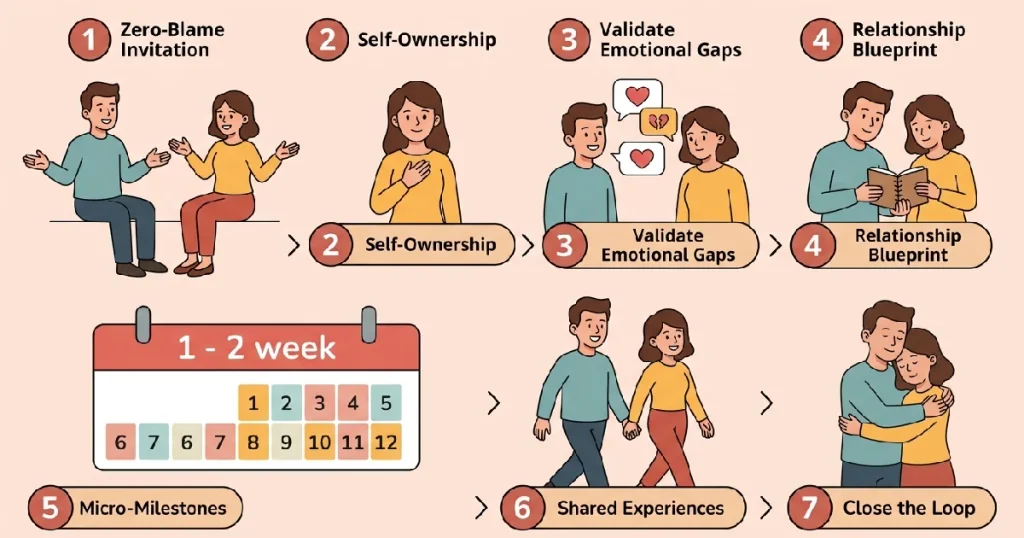
This is the part most guides skip. Everyone tells you to “communicate better,” but nobody tells you what that actually looks like on a Tuesday night when you’re both exhausted and hurt. Here’s the structure.
Step 1: Initiate With a Zero-Blame Invitation
Pick a distraction-free time and say something like, “Can we talk about Sunday? I want to understand your side, not win the argument.” The goal of the invitation is understanding, not scorekeeping. This single shift in framing changes your partner’s nervous system before the conversation even starts.
Step 2: Practice Radical Self-Ownership Over Defense
Own your exact share of the conflict without adding a qualifier or redirecting blame. Not “I raised my voice, but you started it.” Just, “I raised my voice. That wasn’t fair to you.” This is genuinely hard. It’s also the fastest way to lower your partner’s defenses.
Step 3: Map and Validate the Specific Emotional Gaps
Ask directly where your partner feels lonely, dismissed, or unheard, and then repeat it back in your own words. “So when I canceled our plans, you felt like you’re not a priority.” Mirroring like this proves you actually absorbed what they said, rather than just waiting for your turn to talk.
Step 4: Draft a Custom Relationship Blueprint
Vague promises like “I’ll try harder” don’t hold up under stress. Instead, define small, specific daily behaviors together. If she needs more verbal affirmation, that might mean one genuine compliment a day. If he needs more physical connection, that might mean a ten-second hug before work.
Step 5: Set Micro-Milestone Timelines
Agree to test the new behaviors for one to two weeks, then check in together. This keeps the repair from feeling permanent and terrifying. It also gives you real evidence of change instead of just words, which is exactly how you rebuild trust after conflict over time.
Step 6: Inject Pressure-Free Shared Experiences
Schedule something low-stakes and new, a walk somewhere neither of you has been, a cooking class, anything that isn’t loaded with old history. Novel shared experiences activate the brain’s reward system in ways that routine can’t, which helps loosen lingering tension between you.
Step 7: Formally Close the Conflict Loop
Don’t let repair fade out unspoken. Say it directly: “Are we okay? Do you feel resolved about this?” Pair it with physical touch, a hand on the back, a hug held a beat longer than usual. Your nervous system needs the explicit signal that the threat has passed.
5 Relationship Communication Exercises to Stop Constant Fighting

Repairing the big rift matters, but daily maintenance is what keeps you from ending up back there. These relationship communication exercises are the ones I return to most often with couples in my practice.
The Speaker-Listener Turn Protocol. Use a physical object, a pen, a coaster, anything, and only the person holding it can speak. The other person has to wait, which trains both of you to actually listen instead of rehearsing your rebuttal.
“I-Feel” Emotional Anchoring. Swap “you always ignore me” for “I feel invisible when I don’t hear back from you.” The first sentence attacks. The second one informs. Your partner can’t argue with your feelings the way they can argue with an accusation.
Anthropological Active Listening. Approach your partner’s account like an anthropologist studying an unfamiliar culture, genuinely curious rather than ready to correct the record. Ask, “Help me understand what that felt like for you,” instead of jumping to your version of events.
The Step-Out-to-Regulate Boundary. The moment you notice your heart racing or your jaw tightening, that’s flooding starting. Say, “I need twenty minutes, and I promise I’m coming back to this.” Then actually come back.
Direct Vulnerability Over Hostility. Anger and silence are almost always covering something softer underneath, usually fear of rejection or not being enough. Saying “I’m scared you’re pulling away” does more repair work in one sentence than an hour of arguing ever will.
Realities of Fixing a Broken Relationship: When to Seek Outside Help
Trust doesn’t come back because someone said the right words. It comes back through a pattern of consistent behavior over time, which is exactly why the research on repair after relationship conflict emphasizes small, repeated actions over grand gestures.
Most people don’t realize that a current fight can pull on an old wound from years earlier, which is why a small disagreement sometimes explodes out of proportion. That’s not you overreacting. That’s your nervous system recognizing a familiar pattern.
But here’s what no one tells you: some ruptures, especially betrayal, ongoing dishonesty, or any form of abuse, sit outside the reach of home-based repair. If you’ve tried these steps consistently and still feel stuck, that’s not failure. That’s your signal to bring in a licensed couples therapist trained in evidence-based approaches.
Where to Start Tonight: Turning Insight Into Action
You don’t need to overhaul your entire relationship by morning. You need one small, repeatable move.
The Two-Minute Check-In. Before bed, ask one question: “Is there anything unfinished between us from today?” It takes almost no time and prevents small tension from calcifying into resentment.
The 5:1 Ratio Rule. Researcher John Gottman found that emotionally stable couples maintain roughly five positive interactions for every negative one. One place to start is simply noticing your ratio this week, and adding one small positive moment, a compliment, a text, a shared laugh, whenever you can.
The Repair Word. Agree on a single word or phrase that either of you can say mid-argument to signal “I want to fix this, not fight this.” Something as simple as “timeout” or “team” can interrupt the flooding response before it takes over completely.
A useful question to ask yourself tonight: which one of these could I actually try in the next 24 hours, not eventually, but tonight?
Conclusion: Taking the First Step Tonight
Flooding is like a circuit breaker. The moment the emotional load gets too heavy, everything shuts off, not because you’re broken, but because the system is protecting itself. You now know how to lower the load before the breaker trips.
You came into this still reciting both parts of the same old fight. You’re leaving with a structure instead of a script. That’s the real difference between couples who stay stuck and couples who find their way back to each other.
Pick one step. Try it tonight. Repair doesn’t start with a perfect conversation. It starts with a different one.
My Closing Remarks
I’ve sat across from couples who were certain they were too far gone, and watched them find their way back using exactly this kind of structure. What surprises people most isn’t the repair itself, it’s realizing how much of the damage came from process, not incompatibility. You picked up something real here. Use it before the night is over.
More Related Stories for You
- If repair is on your mind, you might also be curious about where the relationship is heading long term, including the signs he’s planning to propose.
About The Author