David Wall
You’re not a bad driver. You’re a scared one. Here’s the plan to feel safe behind the wheel again.
Key Takeaways
- Learning how to get over fear of driving rarely happens in one brave leap. It happens in a hundred tiny ones.
- A simple five-step grounding trick can pull your brain out of panic mode before your hands even tighten on the wheel.
- The fear of what other drivers think of you is often louder than any actual danger on the road.
Quick Answer: How to get over fear of driving starts with gradual exposure instead of forced bravery. Ride as a passenger first. Then drive short supervised routes. Then go solo, one small step at a time. Combine this with the 5-4-3-2-1 grounding method for panic, and consider CBT if the fear still runs the show.
Contents
Table of Contents
You’re Not Broken. Your Brain Is Just Overreacting
We’ve all sat at a red light praying it doesn’t turn green too fast. Maybe for you it’s not a light. Maybe it’s the on-ramp to the highway, or the driveway with your toddler buckled in the back seat, engine running, hands frozen.
You tell yourself other people do this without thinking twice. So why can’t you.
Here’s what nobody says out loud. Learning how to get over fear of driving isn’t about proving you’re brave. It’s about proving to a jumpy nervous system that the road isn’t the threat it thinks it is. That’s a documented stress response, not a character flaw.
Roughly 6% of adults deal with driving anxiety severe enough to interfere with daily life, according to anxiety clinics across the country. You are nowhere near alone in this.
This article isn’t going to tell you to just breathe and relax. You already know that doesn’t work when your chest is tight and your thoughts are racing. Instead, we’re walking through a real step by step plan, the kind that’s helped hundreds of nervous drivers go from avoiding the car entirely to picking their kids up from school without shaking.
The Real Reason You’re Afraid (It’s Not What You Think)
Panic vs Performance: Two Fears Wearing the Same Face
Most people lump driving fear into one big scary blob. There are actually two separate fears hiding inside it, and they need different fixes.
The first is panic fear. Your heart races, your vision narrows, and it feels like you might lose control of the car because you’re losing control of yourself.
The second is performance fear. It’s quieter but just as exhausting. It’s the fear of being watched and judged, of being the driver everyone behind you is secretly annoyed with.
One Reddit user described it perfectly. They said they always think they’re doing something wrong, and when someone pulls up behind them they assume that driver is thinking “why are we still sitting here.” That isn’t about the car at all. That’s social anxiety borrowing the driver’s seat.
Take Maria, a nurse who drove fine for twelve years until a near miss on the freeway. After that, every car behind her felt like a courtroom. Her skills never changed. Her trust in herself did.
The Imposter Behind the Wheel
A lot of licensed drivers still feel like frauds every time they turn the key. This isn’t rare and it isn’t about talent.
It usually means you never built up enough low stress miles after passing your test to actually trust yourself. Confidence behind the wheel is built through repetition, not through one exam at seventeen.
If that’s you, there’s nothing wrong with your driving ability. You’re just missing the reps.
Secret #1: The Passenger to Pilot Progression
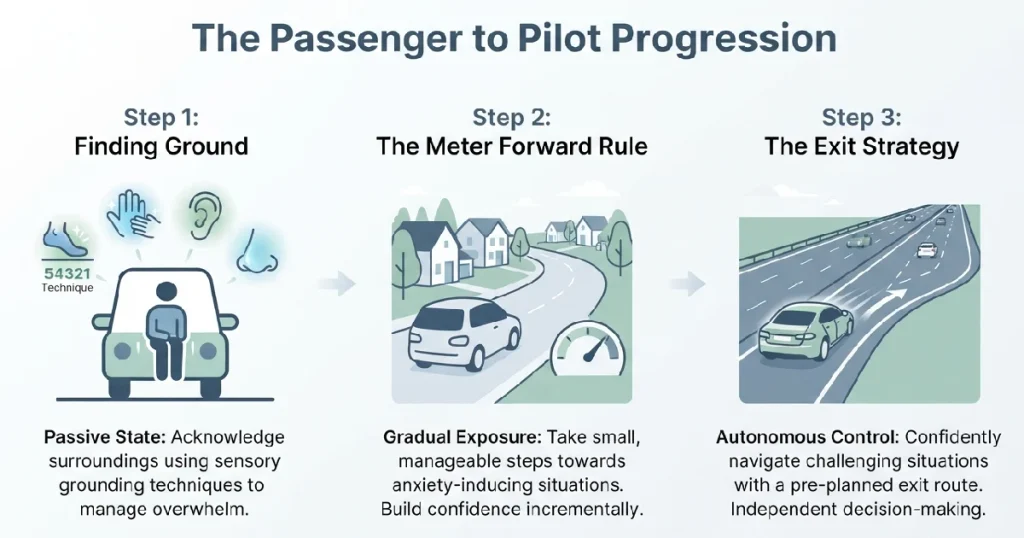
Exposure works because your brain learns through experience, not logic. You can know driving is statistically safe and still panic, because your amygdala doesn’t read statistics. It only updates its threat level after surviving something safely, over and over.
That’s the idea behind what I call the Passenger to Pilot Progression. Three phases, each one building proof that you’re safe before asking more of you.
Phase 1: The Passenger
Don’t drive yet. Sit in the passenger seat on familiar quiet routes. Your only job is to observe the environment without controlling it. Practice the grounding protocol below while you ride, before you ever need it mid-panic.
Phase 2: The Co-Pilot
Now you drive, with a calm non-judgmental person beside you. No highways. No night driving. No bad weather.
A rule from someone in an online driving anxiety group stuck with me: move your car a meter forward, or a meter back. That’s enough for one day. Progress isn’t measured in miles. It’s measured in moments you didn’t quit.
If your specific fear is driving alone, start even smaller. Drive to the end of your street and back, by yourself. That’s not a small win. For some people, that’s the whole mountain.
Phase 3: The Pilot
Solo driving, one new variable at a time. Mastered your neighborhood? Add a slightly busier road. Try the highway for one exit.
This is the Exit Strategy rule. Get on at one entrance, get off at the very next exit. You’re proving to your nervous system that you always have a way out, which is usually the exact thing panic insists you don’t have.
Secret #2: The 5-4-3-2-1 Grounding Protocol
Telling someone mid-panic attack to just breathe is like telling a drowning person to swim better. During a real panic spike, your prefrontal cortex, the thinking part of your brain, goes quiet while the alarm system takes over.
What actually works is forcing your brain to process sensory input, since that runs through different pathways than anxious thoughts do.
Here’s the protocol. Five things you can see, the dashboard, the car ahead, the lane line. Four things you can feel, the wheel, your seatbelt, your feet on the floor. Three things you can hear, the engine, the radio, tires on asphalt. Two things you can smell. One thing you tell yourself, something like “I am in control” or “I can pull over safely.”
Here’s your permission slip. If you’re overwhelmed, pull over somewhere safe and run the protocol. That’s not failure. That’s exactly what a skilled driver does.
Secret #3: Letting Go of What Other Drivers Think
The driver behind you forgets you exist about four seconds after they pass. Their honk is about their own schedule and their own bad morning. It was never about your worth as a driver.
Someone in a driving forum said their grandmother used to just say “let ’em honk.” That’s genuinely good psychology, not just a cute line. It separates someone else’s reaction from your own value.
Take Jordan, who used to freeze at four-way stops convinced everyone was watching his hesitation. Once he started saying “let ’em honk” out loud in the car, the tightness in his chest eased within a few drives. Naming the thought took away its power.
Your goal in the car was never to be fast. It’s to be safe and predictable. If you need a fully clear gap to merge, take it. A slow, safe merge beats a rushed one every time.
Secret #4: The Fears Nobody Talks About Enough
Driving Alone
If you lean on a “safe person” riding shotgun, try replacing them with a podcast or a playlist that keeps your mind occupied without distracting it. Silence gives anxious thoughts room to grow.
Also keep a Home Base Rule. Always know the route back to somewhere familiar. Even on a detour, knowing you can get home takes real pressure off the whole drive.
Highway Driving
Stay in the right lane. It’s your safe harbor since it has the most exits and shoulder space. Use your blinker early and match the speed of traffic, since hesitant merges actually create more danger than confident ones.
If highways still feel like too much, go back to the Exit Strategy. One exit on, one exit off, over and over, until your body stops bracing for disaster.
Secret #5: When to Bring in Professional Help
Self-help steps work for plenty of people, but not everyone, and there’s zero shame in needing more support.
Cognitive Behavioral Therapy has been shown to be highly effective for driving fear according to the Anxiety and Depression Association of America, especially paired with structured exposure work. In fact, a randomized controlled trial demonstrated large effect sizes for CBT in treating driving phobia compared to people who received no treatment at all.
Ask for a therapist who treats specific phobias using graduated exposure therapy. Some clinics now use virtual reality driving simulations for people who aren’t ready for real roads yet.
Medication can sometimes lower anxiety enough to start therapy, but it works best as a bridge, not a permanent fix on its own.
What to Do Next
You don’t need every tool at once. Pick one and let it become familiar before adding another.
1. The Meter Forward Rule
One place to begin is literally moving your car a short distance, then stopping. A driveway works fine. Repeat tomorrow and go a little further.
2. The Home Base Checklist
Before any solo drive, consider naming three things out loud: where you’re going, your route back, and one safe place you could pull over. This takes thirty seconds and removes a surprising amount of pressure.
3. The “Let ‘Em Honk” Script
When another driver reacts impatiently, try saying out loud, even alone in the car, “that’s about them, not me.” Hearing your own voice interrupt the spiral works better than just thinking it.
4. The One New Variable Rule
Once a route feels boring instead of scary, that’s your cue. Add exactly one new challenge, a busier street, five extra minutes, one short highway stretch. Change only one thing at a time.
5. The Three Minute Pause
If panic builds before you even start the car, sit in the driver’s seat with the engine off for three minutes. Run the 5-4-3-2-1 protocol right there in the driveway. Starting the engine only after your body settles teaches your nervous system the car itself isn’t the threat.
Frequently Asked Questions
Is it normal to feel more anxious driving alone than with someone else?
Yes, completely normal. A passenger acts like a security blanket, and without one you rely entirely on your own coping skills. That’s exactly why short, low-stakes solo drives matter so much for building real independence.
What should I do if I feel a panic attack starting on the highway?
Don’t fight it, accept it’s happening. Turn on your hazards and take the next exit, or pull onto the shoulder if that’s not possible. Once stopped, run the 5-4-3-2-1 protocol and only continue once your body has settled.
I’ve had my license for years but I’m still terrified to drive. Am I a lost cause?
Not even close. This is often called imposter syndrome behind the wheel, and it just means you never built up enough calm driving experience to trust yourself. A structured plan like the Passenger to Pilot progression can retrain that response at any age.
You’re Not Stuck in That Driveway Forever
Picture that driver pulling up close behind you again, your hands frozen at 10 and 2. You now have an actual map for that moment. Five senses to ground you. A phase to work from. A reason the honking was never about you.
The fear made sense. It was your brain protecting you with old, outdated information. Now you get to update it, one short drive at a time.
You don’t have to white-knuckle your way through this anymore. You have a plan, permission to go slow, and proof that thousands of people have driven this exact road back to confidence.
The driver’s seat was always yours. You’re just getting back into it.
My Closing Remarks
I’ve sat in that driveway too, keys in hand, telling myself I was being ridiculous. I wasn’t. Fear like this listens to patience far better than pressure. Start absurdly small if you have to. One meter forward still counts as moving forward. You’ll get there.
More Related Stories for You
If public speaking makes your chest tighten the same way merging onto a highway does, this piece on overcoming the fear of talking in public walks through a similar step by step approach.
About The Author