David Wall

Key Takeaways
- You can build a great relationship with your partner without changing who you are, just the small moments you keep missing
- Most couples do not fall apart from one big fight, they fade out from a thousand ignored bids for attention
- The fastest way to feel like a team again is fixing the invisible labor problem before you fix the communication problem
Quick Answer: To build a great relationship with your partner, focus on three repeatable behaviors: repair conflict quickly using a short accountability script, respond to small daily bids for connection within one minute, and rebalance invisible mental labor through clear ownership of tasks. These three actions, backed by Gottman Institute research, matter more than grand romantic gestures.
Contents
Table of Contents
Why “Just Communicate Better” Never Actually Works
We have all heard it a hundred times. Communicate more. Listen better. Make time for each other. It sounds nice on a poster but it means nothing at eleven at night when he is scrolling his phone and your scrubbing a pan and neither of you has said a real sentence to each other in an hour.
You already know you should talk more. That advice never fixed anything because it is not specific enough to use in the moment it actually matters.
The real issue is not a lack of love. It is a lack of precision in the exact seconds a relationship either grows closer or drifts a little further apart. Those seconds happen constantly, and most couples never notice them until the damage is already done.
This article skips the platitudes. Below are three specific, repeatable behaviors that help you build a great relationship with your partner, not by becoming a different person, but by changing what you do in the tiny moments that quietly decide everything.
Tip 1: Master The Repair Conversation (Not Just “Communication”)
How To Maintain A Healthy Relationship With Your Partner When Fights Keep Repeating
Here is the mechanism nobody explains. It is not the fight itself that damages a relationship. It is what happens in the hour after the fight. Couples who stay together are not the ones who argue less, they are the ones who repair faster.
The Gottman Institute studied this for decades and found stable couples keep roughly the “magic ratio” of five positive interactions to every one negative interaction during conflict. That ratio is not luck. It comes from couples actively repairing damage before it piles up into resentment.
Take Sarah and Mark. Every disagreement about dishes somehow turned into a conversation about “every single time” one of them failed at something, going back years. They were not bad communicators. They just never learned how to close the loop after a rupture, so every small fight reopened old wounds instead of resolving the new one.
Here is a script that actually closes a rupture instead of letting it fester:
- “I think I came in hot earlier, and I don’t want to leave it like that.”
- “What I was actually trying to say is I need ten minutes of quiet when I get home, and I didn’t ask for that clearly.”
- “Can we try that part again? I’ll ask directly, and you tell me if it’s a bad time.”
Three sentences. No blame, no keeping score, just a clean redo.
When your partner has ADHD or working memory struggles, they may genuinely forget a repair attempt happened at all. A thirty second voice memo recapping what was said removes the need for either of you to carry it perfectly in your head.
When your partner stonewalls or shuts down, chasing them makes it worse. Try a time boxed pause instead. “I’m going to take twenty minutes, then I’ll come back, not to win, just to understand.” Then actually come back.
Healthy couples make time to check in with one another on a regular basis, according to the American Psychological Association, and that check in is really just a small, consistent repair habit repeated over years.
Tip 2: Turn Toward Bids Before They Become Resentments
How To Keep Your Relationship Strong Without Needing Grand Gestures
This is the part competing articles always skip, probably because it sounds too small to matter. It is not small. It is everything.
Gottman calls them “bids for connection.” A bid is any small reach for attention, affection, or acknowledgement. A sigh. A meme sent at 2pm. A comment about traffic. Couples do not usually fall out of love in one dramatic blowup, they fall out of love through hundreds of quietly ignored bids.
Take Jenna and Derek. Derek would mention something annoying from his day and Jenna would stay on her phone and say “mm.” Nothing cruel happened. No affair, no screaming match. Just years of tiny moments where one person reached out and the other wasn’t really there.
The one minute turn toward rule: when your partner makes a small, low stakes bid, your default response is a brief turn toward, not a dismissal.
- They say “ugh, traffic was insane.” You say “that sounds exhausting, what happened?” (fifteen seconds)
- They send a silly video. You watch it and send one line back. (thirty seconds)
- They sigh doing dishes. You touch their back and ask “long day?” (ten seconds)
Ten of these a day costs less total time than one ignored bid costs in emotional distance.
For long distance couples or brutal work weeks, try a bid log for 48 hours. Each of you writes down three bids you noticed from the other person. At the end of the day say “I saw that, and it mattered.” This rebuilds the habit of noticing, which has to come before turning toward can even happen.
This is how to create a strong relationship without needing a vacation or an anniversary dinner to feel it. Strength comes from frequency, not intensity.
Tip 3: Rebalance The Invisible Load Before It Turns Into Contempt
How To Build A Strong Foundation In A Relationship When One Person Is Exhausted
The mental load is the unpaid managerial work of noticing, remembering, and planning everything a household needs. Its not the same as doing chores. A recurring complaint across Reddit is one partner saying “just tell me what to do” while the other is drained from being the one who has to know what needs doing in the first place.
Take Priya and Alex. Alex genuinely helped with anything Priya asked. The problem was Priya had to ask for literally everything, from scheduling the pediatrician to remembering his mother’s birthday. She wasn’t tired from doing tasks, she was tired from being the only operating system in the house.
The ownership handoff exercise:
- Each partner writes a list of everything they currently notice, remember, and initiate, including emotional tasks like planning date nights or remembering birthdays
- Each partner circles three items from the other person’s list they are willing to take full ownership of
- Use this script: “I’m taking ownership of this. You don’t have to remind me or check on me. If I drop it, it’s mine to fix.”
This moves the fight from “you don’t help enough” to “here is a whole domain I am taking off your plate completely.”
If one partner has ADHD, full ownership without support can set them up to fail. Externalize it with shared reminders or a ten minute weekly check in, no judgment attached.
If one partner carries a heavier load temporarily, like early parenthood or a demanding job, name the imbalance out loud instead of pretending it’s equal. Unnamed imbalance breeds resentment. Named imbalance can actually be managed.
This is how to build a healthy relationship that doesn’t quietly run on one person’s exhaustion.
When Three Tips Are Not Enough

Not every relationship problem is a skill problem. If there is ongoing contempt, control, or a basic mismatch in values, no script fixes that.
If you’ve tried repair conversations, bids, and rebalancing the load for months and it still feels unsafe or chronically unequal, the next move isn’t another hack. It’s an honest conversation, possibly with a couples therapist, about whether this relationship is structurally healthy for both people involved.
What To Do Next: 5 Places To Start This Week
You don’t need to do all three tips perfectly starting tonight. One place to begin is picking just one.
- The Three Sentence Repair – After your next small argument, use the rupture, need, redo script above instead of letting it fade into silence
- The One Minute Turn Toward – Pick one bid your partner makes today and respond to it fully for ten seconds instead of half listening
- The Ownership Handoff – Consider testing this with just one task this week, not the whole list at once
- The Time Boxed Pause – If shutting down is a pattern, try naming a return time instead of chasing or giving up
- The 48 Hour Bid Log – Write down three bids you noticed from your partner and tell them one, out loud, before the day ends
Frequently Asked Questions
What is the fastest way to tell if a relationship is drifting into “roommate territory”?
It’s rarely a lack of sex or a big fight. It’s a pattern of missed bids, small reaches for connection that go unanswered without any repair afterward.
Is the 5 to 1 ratio a strict rule or can couples get by with less positivity during conflict?
It’s a predictive pattern, not a scorecard. Couples below roughly a 1 to 1 ratio are in statistically risky territory, but the habit of replenishing positivity matters more than hitting an exact number.
What if my partner refuses to engage with repair or bids at all?
You can’t force participation in a framework they reject. Start with one low stakes moment yourself, let them feel the difference, and treat a consistent refusal to engage as important information on its own.
You Already Have The Map Now
Remember that kitchen scene, the pan scrubbing, the silence, the phone scrolling. That moment doesn’t have to define the relationship anymore.
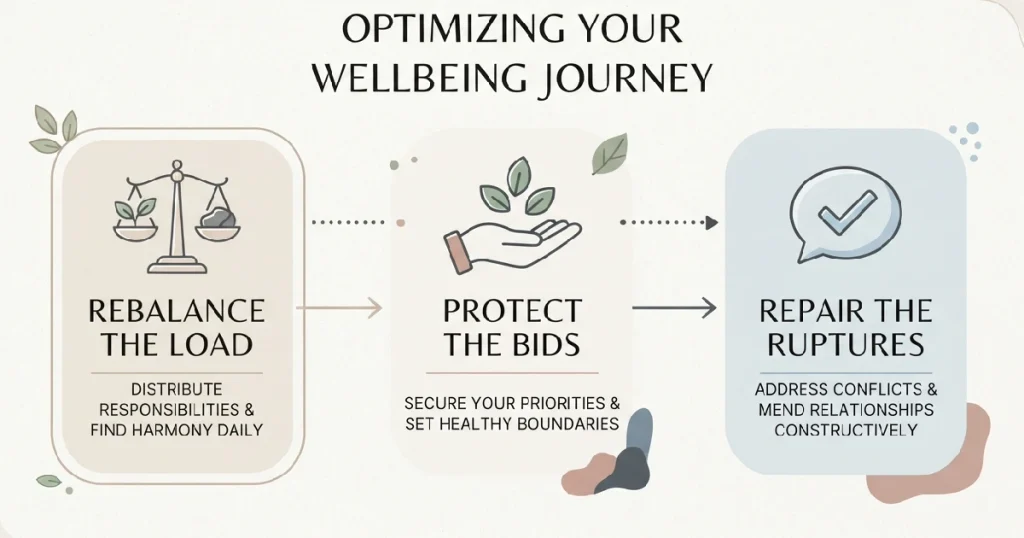
You now know the order that actually works: rebalance the load first, protect the small daily bids second, repair the ruptures third. Skipping the first makes the other two nearly impossible.
A great relationship isn’t built in one conversation, it’s built in a thousand tiny ones you finally know how to have.
My Closing Remarks
I’ve sat across from couples who loved each other deeply and still felt like strangers sharing a mortgage. It was never about effort, they had plenty of that. It was about precision in small moments. If you take just one tip from here and use it this week, you’ll likely feel the shift before your partner even notices what changed.
More Related Stories For You
If this resonated, you may also want to read our full guide on how to have a healthy relationship for a broader look at the habits that keep couples connected long term.
About The Author