
 Nicole Adkins
The goal was never to fix them. It was always to free you.
Key Points
- Learning how to deal with a narcissist family member starts with one hard truth: you’re not managing a person, you’re managing a pattern.
- The ten steps ahead are the real boundaries, scripts, and exit strategies families actually use to survive holidays, phone calls, and full-blown smear campaigns.
- By the end, you’ll know the difference between low contact and no contact, and which one genuinely protects your peace.
Contents
Table of Contents
Family is supposed to be the one place we do not have to perform. For many of us, it is the place we learned to perform first. We learned which version of ourselves kept the peace. We learned which feelings were allowed. We learned that love could arrive with a receipt.
If you have a narcissist family member, you already know the hangover after a “simple” call. Your chest is tight. You replay a comment that sounded almost caring. You wonder if you are the difficult one.
Someone might think you are overreacting to a joke about your job, your body, or your kids. But what they don’t see is that the joke always lands in the same old bruise.
Someone might think you should sit down and talk it out like a mature adult. But what they don’t see is that every talk becomes a courtroom. You are the defendant, the witness, and the person taking notes.
Someone might think pulling back means you do not value family. But what they don’t see is that you have been valuing family at the cost of your own nervous system for most of your life.
How to deal with a narcissist family member is not a better speech. It is a change in the job you think you have. Your job is not to make them see you. Your job is to stop handing them the reactions, private details, and extra time they use to keep you off balance.
This pattern holds for a reason. Many people with strong narcissistic traits feed on what psychologists call narcissistic supply. That is the attention, emotion, status, and control they draw from other people. Your tears count as supply. Your long explanations count. Your hope that this visit will be different counts most of all.
According to the dynamic self-regulatory model described by Morf and Rhodewalt, narcissism is less a solid wall of confidence and more a constant project of protecting a shaky self-image. When you challenge them, you are not offering helpful feedback. You are threatening the project. That is why a small boundary can produce a huge explosion.
This matters in daily life because the family house trains you to treat that explosion as your failure. It is not. It is the system doing what it was built to do.
How Narcissism Shows Up in a Family Member
Not every cold parent or dramatic sibling has narcissistic personality disorder, a clinical diagnosis that involves a lasting pattern of grandiosity, need for admiration, and low empathy. Narcissistic behavior still sits on a spectrum. At home, the damage comes from repetition. One holiday can be survived. A childhood of it rewires how you trust yourself.
Common traits of a narcissistic relative
You may notice a severe lack of affective empathy, which is the ability to feel with you, not just talk about you. There is a steady hunger for unearned admiration. Facts shift so they can remain the hero or the wounded party. Arrogance is used as a shield. When they hurt you, the story becomes how hard it is to have a child or sibling like you.
Triangulation is common. That means they pull a third person into a two-person conflict so they can control the story. Gaslighting shows up too. That is the move of making you doubt your memory, your tone, or your sanity until you apologize for a harm you did not cause.
Most people in this situation do not realize how much of their “personality” is actually a set of survival skills.
Golden child and scapegoat roles in a narcissist family
Toxic families often split people into parts. The golden child is the showcase. They get the praise, the excuses, and the public loyalty. The scapegoat is the family’s shock absorber. They get blamed for tension that started long before they could speak in full sentences.
If you were the scapegoat, your nervous system learned hypervigilance. That is a state of always scanning for the next blow-up. If you were the golden child, you may feel loyalty mixed with a private fear of falling from the pedestal. Either role is a trap. Neither one is proof of who you actually are.
Left unexamined, this pattern does not stay at your parents’ table. It can follow you into work, friendship, and the way you accept love from people who are actually safe.
10 Steps for How to Deal With a Narcissist Family Member
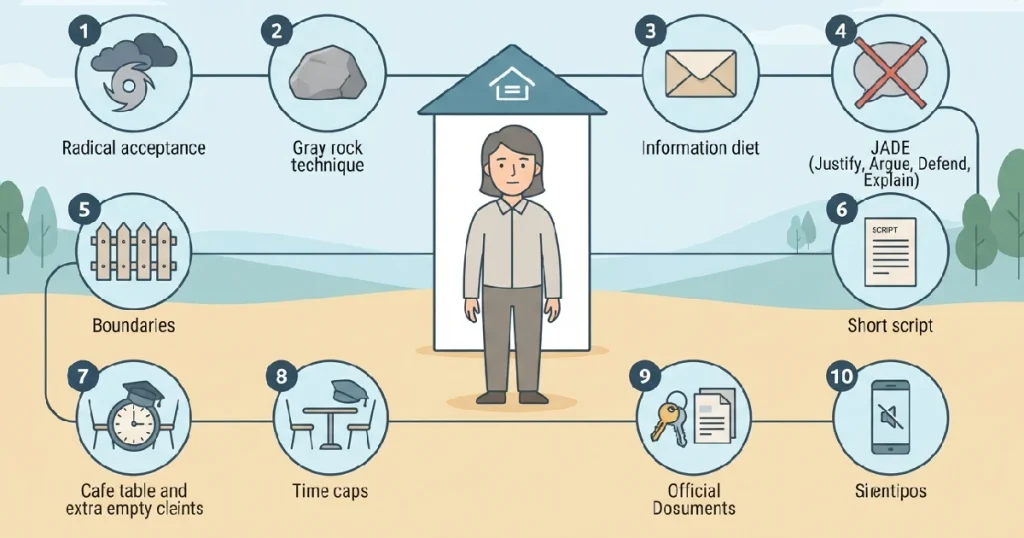
The shift is not “How do I heal them?” The shift is “How do I stop abandoning myself in their presence?”
1. Shift your expectations of a narcissist family member
Radical acceptance means you stop waiting for a breakthrough that would make this fair. In dialectical behavior therapy, radical acceptance is not approval. It is the decision to stop arguing with reality so you can choose a response.
They are unlikely to offer a clean apology. They are unlikely to sit with the impact they had on you. Treat them as a fixed weather system, not as a person one heartfelt letter away from change.
You do not negotiate with a hurricane. You track it, you board the windows, and you stop standing in the yard hoping it will say sorry for the wind.
2. Use the gray rock method with a narcissistic relative
Gray rock means you become as dull and unreactive as a plain rock. Short answers. Flat tone. No extra color. No juicy details.
If they bait you with a smirk about your relationship, you do not produce a defense. You say, “Work is fine,” or “We are well,” and you let the silence sit. You are starving the interaction of supply.
This feels rude if you were raised to be the family soother. It is not rude. It is a dimmer switch.
3. Put your personal life on an information diet
An information diet is a hard cut on what they get to know. No career plans. No money stress. No fertility news. No fight you had with your partner.
If they do not know what matters to you, they cannot weaponize it at the next gathering. Celebrate wins with chosen friends. Take your tender news to people who can hold it without turning it into a story about themselves.
4. Refuse to J.A.D.E. with a narcissist family member
J.A.D.E. means Justify, Argue, Defend, or Explain. Those four habits feel like maturity. In this dynamic they are fuel.
A long, careful explanation gives them more sentences to twist. A calm argument still counts as engagement. The fight is not a path to truth.
The argument is the prize.
That is the piece most advice skips. They do not need you to believe their version. They need you to keep playing. While you are proving your point, they still have you.
5. Establish immutable boundaries with a narcissistic relative
A boundary is not a speech. It is a limit plus an action. “I will not stay on a call if I am being yelled at” only works if you hang up.
The Cleveland Clinic’s guidance on narcissistic parents is blunt on this point: you cannot control their reaction, only what you will continue to allow. State the limit once. Then move your body. Leave the room. End the visit. Put the phone down.
If you explain the boundary for twenty minutes, you have already handed it back.
6. Use short scripts to deal with a narcissist family member
You do not need a perfect line. You need a few sentences you can say while your heart is racing.
Try:
- “I am not comfortable with how you are speaking to me.”
- “Your memory of that event is different from mine.”
- “I will not continue this conversation if I am being yelled at.”
- “I am not going to discuss my finances.”
Then stop talking. Scripts fail when you add a paragraph of proof. The power is in the period.
7. Meet a narcissistic relative in public or in a group
Do not get caught alone behind a closed door if you can help it. They are often more contained when a waiter, a cousin, or a partner can hear them.
Public space is not a cure. It is a deterrent. If the only safe version of them appears in front of witnesses, believe that data.
8. Set hard time caps for family gatherings
Never arrive without an exit. Before you go, say, “I can stay until 3.” Set an alarm if you need one. When the time hits, leave.
Do not wait for a pleasant moment. Pleasant moments are often the bait that resets the clock. A time cap protects you from the slow boil, the extra drink, the late-night revision of your character.
9. Secure money, keys, and documents from a narcissist family member
If you still live with them, share accounts, or depend on them for a car, emotional tactics are not enough. Keep a bank account they cannot see. Hold your birth certificate, Social Security card, and passport in a place they cannot “tidy up.” Know where your keys are at night.
If the control includes threats, isolation, or financial coercion, that can cross into abuse. The National Domestic Violence Hotline is a confidential place to map a safer exit.
Independence is not a vibe. It is a folder, a balance, and a way out of the driveway.
10. Control contact with digital boundaries
You are not required to take in abuse in real time. Silence unknown numbers. Route their email to a folder you check on your schedule. Archive texts without answering them at midnight.
A delayed reply is not cruelty. It is you refusing to let their nervous system set the tempo of yours.
Maya Stopped Explaining. The Family Called It Betrayal.
Maya, 34, was the family scapegoat with a talent for peacekeeping. After every holiday she wrote long messages proving she had not been rude, had not “started it,” had not ruined dessert with her face. Her mother would forward pieces of those messages to an aunt. The aunt would call Maya and ask her to be the bigger person.
The year Maya stopped J.A.D.E.ing, she used one script and a two-hour cap. She did not announce a new philosophy. She ate, she asked no one about their marriage, and she left when she said she would. By Thursday the family chat had a new plot. Maya was cold. Maya was ungrateful. Maya had been “influenced” by her partner.
Here is the part that rarely gets said. A narcissistic household is often not one person with a problem. It is a shared story. Your assigned job is to keep that story running by staying confused, helpful, and ashamed. When you stop performing, the system panics. That panic is not evidence that you became cruel. It is evidence that the system needed you dysregulated.
Maya still felt sick with guilt for weeks. She also slept through the night for the first time in months. Guilt was the alarm the old house had installed in her. Peace was the new data.
Surviving Smear Campaigns From a Narcissist Family Member

When you change the terms, many narcissistic relatives recruit help. People call those helpers flying monkeys, a phrase for relatives or friends sent to pressure you, collect information, or repeat the smear. They may think they are saving the family. They are often repeating a script.
You do not have to win the extended family. You do not have to hold a press conference. A simple line works: “I am handling my relationship with them directly. I am not going to debate it.” Then return to your information diet. Every detail you give a flying monkey can travel.
Stay grounded with a reality file if you need one. Write what was said, what you did, and how you felt, on the same day. Gaslighting feeds on fog. Dated notes cut fog. You are not building a legal case for its own sake. You are giving your future self a record when the old voice says you imagined it.
Most people who were scapegoated do not need more self-criticism. They need an outside witness who is not in the family play.
Low Contact, No Contact, and Healing After a Narcissistic Relative
Low contact means tightly managed doses. Public places. Time caps. Gray rock. Digital filters. It can fit when full cutoff is not safe or not possible yet, or when you still want limited access to other relatives.
No contact means you stop the relationship. It is not a tantrum. It is a last-line medical decision for some people, the way you would stop drinking a poison you have already named. Grief still comes. So can relief. Both can be true in the same week.
Healing asks for a found family: friends, a partner who believes you, a therapist who understands family trauma, or a support space where you do not have to prosecute your own memories. Recovery is less about a dramatic speech and more about repeating new rules until your body trusts them.
One place to start in the next 24 hours is a Peace Audit. Write three columns: What they get from me. What it costs me. What I will no longer provide this month. Keep the list boring and specific. Time. Money. Private news. Late-night calls.
A second move is the Exit Sentence. Choose one line and one time limit before the next gathering. Practice it out loud in your kitchen so your mouth knows it before your fear does.
A third is the 24-Hour Delay. If a provocative text arrives, wait a day. Most urgencies in this dynamic are manufactured. Delay is how you take back the clock.
You do not have to do all ten steps this week. You only have to stop treating self-erasure as the price of being a good daughter, son, or sibling.
Sunday dinner may look the same from the outside. The same stories. The same chair. The same person who still wants a reaction. What can change is you. You stay one hour. You give weather-report answers. You do not hand over the new job, the new grief, or the old hope that this is the visit they finally become someone else.
The storm does not get a vote on whether you come inside.
You can love people and still leave the room.
My Closing Remarks
In my practice I have watched capable adults apologize for wanting a normal phone call. If that is you, I want you to hear this without a lecture attached. You were trained to confuse endurance with love. Unlearning that is messy, slow, and deeply human. You may still miss them on a Tuesday and protect yourself on a Saturday. That mix does not make you fake. It makes you someone who is finally telling the truth in two directions at once, toward them and toward yourself.
More Related Stories for You
- If you are trying to name the pattern itself, start with the characteristics of a narcissist man and notice which traits show up at your family table, not only in a romantic partner.
About The Author