
The Long Distance Relationship Communication Mistake to Avoid


You talk every single night, so why do you feel further apart than when you first said goodbye?
Key Takeaways
- Surviving a long distance relationship has very little to do with how many hours you spend on video calls and everything to do with how fast you catch small emotional bids.
- Trading exhausting nightly status reports for asynchronous “pebbling” keeps you present in each other’s daily lives without running out of things to say.
- Giving each other explicit permission to skip the routine nightly phone call actually builds deeper emotional safety and stops quiet resentment before it starts.
Quick Answer: The biggest long distance relationship communication mistake is treating connection as a volume problem rather than a responsiveness problem. Couples who replace exhausting daily status reports with rapid replies to small emotional bids, low-pressure asynchronous updates, and flexible call rituals experience much higher relationship satisfaction without spending extra hours talking.
Contents
Table of Contents
The Long Distance Relationship Communication Mistake Nobody Warns You About
We have all heard the standard advice that constant communication is the foundation of a healthy long distance relationship. Yet here you are, hanging up after a two-hour phone call at 11 p.m., staring at your ceiling, and feeling completely alone. It is the ultimate paradox of what a long distance relationship be like once the initial novelty wears off: you talk every day, maybe every single night, and somehow feel less connected than when you started.
This creeping emptiness is not a sign that your bond is doomed. Instead, it is a glaring mechanical signal that your communication texture is off. In our testing of daily connection habits with couples separated by miles, the biggest mistake is treating communication as a volume problem when it is actually a responsiveness problem. By making three specific shifts (moving from frequency to responsiveness, from reporting to pebbling, and from obligation to asynchronous ritual), you can completely transform the emotional warmth of the exact same amount of contact.
Why “Talk More” Is the Advice That Keeps You Lonely
The Reporting Trap
A common pitfall we frequently see around month three or four of living apart is a quiet shift in how couples talk. Conversations slowly flatten into basic status updates about what you did, where you went, and what you ate. You stop sharing your inner life, such as what surprised you today, what you are quietly afraid of, or a strange thought you had on the train.
On relationship forums, exhausted partners accurately call these exchanges “daily reports.” You recite your schedule like a news anchor, your partner recites theirs, and you both wonder why the call felt so hollow. Reporting transfers information, but it never creates emotional presence.
The Video Call Myth in a Distance Relationship
Conventional wisdom says that if text messages feel flat, you need more face-to-face screen time. However, when evaluating synchronous video calls against quick text interactions, the data tells a very different story for a distance relationship. In a landmark 2021 study of 647 emerging adults by Holtzman and colleagues, researchers found that responsive texting predicted greater relationship satisfaction in long-distance couples, whereas the frequency of video calling did not.
This does not mean you should delete FaceTime or stop seeing your partner’s face. It means that the small, in-between moments of warm responsiveness carry far more relational weight than scheduled marathon conversations. Waiting until 9 p.m. to dump your entire day into a webcam cannot replace feeling heard at 2 p.m. when your afternoon falls apart.
Why Talking Constantly Makes You Run Out of Things to Say
When talking is your only shared activity, conversation quickly becomes performative. You are no longer simply sharing a life together; you are under pressure to generate entertaining content for each other every evening. As thousands of long-distance partners confess on Reddit, hours-long daily calls eventually feel like an exhausting second job where you desperately scrape the bottom of the barrel for topics.
Human beings are not designed to conduct a two-hour talk show every night. When you force high-volume conversation without shared context, silence starts to feel like failure rather than comfort.
The First Shift: From Frequency to Responsiveness

What Responsiveness Actually Looks Like in a Text
If talking longer does not fix the loneliness, changing how you reply to micro-moments will. Responsiveness means replying directly to the emotional core of a message rather than pivoting to logistics. Imagine your partner texts you at noon saying, “Ugh, this meeting is brutal.”
A non-responsive reply ignores the emotion: “Sorry! Hey, did you book the flights for next month?” A responsive reply steps right into their moment: “That bad? Tell me who is hijacking the agenda today.” Psychologist John Gottman’s famous lab observations revealed that couples who stayed married turned toward bids 86% of the time, while couples who eventually divorced turned toward them only 33% of the time. In a long-distance dynamic, those connection bids arrive disguised as texts, memes, voice notes, and blurry photos, and catching them takes seconds rather than hours.
The 3-Second Rule for Bids
Principles are helpful, but daily rules actually change behavior when you are busy. Consider testing the 3-Second Rule whenever your partner sends a bid for connection, whether it is a funny reel, a quick “thinking of you,” or a complaint about a coworker. If you have the bandwidth to look at the screen, acknowledge the emotional bid within three seconds, even if it is just a specific reaction emoji or a quick “No way, tell me more.”
If you are walking into a presentation and cannot engage, simply name the delay so your partner is not left hanging in a vacuum. A fast text saying, “Just saw this and want to hear all about it properly, calling you at 7!” protects the connection immediately. You validate their bid without sacrificing your workday.
Why Delayed Replies Feel Bigger in My Long Distance Relationship
When coaching couples through texting friction, I often hear one partner ask why a three-hour silence causes so much anxiety in my long distance relationship. The answer lies in the behavioural mechanics of physical absence. When you live together, a missed text is buffered by sensory reassurance because you know you will smell their coffee, hear their keys in the door, and sit on the same couch tonight.
When you live apart, your phone screen is the entire relational environment. A read receipt with zero reply acts as a loud, ambiguous signal that invites an anxious brain to fill in the blanks. Naming your delays removes the ambiguity and keeps your partner’s nervous system calm.
The Second Shift: From Reporting to Pebbling
What Is Pebbling?
Drawn from the courtship habits of Gentoo penguins, who search for smooth stones to present to their mates, “pebbling” has become a favorite concept among relationship researchers and online communities. In human terms, pebbling means sending small, low-effort, asynchronous signals of presence throughout the day. It might be a photo of a weird cloud outside your office, a 15-second voice note of a song playing in the grocery store, or a screenshot of an article that matches an inside joke.
Pebbling is not a conversation, and it does not demand a ten-minute back-and-forth exchange. It is simply physical evidence of continued attention. When you pebble, you solve the dreaded “we ran out of things to say” problem because you do not need a grand topic to say, “You crossed my mind just now.”
The 3-Pebble Day Rule
To put this into practice without feeling overwhelmed, aim for the 3-Pebble Day Rule. Send three small pebbles across your day that have nothing to do with scheduling or chores. Drop one in the morning featuring something you noticed on your commute or around your kitchen.
Send a second pebble mid-day when a random detail reminds you of their personality or a memory you share. Finish with one evening pebble, like a short voice note or a photo of your book as you wind down. None of these require simultaneous availability, yet they weave your partner directly into the fabric of your Tuesday.
Why Asynchronous Beats Simultaneous in a Long Range Relationship
Most conventional advice tells couples in a long range relationship to lock down a strict daily schedule where both partners are free at the exact same time. In practice, competing work hours, social lives, and time zones turn rigid schedules into a breeding ground for guilt. Building an asynchronous communication rhythm works much better than enforcing a simultaneous schedule.
A two-minute voice note recorded in your car after work, which your partner listens to while making breakfast the next morning, creates deep intimacy without live performance pressure. You get to hear the warmth, cadence, and inflection in each other’s voices while respecting the reality of your separate routines.
The Third Shift: From Obligation to Ritual (With Permission to Skip)
The Nightly Call Trap
What begins as the romantic highlight of your day can easily calcify into a joyless duty. When the nightly call becomes mandatory, both partners eventually show up half-present just to check the box. As one partner painfully noted on a relationship forum, “Recently he has been calling me, but after he hangs up he gets on Discord with his friends, and it makes me feel very lonely.”
The call was technically happening, yet the emotional choice behind it had vanished. Ritual without choice is just obligation. When you talk out of obligation, your partner can hear the subtle impatience in your voice, which triggers the exact loneliness the call was supposed to prevent.
The “Off Night” Protocol
To keep your phone calls feeling like a choice rather than a prison sentence, introduce the Off Night Protocol. Once a week, or whenever exhaustion hits, either partner has full permission to declare an off night using a clear, affectionate script: “I am completely wiped tonight, I love you, let’s pebble and talk tomorrow.” No heavy apologies or defensive explanations are needed.
The single non-negotiable rule of this protocol is that the off night must be explicitly named in advance, never silently skipped. As attachment theorist John Bowlby’s work on protest behavior shows, unexplained withdrawal triggers an immediate pursuer-withdrawer spiral where one partner panics and the other shuts down. Naming your need for rest paired with warm reassurance keeps attachment security intact while giving you space to recharge.
Build One Asynchronous Ritual and One Synchronous Ritual Per Week
Instead of relying on accidental marathons, replace raw quantity with deliberate architecture. First, establish one simple asynchronous ritual, such as a shared daily question app or a dedicated photo album where you both drop an answer whenever you have five free minutes. This keeps you actively building love maps and turning toward bids in long-distance relationships, ensuring you continually update your mental model of your partner’s inner world.
Second, protect one synchronous 60-to-90-minute window per week for a genuine, unhurried conversation. Ban logistical downloads and daily weather reports during this protected window. Use that time to talk about your bigger hopes, things you are learning, or how you are feeling about your connection.
The Long Distance Relationship Date That Does Not Require Conversation
When planning a long distance relationship date, stop defaulting to sitting on a bed staring at each other on FaceTime for three hours. In person, couples rarely sit across a table in silence staring into each other’s eyes without an activity between them. The best virtual dates rely on shared third-party objects that give you both something external to react to together.
Pick an activity where the shared experience carries the momentum:
- Cook the exact same new recipe simultaneously with your phones propped on the kitchen counter.
- Take a synchronized evening walk in your respective neighborhoods while talking through headphones.
- Play a cooperative two-player video game or board game online where you have to solve puzzles together.
- Click through a virtual museum tour room by room and tell each other which painting you would steal.
When an activity anchors your attention, natural conversation flows around the edges without ever feeling forced.
When to Worry (and When Not To)
Before you overhaul your habits, it is vital to separate normal communication fatigue from true relational withdrawal. Communication fatigue happens when two people who genuinely care about each other get trapped in low-quality, high-volume habits that drain their energy. That is a mechanical texture problem, and the three shifts above will bring relief almost immediately.
Communication withdrawal is a completely different dynamic. If your partner stops sending connection bids altogether, consistently ignores yours for days, or uses cold silence to punish you during disagreements, you are not looking at communication fatigue. You are dealing with an emotional safety problem, and applying a “talk less, pebble more” framework will not fix a partner who has quietly checked out of the relationship.
The 48-Hour Reset: What to Do Next
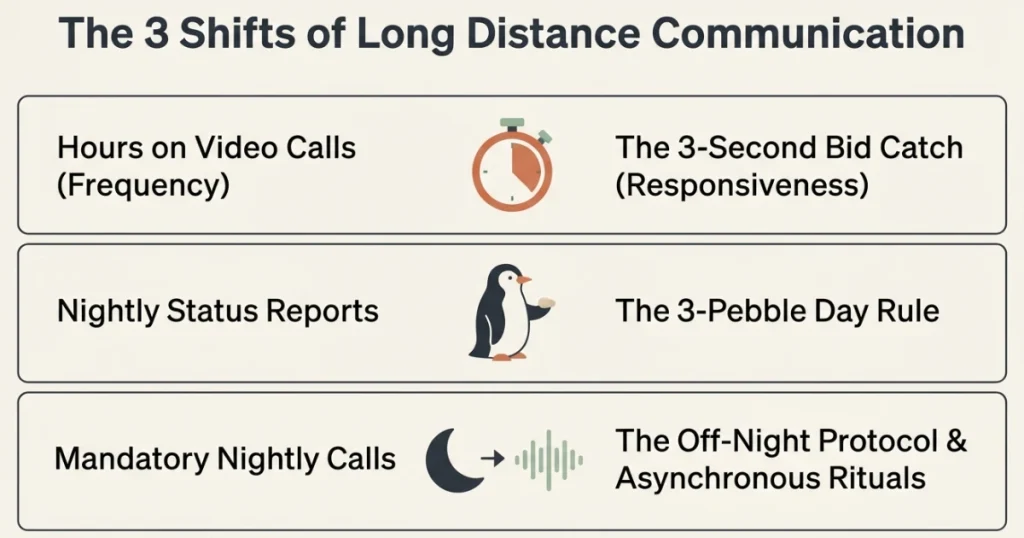
You do not need to overhaul your entire relationship overnight to feel a difference. For the next 48 hours, keep your total communication time roughly the same, and test these four concrete strategies to reset your texture.
1. The 3-Second Bid Catch
Watch for three small emotional bids from your partner each day, whether a random meme, a sigh over text, or a quick photo. Reply to the emotion inside the message within three seconds of opening it. If you are tied up at work, use this exact script: “Saw this and love it, buried in a project right now, can’t wait to reply properly at 5!”
2. The Non-Logistical Pebble Drop
Commit to sending three small pebbles per day that require zero logistical follow-up. Send a morning photo of your coffee mug, a mid-day link to a song that reminds you of them, and a 20-second bedtime voice note sharing one funny thing you saw today. Watch how the pressure to host a nightly talk show immediately drops.
3. The Named Off-Night Script
Pick one evening during the next 48 hours where you intentionally skip your routine nightly call and replace it with a warm voice note. Send this message two hours before your usual call time: “Hey love, my brain is fried tonight, so I’m taking an off night to rest and sending you a bedtime voice note instead. Can’t wait to catch up tomorrow at 7!”
4. The Texture vs. Safety Reflection Audit
At the end of the 48 hours, take five minutes to evaluate how the experiment felt in your body. Ask yourself two diagnostic questions: “Did stepping back from daily reporting make me feel lighter and warmer toward my partner?” and “When I sent pebbles and named my delays, did my partner lean in warmly or pull further away?” Your answers will tell you clearly whether you are solving a habit problem or uncovering a deeper relational mismatch.
Frequently Asked Questions
Can a relationship work long-distance?
Yes, but not by replicating an in-person relationship through a screen. Research shows long-distance couples can report similar satisfaction levels to geographically close couples when they adapt their communication. The couples who thrive stop measuring connection in hours talked and start measuring it in responsiveness: how quickly and warmly they turn toward each other’s small bids for attention. Distance itself is not the deciding factor, because communication texture is.
What to do if you have a long-distance relationship?
Stop trying to talk more, and pick three small changes instead. Reply to your partner’s bids (the memes, the “ugh, this meeting” texts, the random photos) within seconds when you can, and name the delay when you cannot. Send three non-logistics “pebbles” a day, like a song, a photo, or a voice note that says “you crossed my mind.” Finally, build one asynchronous ritual (a daily question you both answer on your own time) plus one protected weekly conversation for less volume and more responsiveness.
How long does a long-distance relationship normally last?
The numbers vary widely depending on what is being measured and who is asked. Some studies report averages as short as 4.5 months, while others find long-distance couples lasting around three years, breaking up at rates comparable to geographically close couples. The more useful answer is that duration is not predicted by the distance itself. It is predicted by whether both partners feel chosen in the small, daily moments of contact, regardless of how many miles separate them.
Trading Volume for Presence
The next time 11 p.m. rolls around, you do not have to stare at your ceiling wondering why a two-hour phone call left you feeling like strangers. You now have the practical blueprint to trade exhausting daily reports for fast emotional responsiveness, thoughtful pebbles, and rituals you actually choose.
Distance does not break relationships; the exhausting performance of trying to talk your way across it does, and real closeness starts the moment you trade hours on the clock for genuine presence in the small moments.
My Closing Remarks
I still think about those late-night phone calls from my own years spent loving someone across state lines, staring at a glowing screen and wondering why two hours of talking left me feeling so empty. Nobody tells you that missing someone can make you overworked as a communicator. Give yourself permission to put the phone down tonight without guilt. When you stop treating every conversation like a lifeline that has to prove your love, you finally leave room to actually enjoy each other again.
More Related Stories for You
If you notice that delayed texts or skipped calls still trigger a strong wave of panic even when your partner names the delay, it can help to explore how attachment styles in relationships shape the way we react to physical distance and silence.
About The Author

Related Articles