
 Nicole Adkins

A real permission structure for siblings who are done being the family shock absorber.
Key Takeaways
- Learning how to deal with a toxic brother starts with filtering the guilt your family installed in you decades ago.
- The FENCE method gives you five rules you can use tonight. Not theory for later.
- You can protect your peace without becoming the villain of the family story.
Quick Answer
To deal with a toxic brother, use five rules in order. Filter the guilt your family taught you. Exit the room when he performs for an audience. Name the behavior once without arguing. Cut off money and emotional support. Put your own household first. Consistency works better than confrontation.
Contents
Table of Contents
Most people who type how to deal with a toxic brother into Google are not looking for a list of warning signs. They already know what he is.
We all grow up thinking family is supposed to feel like a safe landing spot. Then one sibling spends twenty or thirty years proving that idea wrong, and everyone else at the table acts like nothing happened.
You’re driving home from Sunday dinner right now. Hands a little too tight on the wheel. Replaying the comment your brother made about your parenting in front of your aunt and your kids. Then you remember what your mom said two minutes later. “Oh don’t take it so personal, he’s just going through a rough patch.” That sentence stings almost worse than his did.
If that scene feels familiar, you’re not searching for a diagnosis. You’re searching for permission to stop being the family’s shock absorber.
What you’re living through isn’t normal sibling rivalry, because rivalry usually fades with age. What you’re describing is a pattern family therapists call triangulation. Psychiatrist Murray Bowen first mapped this out decades ago. One person’s bad behavior gets quietly managed by everyone around him so the family never has to deal with it directly (Bowen, 1978). It happens in workplaces too. It just cuts deeper when the person doing it shared your childhood bedroom.
The Family System You Were Born Into (And Why It Keeps You Stuck)
You’re also not alone in this, even though it feels isolating at 11pm on a Sunday. Researchers at Cornell University, led by sociologist Karl Pillemer’s landmark research on family estrangement, found that roughly 27 percent of Americans report being estranged from a family member. Sibling relationships are the most common type to break down.
So if you’ve asked how do you deal with a toxic brother and felt like the only person on earth with this problem, the numbers say otherwise.
Here’s the part that actually explains why you feel stuck though. It’s not really about him. It’s about the role the family handed you before you were old enough to say no thanks. You got cast as the responsible one. He got cast as the one who just needs grace. Nobody voted on this. It just happened, and thirty years later you’re both still playing the same parts at Thanksgiving.
The FENCE Method: 5 Rules For How To Deal With A Toxic Brother In Real Time
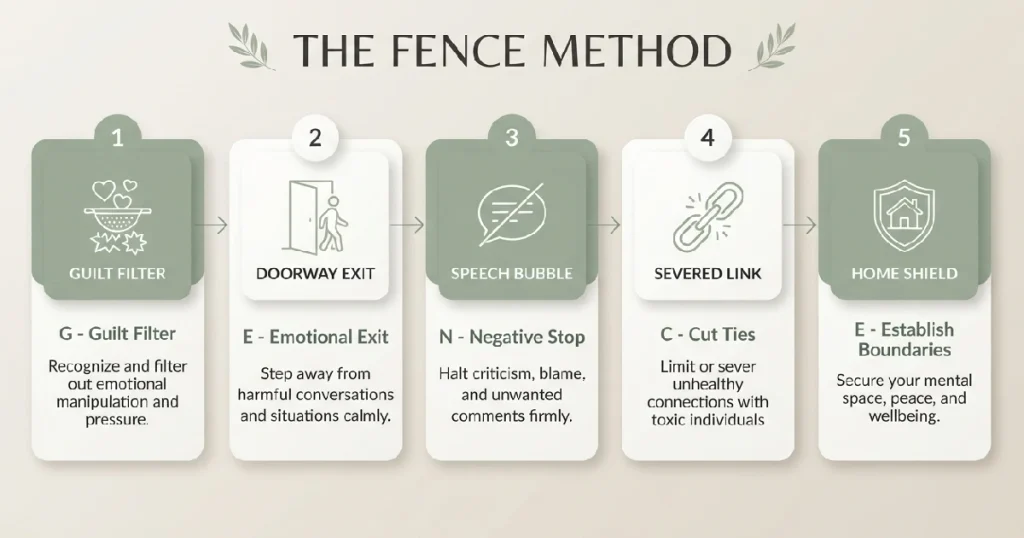
So how do you deal with toxic brother behavior? Not in a therapist’s office. At the dinner table. At your dad’s hospital bedside. On the phone at 10pm for the third time this week.
These five rules work in order. Use them that way. They spell FENCE, because that’s exactly what you’re building.
Rule 1: Filter The Guilt
Before you set a single boundary, you have to deal with the voice in your head that isn’t even his. It says you’re the older one. You’re supposed to be the bigger person. Don’t upset your mother. The American Psychological Association’s guidance on family boundary setting describes guilt like this as a conditioned response rather than a moral signal. It fires whether or not you’ve actually done anything wrong.
Take Dana. Every time her brother Kyle showed up late and half checked out to their dad’s chemo appointments, Dana felt a hot flash of guilt the moment she considered saying something. Not because she’d done anything wrong. Because the script she learned at age nine said the older sibling keeps the peace no matter what.
The fix isn’t telling yourself not to feel guilty. That rarely works. The fix is naming the guilt as a program instead of a fact. Try this exact line before you talk to him: that script was written when I was nine, I am not nine, I do not owe him my silence to keep the table quiet. If this guilt pattern runs deeper than just your brother, it usually traces back to how your parents handle conflict in general.
Rule 2: Exit The Performance
Toxic behavior needs an audience to really land. That’s not a character flaw unique to your brother. It’s a pattern seen in people who use charm and control to manage how a room sees them. Take away the witnesses and a lot of the behavior loses its point.
Dana’s brother Kyle was a different person one on one than he was at the family barbecue. At the barbecue he’d corner her by the cooler and make a comment about her job, loud enough for three cousins to half hear. Then he’d turn around and crack a joke for the crowd. She used to freeze because everyone was watching.
Here’s what changed it. When he starts, say “I’m going to grab some air.” Smile. Walk outside. Don’t explain. Don’t re-engage. On the phone, say “I’m not going to continue this conversation, I’ll call you next week,” then hang up. No dramatic mute. Just end the call. If your mom asks why you stepped out later, “I needed some air” is a full answer.
Rule 3: Name It Once
Psychologist Manuel Smith described an assertiveness technique sometimes called the broken record method back in the 1970s. You state your position one time clearly. Then you simply repeat it without justifying or escalating (Smith, 1975). The power isn’t in arguing better. It’s in refusing to negotiate at all.
At the next dinner, when Kyle brought up Dana’s parenting in front of the kids, she said one sentence. “I’m not going to discuss my parenting with you. If you bring it up again tonight I’ll leave.” Then she changed the subject. He tested her once more twenty minutes later. She got her coat.
Repeating a boundary five times with more explanation each time tells everyone, including you, that you’re not sure you mean it. Saying it once and then acting on it tells everyone the decision is already made.
Rule 4: Cut The Supply
Family researchers use the word enabling for what happens when someone keeps absorbing the consequences of another adult’s choices. Usually out of love. Usually at real cost to themselves. It feels like loyalty. It functions like a subsidy.
For years Dana was Kyle’s unofficial bank, his crisis line at midnight, and the one who called his landlord when he “forgot.” Her parents expected it, because she was always the one who “had it together.”
Supply has three parts. Money, emotional labor, and logistical rescue. On money, try “I love you, and I’m not in a position to help him financially, that’s between him and his choices.” On emotional labor, let voicemail be voicemail. On logistics, stop fixing what he’s capable of fixing himself. This isn’t punishment. It’s the end of an unpaid job you never applied for.
Rule 5: Establish Your Unit First
Bowen’s family systems theory calls this differentiation. It’s the ability to stay connected to your family of origin while still operating as your own person with your own values (Bowen, 1978). Your primary loyalty shifts once you build your own household, whether that’s a partner, kids, or close chosen people.
Dana and her husband now agree on a plan before every holiday. Two hours, and if Kyle starts in on her in front of the kids, they leave. No debate in the moment, because the decision got made in the car beforehand.
You’re also allowed to protect your kids from an uncle who undermines or embarrasses them. “The kids aren’t coming this year” is a complete sentence. The fence isn’t just around you anymore. It’s around your whole household, and he doesn’t get a key.
A quick, honest note. Once you start using these rules, a strange sadness tends to show up that nobody warned you about. You can grieve a brother who is still alive. You’re allowed to miss the kid who shared a bunk bed with you at seven, while still refusing to be treated badly by the man he is at forty. Both things are true. Let them both be true.
3 Questions You’re Probably Asking Right Now
How do you deal with a toxic brother when your parents expect you to keep the peace?
You stop keeping it. The peace you’ve been keeping is really just his comfort, paid for with your silence. Try telling your parents once, calmly: I love you, I won’t pretend his behavior is fine to keep dinner pleasant. You don’t need their approval for this. You need your own.
What if he’s also the one caring for our aging parents?
Separate the caregiving from the relationship. They’re not the same ledger. You can say thank you for driving dad to his appointment, and still mean that doesn’t erase how you spoke to me last week.
Will he ever change, or am I wasting time waiting around?
You’re not required to wait, and you’re not required to predict whether he’s capable of change. Build the fence. Live your life. If he changes later, the fence can get a gate.
What To Do Next: 3 Ways To Start Tonight

The Guilt Audit. One place to begin is a two minute audit before your next family event. Write down the exact sentence your family used on you growing up, something like “you’re the responsible one.” Then write one line back, the way Dana did. Keep it in your phone notes.
The Exit Line Rehearsal. Consider testing your exit line out loud before you need it, the same way you’d rehearse a job interview answer. Say “I’m going to grab some air” to your bathroom mirror a few times. A line only works under pressure if your mouth already knows the shape of it.
The Two Hour Agreement. Before the next holiday, sit down with your partner or a close friend and set a time limit and an exit trigger together, in writing. Something like: two hours, and if he brings up my job in front of the kids, we leave. Deciding this beforehand means you’re not negotiating with yourself while he’s standing three feet away.
None of these three things require your brother to cooperate or apologize. That’s the point. A fence doesn’t ask the weather for permission. It just gets built.
You’re Allowed To Love Him From A Distance
Picture that same drive home from Sunday dinner. Same tight hands on the wheel, maybe. Except this time you know what Filter, Exit, Name, Cut, and Establish actually mean. You already used two of them tonight.
He might call you selfish for it. Your mom might sigh. The family group chat might go quiet for a few days. You will survive every bit of that, because you’ve survived harder things sitting at that same table for years.
You don’t owe your brother your peace. You owe that to yourself.
My Closing Remarks
I’ll be honest, I still show up to family dinners. I just don’t sit next to my own version of this story anymore. My mom is still a little disappointed about that, and I’ve made peace with her disappointment too. You can love someone from across the table and still refuse to be his audience. That’s not coldness. That’s just what growing up actually looks like.
More Related Stories For You
If this dynamic shows up with more than just your brother, read how to deal with toxic family members for a wider look at protecting your peace across the whole family system.
About The Author