
 Nicole Adkins

A guilt-free way to stop performing sisterhood and protect your peace, without starting a family war.
Key Takeaways
- Learning how to deal with a toxic sister isn’t about cutting her off. It’s about making her opinion of you stop mattering so much.
- The GLASS Method gives you five specific boundaries you can actually use this week, not vague advice like “communicate better.”
- You’re allowed to grieve the sister you never got AND calmly manage the one you actually have. Both things are true at once.
Quick Answer: To deal with a toxic sister, use the GLASS Method: Ground your identity outside her opinion of you, Limit what information she gets, Assign her no authority over your choices, Stop performing closeness for family’s sake, and Separate your partner and kids from her reach. Consistency works better than confrontation.
Contents
Table of Contents
You just got off the phone with your sister. She made a comment about your new job, something small, something that sounded like a joke if you weren’t paying attention. Your mom laughed. You said nothing. Now you’re sitting on the edge of your bed at eleven at night feeling thirteen years old again, and you’re thirty eight.
If you typed “how to deal with a toxic sister” into Google tonight, you’re not overreacting. You’re done being the family’s emotional punching bag and calling it sisterhood because that’s what you were told it was supposed to look like.
Every greeting card at the store says “To My Sister, My Best Friend.” You’ve picked one up before and felt absolutely nothing. That’s not a flaw in you. That’s a flaw in the script you were handed.
So how do you deal with a toxic sister when you still have to sit across from her at Thanksgiving for the next thirty years? That’s exactly what this is about. Five boundaries. One method. Real sentences you can actually say out loud.
The Sister Wound Is Real, And the Research Proves It
Here’s something nobody tells you. Sister relationships carry the heaviest emotional expectation of any sibling pairing there is. When that expectation gets violated, it doesn’t just annoy you. It wrecks something deeper.
Research published through the American Psychological Association’s work on family psychology has looked at adult sibling conflict and found that things like favoritism, unsolicited advice, and crossed boundaries are directly tied to lower life satisfaction and higher rates of depressive symptoms in adulthood. This isn’t a soft feeling. This is a measurable pattern.
You can read more in this research on adult sibling conflict and its impact on psychological well-being, which breaks down exactly why sister conflict hits harder than most people admit out loud.
There’s a name for what you’re actually mourning here. Call it the Phantom Best Friend. It’s the sister who was promised to you by every movie, every card, every family photo caption, and who simply never showed up. You’re allowed to grieve her even though the real woman is standing right there at Christmas dinner.
Understanding how to deal with toxic sister dynamics starts with putting that grief down so you stop measuring your real sister against a fictional one.
The GLASS Method: 5 Boundaries That Actually Work
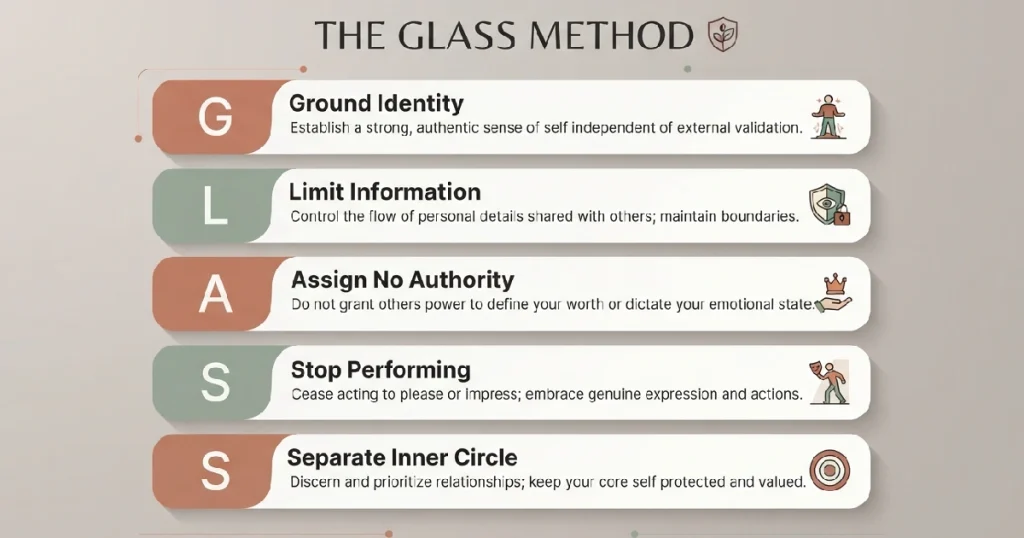
So how do you deal with toxic sister behavior, not in theory, but at your mom’s Sunday dinner table or in the family group chat at 9pm on a Tuesday? These five boundaries spell GLASS. You can see her through it. She can’t walk through it into your life anymore.
Ground Your Identity Outside Her Narrative
Here’s the mechanism nobody explains to you. Your sister’s power over you depends entirely on you still seeing yourself through the lens she built in 1996. If she cast you as “the messy one” or “the dramatic one” when you were nine, part of you is still quietly auditioning to disprove it.
Take Jenna. Her older sister called her “the chaotic one” for thirty years, even after Jenna built a stable career and raised two kids without incident. Every family gathering, Jenna found herself over-explaining her choices like she was still twelve.
What broke the pattern wasn’t a big confrontation. Jenna wrote down three true things about herself her sister had never once acknowledged. “I’m a good mother. I finished my degree while working full time. I stayed in my marriage through a genuinely hard year.” She read them in the car before walking into family dinners.
This isn’t confidence coaching. The British Psychological Society’s work on family dynamics notes that childhood roles assigned by siblings often persist well into adulthood unless they’re consciously dismantled, which is a real clinical observation, not a feel-good platitude. Try the internal script: “That’s her version of me from decades ago. I’m not that person. I don’t need her to agree.”
Limit the Information Flow
Information you give her in trust becomes ammunition later. That’s not paranoia. That’s a pattern described repeatedly by people living through this exact dynamic.
Think of it as an information diet. She doesn’t get updates on your finances, your marriage struggles, your health scares, or your five year plan anymore. Not because you’re punishing her. Because what she doesn’t know, she can’t use.
At dinner, when she probes, try this. “Oh, things are good, thanks. How’s your garden coming along?” Then change the subject completely. Don’t justify the redirect. Don’t explain why you’re being vague.
If your sister in law is the one fishing for details through your brother, the same rule applies there. Learning how to deal with a toxic sister in law often starts with limiting what your brother knows, at least until the relay stops running through him straight to her.
Assign Her No Authority
She is not your manager. She’s not your co-parent. If she’s your older sister, her seniority expired the day you both turned eighteen, whether she accepted that memo or not.
When she gives unsolicited parenting advice, try: “Thanks for the thought. I’ve got it handled.” That’s a complete sentence. You don’t need to debate your parenting philosophy with her at the dinner table.
If a sister in law critiques your relationship with your partner or her brother, try: “I appreciate the concern. I’ll talk to him about it directly.” This quietly removes her from the loop without any drama attached to it.
If you’re wondering how do you deal with a toxic older sister who still talks down to you at forty three, here’s the honest answer. The authority she holds was installed by your parents when you were both children. You’re allowed to uninstall it now, and you don’t need her permission or theirs to do it.
Stop Performing the Good Sister
Name the performance for what it is. Showing up to every single event, bringing the perfect gift, smiling through the group photo, defending her to relatives who already know better.
You’re allowed to reduce it. Attend every other gathering instead of all of them. Send a text instead of a three hour visit. Sit at the far end of the table. Leave by eight without announcing it or explaining yourself to anyone.
Your mom will notice. She might sigh and say “can’t you two just get along.” Your answer can simply be, “I’m here. I’m being civil. That’s what I can offer right now.” Full stop, no further defense required.
Separate Your Inner Circle
Your partner, your kids, your closest friends sit behind the final pane of glass. Your sister doesn’t get a vote in how you raise your children or run your marriage.
If she undermines your parenting in front of your kids, one calm line handles it. “We do things differently in our house,” then redirect your child. No showdown required.
If she gossips about your partner to the family, tell your partner once, factually, and then let it rest there. Don’t make him or her fight battles that belong to you. This principle matters for how to protect your children from toxic family members too, since kids absorb far more of this tension than adults assume.
She can see the light in your window. She doesn’t get a key to the house.
You’ll feel a specific kind of sad once the glass goes up. It’s not sadness for her. It’s grief for the sister you were promised, the one who would’ve held your hair back or called you at 2am just to laugh about nothing. She didn’t show up. You’re allowed to mourn the phantom, pour your tea, and go home anyway.
What To Do This Week

Try the Paper Exercise tonight. Write three true things about yourself your sister has never once acknowledged. Keep the list in your phone. Read it before you walk into any family event.
Test the Redirect Script at the next dinner. When she probes for details, answer in one short sentence and immediately ask her a question back about something she loves talking about. Watch how much easier the room feels.
Practice the Ninety Minute Exit. Before your next family gathering, decide your departure time in advance. Leave without a speech. Don’t explain it to anyone, including yourself.
One place to begin might just be the paper exercise, since it costs nothing and takes four minutes.
Frequently Asked Questions
How do you deal with a toxic sister who badmouths you to your parents?
Stop defending yourself to your parents every single time. Address it directly with her once, calmly, and then redirect your energy toward your own peace rather than correcting the narrative with everyone in the family.
Is it normal to not feel close to your sister at all?
Yes, completely normal. Research on sibling relationships shows closeness isn’t automatic just because two people share parents, and expecting it to be can actually deepen the hurt when it doesn’t happen naturally.
Can a toxic sister relationship ever get better?
Sometimes, usually only if she takes real accountability without you chasing her for it. Until then, dignified distance through the GLASS Method tends to be far more sustainable than waiting for change that may never come.
You Can See Her Through the Glass
Remember the phone call that started all this, the joke, the laugh, the thirty eight year old sitting on the edge of her bed feeling small. You now have a map for that exact moment. Ground, Limit, Assign no authority, Stop performing, Separate.
Reading this far doesn’t make you the difficult sister. It makes you the author of your own life instead of a character stuck inside hers.
The glass isn’t cruelty. It’s simply the line between who she is and who you’re finally allowed to become.
My Closing Remarks
I sat exactly where you’re sitting now, tea gone cold, replaying something small my own sister said at a dinner I didn’t even want to attend. It took me about a year to stop auditioning for her approval. I still go to my mom’s birthday dinner every year. I just sit at the other end of the table now, and I leave by eight. Nobody’s ever asked why, and I’ve never explained it.
More Related Stories for You
If this resonated, you might also want to read about how to deal with toxic family members for the wider playbook beyond just sisters.
About The Author