
 Sara Carmen
Love is not missing from your marriage. It is simply arriving in a dialect your partner cannot yet hear.
Key Points
- A different language for love does not mean you are incompatible. It means you are still speaking from your own emotional dialect.
- Most couples give affection the way they wish to receive it, then feel exhausted when that care goes unnoticed.
- Daily micro-behaviors and genuine emotional attunement rebuild a happier marriage far more reliably than matching any quiz result.
Contents
Table of Contents
A mismatch in how you show love happens not because affection is missing, but because you default to giving care the way you wish to receive it. Lasting happiness comes from relational multilingualism: the daily habit of translating your love into a form your partner can actually absorb.
We work so hard at loving the people we married. We fold the laundry they forgot. We plan the dinners. We remember the dates that matter. And still a quiet ache sits between us at the end of the day, the sense that all that effort somehow never quite landed.
You know this feeling. You leave the office early to cook. You send the thoughtful text. You take care of the thing they mentioned once, three weeks ago. Then you wait for the warmth that should follow. It does not come. Or it comes in a form you barely register, and you both go to bed a little more alone than you intended.
Someone might think their partner has grown cold. But what they do not see is a person who spent the entire week trying to say I love you in the only dialect they know.
Someone might think they are the only one trying. But what they do not see is their spouse filling the gas tank, paying the bill, or sitting nearby in silence, believing that presence itself was the gift.
Someone might think the marriage is running out of love. But what they do not see is two people broadcasting on different frequencies, each wondering why the other never answers.
That gap has a name. Psychologists call it an expression-reception discrepancy. In plain language, it means the way you encode care and the way your partner decodes it are not the same channel. You are not failing at love. You are speaking a different language for love without a translator in the room.
Left unexamined, this pattern does not just create distance. It can quietly become the story you tell yourselves about why the marriage stopped feeling like home.
The Psychology Behind a Different Language for Love
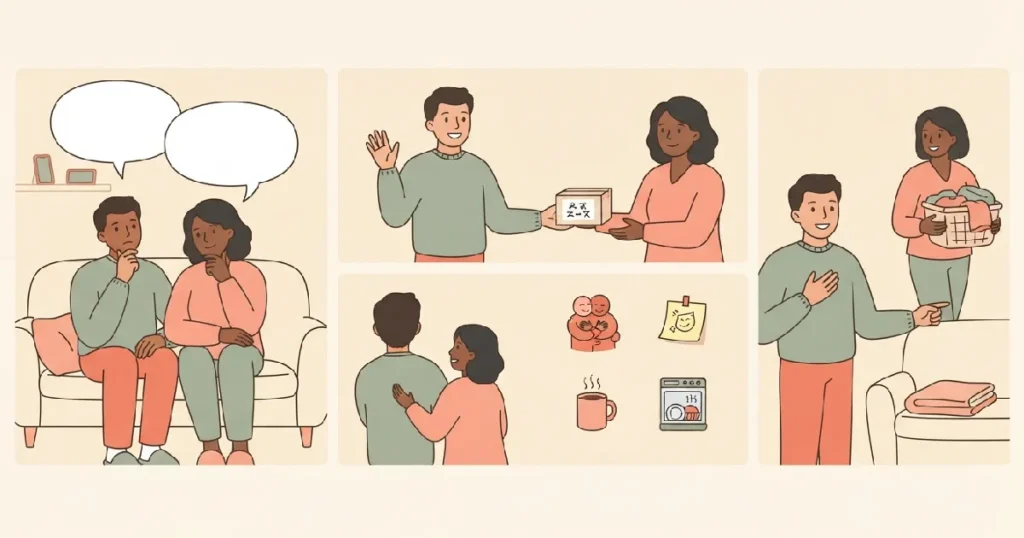
Here is the mechanism most couples never get named for them.
You do not give love randomly. You give it the way your nervous system learned that love is supposed to look. If reliability made you feel safe as a child, you will show love by handling tasks. If warmth arrived through touch, you will reach for a hand. If praise was scarce and precious, you will offer words and wait to hear them back. This is not a personality quirk. It is attachment memory doing its job.
Researchers call the next part projection bias. You treat your partner as an emotional mirror. You assume the thing that fills your tank will fill theirs. So you keep pouring from your own pitcher. When they do not light up, you pour harder. When they still do not light up, you conclude they do not appreciate you. They, meanwhile, have been standing at a different well the entire time.
Most people in this situation do not realize how ordinary this is. It is not a sign you married the wrong person. It is a sign you married a separate human being.
There is another problem hiding underneath the popular quizzes. Relationship scientists have found that most people do not have one fixed, exclusive way of feeling loved. Affection works more like a balanced diet than a blood type. Words, time, touch, help, and tokens all matter. When you lock yourself or your partner into a single category, you stop feeding the rest of the marriage.
A team at the University of Toronto reviewed the evidence behind the famous five-category model and found little proof that matching a primary style automatically produces a healthier bond. What predicted satisfaction was not the label. It was whether a partner noticed a need and responded to it. You can read that research in this University of Toronto report on love languages.
That finding should take a weight off your chest. You do not need identical emotional profiles. You need willingness.
Clinicians call this perceived partner responsiveness. It is the felt sense that the person beside you sees you, values you, and will move toward what you need. Studies housed in the National Library of Medicine keep returning to the same conclusion: responsiveness predicts closeness more reliably than any shared “type.” Matching languages is pleasant. Feeling answered is what keeps a marriage alive.
Maya and David Were Both Trying. That Was the Problem.
Maya kept a running list in her phone. Dry cleaning. His mother’s birthday. The dentist he would cancel if she did not book it. She believed love looked like a life that ran smoothly because someone was quietly holding it together. David believed love looked like being wanted. He reached for her in the kitchen. He asked her to sit on the couch after the kids were down. She would finish one more email. He would go to bed first.
By the time they sat across from me, Maya was furious at being invisible. David was lonely in a house full of completed chores. Neither was unloving. Each was fluent in a dialect the other could not hear.
The turning point was not a grand apology. It was a smaller, stranger act. Maya set a 9:15 reminder labeled “phone down, ten minutes.” David started unloading the dishwasher before she asked, then said out loud, “I did this so your morning is lighter.” She needed the help and the sentence that made the help visible. He needed her body in the room and her eyes, not just her efficiency.
They did not become the same person. They became translators.
The Modern Dimensions of Affection in Marriage

If love is a diet, every modality still has a job. The work is not to pick a favorite. The work is to learn what each one actually delivers in a long-term marriage, especially now, when attention is the scarcest resource in the house.
Words of affirmation are not empty compliments. In a mature marriage they function as emotional validation. They name the invisible labor. “I saw how you handled that call with the school” lands differently than “you look nice.” One praises a surface. The other tells your partner their inner effort registered.
Quality time is the most requested form of care in many surveys of married adults, and the hardest to deliver. Co-presence is not the same as undivided presence. Two people on a couch, both scrolling, are occupying the same furniture. They are not occupying the same moment. Quality time in a modern marriage is a digital boundary, not a shared zip code.
Physical touch is often reduced to sex, which is why so many partners miss its daily job. Non-sexual touch, a hand on the shoulder, a lingering hug at the door, is a nervous-system regulator. It tells the body, before the mind has words, that it is not alone. If touch is your partner’s channel and you only offer it at night, you have been silent all day.
Acts of service fail when they are self-selected. Washing a car your partner did not care about, while the form they have asked you to sign sits untouched, is not service. It is a monologue. Strategic empathy means reducing their cognitive load, the mental pile of remembered tasks, not performing the chore that makes you feel useful.
Receiving gifts is the most mocked modality and the most misunderstood. In a long marriage a gift is rarely about price. It is proof of being held in mind during the hours you were apart. A coffee they like, placed on the counter without a speech, says: you existed in my head when you were not in the room.
None of these is a personality test. They are delivery systems. The question is never “which one are you.” The question is “which one can your partner absorb today.”
Why Matching Love Languages Is Not Enough
This is the part most advice skips, and it is the part that changes the work.
Even couples who share a preferred style do not automatically feel close. Concordance is not connection. What moves the needle is attunement: the practiced habit of noticing a bid and turning toward it.
The Gottman Institute has spent decades coding these tiny moments. A bid is any small reach for contact. A sigh. A comment about the weather. A tap on the arm. Partners who stay stable over years turn toward those bids with remarkable consistency. Partners who drift turn away, or turn against. The anniversary trip cannot repair a thousand unanswered glances.
That is not weakness. That is wiring.
There is a second hidden variable. You cannot learn a different language for love if every piece of feedback feels like an attack. Dyadic studies, the kind that watch both partners at once, show that self-regulation, your ability to stay present when your ego gets bruised, accounts for more of marital satisfaction than language matching ever will. Work published across SAGE Journals on emotional responsiveness keeps pointing to the same skill: the capacity to hear “this did not land” without collapsing into “so I am a failure.”
Learning your partner’s dialect is, at bottom, an exercise in distress tolerance. You will feel clumsy. You will feel unseen while you are trying. The marriage grows in that exact discomfort, not around it.
The American Psychological Association has long described healthy marital communication as a regulated exchange, not a perfect script. You do not need better lines. You need a calmer nervous system when the lines do not work on the first try.
Four Practices That Build Emotional Attunement
Theory without a next move just becomes a more educated form of loneliness. One place to start is with four small, named practices. None of them requires a weekend retreat.
The Bi-Weekly Emotional Audit: Every other week, take fifteen minutes. Phones in another room. Ask two questions only: “What made you feel most supported this week?” and “Where did you feel an emotional gap?” Do not defend. Do not explain. Write down what you hear. The point is data, not a verdict. Maya learned that David never counted the packed lunches. He counted the ten minutes she sat down. That single fact redirected a year of wasted effort.
The Translation Protocol: Replace the global accusation with a specific, time-bound request. “You never spend time with me” gives your partner a character flaw to fight. “I need twenty minutes of phone-free conversation tonight” gives them a task they can complete. You are not being needy when you do this. You are handing them the glossary.
Micro-Dosing a Disfavored Language: If words feel unnatural, do not wait to become a poet. Set one daily reminder. One specific sentence. “I noticed you handled bedtime so I could finish that call. Thank you.” If touch feels awkward, start with a six-second hug at the door, long enough for the body to register safety. If gifts feel silly, put a two-dollar item they mentioned in their bag. Fluency is built in sixty-second reps, not in personality transplants.
The Intent Reframe: Before you correct how your partner loves you, name what they just tried. “I see that you cleaned the kitchen because you wanted me to rest. That matters to me. Tonight what I also need is you on the couch.” You train your own eyes to find the package they did send, even if it arrived at the wrong address. Appreciation first. Translation second. Correction never as the opening move.
A useful question to ask yourself tonight is simple. If my partner were already loving me, in their dialect, where would the evidence be? Look there before you conclude the evidence does not exist.
Sustaining Connection When Life Changes the Dialect

Emotional needs are not statues. Parenthood can make acts of service feel like oxygen and make long conversations feel impossible. A career pivot can make words of affirmation suddenly urgent, because identity has gone wobbly. Illness, aging, and grief rewrite the menu again. The couples who last are not the ones who took a quiz in year two and framed the result. They are the ones who keep asking what the other person can absorb now.
Relational flexibility is the long game. You become multilingual not by abandoning your native tongue, but by refusing to make it the only one spoken in the house. That is how a marriage stays habitable across decades instead of only across a honeymoon.
You already know how to love. The next skill is translation.
The quiet ache you woke up with this morning does not have to be the weather of the marriage. It can be a signal. Not that love left. That love has been speaking, on a channel you can still learn to hear.
Turn the dial.
My Closing Remarks:
I have sat with too many exhausted spouses who were already doing enough. They were just doing it in the wrong direction. If that is you, I want you to feel the relief and the responsibility at the same time. Relief, because you are not unlovable. Responsibility, because no quiz will do this for you. Tonight, do one clumsy thing in their dialect. Say the sentence. Put the phone down. Touch the shoulder. Then watch their face, not your own discomfort. That face is the only dictionary you need.
More Related Stories for You
- The private world the two of you are rebuilding deserves protection. Read more about why it helps to keep your relationship private while you learn how to speak to each other again.
About The Author