
 Nicole Adkins
Your open-door policy might be quietly breeding resentment. Here’s how real workplace transparency actually gets built.
Key Points:
- Open communication in the workplace without structure often collapses into venting sessions that drain HR and alienate your quiet high performers.
- Real team psychological safety isn’t about saying whatever you feel. It’s built through guardrails that make honesty useful instead of just loud.
- Five behavioral shifts can turn your flat hierarchy from chaotic to genuinely accountable, and you can test the first one in tomorrow’s meeting.
Contents
Table of Contents
Everything you have been told about open communication in the workplace might be making your team worse, not better.
You opened your door. You said the words every good leader is supposed to say: “My door is always open.” You meant it.
Then came the parade.
A vague complaint about a coworker’s tone. A Slack channel that quietly turned into a courtroom. A direct report who used the phrase “radical candor” as permission to say whatever crossed her mind, whenever it crossed her mind.
You didn’t build trust. You built a venting machine.
Command-and-control management feels cold and outdated now. Nobody wants to run a workplace where people are afraid to speak up. But unregulated transparency feels just as dangerous, like it’s quietly eating your HR team alive one complaint at a time.
Here’s the part almost nobody explains clearly. Open communication in the workplace was never supposed to be a personality trait or a vague cultural vibe. It’s a management system. And like any system, it fails without structure.
If you’ve been searching for how to improve communication in the workplace without triggering total chaos, this is where it actually starts. In my years working with leadership teams, the ones who succeed at flattening their hierarchy are never the ones who simply “encourage honesty.” They’re the ones who build guardrails around it first.
That distinction is what this piece is about.
The Hidden Trap of Unchecked Workplace Transparency
Most leaders assume the opposite of a rigid hierarchy is total openness. That assumption is exactly where things start to go wrong.
When “Authentic” Feedback Becomes Toxic Venting
There’s a real tipping point between constructive candor and corrosive complaining, and most companies never define where it sits.
Constructive candor names a specific behavior, ties it to an impact, and offers a next step. Toxic venting names a person, ties it to a feeling, and offers nothing but heat.
Picture a marketing coordinator named Priya. She’s frustrated that her manager keeps changing campaign direction mid-sprint. If she says, “I feel like nothing I do matters here,” that’s venting. It’s real, but it gives her manager nothing to work with.
If she instead says, “The direction changed three times this month without a debrief, and it cost us two production days. Can we lock scope before kickoff?” that’s candor. Same frustration. A completely different outcome.
Without a shared definition, HR departments end up refereeing tone instead of solving problems. That’s expensive, and it burns out the very people meant to protect your culture.
The Psychology Behind Team Psychological Safety
Here’s a common workplace myth that needs correcting: cohesive is not the same thing as safe.
Group cohesiveness describes how much a team likes each other and wants to keep the peace. It sounds healthy. Often it isn’t. High cohesiveness without structure tends to produce groupthink, a term used to describe how tightly bonded groups quietly suppress dissent to preserve harmony.
Team psychological safety is different, and far more useful. Harvard Business School professor Amy Edmondson, who has spent decades studying this concept, defines it as a shared belief that a team is safe for interpersonal risk-taking. It’s the felt permission to say “I made a mistake” or “I disagree” without fear of punishment or humiliation.
Notice what that definition doesn’t say. It doesn’t say you get to say anything, anytime, in any tone. It describes permission for candor, held inside a container of mutual respect.
Think of unregulated transparency like a fire built without a hearth. Fire itself isn’t the problem. It can warm a room, cook a meal, bring people close together. But without something to contain it, that same fire burns the house down. Open communication in the workplace works the same way. The heat of honesty needs walls to hold it, or it destroys the very thing it was meant to warm.
That’s the shift every leader trying to flatten their hierarchy needs to make. Structure isn’t the enemy of openness. It’s the only thing that makes openness survivable.
5 Modern Tips for Effective Communication in the Workplace
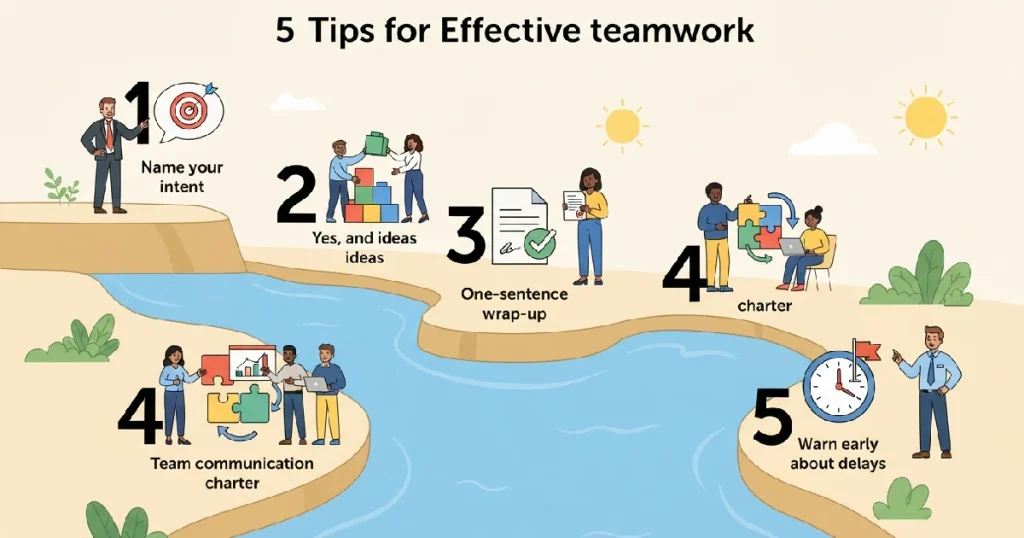
Once you accept that transparency needs architecture, the next question is practical. What does that architecture actually look like day to day? Here are five behavioral shifts worth testing with your team starting tomorrow morning.
1. Name Your Intent Before You Speak
Before delivering hard feedback, say out loud what you’re trying to do with it. Something as simple as, “I want to give you honest feedback on this data, and I also want to respect the work you put in,” changes how the next sentence lands. This is called a meta-conversational acknowledgement, a way of naming your intent before acting on it. Ambiguity about intent is often what makes people defensive, not the feedback content itself. Try this in your next one-on-one and watch the tension in the room drop by half.
2. Ban “Yes, But” From Brainstorming
Replace “no, but” and “yes, but” with “yes, and” during any idea-generation session. “But” quietly cancels whatever came before it. “And” builds on it. Improv performers have used this rule for decades because it keeps creative momentum alive instead of shutting it down at the first objection. Post the rule visibly in your next brainstorm and correct people gently when it slips.
3. End Meetings With a One-Sentence Summary
Close every cross-functional meeting by having each stakeholder state the outcome in one shared sentence. This is a form of progressive summarization, a micro-skill that forces complex directives into plain, aligned language before anyone leaves the room. Miscommunication rarely happens during the meeting. It happens in the twenty minutes after, when three people walk away with three different understandings of what was decided.
4. Let Teams Write Their Own Communication Charter
Have each department draft a short, self-organizing agreement about which tool gets used for what, before anything escalates to you. A charter might say Slack is for logistics only, email is for anything needing a paper trail, and disagreements about direction get a fifteen-minute call instead of a thread. Teams that design these rules themselves tend to actually follow them.
5. Flag Bottlenecks the Moment You See Them
Normalize telling affected parties about a coming delay the moment it becomes visible, not the day the deadline is missed. This is sometimes called an over-the-horizon loop, and it strips the surprise out of bad news, which is often what damages trust more than the delay itself.
These five habits are small. That’s the point. Big culture shifts rarely come from big speeches. They come from small, repeated behaviors that make honesty easier to practice than avoidance.
How to Securely Scale Your Employee Feedback Loop Framework
Individual habits fix conversations. But once you’re running a company of more than thirty people, you also need systems that scale honesty without drowning HR in noise. This is where a strong employee feedback loop framework earns its keep.
Guardrail 1: Enforce the Solution-Linked Format
Set a simple rule inside your performance software: no peer critique gets submitted without a concrete next step attached. If someone wants to flag a problem, they also propose one possible fix. This single rule filters out a surprising amount of low-value complaining before it ever reaches a manager’s desk, because it forces the writer to think past their own frustration.
Guardrail 2: Automated Triaging and Keyword Moderation
Modern platforms can be configured to flag emotionally charged language, things like “always,” “never,” or personal attacks, before a submission ever routes to a manager. This isn’t about censorship. It’s about triage. Flagged submissions get sent to a quick micro-coaching step instead of landing straight in someone’s inbox as a formal complaint, and that one pause often turns a reactive message into a workable one.
Guardrail 3: Visible Action Beats Stagnant Employee Feedback
Feedback fatigue is real, and it sets in fast. Employees stop filling out surveys the moment they suspect their answers vanish into a black hole with no visible follow-up.
According to the Harvard Business Review’s internal communications research, business units with highly engaged internal communication channels see measurable shifts in productivity, largely because employees can actually see leadership respond to what they hear. Visible action, not survey volume, is what builds durable trust.
The fix is operational, not motivational. Build a simple monthly ritual: pull the top three recurring themes from feedback data and publish what changed because of them. It doesn’t need to be dramatic. It needs to be visible and consistent.
Frameworks for Hybrid Teams and Asynchronous Communication Tools

Everything above gets harder when half your team is in the office and half is scattered across time zones. Hybrid work didn’t create the trust problem. It just made it impossible to ignore.
The Asynchronous Sandbox Framework for Remote Teams
Set up a shared, written space where any significant proposal has to stay open for forty-eight hours before a decision gets made. Anyone can comment in that window, regardless of location or time zone.
This single rule directly combats proximity bias, a well-documented risk in remote work where leaders unconsciously favor the ideas and visibility of people they physically see every day. Remote employees lose out here constantly, not because their ideas are weaker, but because they aren’t in the room when decisions happen informally.
Build a Multi-Tiered Communication Channel Blueprint
Not every message deserves the same tool. A workable blueprint looks like this: video calls for anything emotionally sensitive or high-stakes, project management software for anything needing a paper trail, and instant messaging strictly for quick, time-sensitive logistics.
When teams mix these up, urgent things get buried in email and sensitive things get flattened into a chat bubble that strips out tone entirely.
Trade Always-On Pings for Structured Office Hours
Constant pinging trains people to expect an instant reply at all hours, which quietly manufactures burnout. Replace it with scheduled, predictable access instead: a standing thirty-minute “open mic” window twice a week where anyone can bring a leader a question directly.
This also protects quieter or more introverted employees, who often get talked over in live meetings but do their best thinking in writing beforehand. Give them the sandbox window described above, and their voice stops depending on how fast they can speak up in a room.
Try This This Week: Turning Ideas Into Practice
Reading about guardrails is one thing. Building them is another. One place to start is picking a single tip from this piece, not all five, and testing it with your team for two weeks before adding the next one.
Consider naming your approach out loud to your team. Something like, “We’re testing a new rule this month, every piece of feedback needs a suggested fix attached.” Naming it turns a quiet policy shift into a shared experiment, which people tend to support more readily than a silent new rule.
A useful question to ask yourself before your next meeting: if someone disagreed with you right now, would they feel safe enough to say so, and specific enough to say it usefully? If the honest answer is no, that’s your starting point, not a failure.
Conclusion: Moving Beyond Command-and-Control
Open communication in the workplace was never meant to be a slogan on a values poster. It’s an active operating system, one that needs deliberate design the same way your budgeting process or your hiring pipeline does.
A flat hierarchy is not automatically a safer or more honest one. It’s only as strong as the structure holding it together.
Go back to that open door for a second. The door was never the problem. What was missing was a hallway leading somewhere, and a room built to hold what walked through it.
Build the room. The door was always the easy part.
My Closing Remarks
I’ve watched more leadership teams break their own trust with good intentions than with bad ones. Nobody sets out to build a toxic Slack channel. They just forget that honesty, like anything powerful, needs a container. Give your team the structure first. The openness that follows will actually last, and it will feel like relief instead of risk.
More Related Stories for You
If workplace stress follows you home, or your own anxiety makes these conversations harder to have, these mindfulness exercises for anxiety can help you show up steadier for the harder ones.
About The Author