
 Nicole Adkins
A quiet, tactical roadmap to reclaim your money, your safety, and your future, one careful step at a time.
Key Points
- Narcissist financial abuse hides behind closed doors, but it leaves clues you can learn to spot long before you plan your exit.
- A safe escape depends on total silence, not one dramatic confrontation, until every account and document is secured.
- Small, quiet moves made now can protect your credit, your cash, and your future far more than one big goodbye speech.
Contents
Table of Contents
You check your bank balance in private, like it’s something to hide. You calculate the cost of groceries in your head before you reach the register, even though you already know exactly what’s sitting in the account. You have learned to read a mood shift before a single word gets said, because in your house, money has never just been money.
If any of that sounds familiar, you are not imagining things. What you are living through has a name: narcissist financial abuse. It is one of the most common forms of coercive controlling behaviour, and it almost never leaves a mark anyone else can see.
Narcissist financial abuse happens when a partner uses money, debt, or access to resources to control, isolate, or punish you. Escaping it safely comes down to quiet financial safety planning: separate accounts, secured documents, and a support network built long before you ever say the word “leaving” out loud.
Most people in this situation do not realize how far the control has gone until they try to leave and discover they cannot even find their own name on a single bank statement.
According to research by Judy Postmus and colleagues, published in the Journal of Interpersonal Violence, economic abuse shows up in the overwhelming majority of relationships marked by coercive control, often years before any other form of abuse becomes obvious. Money is simply the quieter weapon. It doesn’t leave bruises. It leaves confusion, shame, and a nagging feeling that you must be bad with money, when the truth is the numbers were never really yours to control in the first place.
You can get out of this. But your exit has to be quiet, tactical, and planned with the same patience your partner used to build the trap.
Recognizing the Signs of Economic Control
Financial abuse rarely starts with a locked account on day one. It starts small, the way a pot of water warms so slowly the frog inside never thinks to jump.
The shared account trap. Your partner insists everything you earn goes into one account they oversee, while keeping a private account you’re not allowed to see. Ask to check it, and suddenly you’re the one being accused of not trusting the relationship.
Forced financial dependency. Maybe you were talked out of a promotion. Maybe you were pushed to quit your job “for the family” or to work unpaid in a partner’s business, a project that builds their wealth while your own resume goes quiet.
Secret debt and retaliation. Credit cards opened in your name without your knowledge. Loans you find out about only when a collections call reaches your phone. This is a textbook piece of coercive controlling behaviour, and it’s designed to make leaving feel financially impossible.
Weaponized micro-management. Your partner spends freely on themselves, then hands you a strict allowance for groceries or your child’s shoes, sometimes demanding receipts for every dollar. The rules only ever seem to apply to you.
If you counted two or more of these on your fingers just now, that recognition is not paranoia. It’s data.
The Golden Rule: Why You Never Announce You’re Leaving
Here is the part that feels counterintuitive if you’ve ever tried to solve a problem by talking it through. With a narcissistic partner, telling them you’re leaving before you’re financially ready isn’t honesty. It’s a warning shot.
Narcissistic injury is the clinical term for the intense, often disproportionate reaction a person has when their sense of control or superiority feels threatened. When your partner senses they’re losing power over you, the nervous system response isn’t sadness. It’s often rage, followed by retaliation aimed exactly where it will hurt most: your money.
Think of the control like a leash on a retractable cord. It gives you enough slack to feel like you’re moving freely, right up until the moment you pull too far, and it snaps you straight back to where you started.
That’s why joint accounts can empty overnight. That’s why credit lines get maxed the same week a partner suspects something is different.
But here’s what no one tells you: the safest move is rarely confrontation. It’s silence, followed by systematic, invisible action.
5 Steps for Financial Safety Planning Before You Leave
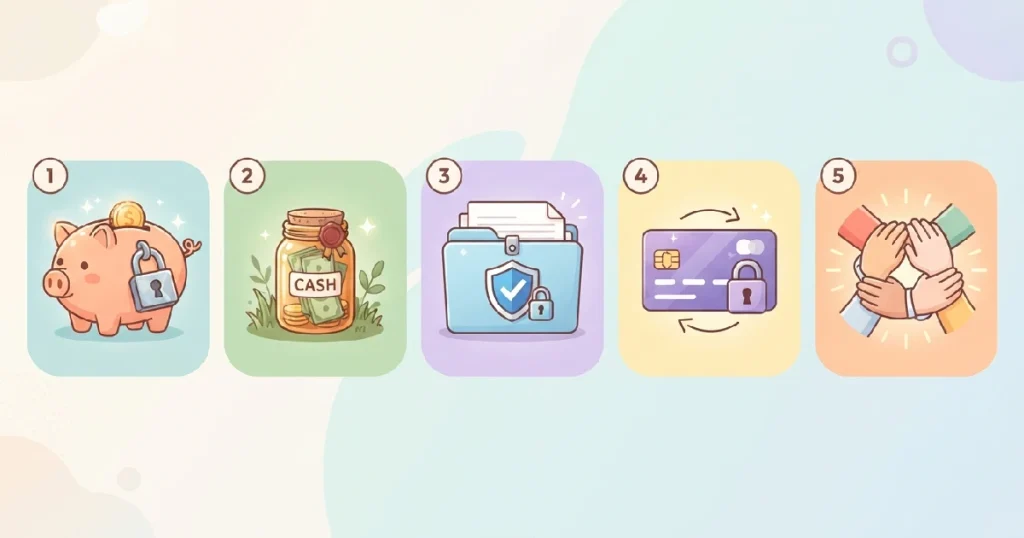
This is where the plan gets real. Each step is small enough to do quietly, and together they build the financial floor you’ll need to stand on.
Step 1: Open a Secret Account With Paperless Statements
Open an account at a completely different bank than the one your partner uses or watches. Choose paperless statements sent to a brand-new email address your partner has never seen, ideally accessed only from your phone or a device kept outside the home.
A single mailed statement or a shared inbox is often how quiet exits get discovered. Treat this account like it’s the only one that’s truly yours, because right now, it is.
Step 2: Quietly Build Your Hidden Escape Fund
Before you understand why this part feels so hard, it helps to know what’s actually happening in your brain.
Research by Anandi Mani, Sendhil Mullainathan, Eldar Shafir, and Jiaying Zhao, published in Science in 2013, found that financial stress taxes cognitive function the same way sleep deprivation does. They called it a bandwidth tax, meaning your mind spends so much energy tracking every dollar and every possible reaction from your partner that there’s less mental space left for planning and decision making.
That’s not a personal failing. That’s your brain doing exactly what chronic stress trains it to do.
Once you know that, the small stuff makes more sense. Take cashback at the grocery store, ten or twenty dollars at a time. Pocket cash gifts instead of depositing them. Store the cash somewhere outside the home, not in a drawer your partner might open.
Step 3: Vault Your Critical Documents Digitally
Locate your passport, social security card, car title, birth certificate, and recent tax returns. Photograph or scan every page using a secure, password-protected app, and store copies in encrypted cloud storage your partner has no access to.
If you can, leave physical duplicates with someone you trust completely, somewhere entirely off site. In my practice, I’ve seen how often people underestimate this step, only to realize during separation that their partner physically controls every document proving who they are.
Step 4: Audit and Freeze Your Credit Files
Pull your credit report and read it carefully, watching for accounts you never opened. This is one of the fastest ways to catch financial abuse hiding in plain sight.
Then place a credit freeze with each of the three major bureaus. This prevents your partner from opening new lines of credit in your name, even if they already have your social security number memorized.
Step 5: Map Out Support Networks in Total Secrecy
Use a private browser window or a device your partner has never touched to research local domestic abuse organizations and pro bono legal aid. Clear your history afterward every single time, without exception.
Some high street banks now build tools specifically for this. Monzo, for example, has introduced technology aimed at helping survivors flag financial abuse and access emergency funds discreetly. Several banks also offer emergency “flee funds,” small amounts of cash released quickly to someone documented as leaving an abusive situation. Ask about these options quietly and in person, never over a shared phone line or email.
Legal Strategy: How to Protect Assets From a Narcissist

Protecting assets from a narcissist means moving quickly and quietly, ideally before any paperwork gets filed.
The moment it’s legally safe to do so, change your digital passwords and remove your partner as an authorized user from your personal accounts. Document everything: lifestyle spending that doesn’t match reported income, unexplained transfers, joint debts, anything that tells the real financial story of the relationship.
If you’ve been wondering how to separate finances from spouse while still under one roof, the honest answer is that it starts on paper long before it starts in court. Gather statements, screenshots, and receipts now, because narcissistic partners often become far less cooperative once a filing is served.
Look specifically for a lawyer familiar with high-conflict divorce and coercive control, not just a general family attorney. Ask directly about a court-ordered financial freeze, sometimes called an asset restraint, which legally locks marital funds so your partner can’t drain accounts out of spite while proceedings unfold. A lawyer who understands narcissistic patterns will anticipate delay tactics and legal exhaustion, where a partner drags out the case simply to wear you down financially and emotionally.
Your Next 24 Hours: Where Financial Safety Planning Starts
You don’t need to do everything today. You need one solid starting point.
Consider the SAFE checklist: Secure your documents, Audit your credit, Fund a hidden account, Enlist one trusted contact. Pick just one letter and complete it in the next 24 hours.
A useful question to ask yourself tonight: is there one document I could photograph right now, in the next ten minutes, without anyone noticing? Start there. Momentum matters more than speed.
Reclaiming Autonomy After Narcissist Financial Abuse
Something shifts once the plan is actually in motion. Money stops feeling like a source of anxiety and starts becoming what it was always supposed to be: a tool for safety, choice, and healing.
Rebuilding from zero sounds frightening, but it is entirely survivable, and you don’t have to map it out alone. The National Domestic Violence Hotline offers free, personalized financial safety planning support, including help thinking through exactly the steps outlined here for your specific situation.
You are allowed to want your name back on your own financial life.
The Quiet Life on the Other Side
Picture yourself checking that new account balance again. Only this time, you’re not hiding it. You’re smiling at it.
The leash that used to snap you back doesn’t reach here anymore.
Narcissist financial abuse thrives on your silence and your fear. Your exit plan simply borrows that same silence and uses it against the control instead.
My Closing Remarks
I’ve sat across from clients who felt foolish for not “just leaving” sooner, and every time, I’ve had to remind them: you weren’t staying out of weakness, you were staying because the system built around you made leaving feel impossible. Watching someone quietly rebuild, one hidden account and one photographed document at a time, is one of the most hopeful things I get to witness in this work. You can do this too, and you don’t have to do it loudly.
More Related Stories for You
- Curious what a genuinely safe, respectful partnership looks like once you’re on the other side of this? Read our guide on the qualities of a good partner to know exactly what you’re rebuilding toward.
About The Author