
 Nicole Adkins
The problem was never your nerves. It’s where you’ve been pointing them.
Key Points
- Your racing heart before a presentation is a survival reflex and not a character flaw, and these Tips to Overcome Your Fear of Public Speaking work with that reflex instead of against it.
- Telling yourself to calm down fails because it asks your body to do the impossible. Relabeling nerves as excitement is easier and backed by research.
- The highest-risk window of stage fright is the first 60 seconds. Master that one minute and everything after it gets easier.
Contents
Table of Contents
Everything you’ve been told about calming down before a presentation may be making your stage fright worse.
You know your material cold. You could walk anyone through the roadmap or the hiring plan in your sleep. And yet ten minutes before you’re due to present it to the executive team, your heart starts hammering against your ribs. Your mouth goes dry. You stand up and hear a stranger’s voice come out of your throat. It wobbles on the second sentence and you spend the rest of the meeting monitoring it like a leaking pipe.
Afterward you tell yourself you’re fine. You’re not fine. You start to wonder whether something is fundamentally wrong with you. There isn’t.
The fastest way to overcome your fear of public speaking is to stop fighting adrenaline and start steering it. Relabel nerves as excitement, lengthen your exhale to slow your heart rate, script your first 60 seconds word for word, and move your attention off your body and onto the people you’re there to help.
That is the whole idea in one paragraph. The rest of this piece shows you how to actually do it under pressure.
Understanding the Corporate Panic: Why Stage Fright Paralyzes Your Career
The clinical name for what you’re feeling is glossophobia, from the Greek word for tongue. In plain terms it’s a fear of speaking in front of others that is intense enough to make you avoid it or suffer through it. Psychologists classify it as a performance-only form of social anxiety, which means you may be perfectly relaxed at dinner with friends and still fall apart at a podium. The engine underneath it is the fear of negative evaluation: a deep and mostly unconscious dread of being judged and found wanting by a group.
That dread is old. For most of human history being rejected by the group meant being left alone with the predators. So when you stand up in front of forty colleagues your brain’s threat detector, the amygdala, reads the scene and hits the alarm.
Your body thinks the boardroom is a cliff edge.
The alarm triggers your sympathetic nervous system, the branch of your nervous system that handles fight or flight. It floods your bloodstream with adrenaline. Your heart speeds up to move blood to your big muscles. Your digestion and saliva production shut down, which is why your mouth turns to sandpaper. The small muscles in your hands and larynx pick up a tremor, which is why your voice shakes. And your prefrontal cortex, the part of the brain that holds your carefully rehearsed points, gets less priority than your legs. That is the blank mind.
None of this is weakness. It’s wiring.
The Mayo Clinic notes that fear of public speaking is one of the most common forms of anxiety, and a well-known study by Dwyer and Davidson in 2012 found that people select public speaking as their most common fear more often than death, spiders, or heights.
Common does not mean harmless. Left unmanaged, presentation anxiety quietly caps a career. The people who get promoted are rarely the smartest in the room. They’re the ones whose ideas get heard. If your best thinking never survives the trip from your notes to the microphone, someone less prepared will get credit for a version of it. That is the real cost of stage fright, and it’s the reason the following tips matter.
7 Realistic Peer-Recommended Tips to Manage Public Speaking Anxiety and Speak Confidently
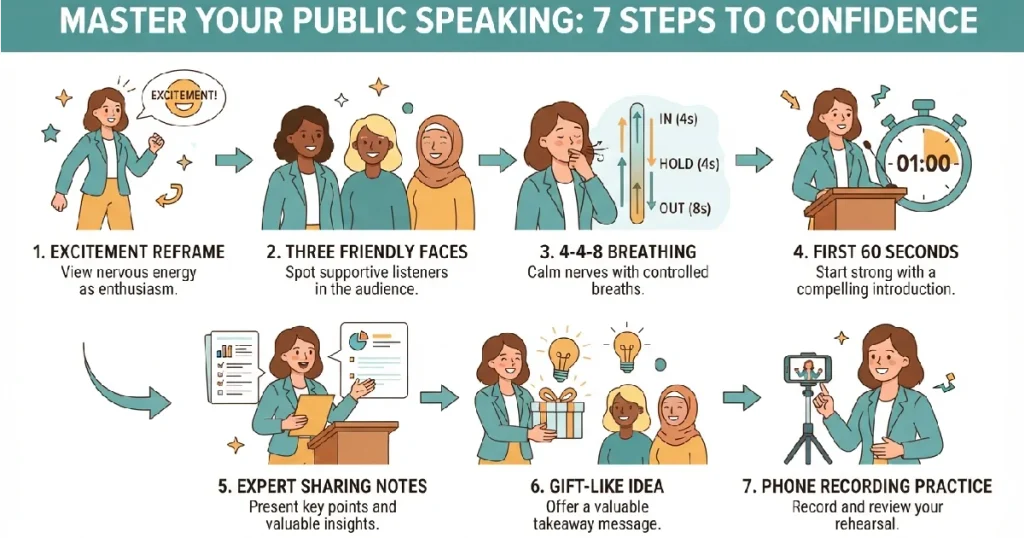
1. Reframe Public Speaking Anxiety as Excitement Instead of Fighting It
Here is the counterintuitive part. Trying to calm down before a presentation asks your body to move from high arousal to low arousal in seconds, which it cannot do. Excitement is also a high arousal state. Moving sideways from fear to excitement is a much shorter trip.
Harvard researcher Alison Wood Brooks tested this in 2014. Participants who said “I am excited” out loud before giving a speech were rated as more persuasive and competent than those who said “I am calm.” Same racing heart. Different label. Better outcome.
Think of adrenaline as rocket fuel with no opinion about direction. It will drive you toward the audience or straight into the floor depending on the story you attach to it. Your job is not to drain the tank. Your job is to point it.
How to execute:
- The moment you notice your pulse rising, say quietly or in your head: “This is excitement. My body is getting ready.”
- Repeat it three times. Don’t argue with yourself about whether it’s true. The label works even when you’re skeptical.
2. Break the Audience Monolith to Reduce Stage Fright
Your brain does not fear forty people. It fears one giant judging organism called “the audience.” That organism doesn’t exist. What exists is a woman in row two wondering whether she left her laptop charger at home and a man near the door hoping you’ll finish early.
In my practice I’ve watched anxious managers transform mid-sentence simply by finding one warm face and speaking to that person for ten seconds. Eye contact with an individual converts a performance back into a conversation, and your nervous system knows how to have conversations.
How to execute:
- Before you begin, scan the room for two or three people who are already nodding or smiling. Mark their positions.
- Deliver your first point to person one, your second point to person two, and rotate. You are not giving a speech. You’re having three conversations with witnesses.
3. Use the 4-4-8 Breathing Anchor to Calm Nerves Before a Presentation
Shallow chest breathing is both a symptom of panic and a cause of it. A long exhale is the fastest manual override you have. It stimulates the vagus nerve, the main cable of your parasympathetic nervous system, which is the “rest and settle” system that brakes your heart rate.
The mechanics matter. Your heart naturally speeds up slightly when you inhale and slows when you exhale. Make the exhale twice as long as the inhale and you tip the balance toward slowing down.
How to execute:
- Inhale through your nose for a count of 4.
- Hold for a count of 4.
- Exhale through slightly pursed lips for a count of 8, as if you’re cooling a spoonful of soup.
- Do four rounds in the hallway or at your seat. That’s under two minutes and nobody will notice.
4. Over-Prepare the First 60 Seconds of Your Speech
Anticipatory anxiety peaks right before and right after you begin speaking. Once you’re a few minutes in, the adrenaline that isn’t reinforced by new threat begins to clear from your bloodstream and your thinking brain comes back online. The danger zone is short. So defend it ruthlessly.
Most people rehearse the whole talk evenly. That’s backward. Memorize your opening 60 seconds word for word until you could say it while someone shouted at you. Everything after that can be looser because by then your body will have stopped screaming.
How to execute:
- Write your first four or five sentences out in full, including your name and the one line that tells the room why they should care.
- Say them out loud 20 times over three days. Say them while walking. Say them in the shower.
- On the day, your mouth will run the opening on autopilot while your brain catches up.
5. Establish the Expert Frame to Beat Presentation Anxiety
You are not standing up there to be graded. You are standing up there because you know something the room does not. That is the only reason meetings with presentations exist. This is called information asymmetry, and in this room it runs in your favor.
Anxiety flips the frame so that you feel like a student in front of examiners. Flip it back. You’re the person with the data, the plan, or the lessons learned. They came to receive it.
How to execute:
- Before you walk in, finish this sentence in writing: “By the end of this, they will know ______ that they don’t know now.”
- Read it twice. It relocates you from the defendant’s chair to the front of the classroom.
6. Shift From Performing to Giving to Silence Speech Anxiety
This is the tip most guides skip and it is the one that changed things most for my clients. The engine that keeps social anxiety running is self-focused attention. Psychologists Clark and Wells showed in the 1990s that anxious speakers turn their attention inward, monitoring their heartbeat and voice and sweat, and then use that internal data as proof they’re failing.
Here is the insight nobody tells you. You have one spotlight of attention. You can point it at your body or at the room. Not both. Every second you spend tracking your shaking hands is a second your message goes unattended, and the drop in quality then confirms your fear. The loop feeds itself.
Break it by choosing to give rather than perform. Performing asks “How do I look?” Giving asks “Did that land for her?” The second question pulls the spotlight outward, and your symptoms fade from awareness because nothing is watching them anymore.
How to execute:
- Pick one person in the room who genuinely needs what you’re about to say. Make the talk a gift to that person.
- When you catch yourself monitoring your voice, ask silently: “What does the room need next?” Then answer it.
7. Run a Video Audit to Expose the Illusion of Transparency
You feel like your panic is broadcast on a screen above your head. It isn’t. Psychologists call this the illusion of transparency: the belief that your internal states are far more visible to others than they actually are. Savitsky and Gilovich demonstrated in 2003 that speakers dramatically overestimated how nervous they looked, and that simply learning about this illusion improved their performance.
The fastest way to believe it is to see it. Film yourself and watch the footage.
How to execute:
- Record a full practice run on your phone. Note the exact moments you felt the worst inside.
- Watch it back and look for those moments. Most people find they cannot locate them. The internal earthquake registered as a slight pause on camera.
- Keep the clip. Rewatch it the morning of your real presentation as evidence.
The Empathetic Story: How Marcus Learned to Aim His Nerves
Marcus was a 38-year-old engineering lead in Denver who had been passed over twice for a director role. His technical reviews were excellent. His presentations to the leadership team were, in his words, “a hostage video.” His voice shook within the first sentence, his mind blanked, and he would read straight from his slides while his neck flushed red.
He came to me convinced he needed to become someone else. Instead we worked on three things. He scripted and drilled his first 60 seconds until they were boring. He learned to say “I’m excited” instead of “I need to calm down.” And he watched his own practice videos and discovered that the terror he felt was almost invisible on screen.
At his next quarterly review he still felt his heart racing as he stood up. He did the 4-4-8 breath, found a friendly face in the second row, and let his mouth run the opening on autopilot. Ninety seconds in he realized he was just talking. He got the director role four months later. His nerves never left. He just stopped letting them drive.
Troubleshooting the Body: Medication, Exposure, and Strategic Realism for Speaking Anxiety

Some readers will do all seven tips and still find their body overreacts in the highest stakes rooms. That’s worth talking about honestly.
A growing number of professionals use beta-blockers such as propranolol, prescribed off-label by a physician, for major presentations. These medications don’t touch your thoughts. They block adrenaline’s effect on the heart and the tremor in your hands and voice, which quiets the physical feedback loop that convinces you you’re failing. The Mayo Clinic mentions this as a legitimate option for performance-only anxiety when other approaches aren’t enough. Beta-blockers are not right for everyone, particularly people with asthma or low blood pressure, so this is a conversation to have with a doctor and not with a colleague who had some left over.
The second piece is strategic realism. The goal is not to become a flawless TED speaker with a velvet voice. The goal is to deliver your information clearly while your body does whatever it does. A slightly shaky voice attached to a sharp point still wins the room. Perfectionism is a form of self-focused attention wearing a nicer suit.
The third piece is reps. Anxiety shrinks through graded exposure, which simply means facing the feared situation repeatedly in doses you can tolerate. Most people in this situation don’t realize that a corporate pitch is a terrible place to practice because the stakes are too high to learn from. Organized speaking clubs such as Toastmasters exist to give you low-stakes rooms where you can fail cheaply, watch yourself survive, and teach your amygdala that podiums are not cliffs.
Your First 60 Seconds on Stage: A Fast Checklist to Overcome Public Speaking Fear
Insight is nice. What you need at 2:58 p.m. with a 3:00 slot is a sequence. Remember it as F.U.E.L., because that is what your nerves are.
F is for Feet. Plant both feet flat and feel the floor push back. Anxiety lives in the chest and head. Grounding your weight pulls a little of it downward and steadies your stance so your body isn’t sending “unstable” signals to your brain.
U is for Unwind the breath. Run two rounds of 4-4-8 while you wait to be introduced. Inhale 4, hold 4, exhale 8. Feel your shoulders drop on the long exhale.
E is for Excitement and Eyes. Say “I’m excited” once. Then find your first friendly face before you say a word. You are about to talk to that person and not to the room.
L is for Launch. Deliver your memorized opening exactly as rehearsed. Don’t improvise the first minute. Let your mouth carry you across the danger zone while your brain catches up.
A useful question to ask yourself the night before: “Which one person in that room needs this most?” Hold their face in mind as you fall asleep. The next time your hands start to shake in the hallway, try treating the shaking as evidence that the fuel is loaded rather than proof that something’s wrong.
You walked into this feeling like the wobble in your voice was a verdict on your competence. It never was. It was rocket fuel sitting on the launch pad with nowhere to go, and now you know how to give it a direction.
Your nerves are not going anywhere. Good. You’ll need them.
Adrenaline was never the enemy. Point it at the room.
My Closing Remarks
I still feel my pulse jump before I present, even after years of doing it, and I’ve made peace with that. What I’ve learned from clients like Marcus and from my own shaky early talks is that the people who seem fearless aren’t calmer than you. They’ve simply stopped treating their heartbeat as breaking news. If you take one thing from this, let it be permission to be nervous and useful at the same time. Those two things were never in competition. You’re allowed to shake and still be the smartest voice in the room.
More Related Stories for You
- If the fear of being judged follows you home as well as into the boardroom, this guide on handling a narcissistic husband may help.
About The Author