


Protect Your Peace Without Provoking a War: A Clinical Guide to Surviving and Outsmarting Manipulation at Home.
Key Points:
- Learning how to deal with a narcissist husband starts with an uncomfortable truth: boundaries are not requests he agrees to, they’re decisions you make about your own behavior.
- Standard advice like “communicate your feelings” often backfires with a narcissistic spouse, triggering an escalation cycle psychologists call an extinction burst.
- You’ll learn the difference between Gray Rock and Yellow Rock communication, plus exact scripts that quietly starve manipulation of the fuel it needs to survive
Contents
Table of Contents
We don’t talk enough about the specific exhaustion of living with someone who makes you doubt your own memory. You replay conversations at 1 a.m., searching for the moment you said something wrong. You’ve apologized for things that weren’t your fault, just to restore peace for an hour. If this sounds familiar, you’re not imagining things, and you’re not alone.
You’ve tried explaining your feelings calmly. You’ve tried picking the “right” moment to bring up how his words land on you. And somehow, every single time, the conversation twists until you’re the one apologizing. You start to wonder if something is wrong with you.
There isn’t.
What’s happening in your home follows a predictable psychological pattern, one that researchers and clinicians have studied for decades. Once you understand the mechanism, the fog starts to clear. This article walks you through why typical relationship advice fails with a narcissistic partner, and gives you seven concrete, safe steps to protect your mental health starting today.
Understanding the Dynamic: Why Standard Boundaries Backfire
The Negotiation Trap: Why You Cannot JADE
Most marriage advice assumes both partners want the relationship to feel fair. That assumption collapses when narcissistic traits are in play.
Clinical psychologists use the acronym JADE, which stands for Justify, Argue, Defend, Explain. It describes the natural human instinct to over-explain yourself when someone challenges your reality.
Here’s the problem. With a narcissistic husband, JADE-ing doesn’t build understanding. It hands him material.
Every explanation becomes something to pick apart. Every justification becomes proof, in his mind, that you’re the unstable one. According to the therapist framework outlined in Empathi’s guide on navigating narcissistic spouses, the moment you start explaining your feelings, you’ve shifted from stating a fact to opening a debate. And debates with a narcissist are rigged from the start, because the goal was never resolution. The goal was control.
This is the first mental shift you need to make. A boundary is not something you convince him to accept. It’s something you simply do.
The Extinction Burst: Preparing for the Control Backlash
Here’s what almost nobody warns you about.
The moment you actually start enforcing a boundary, things will get worse before they get better. This isn’t a sign you’re doing it wrong. It’s a well-documented behavioral phenomenon called an extinction burst.
In behavioral psychology, an extinction burst happens when a behavior that used to get a reliable reward suddenly stops working. Instead of giving up, the person escalates. Think of a vending machine that stops dispensing snacks. You don’t just walk away. You press the button harder. You kick the machine.
Your husband has spent years being “rewarded” with your emotional reactions, your explanations, your compliance. The first time you calmly refuse to engage, his brain registers a malfunction in a system that used to work perfectly. So he escalates. Louder accusations. Guilt trips. Sometimes even temporary charm offensives to pull you back into the old pattern.
Knowing this in advance changes everything. Instead of thinking “this proves the boundary failed,” you can recognize it for what it is: evidence the boundary is working exactly as intended.
The 7 Safe Steps to Setting Unbreakable Boundaries
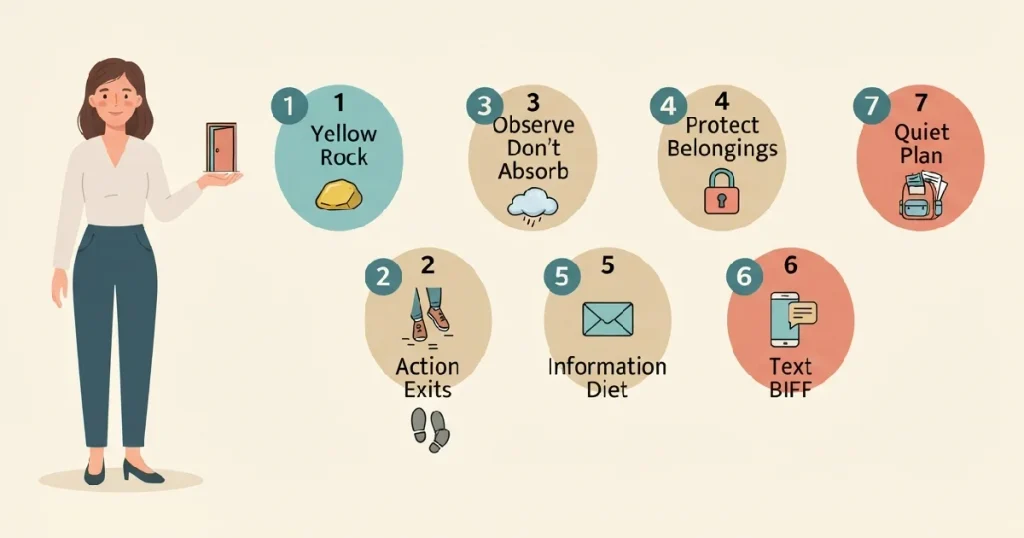
Step 1: Switch From Gray Rock to Yellow Rock Communication
You’ve probably heard of Gray Rocking, the strategy of becoming as emotionally boring as a rock so a narcissist loses interest in provoking you. It works well with an ex you no longer live with.
But inside a shared household, going completely flat overnight can misfire. If you suddenly stop reacting to everything, some narcissistic partners interpret the silence as a threat, or as passive aggression, which can trigger what researchers describe as narcissistic rage, an outsized, often disproportionate response to a perceived insult or loss of control.
This is where Yellow Rocking becomes the smarter middle ground. You stay polite, even pleasant on the surface. You answer basic questions. You maintain civil, low-friction daily exchanges. But underneath that pleasant tone, there’s nothing personal left for him to grab onto.
According to the communication framework detailed in Annie Wright Psychotherapy’s Grey Rock communication scripts, the goal isn’t to disappear emotionally. It’s to remain functional and cordial while removing the emotional depth that used to fuel conflict.
Try phrases like:
“That’s an interesting way to see it.”
“I hear you.”
“Noted, thanks.”
“Okay, I’ll think about it.”
None of these invite debate. None of them confirm or deny anything he can later twist. They simply close the loop.
Step 2: Establish Action-Based Consequences
Here’s the pattern interrupt you need to remember: a boundary is not a sentence you say to him. It’s a decision you make about yourself.
“Stop yelling at me” is a demand. It requires his cooperation, and narcissistic personalities are notoriously resistant to demands that threaten their sense of control.
Compare that to: “When voices are raised, I’m going to step into another room.”
Notice the difference. The second version doesn’t need his permission. You’re not asking him to change. You’re simply describing what you will do, and then you do it, calmly and immediately, without a lecture attached.
According to Psych Central’s clinical guide on setting boundaries with a narcissist, effective boundaries with high-conflict partners always center on your own actions, never on controlling theirs. This single shift removes the entire negotiation from the table.
Step 3: Implement the “Observe, Don’t Absorb” Rule
Let’s talk about something the online support communities have started calling reactive abuse, and it’s one of the cruelest traps in this dynamic.
Here’s how it works. He pushes, needles, and provokes until you finally snap. Maybe you raise your voice. Maybe you say something sharp you regret. Then, almost instantly, the narrative flips. Suddenly you’re the “crazy” one, the “abusive” one, the reason the household feels tense.
Some partners even record these moments specifically to use later, in arguments, in custody disputes, or simply to reinforce the story that you’re the unstable one in the relationship.
This is where a mental anchoring practice becomes essential. Instead of absorbing his provocation as a personal attack, try observing it as data. A composite example: Maria, a mother of two in Ohio, started silently narrating her husband’s outbursts in her head like a scientist taking field notes. “He’s raising his voice because I didn’t respond the way he expected.” That tiny mental distance kept her from getting pulled into the explosion he was fishing for.
This isn’t about suppressing your emotions. It’s about recognizing the bait before you bite it.
Step 4: Shield Your Material World With Micro-Boundaries

Some of the most exhausting violations aren’t dramatic. They’re small, repeated, and constant.
Going through your purse. Reading your texts. Moving your belongings without asking. Quora threads on narcissistic partners are full of real accounts describing exactly this: “Do not touch my things. Do not go through my computer.” These sound like obvious boundaries, but with a narcissistic spouse, nothing is assumed. Everything has to be stated once, then enforced through action, not repeated pleading.
Lock your phone with a code you don’t share. Use a password-protected folder for financial documents. If you have a home office or drawer, use an actual lock. These aren’t dramatic gestures. They’re quiet acts of self-respect that don’t require his approval to implement.
Step 5: Stop Sharing Good News First
Here’s a shift that surprises a lot of readers.
If you’ve noticed that every promotion, weight loss milestone, or personal win gets met with a flat response, a backhanded comment, or sudden one-upping, you’re not imagining a pattern. Narcissistic partners often experience your success as a threat to their own status, which triggers minimization or quiet competition.
Consider what researchers call an information diet. Instead of sharing wins with him first, build a small circle, a sister, a close friend, a therapist, who gets to hear the good news before he does. Let your excitement land somewhere safe before it gets filtered through his reaction.
This isn’t secrecy for its own sake. It’s protecting your joy from becoming another supply source for his ego, or another disappointment for yours.
Step 6: Transition Logistical Communication to Text or Apps
Real-time conversations with a high-conflict partner have a way of spiraling. Voices escalate. Old grievances resurface. What started as “can you pick up the kids Thursday” becomes a two-hour argument about your character.
Moving scheduling, chores, and parenting logistics to text or a shared family app cuts down on live sparring significantly. Family law professionals often recommend the BIFF method for exactly this reason: keep every message Brief, Informative, Friendly, and Firm.
An example: “Thursday pickup works for me. I’ll have the kids ready by 4.” No apology, no lengthy justification, no bait taken. Just the facts, delivered cleanly, in writing, where there’s a record.
Step 7: Build a Stealth Sovereignty Plan
This last step happens quietly, in the background, away from his awareness.
A sovereignty plan means slowly building the resources that give you real options later, even if you’re not ready to use them yet. That might include a separate savings account, a folder of documentation for concerning incidents, or, most importantly, a licensed trauma-informed therapist who specializes in high-conflict relationships.
In my practice, I’ve noticed that clients who quietly build this scaffolding, even without any immediate plan to leave, report feeling calmer almost immediately. Having an exit map, even one you never use, restores a sense of control that narcissistic relationships slowly erode.
Moving Forward Safely: Protecting Your Mental Health
Let’s be honest about what these seven steps can and cannot do.
They will not fix your husband. Narcissistic personality patterns are notoriously resistant to change, especially without sustained clinical intervention that he actively wants. These steps exist to protect your nervous system while you figure out your next move, whatever that looks like for your specific situation.
There’s also a critical line you need to watch for. Emotional manipulation is one thing. Physical intimidation, threats, or violence is an entirely different category that requires immediate outside support, not boundary scripts. If you ever feel physically unsafe, contact the National Domestic Violence Hotline or a local safety network right away. Healthline’s guide on coping with personality disorders in relationships offers a useful benchmark for evaluating when a relationship has crossed from difficult into dangerous.
Most people in this situation don’t realize how much energy they’ve spent trying to manage someone else’s ego at the cost of their own stability. Recognizing that pattern is not weakness. It’s the first accurate reading you’ve had in a long time.
What to Try This Week

One place to start is choosing just one boundary from this list and practicing it for seven days, without trying to implement all seven at once. Overhauling everything simultaneously invites a bigger extinction burst than you’re ready to manage.
Consider starting with Yellow Rocking during your next tense exchange. Notice how it feels to stay pleasant without offering emotional depth.
A useful question to ask yourself each evening: “Did I explain myself today when I didn’t need to?” Awareness alone starts rewiring the habit.
If you have a support person, a friend, a sibling, a therapist, name them now as your information diet contact. Send them your next piece of good news before anyone else hears it.
Yellow Rock, Steady Ground
Think of Gray Rocking like going completely silent, and Yellow Rocking like wearing a calm, pleasant mask that reveals nothing underneath. That small shift, from cold to composed, keeps the peace at home without handing over your inner world.
You didn’t start this relationship looking for a survival manual. But here you are, and you now have one. These seven steps won’t transform him. They will, however, change how much of yourself you keep intact while you decide what comes next.
That’s not settling. That’s strategy.
My Closing Remarks
I’ve sat across from women who thought they were losing their minds, only to realize they were responding perfectly rationally to an irrational system. You are not too sensitive, too dramatic, or too much. You’re someone adapting to an unfair equation, and adaptation takes real skill. Give yourself credit for surviving something most people never have to understand.
More Related Stories for You
Curious what other patterns to watch for? Read our full breakdown of the characteristics of a narcissist man to sharpen your radar even further.