
 David Wall
The answer has less to do with how good your life looks and more to do with how safe it feels.
Key Points
- What does it mean to be happy? Science says it’s less about excitement and more about a nervous system that finally feels safe.
- The most “successful” schedule can still leave you empty, while small, boundaried, low-tech habits quietly rebuild peace.
- Real happiness grows from meaning and connection, not achievement, and that shift changes how you spend your very next Tuesday.
Contents
Table of Contents
Everything you’ve been told about happiness might be the reason you can’t find it.
We have been sold a version of the good life that looks like a highlight reel. The promotion. The wedding. The vacation photo with the perfect light. You’ve probably chased a few of those moments yourself, certain that this one would finally be the one that sticks.
Then the feeling faded. Sometimes within a week. Sometimes within a day. And you were left wondering what was wrong with you.
Nothing is wrong with you.
Someone might look at your color-coded calendar and assume you’re thriving. What they don’t see is the 11 p.m. scroll session where you compare your actual life to a stranger’s edited one.
A friend might glance at your quiet Tuesday night at home and think nothing much is happening. What they don’t see is that this is the first evening in months your body has actually felt calm.
You’ve built a life full of milestones and still feel a low hum of unease underneath it. You start to wonder if happiness was ever really about the milestones at all. It wasn’t.
Happiness, in plain terms, is not a feeling you chase. It’s a baseline you build: emotional safety, structured purpose, and connection that doesn’t depend on a screen. Once you understand that, the whole search changes shape.
This is the psychological mechanism behind that shift. Researchers call the fading-excitement problem hedonic adaptation, the brain’s tendency to return to a stable mood set point no matter how big the win. You get the raise. You feel great for three weeks. Then your baseline resets, and you start scanning for the next thing. According to foundational work on self-determination theory by psychologists Edward Deci and Richard Ryan, lasting wellbeing depends less on rewards and more on three ongoing needs: autonomy, competence, and genuine connection with other people. Miss those, and no achievement will fill the gap for long.
That’s the map. Now let’s walk through the territory.
Re-Defining the Baseline: What Does It Mean to Be Happy Right Now?
The Death of Hedonic Adaptation: Why Excitement Isn’t Joy
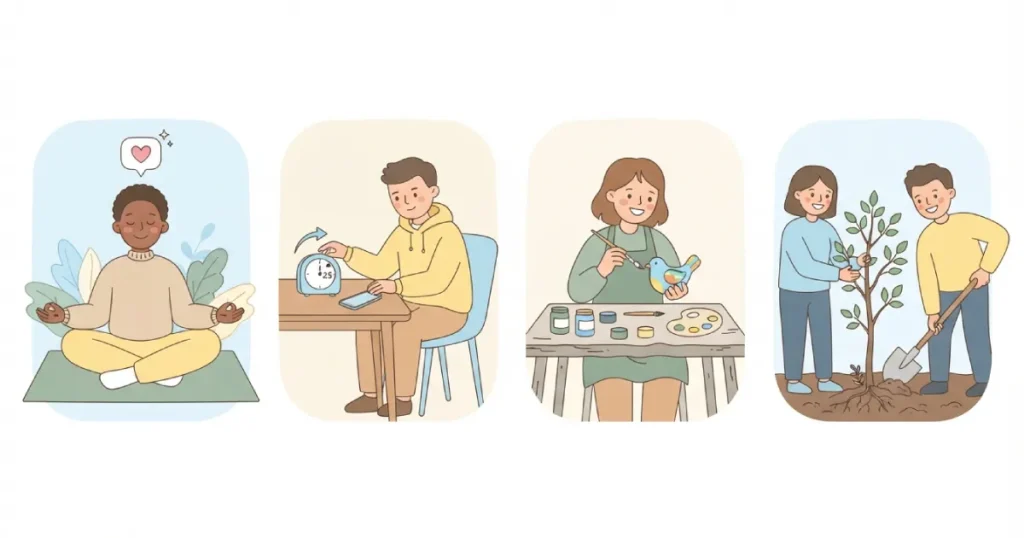
Excitement spikes and drops. Joy, the kind that actually holds up over time, looks more like a steady floor than a ceiling.
Think about the last time you felt genuinely at ease. It probably wasn’t during a peak moment. It was probably something small: a slow morning, an easy conversation, a day where nothing went wrong and nothing needed to be proven.
That’s not boredom. That’s regulation.
A nervous system that isn’t constantly bracing for the next demand finally has room to feel something other than adrenaline. Growth without panic is starting to replace achievement without rest as the new marker of a good day, and that reframe alone can take real pressure off your shoulders.
From GDP to a Wider Measure: The Global Shift in Measuring a Good Life
For decades, national success has been tracked almost entirely through economic output. But wellbeing researchers have been pushing back on that model for years, arguing that a growing economy can exist alongside a shrinking sense of meaning.
The World Happiness Report, published annually through a partnership with the United Nations, now tracks factors like social support, generosity, and freedom to make life choices alongside income. Countries with modest wealth but strong community ties routinely outrank wealthier, more isolated ones.
This matters for you personally, not just politically. If your country, culture, or workplace is still measuring your worth by output alone, it makes sense that you feel like something is missing even while your resume looks fine.
The Anatomy of Modern Inner Peace
Sustainable Ambition: How to Grow Without Panic
Ambition itself isn’t the problem. Ambition without a floor underneath it is.
Sustainable ambition means setting goals your nervous system can actually support, rather than goals that require you to run on adrenaline for months at a time. It’s the difference between building a career and burning through one.
Picture Maya, a 32-year-old marketing manager who hit every goal she set for a decade. New title, new apartment, new relationship. She told me during a session that she felt like she was “winning a game nobody had explained the rules to.” Once Maya started measuring her weeks by how rested and present she felt, rather than by output alone, her anxiety dropped even though her job stayed exactly the same.
A useful question to ask yourself: is this goal expanding my life, or is it quietly draining the hours I’d otherwise spend living it?
The Self-Improvement Trap: Why Optimizing Your Life Destroys Your Peace
Here’s what no one tells you about the wellness industry.
The constant tracking, the sleep scores, the habit trackers, the five-step morning routines, they were supposed to reduce anxiety. For a lot of people, they’ve become a second job that never clocks out.
British writer Oliver Burkeman, whose work on time and mortality has reshaped how many people think about productivity, argues that waiting until you’re “on top of everything” before you start actually living guarantees you’ll never start. There will always be one more app, one more habit, one more optimization left undone.
Optimization anxiety is like trying to fill a bathtub with the drain wide open. No matter how much you pour in, the level never rises, because the system was never designed to hold. Peace doesn’t come from closing every gap in your routine. It comes from deciding some gaps are allowed to stay open.
Reclaiming Purpose in a Hyper-Digital World

The 60-Minute Rule: Navigating Social Media Without Lowering Wellbeing
You’ve probably been told to just delete the apps. That advice skips an important detail.
A well-known analysis by researchers Andrew Przybylski and Netta Weinstein, published in the journal Psychological Science, found something researchers call the digital Goldilocks effect: moderate daily technology use, roughly under an hour, was linked to better wellbeing than either heavy use or complete abstinence. Total isolation from digital connection, it turns out, has its own cost.
The goal isn’t zero screen time. The goal is boundaried screen time.
That means using your accounts to plan a coffee date, coordinate a volunteer shift, or find a local run club, and then closing the app. The scroll is where wellbeing goes to die. The message that turns into a real plan is where it comes back to life.
Trading Algorithms for Analog Play: Cultivating Unmonetized Hobbies
Here’s the differentiator most happiness content misses entirely: not every hour of your day needs to be productive, trackable, or shareable to count.
Somewhere along the way, hobbies became side hustles. Running became a way to build a following. Painting became a way to sell prints. Even rest got monetized into “self-care content.”
Consider James, a 41-year-old accountant who picked woodworking back up after fifteen years away from it. He wasn’t posting it, monetizing it, or tracking his hours. He was just doing it. He described the first project he finished, a small bookshelf, as “the first thing I’d made in years that wasn’t for anyone else.” That single unmonetized hour a week became the calmest part of his entire schedule.
An unmonetized hobby has no metrics attached to it. No likes, no followers, no personal-growth podcast telling you how to optimize it. That absence of pressure is exactly what makes it restorative.
The Architecture of True Meaning
The Solitude Paradox: Why Complete Isolation Lowers Life Satisfaction
Alone time is genuinely good for you, up to a point. Past that point, it starts working against you.
The Harvard Study of Adult Development, one of the longest-running studies on human wellbeing ever conducted, has tracked participants for over eight decades. Its lead researchers, including psychiatrist Robert Waldinger, have consistently found that the strength of a person’s relationships predicts happiness and even physical health more reliably than wealth, fame, or career achievement.
Most people in this situation don’t realize that the loneliness they feel isn’t a personal failing. It’s often the predictable result of a culture that prizes independence over interdependence.
The Youth Happiness Gap: Why Where You Live Shapes How You Feel
If you’re under 25 and living in the United States, the United Kingdom, or Canada, there’s a decent chance your happiness has felt harder to hold onto than it did for previous generations at your age. Recent editions of the World Happiness Report have documented exactly this pattern: youth happiness declining in several English-speaking countries even as it holds steady or rises in more collectivist regions of the world.
Left unexamined, this gap doesn’t just stay a personal mystery. It quietly convinces an entire generation that something is wrong with them individually, when the pattern is far more cultural than personal.
Hyper-individualism, the cultural emphasis on standing out and going it alone, tends to erode the very things that produce meaning: shared identity, community obligation, and a sense of belonging to something bigger than your own résumé. That’s not an excuse to give up on ambition. It’s permission to stop blaming yourself for a weather pattern you didn’t create.
Micro-Generosity and Local Activism: The Simplest Paths to Purpose
You don’t need a five-year plan to feel like your life has direction. You need a next Tuesday.
Micro-generosity, small, low-effort acts like checking in on a neighbor or covering a stranger’s coffee, activates a sense of contribution that large, abstract goals rarely do. Local activism, volunteering at a food bank or showing up to a community cleanup, offers something even more powerful: a physical room full of people working toward the same visible outcome.
That’s the piece most goal-setting frameworks leave out entirely. Purpose isn’t only found in your career. It’s found in the five feet of space around you, right now, today.
Now What? Building a Life That Feels Like Yours

One place to start is what I’d call the Baseline Audit. At the end of each day this week, rate how safe and calm you felt, not how productive you were. Notice the gap between the two numbers. That gap is your real starting point.
Consider setting a hard stop hour for social media, borrowed directly from the Goldilocks research above. Pick one purpose for your accounts, event planning, community groups, or staying close to family, and log off once that purpose is met.
Try the Unmonetized Hour, one block of time each week dedicated to something you’re not tracking, sharing, or improving. Draw. Garden. Build something with your hands. Let it be bad. Let it be just for you.
A useful question to carry into your week: if no one ever saw this activity, would I still want to do it? If the answer is yes, you’ve found a piece of real purpose hiding in plain sight.
You started this article carrying a quiet suspicion that your milestones weren’t adding up to the peace you were promised. That suspicion was accurate. Happiness was never going to be found at the finish line, because it was never a finish line to begin with.
It’s the floor you stand on while you keep living.
You now have language for what was missing: emotional safety over excitement, boundaried connection over constant scrolling, unmonetized joy over relentless self-improvement, and purpose measured in feet, not miles. That’s not a small thing to walk away with.
The people who feel most at peace aren’t the ones who fixed everything. They’re the ones who stopped waiting to start living until everything was fixed.
My Closing Remarks
Honestly, the happiest clients I’ve worked with were rarely the most accomplished ones. They were the ones who gave themselves permission to have a boring Tuesday and call it enough. I stopped believing happiness was a destination the year I watched a client cry with relief, not over a promotion, but over finally taking a walk with no podcast, no goal, and no phone. That’s the whole secret. It was never hiding. You were just told to look somewhere fancier than your own front porch.
More Related Stories for You
- If you want to understand your closest relationships on a deeper level, this piece on who really knows you best is worth your next ten minutes.
About The Author