
 David Wall
Key Points
- The meaning of happiness isn’t a mood you chase. It’s a byproduct of a life built around growth, connection, and purpose.
- New research shows that treating happiness as a goal quietly drains the self-control you need to actually live well.
- Understanding what is the meaning of happiness starts with trading constant comfort for connection, and simplicity for complexity.
Contents
Table of Contents
We’ve been sold a lie about happiness. We think it’s a feeling to chase, a mood to manufacture, a state we can manifest with the right morning routine or the right salary bump. You’ve tried the gratitude journals. You’ve tried the vision boards. You’ve tried cutting toxic people out and doubling down on self-care Sundays.
And yet, the anxious hum underneath your days hasn’t gone away.
The meaning of happiness isn’t a feeling you generate on demand. It’s what psychologists call eudaimonic well-being, a state of psychological richness that grows out of purpose, growth, and connection, not out of pleasure alone. Chasing the feeling directly often backfires.
What Is the Meaning of Happiness? (Hint: It’s Not Hedonism)
For most of human history, happiness meant something closer to “living well” than “feeling good.” Aristotle called this eudaimonia, a word that roughly translates to human flourishing. It has nothing to do with a mood ring and everything to do with whether your life is aligned with something bigger than your next dopamine hit.
Modern research backs this up. The American Psychological Association defines eudaimonic well-being as happiness rooted in meaning, purpose, and self-realization, distinct from hedonia, which is happiness rooted in pleasure and the avoidance of pain.
You already know the difference in your body. Think about the last time you binged a show for six hours versus the last time you finished a hard project you cared about. Both felt good in the moment. Only one left you feeling like yourself.
The Hedonic Treadmill vs. Eudaimonic Well-Being
Here’s the trap. Every time you get the raise, the new apartment, or the relationship milestone, your happiness spikes and then quietly resets. Researchers call this the hedonic treadmill, the tendency for people to return to a stable baseline of happiness no matter what good or bad things happen to them.
This is why the salary bump didn’t fix the emptiness. It was never designed to.
Eudaimonic well-being works differently. It doesn’t spike and crash. It accumulates slowly, the way trust in a friendship builds over years instead of one good conversation.
Why Chasing “Good Vibes Only” Is Making You Anxious
Most people in this situation don’t realize that their self-improvement routine has quietly become another job. You track your mood. You audit your gratitude. You measure your peace like a KPI.
That’s not wellness. That’s surveillance of your own nervous system.
The Happiness Chasing Paradox: Why Forcing Joy Backfires
A June 2026 study out of the University of Toronto found something uncomfortable. When people are told to explicitly pursue happiness as a goal, they start running an internal checklist: Am I happy enough yet? Did that count as joy? Should I be feeling more grateful right now?
That constant checking has a cost.
The Cognitive Cost of Constantly Checking Your Mood
Self-control is a limited resource, similar to a muscle that tires with overuse. Psychologists refer to this general phenomenon as ego depletion, the idea that exerting willpower or self-regulation in one area leaves you with less capacity in another.
When you’re busy monitoring your happiness, you’re spending self-control on emotional bookkeeping instead of on the things that actually build a good life, like showing up fully for a friend or finishing meaningful work.
The result is emotional fatigue that masquerades as anxiety. You feel tired in a way sleep doesn’t fix, because the exhaustion isn’t physical. It’s regulatory.
Shifting Happiness From a Target to a Byproduct
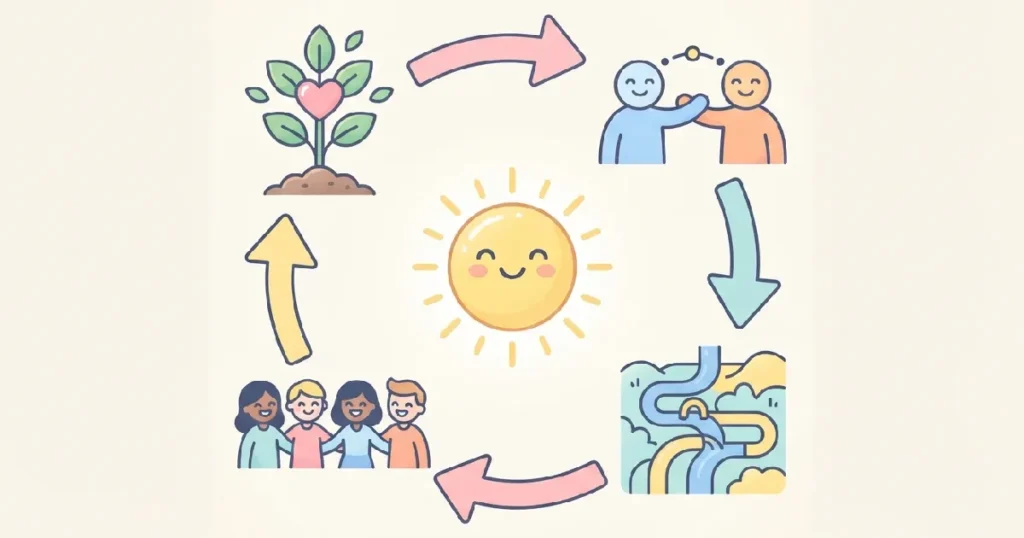
Here’s the reframe that changes everything: happiness works best as a side effect, not a destination.
Chasing happiness directly is like trying to hold a soap bubble in your closed fist. The tighter you grip, the faster it pops. But if you open your hand and let it rest on your palm, it stays.
In practice, that means happiness shows up when you’re absorbed in a hard conversation with your partner, deep in a creative project, or laughing with someone who actually knows you. Not when you’re checking if you’re laughing correctly.
Consider Maya, a 29-year-old graphic designer who spent two years optimizing her mornings, her supplements, and her meditation streak, convinced that consistency would finally make her feel settled. She got more anxious, not less. When she stopped tracking her mood and instead recommitted to a pottery class she’d abandoned years earlier, purely because she loved it, her anxiety dropped within weeks. She wasn’t chasing happiness anymore. She was living a life that produced it.
Beyond Feeling Good: The Structural Dimensions Your Life Actually Needs

Feeling good is not nothing. But it’s a thin layer sitting on top of something structural. Think of happiness less like a paint color and more like the foundation underneath a house.
Broad Social Trust vs. the Hyper-Local Bubble
Here’s where the research gets genuinely surprising.
A large-scale 2026 psychological assessment spanning 66 countries found that people who rely exclusively on tight, hyper-local bonds, only immediate family, only their block, only people who think exactly like them, actually report lower well-being over time. Tight local bonds without broader social trust are linked to more outward prejudice and less institutional confidence.
This challenges the popular advice to “protect your inner circle at all costs.” Your inner circle matters enormously. But a life built entirely inside it becomes fragile, because it has no shock absorbers.
Think of broad social trust the way immunologists think about early microbial exposure. A body raised in a completely sterile environment doesn’t become stronger. It becomes more reactive to anything unfamiliar. Psychologically, the same principle applies to your sense of safety in the world. A life exposed only to the familiar develops a kind of social fragility, quick to see strangers and difference as threats rather than as one more source of stability.
Widening your circle of care, volunteering outside your usual network, engaging with neighbors who don’t share your politics, trusting institutions enough to participate in them, builds a kind of psychological resilience that a tight, closed circle simply cannot offer.
Why the Self-Care Movement Misses Collective Community
The self-care industry has quietly convinced an entire generation that healing is a private, individual project. Bath bombs. Solo retreats. Personal boundaries as the ultimate virtue.
But here’s what no one tells you.
Isolation dressed up as self-protection still produces isolation. Genuine well-being research consistently shows that community involvement and collective belonging predict life satisfaction more reliably than any individual wellness purchase.
Reclaiming the Digital Soul: Active Connection vs. Algorithmic Traps

The March 2026 World Happiness Report found a sharp divide in how digital life affects well-being. Passive, algorithmically curated scrolling, the kind where content is fed to you with no active input, consistently lowers happiness. Meanwhile, digital platforms used specifically to build real connection with real people actually raise it.
How Passive Feeds Drain Your Life Evaluation Score
Researchers use the term “life evaluation” to describe how people rate their overall life satisfaction, separate from momentary mood. Passive scrolling doesn’t just waste time. It quietly lowers this deeper evaluation, because comparison without connection breeds a specific kind of loneliness, the feeling of being surrounded by people while belonging to none of them.
You already know this feeling. You put the phone down after forty minutes of scrolling and can’t name a single thing you actually enjoyed.
Simple Strategies to Put the “Social” Back in Social Media
A full digital detox rarely sticks, because it ignores a real human need to stay connected to your generation’s shared culture. The fix isn’t deletion. It’s redirection.
One place to start is auditing your usage by function, not by app. Ask yourself: did I just consume something, or did I connect with someone? A voice memo to a friend counts as connection. An hour of unrelated video content does not.
Designing a Complex Life: How to Find Meaning When Life Isn’t Perfect
The 2026 Global Happiness Studies synthesis introduced a concept worth sitting with: the “intellectual survival strategy.” It found that the most emotionally resilient people aren’t the ones with the smoothest lives. They’re the ones who can hold complexity, discomfort, contradiction, bittersweet memory, without collapsing into either despair or forced positivity.
That’s not weakness when things get hard. That’s wiring built for the real world.
Toxic positivity, the pressure to maintain a cheerful outlook regardless of circumstance, leaves people unprepared for the inevitable friction of a real life. A grief that gets rushed. A career setback reframed too quickly as a “blessing.” None of it gets processed. It just gets buried.
This same principle shows up at work, where roughly a third of your waking life happens. Gallup’s 2026 State of the Global Workplace Report found that low employee engagement now costs the global economy close to $10 trillion, with only 27 percent of managers reporting genuine engagement in their own roles. When work offers no autonomy and no human connection, life satisfaction craters, no matter how balanced your evenings look.
Daniel, a 34-year-old project manager, thought his burnout was about hours. He negotiated better boundaries and still felt hollow. What actually shifted things was smaller: he started having one real, non-work conversation with a colleague each day. Not networking. Just noticing another human being. His engagement scores rose before his hours ever changed.
Now What? Building a Life That Produces Happiness
Try the Byproduct Audit. Once a week, instead of asking “Am I happy?”, ask “What did I do this week that I lost myself in?” Write down one activity. That list becomes your map toward eudaimonic living.
Widen one circle intentionally. Consider one small act of trust outside your usual bubble this month, a new neighbor, a community event, a conversation with someone whose life looks nothing like yours.
Run a connection check on your phone. Before opening an app, ask yourself whether you’re about to consume or connect. If it’s consumption, set a specific time limit. If it’s connection, lean in fully.
Let one complicated feeling stay complicated. The next time something bittersweet happens, resist the urge to resolve it into a neat lesson. A useful question to ask yourself: what would it feel like to just let this be hard and good at the same time?
The Meaning of Happiness Was Never Meant to Be Simple
You didn’t fail at happiness. You were handed the wrong instructions.
The mood tracking, the manifestation boards, the constant self-audit, none of that was ever going to work, because happiness was never a feeling to manufacture. It’s the quiet result of a life with roots, purpose you’re absorbed in, people you trust beyond your bubble, and enough honesty to hold the hard parts without flattening them.
Open your hand. Stop gripping the bubble. Let your life get complex enough, connected enough, and real enough that happiness has somewhere to land.
My Closing Remarks
Here’s what I’ll tell you honestly, after years of watching this play out in session after session: the happiest clients I’ve worked with were rarely the most comfortable ones. They were the ones who stopped performing wellness and started building an actual life, messy relationships, honest griefs, and all. Comfort was never the goal. Aliveness was. Stop auditing your joy and go live something worth feeling.
More Related Stories for You
- Curious how well the people closest to you actually see who you are? Take a closer look at who really knows you best.
About The Author