
 David Wall
When joy goes quiet, the answer isn’t to chase happiness harder. It’s to work with your brain’s biology instead of against it.
Key Points
- What to do when nothing makes you happy starts with understanding that your brain’s reward system, not your character, is offline.
- Small, low-effort actions rebuild motivation faster than waiting to “feel like it” ever will.
- You don’t need to force joy today. You need seven tiny, science-backed lifelines that ask almost nothing of you.
Contents
Table of Contents
You’ve tried the gratitude journal. You’ve tried the walk outside, the hot shower, the phone call to an old friend you used to laugh with for hours. None of it moved the needle. You start to wonder if something inside you is broken.
It isn’t.
What you’re experiencing has a clinical name: anhedonia, a documented drop in your brain’s capacity to register reward or pleasure. It’s not laziness. It’s not a personality flaw. It’s a sign that the part of your brain responsible for wanting things has quietly powered down, and no amount of willpower can override a system that’s protecting itself.
Someone Might Think You’re Just Being Difficult. Here’s What They Don’t See.
Someone might look at you and think you’re choosing to be distant. They see you canceling plans, staring at your phone without texting back, sitting through a favorite show without cracking a smile.
But what they don’t see is the exhaustion underneath. You’re not avoiding connection out of spite. You’re conserving energy your body has decided it doesn’t have to spare.
Someone might think you’re depressed in the way people usually picture it, sad, tearful, visibly struggling. But what’s actually happening might feel more like static. Flat. Gray. Present but unreachable.
Someone might think a vacation or a new hobby will “snap you out of it.” But what they’re missing is that the problem isn’t a lack of good options. It’s that your brain has temporarily lost the ability to flag anything as good at all.
Why Your Brain Stopped Rewarding You (And Why It’s Not Your Fault)
Here’s the part almost nobody explains clearly: happiness isn’t a feeling you summon. It’s a chemical event, largely driven by dopamine, the neurotransmitter responsible for motivation, anticipation, and the drive to pursue rewards. When that system gets overworked by chronic stress, it doesn’t just quiet down. It goes into something closer to shutdown mode.
Think of it like a phone stuck in low power mode. Nothing is broken inside it. It’s rationing energy, dimming the screen, closing background apps, refusing to run anything that costs more than it can currently spare. Your brain, under chronic stress, does the exact same thing to your capacity for pleasure.
For years, treatment for low mood centered almost entirely on serotonin, the neurotransmitter tied to mood regulation and calm. But newer research points somewhere different. Work coming out of Emory University by psychiatric researcher Andrew Miller has connected chronic low-grade inflammation to blunted reward response, meaning your immune system and your motivation system are more connected than most people realize. You can read more about that connection through Harvard Medical School’s overview on inflammation and depression.
That’s not depression failing to lift on its own. That’s your nervous system actively protecting its last reserves.
Meet Daniel, a 34-year-old marketing manager I worked with early in my practice. Daniel wasn’t sad, exactly. He described his days as “watching my own life through glass.” He still went to work, still made dinner, still showed up to his kid’s soccer games. But nothing landed. Not the promotion, not the vacation, not his daughter’s laugh. Daniel assumed he needed a bigger change, a new job, maybe a new life. What he actually needed was smaller and stranger than that: proof that his reward system could still respond to anything at all.
Most people in Daniel’s situation assume the fix has to match the size of the numbness. It doesn’t. The American Psychological Association’s research on behavioral activation shows the opposite: small, mechanical actions taken before motivation returns are what actually rebuild the neural pathway between action and reward.
That’s where the seven lifelines come in.
7 Tiny Lifelines for Numb Days
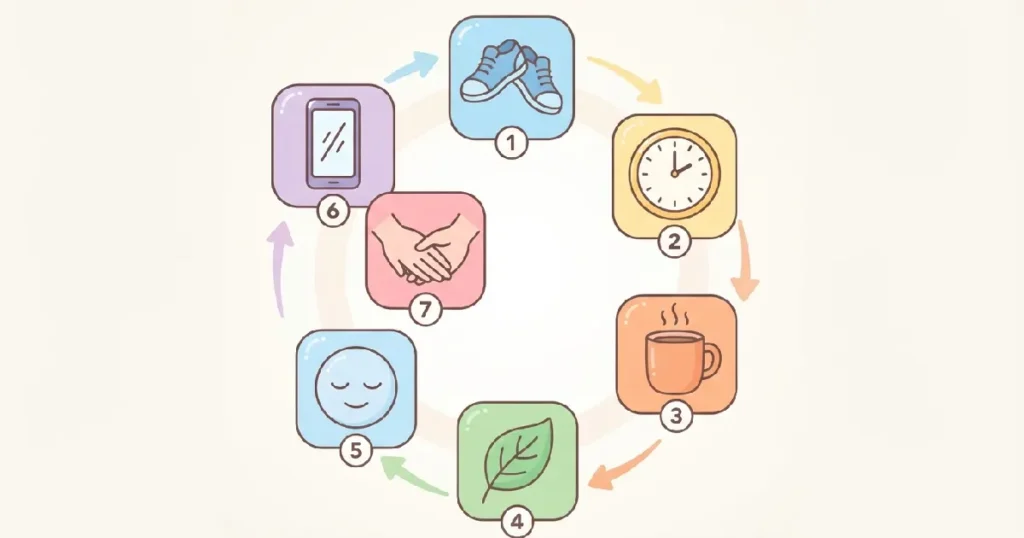
1. Mechanical Execution: Move Before You Feel Ready
The Claim: Waiting to feel motivated before acting keeps you stuck, because motivation is often the result of action, not the cause of it.
The Evidence: Behavioral activation, a well-established treatment approach outlined by the American Psychological Association, consistently shows that doing a small task regardless of mood produces measurable improvement in mood over time. Daniel started by simply putting his shoes on and standing at the front door. No walk required. Just shoes, just the door.
So What: Pick one task today that takes under two minutes. Brush your teeth. Make the bed. Don’t wait for the feeling. Let the doing come first.
2. The 5-Second Anticipation Loop: Borrow a Spark From the Future
The Claim: Your reward circuitry responds more to anticipating something than to receiving it, so you can activate that circuitry in tiny bursts even when actual pleasure feels unreachable.
The Evidence: Neuroscience research on dopamine has repeatedly shown that dopamine spikes during the anticipation of a reward, not just the reward itself. This means you don’t need the payoff to feel something. You just need the five seconds before it.
So What: Before doing something neutral, like opening your fridge or starting your car, pause for five seconds and consciously anticipate it. You’re not manufacturing joy. You’re gently re-teaching your brain that anticipation still works.
3. Somatic Savoring: Feel Warmth Instead of Chasing Joy
The Claim: When emotional pleasure is unavailable, physical sensation often still is, and shifting your attention there gives your nervous system something real to register.
The Evidence: This is somatic, meaning body-based, rather than emotional. Instead of asking “do I feel happy,” you ask “what does warm water on my hands feel like right now.” Daniel started doing this with his morning coffee, focusing only on the heat of the mug, nothing else.
So What: Stop searching for joy in the moment. Search for sensation instead. Warm blankets, sunlight on skin, the weight of a good chair. These are honest wins on a numb day.
4. Inflammation Reduction: Cool the Fire Under the Numbness

The Claim: Because chronic inflammation is linked to blunted reward response, calming your body’s stress load can directly support your brain’s capacity to feel again.
The Evidence: Miller’s research at Emory, along with findings summarized by Harvard Health, points to sleep, gentle movement, and reduced sugar intake as measurable ways to lower inflammatory markers connected to low mood.
So What: This isn’t about a diet overhaul. It’s about one low-energy choice, an earlier bedtime, a ten-minute walk, a glass of water instead of a third coffee. Small physical care is neurological care.
5. Radical Neutrality: Aim for Neutral, Not Happy
The Claim: Demanding happiness from a depleted system creates pressure that makes the shutdown worse, but aiming for simple neutrality lowers that pressure enough for real recovery to start.
The Evidence: This mirrors a concept in acceptance-based therapy models, where reducing the emotional stakes of a moment often allows genuine feeling to return faster than forcing positivity does.
So What: Stop asking “how do I get happy today.” Ask “how do I get to neutral in the next hour.” Neutral is not failure. Neutral is the doorway happiness eventually walks through.
6. The Dopamine Detox: Quiet the Noise So Reward Can Return
The Claim: Constant high-stimulation input, endless scrolling, fast content, quick dopamine hits, can flatten your baseline sensitivity, making smaller, real-life rewards feel even less noticeable.
The Evidence: This idea, sometimes called dopamine fasting in casual conversation, is really about recalibration rather than punishment. Psychology Today’s overview of anhedonia notes that overstimulation can further mute an already blunted reward system.
So What: Try one hour today with no screens, no notifications, no background noise. You’re not depriving yourself. You’re giving your baseline room to reset.
7. The Kindness Echo: Let Action Do What Feeling Can’t
The Claim: Small, automatic acts of kindness activate reward circuitry even when you don’t feel emotionally connected to them, which is the exact principle behind Positive Affect Treatment.
The Evidence: UCLA researcher Michelle Craske developed Positive Affect Treatment specifically for anhedonia, and her clinical trials found that engaging in small kind or generous acts, even without emotional buy-in, measurably increased participants’ capacity for positive feeling over time.
So What: Hold a door. Text someone “thinking of you.” You don’t need to feel generous first. The feeling often shows up after the act, not before it.
Now What: Building a Numb-Day Protocol You Can Actually Use

One place to start is what I call the Two-Minute Anchor: pick one lifeline from the list above and attach it to something you already do every day, like brushing your teeth or making coffee. Consistency matters more than intensity here.
Consider building a short Numb Day Checklist, three items maximum: one mechanical action, one somatic moment, one act of kindness. Keep it taped somewhere visible. On the days motivation is gone, you won’t need to think. You’ll just follow the list.
A useful question to ask yourself each morning: “What is the smallest possible version of care I can offer myself today?” Not the ideal version. The smallest one.
The next time you catch yourself waiting to feel ready before you act, try flipping the order. Act first. Let the feeling catch up when it can.
You Are Not Broken. You Are Rationing.
Remember Daniel, standing at his front door with his shoes on, waiting for nothing in particular. Three weeks later, that same doorway didn’t feel like glass anymore. It felt like a door again, one he could actually walk through.
That’s the truth worth carrying with you: your brain isn’t malfunctioning. It’s in low power mode, protecting its last reserves the same way a phone protects its final battery percentage. And low power mode isn’t permanent. It’s a setting, not a diagnosis.
You don’t need to force your way back to happy today. You need one small, honest action that tells your nervous system it’s safe to want things again.
Numbness isn’t the absence of feeling. It’s feeling waiting for permission to come back online.
My Closing Remarks
Here’s the part I won’t soften: I’ve sat across from people convinced they’d lost their capacity for joy forever, and almost none of them had. What changed wasn’t a breakthrough. It was a Tuesday where they did one small, mechanical thing without waiting to feel ready. That’s not a small miracle. That’s just how healing actually works.
More Related Stories for You
Curious what genuine happiness looks like once the fog lifts? This next read breaks down what actually makes people happy, and why it’s rarely what you’d expect.
About The Author