
 Nicole Adkins
The winter slump isn’t a personality flaw. It’s biology, and biology can be worked with.
Key Points
- Learning how to deal with seasonal depression starts with fixing your morning light exposure, not your willpower.
- Small, precise shifts in timing, protein intake, and evening lighting can reset the circadian rhythm behind your winter slump.
- You don’t have to fight winter to feel better. Sometimes the science-backed answer is learning to work with it instead.
Contents
Table of Contents
We tell ourselves it’s just tiredness. The kind a stronger coffee or an earlier bedtime should fix. But when the clocks change and your motivation disappears along with the daylight, you start suspecting something bigger is happening. You are not lazy. You are not falling behind. Your brain is doing exactly what it evolved to do when light disappears, and modern work culture never gave you permission to adjust.
Someone might glance at your calendar and think you’re simply busy. What they don’t see is the ten minutes you sit in your car before walking into the office, gathering enough energy just to open the door.
A friend might assume you skipped the gym because you got lazy. What they don’t see is the brain fog that makes packing a gym bag feel like solving a math problem you never studied for.
Your partner might think you’ve lost interest in weekend plans. What they don’t see is a hormone shift happening in your brain right now, one that has nothing to do with motivation.
Learning how to deal with seasonal depression starts with understanding that your body isn’t malfunctioning. It’s responding to a light signal, precisely and predictably. Once you see the mechanism, the whole situation changes shape.
The Real Reason Seasonal Depression Hits So Hard
How Shorter Days Trigger a Melatonin and Dopamine Crash
Your brain runs on light. Specifically, on a tiny cluster of cells behind your eyes called the suprachiasmatic nucleus, the internal clock that tells every organ in your body what time it thinks it is.
When daylight drops, that clock gets confused. Melatonin, the hormone that makes you sleepy, starts releasing earlier and lingering longer into the morning. That’s why waking up at 7 a.m. in January can feel like being pulled out of surgery.
At the same time, serotonin production slows. Serotonin helps regulate mood, appetite, and sleep, and less daylight means your brain manufactures less of it. Lower serotonin is directly tied to the carbohydrate cravings so many people report once autumn arrives.
Here’s what most guides on seasonal depression leave out: dopamine takes a hit too. Dopamine drives motivation and the desire to seek out reward. When it drops, you don’t just feel sad. You feel restless, craving quick hits of pleasure through sugar, scrolling, or substances, because your brain is trying to manufacture the reward it can no longer generate on its own.
Dr. Norman Rosenthal, the psychiatrist who first described Seasonal Affective Disorder in the 1980s, found this pattern follows the seasons with clock-like reliability in people sensitive to light change. Most people don’t realize this reaction is measurable and shared by millions. It isn’t a character flaw.
Think of daylight exposure like a bank account for your mood. Skip enough deposits, and by January you’re running on overdraft.
Winter Blues vs. Clinical Seasonal Affective Disorder
Feeling sluggish in December doesn’t automatically mean you have SAD, a form of major depression with a seasonal pattern recognized in the DSM-5.
The winter blues might mean lower energy and a stronger pull toward comfort food. Clinical SAD means that pull becomes disabling: missed workdays, hopelessness that doesn’t lift, and sleep that stretches past ten hours without feeling restorative.
If your symptoms interfere with your relationships or your ability to function for more than two weeks, that’s the line where self-help strategies should be paired with professional support, not used instead of it. Left unaddressed, this pattern doesn’t always resolve on its own with spring; for some people, each unmanaged winter deepens the baseline they carry into the next one.
The good news is that there are five specific, science-backed adjustments that address this directly.
5 Science-Backed Hacks to Deal With Seasonal Depression
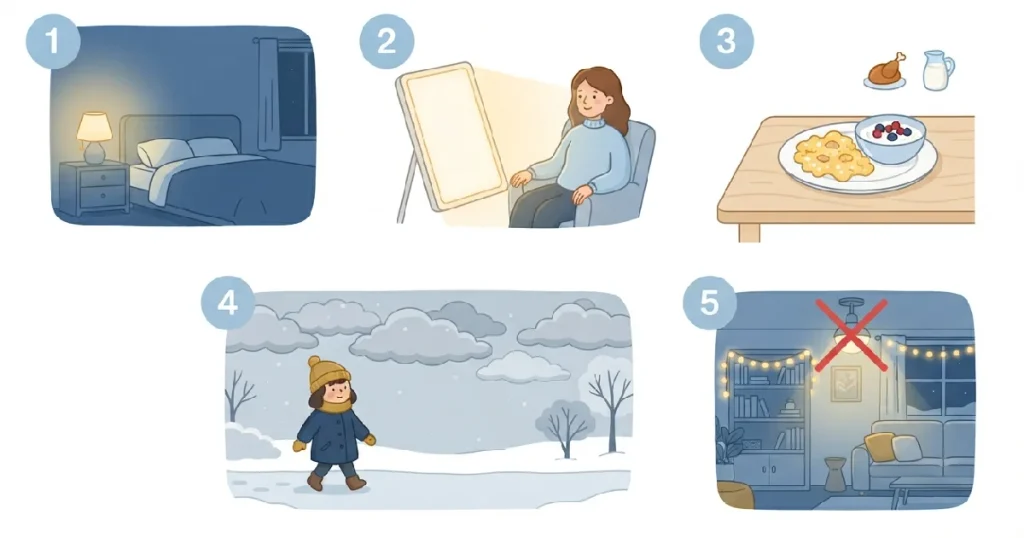
Hack 1: The Automated Dawn Simulation Sequence
A blaring alarm in pitch darkness spikes cortisol, your primary stress hormone, which is part of why winter mornings feel like an assault instead of a wake-up.
Dawn simulation works differently. A study hosted on PubMed Central found that gradually increasing light before waking helped reset circadian timing and improved mood in people with winter depression, without the jolt of a traditional alarm.
Plug a dimmable warm light or light box into a smart outlet timer. Set it to switch on at low brightness 30 to 45 minutes before your alarm, then gradually brighten to full strength, so your body wakes the way it would on a summer morning: slowly, with rising light instead of noise.
Hack 2: Fix the Lux Trap Wrecking Your Light Therapy
Most people buy a light box, use it twice, and quit. Community threads on seasonal depression are full of the same complaint: instant headaches, eye strain, and glare so intense the lamp ends up in a closet.
The problem usually isn’t the lux rating. It’s the surface area. A small lamp claiming 10,000 lux has to sit so close to your face to hit that number that it floods a tiny slice of your visual field with harsh, concentrated light instead of the soft, wide light your eyes actually need.
Look for a wide-panel box, not a small puck-shaped one, and position it about 16 inches away at a slight downward angle. The Harvard Health Blog recommends verified medical-grade boxes that filter UV light, used for about 30 minutes before 8 a.m. If glare is still a problem, wearable light glasses spread the same light across a wider lens, cutting the harsh point-source effect that triggers migraines.
Hack 3: The Protein Buffer That Blunts Seasonal Depression Cravings
That 3 p.m. craving for bread, pasta, or anything sweet isn’t weak willpower. It’s your brain trying to manufacture serotonin the fastest way it knows, through a rapid insulin spike from simple carbohydrates.
The problem is that spike crashes just as fast, leaving you more depleted than before.
Front-loading protein solves this at the source. Getting around 30 grams within an hour of waking, through eggs, Greek yogurt, or a shake, gives your brain the amino acids it needs to build dopamine and serotonin steadily throughout the day, instead of chasing sugar to get there in a rush.
Hack 4: Micro-Dosing Cold and Midday Light
But here’s what almost nobody expects.
Staying indoors to stay warm often makes seasonal depression worse, not better. A brisk 10 to 20-minute walk outside at lunch, even under a flat gray sky, exposes you to far more usable light than sitting under office fluorescents all day. Cold exposure itself triggers a mild endorphin response, the same reward chemical involved in a runner’s high, giving you a lift indoor sitting simply cannot replicate.
Treat this like microdosing daylight the way you’d microdose caffeine: small, repeated, well-timed doses that add up to more than one long session ever could.
Hack 5: Evening Light Deprivation to Protect Your Circadian Rhythm
Bright overhead lighting or a phone screen after 7 p.m. tells your brain it’s still daytime, suppressing the melatonin release you need to fall asleep on schedule.
Guidance from the Sleep Foundation recommends switching to warm, low lighting at least two hours before bed and activating night-shift settings on every screen in the house.
Swap harsh overhead bulbs for string lights, a salt lamp, or an electric fireplace. It sounds decorative, but it’s functional: dim, warm light protects the melatonin surge your body needs to actually rest.
The Reverse-SAD Reality: When Summer Fuels Depression Instead
Most guidance on seasonal depression assumes darkness is the enemy. For a smaller but real group of people, the opposite is true.
Reverse SAD, sometimes called summer depression, shows up as agitation, insomnia, appetite loss, and irritability that spike in June and July instead of December. Heat intolerance and constant bright daylight can overstimulate the same circadian system that winter darkness disrupts, just from the other direction.
If your depression consistently worsens with longer days and higher temperatures, the fix flips. Blackout curtains, air conditioning treated as a mental health tool rather than a luxury, and a strict evening wind-down that limits bright light rather than seeking more of it. Recognizing this pattern matters, because standard “get more sunlight” advice can genuinely make reverse SAD worse.
Tailoring Your Seasonal Depression Plan by Gender

Seasonal depression doesn’t show up identically for everyone. Community reports and clinical patterns both point to real differences worth naming.
Hormone-Driven Energy Drops in Women
Women more often report hypersomnia, oversleeping that leaves you foggy rather than rested, along with sugar cravings tied to both serotonin drops and the menstrual cycle’s own hormone shifts. If your slump hits hardest during the luteal phase, the week before your period, that overlap with seasonal light loss can double the fatigue. Tracking both cycles together, rather than treating them as separate problems, often reveals a pattern worth adjusting for.
Isolation and Executive Dysfunction in Men
Men more frequently report irritability, social withdrawal, and a stall on physical routines like the gym or a running habit. This often gets misread as simply being distant, when it’s closer to executive dysfunction, a reduced capacity to start or organize tasks, even ones you genuinely want to do. Lowering the barrier to entry matters more than motivation here. Packing gym clothes the night before, or scheduling an automatic check-in text to a friend, removes the decision-making step seasonal depression tends to hijack first.
Here’s how those adjustments look built into a full week.
Maya’s Winter Reset
Maya, a 34-year-old marketing manager, used to dread November so much she called it “the lost quarter” at work. She wasn’t sleeping well, she was living on toast and coffee, and she genuinely believed she was becoming a worse employee every year. Once she started using a dawn simulator and moved her light box session to right after her alarm instead of “whenever she got around to it,” her afternoon crashes cut in half within two weeks. She still finds winter hard. But now she has a plan instead of a spiral, and that difference alone changed how she talks about herself during these months.
Your Weekly Action Plan for Seasonal Depression
Call this the Winter Stack. Light before willpower. Protein before pastry. Grey sky before the couch. Dim before delay.
- Monday: Start the dawn simulator. Do 30 minutes of large-panel light while you do easy work. Protein breakfast. Overhead lights off by 8 p.m.
- Tuesday: Open every blind at wake-up. Phone charges across the room.
- Wednesday: Add five slow breaths during the light session. Take a hot shower 90 minutes before bed so core temperature can drop for deeper sleep.
- Thursday: 20-minute lunch walk no matter the clouds.
- Friday: Same light hour as Monday. Keep the house dim. Plan one low-stress shared meal for the weekend so isolation does not quietly win.
- Saturday: Wake within 30 minutes of your weekday time. Get outside early. Screen-free evening with warm lamps.
- Sunday: Light box on while you prep protein snacks and set the smart plug for Monday.
One place to start is tonight. Set the timer. That is the whole first move.
Consider this as a 24-hour test, not a new identity. If the slump is severe, if hopelessness does not lift, or if winters have followed this pattern for years, a licensed clinician can add therapy or discuss medication. Light hacks help many people. They are not a stand-in for care when depression is deep.
Some people also ask their doctor to check vitamin D, which often falls when sun exposure falls. That is a medical conversation, not a homemade cure.
A useful question to carry into tomorrow: Did I get outdoor light today, or only indoor light?
Radical Acceptance: The Hygge Approach to Seasonal Depression

Somewhere along the way, productivity culture decided that slowing down in winter is a problem to solve rather than a season to honor.
Scandinavian countries face far less daylight than most of the US or UK, yet report some of the lowest rates of seasonal depression in the world. Part of the answer is friluftsliv, a Norwegian idea meaning “open-air living,” the practice of dressing properly and getting outside regardless of weather instead of waiting for conditions to improve.
The other part is hygge, the Danish concept of intentional coziness: candles, warm drinks, and slower evenings treated as something to look forward to rather than something to feel guilty about.
Fighting winter head-on, expecting the same output you had in July, often backfires. Working with it tends to produce better mood outcomes than sheer willpower ever does.
What to Do in the Next 24 Hours to Manage Seasonal Depression
One place to start is the Light-First Rule: before checking your phone tomorrow morning, get your eyes on a light source, whether that’s a window, a dawn simulator, or a short walk outside. This single change resets your priority before your brain has a chance to spiral.
Consider building the Two-Minute Buffer: pack tomorrow’s protein breakfast tonight, so decision fatigue can’t talk you out of it at 7 a.m.
A useful question to ask yourself this week: does your evening lighting match the sleep you want? If your living room looks like an operating theater at 9 p.m., that’s worth changing before touching anything else.
The next time you feel the pull to isolate completely, try the 10-Minute Rule instead of an all-or-nothing plan: commit to just ten minutes outside. Most people report wanting to stay longer once they’re already out there.
You Are Not Failing at Winter
Picture that version of you sitting in the car before work, gathering energy just to open the door. That person isn’t lacking discipline. That person is running on a brain doing exactly what darkness tells it to do, without the tools to answer back.
You now have those tools. Light timed correctly. Protein timed correctly. Evenings that protect your sleep instead of sabotaging it. And permission, real permission, to slow down without treating it as a personal failure.
The deposits you make this season, one light session, one walk, one early night, are what keep that mood account from running negative again.
Seasonal depression isn’t a test of your character. It’s a biological weather pattern, and now you know how to dress for it.
My Closing Remarks
I used to treat winter as a personal failing. I would stack hard goals in January and then feel ashamed when my body wanted soup, early nights, and fewer plans. What shifted was dropping the fight while still doing the work. I use the light. I walk in the grey. I also let December be slower on purpose. If you feel heavy right now, that heaviness has a cause you can work with. You are not behind. You are in a season, and seasons are allowed to change the pace.
More Related Stories for You
- Managing seasonal depression often means calming the anxious thoughts that show up alongside it. If racing thoughts tend to spike along with your winter slump, these mindfulness exercises for anxiety pair well with the light and sleep strategies above.
About The Author