
 Sara Carmen
The couples who stay close for decades aren’t luckier than you. They just run on better systems.
Key Points
- Good marriage advice isn’t a feeling you chase, it’s a framework you build and rebuild together, one ordinary Tuesday at a time.
- The “50/50 fairness” model quietly breeds resentment, while a generosity-based approach keeps score of almost nothing.
- Small, repeatable habits, like a two-minute nightly check-in or an agreed pause button during a fight, outperform grand romantic gestures every time.
Contents
Table of Contents
Everything you were taught about a good marriage was built for a life most of us are not living.
We inherited slogans and treated them like skills. Never go to bed angry. Happy wife, happy life. Just communicate more. We nodded. Then we walked back into a kitchen with two laptops still open and a partner who feels more like a roommate than a lover.
You have tried. You have really tried. And the advice still evaporates the moment your nervous system is tired.
Someone might think a strong marriage is two people who never fight. But what they don’t see is the couple who fights, pauses, and comes back without leaving scorch marks.
Someone might think splitting bills, chores, and childcare straight down the middle is fairness. But what they don’t see is the clipboard in each person’s head, tallying who unloaded the dishwasher last.
Someone might think a big anniversary trip will rescue a dry season. But what they don’t see is a marriage starving for ordinary kindness on a random Wednesday, when nobody is performing romance.
The short answer: Good marriage advice that actually works is not a pep talk. It is a small set of rules you can run on a hard Tuesday. Give more than you count. Own whole tasks. Pause before you flood. Protect each other in public. Stay a whole person. Feelings follow the system. The system does not wait for feelings.
That is the map most people never get.
Why Most Good Marriage Advice Falls Apart on a Tuesday
The problem is not that you lack love. The problem is that popular marriage advice targets mood, while real life runs on load.
You work. Your spouse works. The house still generates an endless stream of invisible jobs: forms, groceries, school emails, the weird noise in the dryer, the birthday gift for a cousin you barely like. By 9 p.m., you do not need a quote about soulmates. You need a way to stop treating each other like opposing project managers.
This is where a psychological trap sets in. It is called confirmation bias, which means your brain hunts for evidence that matches the story you already believe. If your story is “I do more,” you will notice every shirt you folded and miss half of what your partner did. That is not because you are petty. That is how attention works when you are exhausted.
There is a second trap, and it is biological. During a sharp argument, many people go into physiological flooding. In plain language, your heart rate spikes, stress chemicals surge, and the thinking part of your brain goes partly offline. You are not having a debate anymore. You are in survival mode. “Never go to bed angry” is a disaster in that state. Sleep can be the repair. A timeout can be the wisdom.
Most people in this situation do not realize they are running a fairness program that their nervous system cannot support. Left unexamined, that program does not just create nagging. It can quietly become the reason you stop reaching for each other.
Decades of couple observation, including work from the Gottman Institute, show that stable marriages are not the ones that never hurt. They are the ones that buffer hurt with repair, ratio, and rules that still work under stress.
You do not need a more cinematic love. You need a better operating system.
The 50/50 Marriage Is a Scorekeeping Trap
“Happy wife, happy life” sounds generous until you live inside it. It turns one partner into the weather system and the other into a customer-service desk. It is transactional. It is one-sided. And it produces the thing it claims to prevent: a house full of quiet unhappiness.
The modern version of that slogan is the 50/50 marriage.
On paper, 50/50 feels adult. You split rent. You split bedtime. You split the emotional labor of remembering whose parents are visiting. It looks like justice.
In practice, it turns your home into an audit.
You stop living in the marriage and start inspecting it. Every extra load of laundry becomes a deposit. Every night your partner falls asleep on the couch becomes a withdrawal. You are both carrying a clipboard, and the clipboard always shows that you are slightly in the red on appreciation and slightly in the black on effort.
That is the hidden math of marital scorekeeping. Because of confirmation bias, your labor is high-definition. Their labor is background noise. So “equal” never feels equal. It feels like a trial where you are both the prosecutor.
But here’s what no one tells you.
Fairness as a 50/50 split is a moving target. Illness, a brutal work week, a new baby, a depressed season, a dying parent: life does not arrive in matching halves. If your marriage can only feel loving when the ledger is perfectly balanced, the marriage will feel failing most of the time.
That is not you being difficult. That is a ledger.
The 60/40 Rule: Good Marriage Advice That Stops the Ledger
The reframe is almost insultingly simple, and that is why it works.
Both of you aim to give about 60 percent and expect about 40 percent back.
Not as a new way to keep score. As a way to retire the scoreboard.
When both partners try to be the one who puts in the extra 10 percent, something strange happens. The house stops being a courtroom. Generosity becomes the default climate instead of a rare weather event. You are no longer waiting to be even. You are looking for the next small place to absorb the slack.
This is the anti-transactional mindset a lot of exhausted couples are hungry for. The internet consensus is not wrong here. Strict 50/50 trains you to notice deficits. 60/40 trains you to notice need.
What does the extra 10 percent look like on a real night? Your spouse had a brutal day. You take the bedtime routine even though it was “their night.” You do not announce it like a press release. You do not store it as a chip to cash later. You let the gift be a gift.
If only one person lives by 60/40, it becomes a new form of self-erasure. This only works as a shared rule. You both agree that overgiving is the point, and under-noticing is the enemy.
Put the clipboard down. The seesaw only rests when both of you lean in.
Mental Load Is the Invisible Work That Breaks Couples
Chores are not just physical. The heavier part is the mental load: the unseen job of noticing, planning, tracking, and worrying until a task is done.
Someone has to remember that the permission slip is due Friday, that you are out of oat milk, that the dog’s vaccine is next month, that your mother-in-law cannot eat tomatoes. If that noticing always lives in one brain, that person is never off the clock. Even when they sit down, they are still working.
This is one of the most common strains in dual-career marriage, especially in the early parenting years. You can split “who washes dishes” and still have a wildly unfair marriage if one person is the household’s project manager.
Most couples do not talk about this because it sounds unromantic. It is not unromantic. It is the ground romance stands on.
Own the Whole Task, Not the Helping
A useful framework here comes from Eve Rodsky’s Fair Play system. She uses a CPE model: Conception, Planning, and Execution.
If you “own” groceries, you do not wait to be handed a list. You conceive the need (we are out of food). You plan (what meals, what budget, what store). You execute (you buy it, you put it away, you notice what failed). No nudging. No “Did you remember…?” That question is not communication. It is a second job.
“Helping” keeps one person as the manager and the other as the intern. Full ownership makes two adults.
A practical way to start is a calm weekly meeting. Not a fight. A 20-minute deal-out of responsibilities. Name a minimum standard of care for each task, meaning the level that keeps both of you from feeling disgusted or abandoned. Groceries means a real dinner plan, not emergency cereal. Laundry means clean school clothes by Sunday night, not a heroic midnight panic.
If you skip the spoken standard, you will fight about values while pretending you are fighting about towels.
Ownership only works if the standard is spoken out loud.
Maya and Jordan Stopped Counting
Maya, 38, managed product launches. Jordan, 40, taught eighth grade. They had two kids and a shared calendar that looked like air-traffic control. They were proud of being “equal.” They split the mortgage. They alternated bedtime. They still felt lonely in the same bed.
Maya could tell you every dentist appointment she had booked. Jordan could tell you every night he had been the one who got up at 2 a.m. Both were right. Both felt unseen. Dinner became a status report. Sex became a rumor.
They did not need a speech about soulmates. They named the 60/40 rule out loud. Then they used CPE. Jordan took full ownership of food: meals, list, shop, leftovers. Maya took full ownership of pediatric care: appointments, forms, medicines, follow-ups. No reminders. No intern energy.
Two weeks later, the house was not magical. It was quieter. Maya stopped narrating what still needed doing. Jordan stopped waiting to be assigned. On a Thursday, while packing lunches, they caught each other’s eye and almost laughed. That small domestic smile did more than the anniversary dinner they had been too tired to enjoy.
Longevity is often that unglamorous. Deep comfort in ordinary rooms. A grin over the sink. That is the domestic delight principle, and it is more durable than a grand gesture.
Conflict Advice That Works When You Are Flooded
You will fight. A good marriage is not a conflict-free marriage. It is a marriage with brakes.
Make a formal pause-button agreement before you need it. When either of you feels the heat rising (tight chest, loud voice, the urge to be devastating), you say a pre-agreed phrase: “I am flooding. I need twenty minutes.” You separate. You drink water. You do not rehearse closing arguments in the shower. You return at the promised time and talk at a human volume.
This is not avoidance. This is respect for physiology. Words said while flooded are often words you cannot sand down later.
Then there is the ratio.
John Gottman’s research on couples found a pattern so consistent it is often called the magic ratio. In stable relationships, especially during conflict, you need about five positive interactions for every one negative. A criticism without repair is a paper cut. A paper cut with no kindness around it becomes an infection.
Positive does not mean fake cheer. It means a touch on the shoulder. A “I know you’re trying.” A shared joke that lets air back into the room. Gottman calls some of these bids for connection: small reaches that say “Are we still on the same team?” You can miss a bid. Miss too many, and the room goes cold.
The third habit is the one most couples skip when they are embarrassed.
They skip repair. They let the fight end by exhaustion instead of by closing the loop. A one-sentence repair is often enough: “I was sharp. I still want us.” That sentence is not weakness. It is how the 5:1 ratio gets built in real time.
Protect Public Dignity and Keep Your Own Life

Good marriage advice is incomplete if it only talks about chores and fights. You also need architecture: what you protect, and what you refuse to outsource.
Public dignity is non-negotiable. You do not correct your spouse’s story at dinner to look clever. You do not joke about their body, income, or competence in front of friends, coworkers, or family. You do not recruit your mother as a witness. Disagreement stays behind closed doors. In public, you are each other’s cover.
Contempt in private is already corrosive. Contempt in public is a demolition.
This matters with in-laws too. You can love your parents and still cleave to your spouse. That old word, cleave, just means you form a new first loyalty. You do not dump your partner’s flaws to your family as entertainment. You do not let a parent veto your household rules. Warmth plus a boundary is not cruelty. It is adult.
And you need a life that is still yours.
Codependency kills desire. If you enter a marriage to be completed, to escape your own life, or to have one person meet every need, you will eventually resent the human in front of you for being human. Keep friendships. Keep a hobby that does not include your spouse. Keep some financial competence of your own. Rodsky calls personal creative time unicorn space. You can call it being a whole person.
You are not half a couple. You are two whole people who chose the same address.
That independence is not a threat to intimacy. It is often what makes intimacy possible, because desire needs a little distance and a little mystery. A partner who vanished into the marriage has nothing left to bring back to it.
Four Moves You Can Try Tonight
This only matters if it can survive your actual evening.
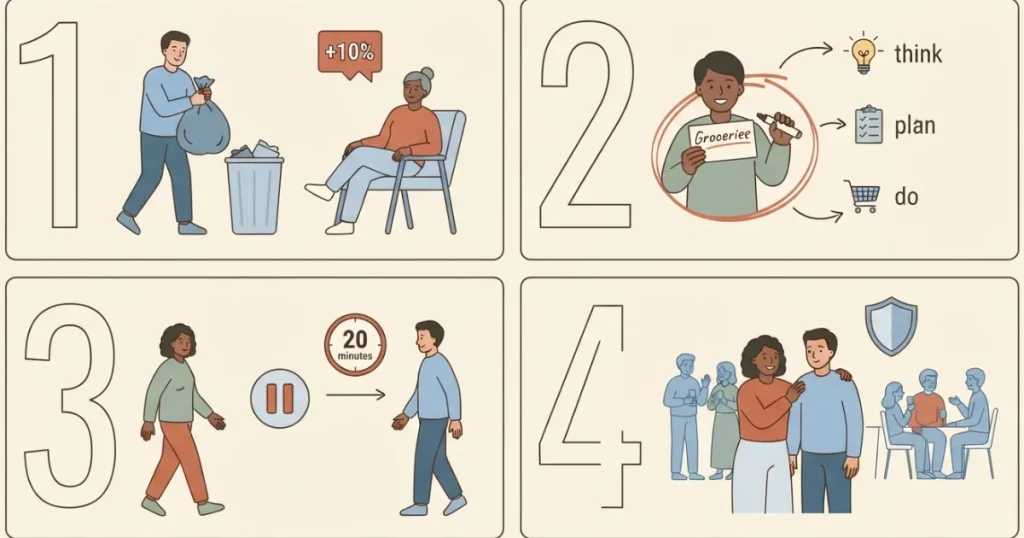
The Extra Ten Percent. Before bed, look for one task that is not “yours” and do it without a speech. The trash. The bottles. The backpacks. Let it be unnamed.
The CPE Swap. Pick one household lane that currently requires nagging. Hand over full conception, planning, and execution. Agree on the minimum standard. Then stay out of the way for two weeks, even if the style is not yours.
The Pause Button. Sit down while you are calm and write the timeout phrase, the number of minutes, and the promise to return. The next time your voice climbs, use the script instead of your sharpest sentence.
The Dignity Rule. For seven days, zero public corrections, zero spouse-as-punchline, zero third-party alliances. If something bothers you, it waits until you are alone.
A useful question to ask yourself is not “Are we in love?” Try: “Where am I still carrying a clipboard?” Another: “What do I own completely, from noticing to finishing?” If you are not married yet, these are the same questions. Ask how career sacrifices will be handled if children arrive. Ask about debt, in-laws, and who tracks the invisible work. Alignment is kinder than hope.
If you want a romance structure later, some couples use a simple cadence: a short date most weeks, a longer stretch most months, a real break most years. Intention beats waiting to feel spontaneous.
One place to start is a single rule, not a personality makeover.
You already know which Tuesday night image this began with. Two laptops. A kitchen. A quiet that felt like distance. That scene does not mean your marriage is empty. It means the slogans failed and the system has not been installed yet.
You now have a different way to stand in that kitchen. Not as an auditor. As the person who leans in 10 percent, owns a lane, pauses before flooding, and guards the other person’s name in every room.
A good marriage is not a mood. It is a practice you can start before the lights go out.
My Closing Remarks
I used to believe the couples who made it were the ones who felt more. Then I sat with enough tired people to see the pattern. The ones who last are not luckier. They are better at small rules when nobody is watching. If your house feels like a workplace with a shared calendar, you are in ordinary company. Pick one rule. Run it tonight. Notice whether your body unclenches even a little. That loosening is data. Trust it more than a slogan.
If you are struggling with your marriage, consider speaking with a licensed therapist.
More Related Stories for You
- If you want good advice for a relationship in the same practical, no-slogan tone, start here.
About The Author