
 Nicole Adkins
From five-minute driveway stargazing to full afternoon waterfall treks, here are 15 ways to trade the couch for fresh air this weekend without spending a fortune.
Key Points
- Outdoor activities don’t require pricey gear, a car, or a full free day. Most of these ideas work with what’s already in your closet.
- These 15 outdoor activities are sorted by energy level and budget, so there’s something here whether you have fifteen minutes or a full Saturday.
- A short dose of time outside can lower stress hormones and interrupt the numb, scrolling version of a weekend you didn’t actually choose.
Contents
Table of Contents
You do not need a wilderness trip or technical clothing to feel like a weekend happened. Pick one nearby outdoor activity, stay out long enough for your attention to unclench, and give yourself a small reward after. That single loop is how autopilot starts to break.
We have a quiet weekend ritual most of us never named. The phone comes out. The hours thin away. Sunday night arrives with that familiar tightness in the chest, as if the two free days never happened.
You tell yourself you needed rest. What you got was more of the same indoor loop.
Someone might think they are simply tired, and that the sofa is recovery. But what they do not see is that the body never received a true off-switch. The mind kept scrolling. The stress chemistry never fully stood down.
Someone might think outdoor activities start after they buy the right jacket, the right boots, the right backpack. But what they do not see is the waiting itself. Preparation becomes a polite way to stay inside.
Someone might think a gray Saturday is a write-off. But what they do not see is how often weather is the alibi, not the obstacle.
Left alone, this pattern does more than waste a weekend. It slowly shrinks the size of your life until “going out” means a parking lot and a screen in a different room.
According to a 2015 study by Bratman and colleagues at Stanford, a 90-minute nature walk reduced rumination, the brain’s habit of chewing the same worries on repeat, compared with a walk along a busy street. The outdoor group also showed less activity in a brain region tied to that mental replay. In plain language, green space gave their thoughts somewhere else to go.
That is the map of the territory you have been lost in. The problem is not a lack of willpower. It is a closed loop.
Why Outdoor Activities Feel Harder Than They Should
Your capacity for outdoor life works like a footpath behind a house. Walk it once a week and it stays clear. Leave it for a month and you start believing the path is gone.
It is not gone. It is overgrown.
Psychologists call the indoor version of this directed attention fatigue. That is the tiredness that comes from forcing your focus all week, on tabs, messages, traffic, and tasks. Nature helps because it asks for a softer kind of noticing, what Attention Restoration Theory describes as “soft fascination.” You watch water move. You hear wind. You do not have to perform.
Most people in this situation do not realize they are protecting themselves with shopping lists. The “over-gear” myth says you cannot enjoy outdoor activities until you look like a catalog. That myth is expensive. It is also a stall.
The Over-Gear Myth is Keeping you Indoors
You do not need a $400 technical backpack for a weekend in the park. A cotton shirt, a fleece, and a cheap rain shell will handle most local trips. Think in three simple layers: something against the skin, something warm in the middle, and something that blocks wind or rain.
If you want a plain-language tour of low-barrier options, the Millets outdoor A-Z of fun outdoor activities makes the same point. Adventure is a behavior, not a receipt.
Dogs do not need premium kit either. A leash, water, and a route that allows pets will do.
The Psychology of an Autopilot Reset
Autopilot living is like leaving your nervous system in airplane mode. The world is still transmitting. You just stopped receiving.
When you stay inside with a phone, your default mode network (the brain’s idle-chatter circuit) often fills with replay and comparison. Movement plus novelty interrupts that circuit. Heart rate changes. Eyes adjust to distance. Cortisol, the body’s main stress hormone, gets a chance to fall.
In my practice I have watched capable adults wait for the “right” Saturday for years. They were not lazy. They were waiting to become the kind of person who already owned the right jacket.
The couch is not rest. It is a holding pattern.
Jordan’s Saturday that Finally Counted
Jordan, 34, tracked steps on an Apple Watch and still felt like the weekend never happened. He worked in product design. He had a 1,000-hour outdoor goal in a notes app. By March he was behind and ashamed of a number no one else could see.
He told himself he would start after he bought trail shoes. He researched rain pants. He opened booking tabs for a cabin he could not afford. Saturday would arrive. He would clean the kitchen, answer one more email, and call it rest.
On a damp weekend in April he tried something smaller. He put on sneakers he already owned, walked streets he had never taken behind his own neighborhood, and ended at a café for hot chocolate. He logged three hours. The watch did not make it meaningful. The new streets did. He said the rest of the day felt wider, as if someone had opened a window in a room he had forgotten was closed.
He did not become an outdoors person that morning. He became a person who left the house without a speech.
15 Amazing Outdoor Activities for Any Weekend
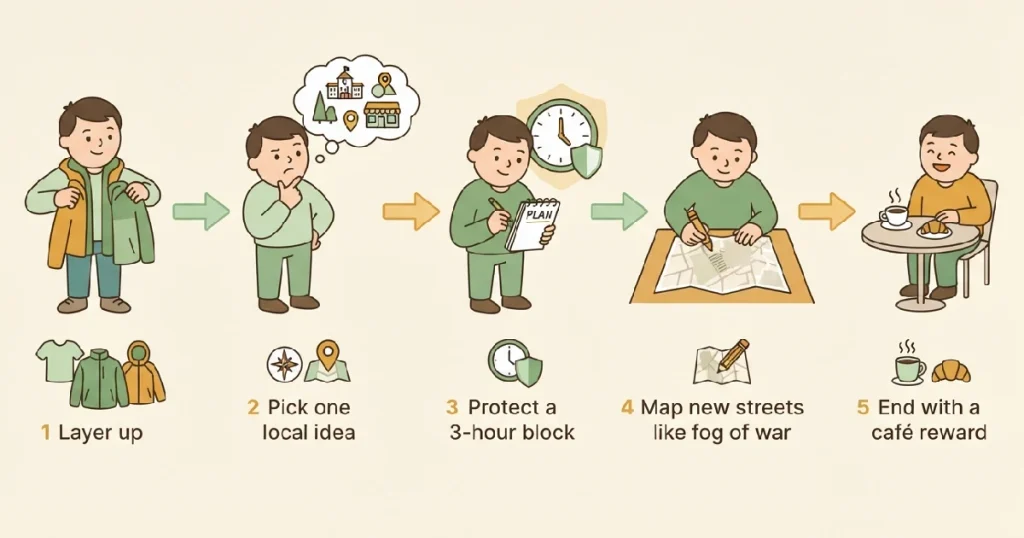
You do not need a bucket list. You need a micro-adventure, a small outing close to home that still breaks the loop. The list below fits mixed energy, mixed weather, and mixed company. Pick by the Saturday you actually have, not the Saturday you perform on social media.
1. Low-Energy Outdoor Activities that Still Reset Your Attention
These are for the weekends when your body wants slow and your mind wants quiet. The claim is simple. Gentle outdoor time still counts, and it often works better than a forced “epic.”
1. “Fog-of-war” local mapping. Treat your neighborhood like an unrevealed video game map. Walk or cycle streets and paths you have never taken. Fill them in on a running app heatmap, an OpenStreetMap trace, or a simple paper grid. Novelty is the point. Your brain wakes up when the route is no longer automatic.
2. The post-stroll café reward. Time a brisk park loop to end at an indie café. Rain is allowed. Cold is allowed. The walk is the reset. The hot chocolate or coffee is the reason you will go again when the sky looks unfriendly.
3. Outdoor reading escapes. Pack a blanket, one book, and no extra tabs. Sit under a tree or on a secluded bench. Put the phone in a bag, not a pocket. Twenty pages outside will often quiet the mental noise that two hours on a sofa never touches.
4. Local dark-sky stargazing. Drive just beyond the glow of streetlights on a clear night. Wear a thermal layer you already own. Use a basic constellation app to find a few major shapes, then put the phone away. Looking up changes the scale of whatever felt huge at 4 p.m.
5. Sunset or sunrise tailgating. Park at a scenic overlook. Sit on the hood or the open boot with a thermos of tea you brewed at home. No screens. Watch color change until it is done. You are practicing presence without calling it that.
So what? If your energy is low, you are not disqualified from outdoor activities. You are being asked to shrink the mission until it fits the nervous system you have today.
2. Budget-Friendly Outdoor Activities for Groups and Solo Weekends
These cost little because public space is already paid for. The claim here is that fulfillment is not a function of spend. Shared air and a simple plan beat a pricey indoor reservation more often than you think.
6. Micro-BBQ in the park. Skip the formal dinner. Bring foil-wrapped food, a small grill where rules allow, and two or three people you actually like. Public parks keep the mess and the cost down. Kids and dogs usually make it better, not worse.
7. Urban stroll and architecture roaming. Walk a historic town center or a few old streets as if they were a free museum. Look at doorways, brickwork, and plaques you have rushed past. Aimless walking is not wasted walking. It is how a familiar city becomes new.
8. Geocaching scavenger hunts. Use your phone’s GPS to find hidden caches in nearby green spaces. It turns a plain trail into a hunt. Families like the puzzle. Solo adults like the excuse to enter a copse they would otherwise skip.
9. Creative nature photos and zines. Frame weeds, puddles, and brick walls with the camera you already carry. Print a few shots later or fold a one-page zine. For playful, low-cost outdoor date energy, Teen Vogue’s spring outdoor date ideas are a useful spark. The point is making, not posting.
10. Foraged-material birdhouse building. Collect fallen twigs, bark, and pinecones on a short walk. Assemble a rustic shelter in the yard that afternoon. You get movement, making, and a reason to glance outside tomorrow.
So what? When money feels tight, outdoor activities are not the luxury you cut. They are the luxury you can still afford.
3. High-Energy Outdoor Activities and Local Micro-Adventures
These are for the weekends when you need distance, pulse, and a story. The claim is that you can get that feeling within a short drive. You do not need a flight.
11. Local wild swim and float. Find a designated, safe river, lake, or coastal spot. Use a basic eco-conscious inflatable and stay with friends. Cold water is a hard interrupt for rumination. Check local rules and water quality first. If swimming is not for you, wading still counts.
12. Waterfall chasing. Use a hiking app to find two or three lesser-known falls within driving distance. Damp weather makes them louder and more dramatic. Trails will be muddy. That is part of the aesthetic, not a failure of planning.
13. Beginner bouldering and rock scrambling. Leave the indoor wall for a public, low-level crag or rocky path. Stay well within your comfort. Shoes you can grip in matter more than a harness you do not need. The outdoor texture of stone is the whole education.
14. Paved mountain biking. Take a hybrid or mountain bike onto flat rail-trails. You get distance and scenery without technical descents. Rent if you do not own. For active planning ideas and rental thinking, TripOutside’s list of ways to get active outdoors is a practical starting point.
15. The 1,000-hour smartwatch block. Set a strict three-hour outdoor block. Track it on an Apple Watch, a Fitbit, or a paper log. No errands disguised as fresh air. This is how 1,000 Hours Outside people actually hit the number: not with hero days, but with protected hours.
So what? High energy does not have to mean high cost or high risk. It means you let your body go farther than the fridge.
How to Guarantee You Actually Get Outside This Weekend

Knowing 15 outdoor activities will not get you out the door. A small system will. One place to start is naming the Saturday before it arrives, the same way you would name a meeting.
The Gamification Strategy for Outdoor Time
Give the walk a scoreboard. Use a heatmap or a drawn map of “explored territory” around your home. Unvisited streets stay fogged. Walked streets clear. It sounds playful because it is. Play is how adults return to habits they abandoned out of seriousness.
A useful question to ask yourself: which three streets nearest my door are still fogged?
If you track 1,000 hours, stop arguing with the year. Protect the next three-hour block. Manual logs work if a watch makes you perform. The tool is only a witness.
Overcoming unpredictable weather without losing the weekend
Build a post-walk reward system. Decide the treat before you leave: a pastry, a shower that is too long, a film, a hot drink. The reward is not a bribe for children. It is how you teach a cautious brain that going out ends well.
Layer before you debate. If you are dry and warm enough, weather becomes texture. Waterfall days want rain. Stargazing wants cold. Café walks want gray. The mistake is waiting for a postcard forecast.
The next time the sky looks unfriendly, try this 20-minute rule. Put the layers on and step outside for 20 minutes. You may turn around after that. Most people do not.
Consider a “territory day” when trails look grim. New alleys, river paths, and park edges still fill the map. Movement is the medicine. Scenery is the bonus.
The path Was Never Gone
You began this reading in that Sunday-night tightness, the feeling that rest happened on paper and not in the body. You can meet that same hour differently now. Not with a better personality. With a smaller door.
The footpath behind the house is still there. Brambles grew because you stopped walking, not because you were unfit for the woods.
Pick one idea. Put on the jacket you already own. Leave a reward on the other side.
Fresh air does not wait for the right kit. It waits for you.
My Closing Remarks
I still catch myself treating a gray Saturday as a reason to disappear into laundry and tabs. The walk I take anyway is almost always the part of the weekend I remember. Not because it was impressive. Because my shoulders dropped. If you have been waiting to feel like an outdoors person before you go outside, you can put that audition down. You are allowed to be ordinary in a park and still have it count. Tomorrow morning, step onto one street you never bother with. Stay long enough to notice the temperature on your face.
More Related Stories for You
- If a slow hour outside still leaves your thoughts sprinting, pair it with these mindfulness exercises for anxiety.
About The Author