
 Sara Carmen
Love got you married. Daily systems will decide whether the first year feels like a partnership or a quiet contest.
Key Points
- The best advice for newlyweds is not more romance. It is dropping the 50/50 scorecard and building a same-team life.
- Most first-year fights are not proof you chose wrong. They are inherited conflict habits meeting money stress and routine.
- Small daily thanks, honest money structure, and calmer fight mechanics protect a new marriage better than grand gestures.
Contents
Table of Contents
We walk out of the wedding convinced love will do the heavy lifting. Then an ordinary Tuesday arrives. Rent is due. Dishes sit in the sink. A comment about spending lands harder than it should. You feel a flicker of panic that this is not what you signed up for.
Someone might think a strong marriage is mostly chemistry and good intentions. But what they don’t see is how fast two full adult lives collide once the guests go home.
Someone might think the first big fight means the spark is dying. But what they don’t see is that you are often arguing in your parents’ voices, not your own.
Someone might think splitting everything down the middle is the fair way to begin. But what they don’t see is how a strict 50/50 split can breed quiet resentment when incomes, student debt, and household tracking are not equal.
The best advice for newlyweds is to treat year one as a build, not a honeymoon. Love is why you chose each other. Conflict habits, money structure, and daily appreciation are what keep that choice from wearing thin under real stress.
Here is the map most couples never get. You did not only marry a person. You married their nervous system, their money story, and the argument style they watched at the kitchen table growing up. Psychologists call this intergenerational transmission of conflict, which simply means you copy the anger habits you saw long before you could name them. Add later marriage ages, dual incomes, and tighter budgets, and the first year becomes a pressure test. According to Pew Research Center’s Family Demographic Trends, adults now marry later than earlier generations. That often means you arrive with formed habits, separate accounts, and a conflict style you have never put into words. Left unexamined, those copied habits do not stay small. They become the weather of the home.
A new marriage is two operating systems trying to run on one device. Each system worked fine on its own. Together they freeze until you write shared code.
1. Deconstruct Your Inherited Conflict Style Before It Runs the House
The fights you are having are rarely only about chores, tone, or who forgot the bins. They are often old family software running in a new kitchen.
The danger of echoing generational arguments
If your parent went silent, you may go silent. If their house used slammed doors, your body may still reach for volume. These are learned responses, not proof of a bad match. Most newly married couples do not realize they are repeating a childhood pattern until the same fight returns for the fourth time.
Name it out loud. “I shut down when I feel overwhelmed because that is what I saw growing up.” That sentence is not a speech. It is a circuit breaker. It moves the moment from attack to information.
Researchers tied to The Gottman Method Principles have long shown that how you fight predicts more than how often you fight. Contempt, stonewalling, and character attacks do more damage than the original issue. Stonewalling is the freeze. You go quiet, look away, and leave your partner talking to a wall. Character attacks sound like “you always” and “you never.” They turn a problem into a verdict on who your partner is.
Shift from me versus you to us versus the problem
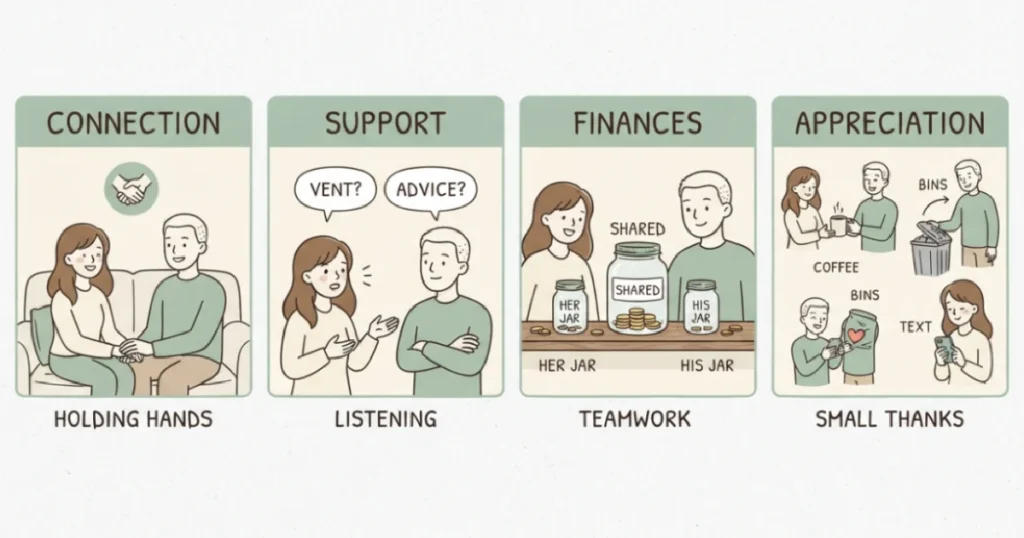
Hold hands when the conversation is hard. It sounds almost too simple. Physical contact keeps your body in the room when your mind wants to bolt. Couples who use this during money talks or logistics talks often notice the sting drop. You are touching an ally, not facing an opponent.
Ask one question before you try to fix anything: “Do you want to vent, or do you want advice?” Many of us rush to repair because anxiety hates an open loop. Your partner may only need to be heard. Trying to solve a vent feels like control. Hearing a vent feels like care.
When your heart starts racing and your thoughts go blank, you may be in emotional flooding. That means your nervous system is so overloaded that clear thinking is offline. Take a short break. Agree on a return time. Twenty minutes is often enough for your body to come back. Then continue. Walking out with no return time is not a break. It is abandonment wearing a calmer face.
Fairness is not the same as teamwork.
2. Master Newlywed Finances Without Falling Into the 50/50 Trap
Money is one of the fastest ways a new marriage turns into two opposing camps. The trap is not spending itself. The trap is a fairness rule that ignores real life.
Move beyond the 50/50 financial split
A strict 50/50 split looks clean on paper. It falls apart when one of you earns more, carries heavier student debt, or works a job that leaves less energy for the household. The lower earner can feel like a child asking permission. The higher earner can feel used. Neither feeling builds a team.
Use a proportional model instead. If you earn 60 percent of the combined take-home pay, you cover about 60 percent of shared costs. Your partner covers about 40 percent. You are both contributing fully relative to what you have. That is equity, not identical cash.
This matters even more when rent, groceries, and energy bills keep climbing. Dual-income newlyweds in the US and UK are not imagining the squeeze. The squeeze is real. A rigid split adds moral judgment to a math problem.
Keep micro-independence and full transparency
A useful structure looks like this. One joint pot covers fixed shared costs: rent or mortgage, utilities, insurance, groceries, and agreed savings. Each of you also keeps a personal account. Money in that personal account needs no justification. A coffee, a gift, a game, a haircut. No inquest.
Transparency still matters. You both see the shared numbers. You both know the goals. You do not police each other’s small spending. Independence without secrecy. Teamwork without surveillance.
Then talk about the mental load. That is the invisible work of remembering, planning, and tracking. Who books the boiler service. Who notices the toothpaste is low. Who remembers a sibling’s birthday. If one of you does most of this unpaid tracking, a “fair” money split is not fair at all. Divide the tracking, not only the tasks.
Love is not a feeling that pays the bills. Love is a repeated choice about how you treat the person sharing those bills.
3. Manage Perpetual Problems in the First Year of Marriage
Your first serious fight can feel like an emergency. It is usually a preview.
The 69 percent rule and incurable differences
A large share of marital arguments are what researchers call perpetual problems. These are conflicts tied to core personality, not to a missing chore chart. One of you wants to socialize. One of you needs a quiet Sunday. One of you spends to feel alive. One of you saves to feel safe. John Gottman’s work found that about 69 percent of relationship conflicts fall into this lasting category. The aim is not total resolution. The aim is kinder management.
That finding should lower your panic. Difference is not a defect. The danger is the belief that a good marriage would eventually erase friction. It will not. A good marriage makes friction survivable.
Catch warning signs before they harden
Voice a complaint about a specific act. Keep it away from your partner’s character. “I felt alone when you stayed on your phone through dinner” is usable. “You are selfish and you never show up” is a wound.
Watch for immediate defensiveness. Defensiveness is the reflex that turns every concern into a counterclaim. “Well you do it too” ends listening. Try “I can see why that landed badly” even if you also have a point. You can hold your point and still receive theirs.
Most people in this situation assume the fight means incompatibility. Often it means two people who have not yet learned each other’s repair speed.
When Lena and Marcus stopped keeping score
Lena grew up in a house where anger meant silence. Her father left the room for hours. Marcus grew up with volume. Doors shut hard. Voices rose. In month four they fought about a credit card bill. Lena went quiet. Marcus got louder because her silence felt like rejection. Neither was really fighting about the bill anymore. They were replaying childhood. The turn came on the couch, hands linked, with one honest line. “I go quiet because that is how my house stayed safe.” The bill still needed a plan. They made one with a proportional split and a weekly money check-in. The climate of the room changed because the target changed. It was no longer Lena versus Marcus. It was the two of them versus a pattern.
Habituation is the other quiet thief. That is the brain’s habit of stopping notice of what it sees every day. The first-year slump is often routine, not a loss of love. You can look at your partner with fresh eyes on purpose. Notice the way they make tea. Notice the joke they still tell. Choose them again in small ways, not only on anniversaries.
4. Protect Newlyweds From the Digital Envy Trap

Your phone can pick a fight your partner never started.
The hidden cost of the Instagram-perfect marriage
Curated feeds offer false benchmarks for romance, date nights, kitchens, and patience. You see a weekend away. You do not see the tense car ride home. You see a caption about “my person.” You do not see the argument about whose turn it was to call the landlord. Comparison creates a private scoreboard. Your real marriage then feels shabby beside a highlight reel.
This breeds a specific kind of resentment. It is quiet. It is hard to confess. It sounds like “Why don’t we ever…” when the truthful sentence is “I am measuring us against people I do not actually know.”
Put the phone down during the first and last ten minutes of the day if you can. Those windows are when many bids for connection happen. A bid is a small reach for attention, humor, or care. “Look at this.” “How was that meeting?” “Sit with me.” Turning toward those bids is one of the simplest marriage skills you will ever practice.
Use a micro-appreciation framework
Grand gestures are optional. Daily noticing is not. Micro-appreciation is the compound interest of a marriage. Thank the person who made coffee. Thank the person who took out the bins. Thank the person who texted your mum. Be specific. “Thanks for handling the council tax email” lands better than a vague “you’re great.”
You are not performing gratitude. You are training attention. What you thank, you start to see. What you see, you stop taking as background noise.
If social media still stings, ask a cleaner question. “What am I hungry for in our real life?” Maybe it is play. Maybe it is rest. Maybe it is being chosen in public in a small way. Feed the real hunger. Do not keep scrolling the advertisement for someone else’s marriage.
What to practice this week
One place to start is the Hand Anchor. The next time a hard topic comes up, sit close enough to hold hands before you speak. Keep holding even when the words get clumsy. Let your body vote for “same team” before your mouth starts the case.
Consider the Vent-or-Fix Check. When your partner is upset, ask which they need. Then obey the answer. If they want a vent, you listen. If they want a plan, you build one together.
A useful structure is the Percentage Pot. This week, write down take-home pay, shared bills, and a proportional split. Open or confirm a joint account for shared costs. Protect a personal account that requires no defense.
Try the Three-Thanks Loop. Before bed, name three small things your partner did. Keep them ordinary on purpose. Ordinary is where habituation lives. Ordinary is also where you break it.
A useful question to ask yourself: “Am I trying to win this, or am I trying to stay married to this person tonight?”
You now have a different way to read that ordinary Tuesday. The dishes are not a verdict. The money talk is not a trial. The awkward fight is not proof the wedding was a mistake. You are watching two operating systems meet. You can write better code.
Start your marriage right by choosing the team every day, then building the habits that let the team survive an unremarkable week. Romance still matters. It lasts longer when it has a structure under it.
Choose the team. Then keep choosing the small acts that make the team real.
My Closing Remarks
I have sat with enough newly married people to know the first year can feel strangely lonely even when you live in the same rooms. You can love someone and still feel shocked by their habits. I used to think a calm marriage was a sign of luck. I do not think that anymore. The couples who settle well are not luckier. They get curious faster. They name the family echo. They stop treating money as a moral test. If you take one thing from me, take this. You are allowed to be new at this. New is not failure. New is the job.
More Related Stories for You
- If you want more good advice for a relationship after the wedding glow fades, start with the daily habits that keep two people on the same side.
About The Author