
 Sara Carmen
The smallest gestures, repeated daily, do more for your bond than any grand romantic gesture ever could.
Key Points
- Learning how to make your mate happy has nothing to do with money. It comes down to small, repeatable acts that rebuild connection every single day.
- Seven zero-cost habits, tested by real couples and grounded in relationship science, can move you out of roommate mode and back into real closeness.
- You’ll also learn what to do when your effort feels one-sided, so these habits build trust instead of quiet resentment.
Contents
Table of Contents
We treat love like a performance we stage a few times a year. The trip. The jewelry. The apology dinner after a cold week. Then an ordinary Tuesday arrives and the person across the table feels more like a roommate than a mate. The silence is not dramatic. It is just empty.
Someone might think a weekend getaway will restore the spark. But what they don’t see is that the distance started in a hundred arrivals with no real greeting.
Someone might think saying “I love you” before sleep is enough. But what they don’t see is that the words have become wallpaper. Heard. Not felt.
Someone might think the problem is lost chemistry. But what they don’t see is that chemistry was starved by ignored moments, unanswered looks, and evenings spent in the same room on separate screens.
You do not make a mate happy with a bigger performance. You do it with repeated proof that you are paying attention. Those proofs calm the body. They rebuild trust in ordinary hours. The seven tiny acts below are that proof, and they cost nothing but presence.
This is not a personality problem. It is an attention problem. Relationship researchers call the 5-to-1 pattern the magic ratio: stable, happy couples tend to offer about five positive everyday interactions for every negative one. You can read the breakdown of that magic relationship ratio from the Gottman Institute. The point is simple. One blowup is not what ends most bonds. A slow shortage of warmth is.
Left alone, the roommate feeling does not stay neutral. It hardens into a story that your mate stopped caring. That story is how many otherwise decent partnerships end.
Why Big Gestures Fail When You Want to Make Your Mate Happy
Most advice assumes both of you are equally hungry to please. Real life is messier. You may be tired. You may have tried. You may be waiting for them to go first so you do not feel foolish.
That is the reciprocity dilemma. You offer care and watch for a matching return. When it does not arrive on schedule, the act starts to feel like unpaid labor. Resentment grows in the gap between what you gave and what you got back.
There is another trap. Call it forced happiness. You keep the peace with smiles, chores, and careful tone while the real issue sits untouched. Small gestures then become a cover, not a connection. Your mate may even distrust them, because the warmth does not match the climate.
Most people in this situation do not realize they have turned love into a transaction. A vending machine. Insert kindness. Wait for thanks.
That is not how attachment works.
A relationship is not a fireworks show you stage twice a year. It is a dimmer switch. Every tiny act turns the light up a notch. Ignore it long enough and you are sitting in the dark, wondering when the spark died.
The shift is this. You stop using micro-gestures to buy a reaction. You use them to become someone who notices. Noticing is the love. The response, when it comes, is a side effect.
When Maya Stopped Waiting for the Spark to Return
Maya, 36, told herself the distance was just a busy season. She and her husband, Dominic, had two kids and a kitchen that never stayed clean. At 6:40 p.m. he would walk in and she would call “hey” from the sink without turning around. He would nod at the back of her head. They were kind. They were also lonely.
After a flat weekend, she tried one change. She put her phone face down, met him at the door, and held on for a full breath longer than felt natural. He laughed, awkward. She did it the next night anyway. By the second week he started lingering in the kitchen instead of disappearing into the bedroom. Nothing cinematic happened. The house just got warmer.
Maya did not fix a marriage with a speech. She changed the greeting. That is the whole secret hiding in plain sight.
The 7 Tiny Acts That Create Big Love
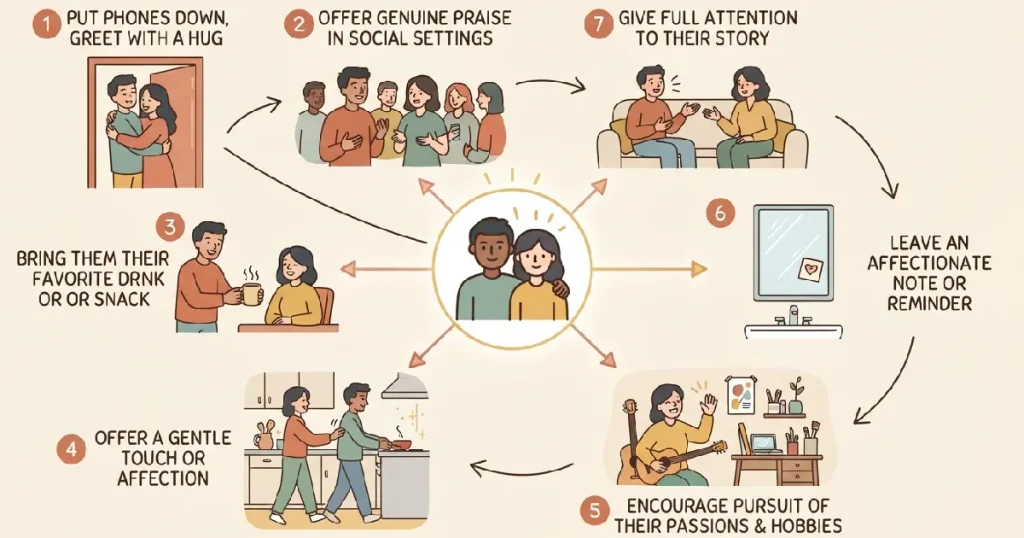
These are not personality makeovers. They are habitual anchors: small, repeatable moves that tell your mate, “I still see you.” Pick one. Do it on purpose. Let it get boring in the best way.
1. Greet Your Mate at the Threshold Like They Matter
The claim is simple. The first ten seconds after you reunite set the emotional temperature of the house.
When they come home, or when you walk into the room, do not offer a passive “hey” from your phone. Stop. Stand up. Look them in the eye. Give a real hug that lasts a beat longer than habit.
Physical touch is not decoration. It is biology. Warm, welcome contact is linked to oxytocin, a bonding hormone that helps the body downshift from stress. Greater Good at Berkeley has a clear look at this science of touch. You are not being sentimental. You are giving their nervous system a landing place.
So what? Tonight, treat the doorway like it matters. The hug is the message. The words can come after.
2. Hype Your Partner in Public to Build Real Respect
The claim: private love is good. Overheard admiration is rocket fuel.
Casually praise their competence, judgment, or craft in front of family or friends. Not a speech. A passing, specific line. “He figured out the insurance mess in one afternoon.” “She is the reason that project did not fall apart.”
Many people, especially men, live on a thin diet of respect. A compliment they overhear feels more honest than one delivered face to face, because it does not look like a performance for their benefit.
So what? The next time you are in a group, name something true about them. Watch their shoulders drop. That is emotional security arriving without a seminar.
3. Drop an Unsolicited Drink to Show Quiet Care
The claim: the most powerful care is the kind that does not demand a conversation.
Learn their timing. Coffee exactly how they like it when the alarm goes off. Their favorite cold drink set on the desk during a brutal work window. No “Did you see what I did?” No invoice.
This is attunement, which means you are tracking their inner weather and responding as if it counts. You are saying, “I know your day,” without adding a task to it.
So what? Pick one beverage ritual this week. Make it boringly consistent. Quiet awareness is one of the fastest ways to make your mate happy without spending a dollar.
4. Initiate Intimacy Before They Have to Ask
The claim: if one person always has to close the distance, desire starts to feel like a job.
You do not need a perfect mood or a free weekend. A hand on their back in the kitchen. Sitting close on the couch instead of at opposite ends. A kiss that is not a prelude to a request. On some days, yes, it is also you being the one who starts sex.
Long-term couples often slip into a pattern where one partner becomes the initiator and the other becomes the gate. That pattern quietly asks, “Am I still wanted?” Proactive touch answers before the question turns bitter.
So what? Once a day, be the first to close the gap. Keep it light if the season is tense. The point is to interrupt the monotony, not to stage a scene.
5. Protect Guilt-Free Time So Your Mate Can Breathe
The claim: clinging is not closeness. Protected solitude is often what makes shared time feel good again.
Actively guard a window for their hobby, gym, game, studio, or quiet walk. Do not sigh. Do not stack a chore list on the way out. Do not text “when will you be back” twenty minutes later.
If you have felt like glorified roommates, part of the claustrophobia is that neither of you gets to be a full person. Autonomy windows reduce that pressure. They come back with more to give because they left as themselves, not as an employee of the household.
So what? Name the window out loud. “I’ve got the kids from 7 to 8:30. Go.” Then actually have it.
6. Leave a Specific Love Note Where They Least Expect It
The claim: generic praise slides off. Specific praise sticks.
Use a dry-erase marker on the bathroom mirror, or a scrap of paper in a pocket or lunch bag. Skip “You’re the best.” Write the thing they did yesterday that made you feel safe, proud, or lucky. “The way you handled her meltdown last night made me feel like we’re a team.”
A vague compliment is polite. A precise one is proof you were paying attention when they were not performing.
So what? One sentence. One specific moment. Put it where they will find it alone. Private discovery hits harder than a public production.
7. Listen Without Correcting When Your Partner Needs to Land
The claim: many mates do not want a fix. They want a safe place to put the day down.
When they vent, practice a zero-correction landing zone. No unsolicited plan. No “Well, actually.” No ranking of whose day was harder. Nod. Reflect one feeling. “That sounds exhausting.” Then stop.
This is active listening, which means you are receiving their experience instead of editing it. Advice has its place. The first minute after a hard day is rarely that place.
So what? The next time they start talking, sit on your hands, metaphorically. Let the story finish. You will be shocked how often “I hear you” does more than a solution.
But here’s what no one tells you.
These acts fail when you watch the other person like a scoreboard.
What to Do If Your Partner Does Not Notice Your Tiny Acts of Love

A stressed mate can miss kindness the way a person in a storm misses a polite wave. Gottman called one version of this negative sentiment override. In plain language, the bad filter is so strong that even a good act gets dismissed, ignored, or treated as suspicious.
That does not mean you should quit on day two. It means the dimmer switch was turned down for a long time. One flick will not flood the room.
Hold the act for two weeks. Same greeting. Same unsolicited care. Same listening. You are not begging to be seen. You are giving positive sentiment a chance to outvote the old filter.
If after steady, warm effort the climate stays icy, that is data. Micro-gestures cannot replace a conversation about contempt, shutdown, or a wound that needs more than a coffee drop.
When you do speak, keep it small and first-person.
“I feel more connected when we greet each other at the door.”
“I miss being close, and I want to try small things that make our evenings softer.”
Notice what is missing. No “You never.” No courtroom exhibit of their failures. You are naming a desire, not delivering a verdict.
If you have felt foolish for wanting more than logistics and shared bills, you are not needy. You are human.
Start Tonight Without Turning Love Into a Project
One place to start is the Single-Act Rule. Choose one move from the seven. Only one. Do it tonight. Do it tomorrow. Do not announce a new era of your relationship. Announcements create pressure. Pressure kills warmth.
A useful question to ask yourself is: “If they never thank me for this, can I still stand being the kind of partner who does it?” If the answer is no, you are still in the vending machine. If the answer is yes, you are practicing identity, not collecting receipts.
The next time the roommate feeling shows up, try the Two-Week Dimmer Test. Same tiny act, daily, for fourteen days. You are looking for a shift in climate, not a standing ovation. A longer pause at the door. A softer tone. Them initiating once.
Consider the Soft Open if you need words. One “I” sentence. One concrete ask. Then return to action. Talking about connection without practicing connection is how couples get stuck in meetings about a life they are not living.
Long-distance pairs can translate every act. A threshold greeting becomes a call the moment they are free, camera on, face actually there. The beverage drop becomes lunch delivered or a grocery order timed to their hardest afternoon. The mirror note becomes a voice memo that names one specific thing from yesterday. The form changes. The noticing does not.
The person across the table is still there. The emptiness was never proof that love died. It was proof that attention went quiet. You know how to turn the dimmer now.
Your mate does not need a show. They need to be found.
My Closing Remarks
I have sat with couples who were waiting for a mood to return as if affection were weather. It is not. The turning point was almost never a speech. It was a hug at the door that lasted one extra breath, or a drink set down without a speech attached. If you feel silly starting small while the distance still feels large, that is normal. Start anyway. Tiny acts are not a consolation prize for people who cannot afford romance. They are how love learns your name again, on a regular Tuesday, when no one is watching.
More Related Stories for You
- If public praise and specific compliments are the part of this that stayed with you, you may also want to read what it can mean when a guy calls you beautiful.
About The Author