
 Sara Carmen
The right words can calm an anxious mind in seconds, but the wrong amount of them can make his fear grow instead.
Key Points
- Learning how to reassure your boyfriend through text works best when you trade long paragraphs for short, structured phrases that signal safety instead of guilt.
- His overthinking spiral usually has less to do with how much you text and more to do with how predictable your presence feels.
- You can calm his anxiety and protect your own mental bandwidth at the same time, without becoming his only coping tool.
Contents
Table of Contents
We have all watched those three dots appear and felt the urge to prove we still care. We type a long, careful message. We reread it. We add one more “I love you.” We hit send and wait for his nervous system to settle. The calm lasts a few minutes. Then another worried text arrives, and we start drafting again.
You know this loop. He is overthinking. You can feel it in the pace of his messages, the extra question marks, the “are we okay?” that comes out of nowhere. You want to soothe him. You also do not want to look clingy, lose your whole evening, or become the only thing standing between him and a spiral.
Someone might think a three-paragraph love letter will finally put him at ease. But what they don’t see is his mind picking apart every extra sentence, hunting for the guilt or the goodbye he is afraid is hiding in there.
Someone might think staying silent until work ends is the mature move. But what they don’t see is his threat system filling the quiet with worst-case stories about you pulling away.
Someone might think she has to answer every anxious ping in real time or she is failing as a partner. But what they don’t see is the slow exhaustion of becoming his only calm-down tool.
The shortest path to calm is not a longer message. It is one clear context line, one honest affirmation, and one specific time you will reconnect. That formula tells his nervous system you are still his, without turning you into his on-demand coping device.
Why reassurance texts often feed relationship anxiety
Most advice on how to reassure your boyfriend through text still pushes the same idea: write more. Be sweeter. Explain yourself fully. Sound available at all hours. That advice feels loving. It often backfires.
When a partner is in an anxious spiral, his brain is not collecting evidence of your devotion. It is scanning for threat. Relationship anxiety, which is the fear that the bond is unstable even when nothing obvious is wrong, makes neutral messages feel cold and long messages feel suspicious. Resources on relationship anxiety describe this clearly: the person is not soothed by volume. They are soothed by consistency they can predict.
A long text can accidentally sound like a defense. You explain where you were, who you were with, why you didn’t reply, how much you care, and what you will do differently. To you, that is care. To an overthinking mind, extra detail can look like you are covering something. That is the paragraph trap.
More words do not create more safety.
What actually interrupts the spiral is a short, clean signal. Think of a good reassurance text like a lighthouse. It does not chase the ship around the harbor. It stays put. It stays bright. The ship finds its own way back.
The paragraph trap and why it feels like guilt
You type fast because you feel responsible for his mood. You over-explain because silence feels dangerous. Then the message comes out looking evasive, even though you were trying to be thorough.
This is protest behavior meeting people-pleasing. Protest behavior is the anxious push for contact: the extra texts, the “did I do something,” the need for a reply that proves the bond is intact. Your long answer rewards that push. His brain learns a simple rule. Distress plus texting you equals relief. Next time the worry shows up, he will reach for you even faster.
Short, clear messages break that loop. They confirm the relationship without training him to need a novel every time his chest gets tight.
A slow texter is not a relationship threat
A lack of text bandwidth is not a lack of love. Some men are batch responders. They reply in clusters when they have a real pause. Some are instant responders until work swallows the day. If you treat every delay as danger, you will over-reassure, and he will over-read.
Look at his responder profile on a normal week, not during a fight. If he is usually a night texter, a quiet afternoon is data, not rejection. Secure couples give each other room to be imperfect texters. Anxious cycles start when a quiet phone gets treated like a verdict.
Therapists who work with young women on dating anxiety often point out that overthinking text messages is less about the words on the screen and more about the fear of being too much or not enough. That fear sits on both sides of the chat. You worry you will look clingy if you send another reassurance. He worries your brief reply means you are done. The fix is not more performance. It is a cleaner signal.
1. Use the One & One method to reassure your boyfriend through text
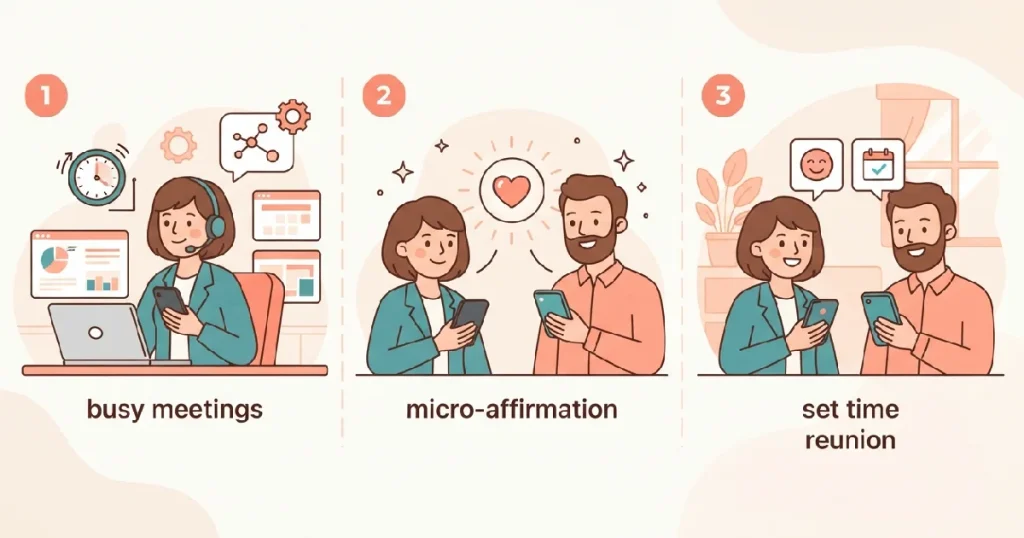
The most useful structure I see work in real relationships is brutally simple. One sentence of context. One sentence of warmth. One definite future touchpoint.
Call it the One & One method, even though it is really three beats. The name sticks because you are pairing reality with connection, then closing the loop.
Step 1: Name your current context in a short phrase. “In back-to-back meetings until 3.”
Step 2: Give one micro-affirmation. “You are my favorite person today.”
Step 3: Plant a specific reunion. “Calling you on my drive home.”
This works because it answers the three questions his anxious brain is actually asking. Where are you? Are we okay? When do I get you back?
Vague comfort (“we’ll talk later”) leaves the threat system open. A clock time or a clear event closes it. His body can wait for 6 PM. His body cannot wait for “soon.”
Workday texts that calm him without starting a chat marathon
Copy the shape, not a speech.
“In back-to-back meetings until 3, but you’re my favorite thought today. Talk soon.”
“Crazy busy day on my end. I love you, I’m safe, and I can’t wait to call you on my drive home.”
“My phone is about to die and I’m running errands, but I wanted to say I love you first. Text you when I’m home.”
“Head down in work mode for the next two hours, then I am all yours. Love you.”
Notice what these do not do. They do not invite a ten-message unpacking of his mood. They do not apologize for having a life. They do not over-explain. They put a floor under the day.
If he replies with more worry, you do not owe a second essay. Repeat the touchpoint. “I hear you. Still on for 6. I love you.” That is enough.
Casual secure checks when nothing is wrong
Sometimes you reassure your boyfriend through text before the spiral starts. Keep these light. Do not turn them into a daily report card he must answer.
“No need to reply to this, just wanted to lock in your daily reminder that you have my whole heart.”
“Even when we are both too busy to talk, you’re always my anchor.”
“I love the life we are building together. I’m completely team [his name].”
The line “no need to reply” matters. It gives affection without creating a homework assignment. Secure love can land and then go quiet.
Maya learned that short texts felt safer than love novels
Maya, 24, dated Jordan through a brutal stretch at his new job. He would text at 2:14 PM: “You being quiet or are you mad.” She would step into a hallway and send 400 words. She listed every feeling. She listed every plan. She listed why he had nothing to worry about.
Jordan would feel better for twenty minutes. Then he would reread the paragraph and snag on one phrase. “You said ‘right now’ I love you. What does right now mean?” Maya started answering from the bathroom stall. She felt generous and trapped at the same time.
She changed one habit. Context, warmth, time. “In a client session until 4. I choose you. FaceTime at 7:15 when I’m home.” The first two days he pushed for more. She stayed kind and short. By the second week his afternoon panic texts dropped. He still had a hard job. He no longer needed her to narrate the entire relationship between meetings.
Maya did not love him less. She stopped drowning the plant. Hourly watering feels like devotion until the roots rot.
That is the quiet cost of overdoing it. Left alone, the pattern does not just tire you out. It can become the reason the relationship starts to feel like work instead of a bond.
2. Reassure your boyfriend through text while holding a real boundary
You can be warm and unavailable at the same time. Those two things are not opposites. In adult attachment, safety is not constant access. Safety is knowing the person returns.
Anxious-preoccupied attachment is a pattern where closeness feels unstable, so the person seeks frequent proof they are still wanted. If that is him, a boundary can sound like abandonment. Your job is not to erase the boundary. Your job is to pair the boundary with a clear reunion so his nervous system has somewhere to land.
Time apart is not a punishment. It is one of the pillars of secure attachment: you can go do your life and the we still exists.
How to say you need space without sounding cold
Name the love first. Name the limit second. Name the return third. Same lighthouse. Same beam.
“I love you so much. I need to focus on this project for an hour, but let’s do a quick phone check-in right at 7.”
“I love you and I’m not going anywhere. I need a little tech break to decompress, let’s catch up before bed.”
“You are completely safe with me. Let’s step away from our phones for a bit and grab dinner later to talk properly.”
If you skip the return time, the limit will feel like a door closing. If you skip the limit, you teach him that your work, sleep, and friends are optional. Both errors cost you.
Redirect him to an offline reset
You are not his only regulator. Co-regulation is the fancy term for calming down through another person. It is healthy in doses. It becomes a problem when he cannot come down without your typing.
A loving redirect sounds like this:
“I hear you and I’m right here with you. Go take a relaxing shower to reset, and I’ll call you the second it’s done.”
You validated him. You gave his body a job. You promised a real voice, which carries tone that text cannot. Digital pauses give both nervous systems a chance to drop out of fight-or-flight. A shower, a walk, a meal, a gym set: these are not brush-offs. They are how adults self-soothe so the relationship does not have to carry every spike.
3. De-escalate jealousy and work stress without giving up your independence

Not every insecure text is about you disappearing. Sometimes it is about your friends. Sometimes it is about his performance review. The content changes. The need is the same: Am I still chosen?
Jealousy and social overthinking
If he spirals about male friends, exes, or a night you are out without him, do not write a case file. Defensiveness reads as guilt. A clean foundation statement reads as security.
“My friends love you, I love you, and there is zero competition. You are my only choice.”
“I know your mind is playing tricks on you right now, but my feelings haven’t shifted a millimeter. I love you.”
Then keep your plans. Reassurance that requires you to cancel your life is not reassurance. It is a trade. You can confirm the relationship and still go to dinner. If the jealousy is constant and controlling, that is a different problem than a one-night wobble, and a short text will not fix a pattern that belongs in a real conversation.
Professional stress and low self-esteem
When he feels small at work or school, he may come to you looking like he needs relationship proof. What he often needs first is emotional validation. The Gottman Institute calls this a stress-reducing conversation: you hear the day, you take his side against the stress, and you do not rush to fix him.
Over text, that can be one grounded line.
“I know things feel overwhelming right now, but our foundation is rock solid. I’m right here.”
“You don’t have to be perfect to keep me interested. I love you exactly as you are right now.”
“You have my back through everything, and I promise I have yours too. We are a team.”
Save the career pep talk for the call. Text is a poor place to rebuild a man’s self-worth. It is a good place to remind him he is not competing for you while he is already competing at work.
4. Keep tone clear, then move the deep talk off the screen
Text is a blunt instrument. No face. No voice. No timing. A period can look like anger. A short reply after a long day can look like punishment. If he has an anxious attachment style, texting patterns often become the scoreboard for the whole relationship.
Explicit tone indicators
You do not need a code language. You need one extra beat that names the feeling your face would have shown.
“Heading into a meeting. Tone is good, just busy.”
“Short reply because I’m driving, not because I’m upset. Love you.”
“Got your message. I’m not mad. Talk at 8.”
A tiny cue like “not mad,” a voice note, or “this is affection, not distance” can stop a two-hour misread. If you are actually upset, say that too. Fake cheer is another kind of overdoing it. Clarity is kinder than a forced smiley.
Save the deep talks for real life
Text is an information tool. It is not a therapy room. Repair, jealousy autopsies, and “what are we” talks need tone, pacing, and the chance to see each other’s face soften.
When a chat starts to spiral, pivot with warmth, not a shutdown.
“I am completely committed to fixing this mismatch with you, but let’s talk it through in person tonight so nothing gets misread over text.”
“This matters, and I don’t want to half-handle it in a thread. Can we do this on a call in 30 minutes?”
Secure couples still send bids for reassurance. They just do not try to settle the whole bond inside a blue bubble. They confirm, they schedule, they show up.
What to practice the next time his chat lights up
One place to start is the Lighthouse Text. Before you type, ask: Did I name where I am, that we are okay, and when he gets me back? If any of those three is missing, add it. If you have already said all three, stop typing.
Consider the Offline Redirect when he is looping. Validate in one line, give his body a next step, and attach a call time. “I love you. Take a shower. I’ll call when you’re done.”
A useful question to ask yourself is: Am I reassuring him, or am I managing his nervous system so I can feel like a good girlfriend? The first is love. The second is a role you will resent.
The next time this happens, try sending the short version and putting the phone face down until the time you named. Let the lighthouse stand. Let him practice waiting for a light that does come back.
You do not have to become colder to become clearer. You do not have to write less love. You have to put the love in a shape his anxious brain can actually use.
Those three dots will still appear. You will still feel the pull to prove everything in one burst. Now you know the burst is the trap. A calm relationship is not built on constant typing. It is built on a bond he can trust even when your phone is face down.
My Closing Remarks
I have sat with enough couples to know this: the girlfriend who sends less, on purpose, often becomes the partner he trusts more. When I stopped treating every anxious ping as an emergency in my own life, the relationship got quieter in the best way. You can offer warmth without handing over your entire nervous system. That is not cold. That is adult love.
More Related Stories for You
- If you are also decoding the way he shows care in person, it helps to understand what it means when a guy calls you beautiful and how those words fit next to the short, steady texts you send.
About The Author