


Female narcissism rarely announces itself with arrogance. It shows up as devotion, generosity, and heartbreak, until you notice what keeps disappearing underneath.
Key Points
- The clearest signs of a narcissist woman rarely look like ego. They look like kindness, sacrifice, and wounded feelings that never quite add up.
- Covert and communal narcissism let a woman keep a spotless public reputation while her partner quietly loses their sense of self at home.
- Once you learn to name these eight patterns, the fog lifts, and the guilt you’ve been carrying starts to make a lot more sense.
Contents
Table of Contents
The easiest signs of a narcissist woman to miss live inside care. Covert narcissism hides behind hurt, generosity, and concern. You are not imagining the drain. You are responding to a pattern that keeps you doubting the one person you should trust: yourself.
We look for narcissism in the person who takes up all the air in the room. We expect the boast, the name-dropping, the obvious hunger for praise. That picture is so familiar it has become a hiding place for something quieter.
You can spend years beside a woman who seems devoted, wounded, and unusually attuned to you. Friends call her kind. Family calls her selfless. You still go to bed feeling oddly alone.
Someone might think she is simply sensitive. But what they don’t see is how her sensitivity always puts you on trial.
Someone might think the early closeness was rare chemistry. But what they don’t see is how quickly she learned your fears and how slowly she revealed her own.
Someone might think you are the problem because you keep reacting. But what they don’t see is how the rules change every time you get close to the truth.
Why the Subtle Signs of a Narcissist Woman Slip Past You
Covert narcissism is a quieter form of self-focus. Instead of open grandiosity, it feeds on sympathy, moral credit, and control. Grandiosity means an inflated sense of specialness. Covert narcissism still needs that specialness. It just borrows softer costumes: the wounded partner, the tireless helper, the one who “gives and gives.”
This pattern lasts because it hijacks traits we have been taught to protect in women. Warmth. Empathy. Victimhood. Once those traits become a shield, you hesitate to name the harm. You do not want to be cruel to someone who looks like she is already hurting.
Clinical research on how narcissism presents in women keeps showing the same gap. Many people, and even some assessment tools, still look for loud dominance. Vulnerable or communal presentations get missed. Communal narcissism is the need to be seen as the most caring, moral, or generous person in the room. The applause is the point. The family can wait.
That is why this matters in daily life. You are not dealing with a cartoon villain. You are living with a slow rewrite of reality. The public version of her stays admirable. The private version leaves you walking on eggshells, which means you stay tense and scan her mood before you speak, move, or need anything.
Left unnamed, this does not just strain a relationship. It can become the reason you no longer trust your own mind.
8 Hidden Signs of a Narcissist Woman Partners Overlook
1. Forced Altruism and the Martyr Trap
This looks like generosity. It functions like a contract you never signed.
She pushes unwanted favors, expensive gifts, or help you did not ask for. If you decline, the warmth drops. Later, outsiders hear that you are ungrateful. The gift was never free. It was a down payment on obedience.
Communal narcissism thrives here. She needs witnesses to her virtue. You become the prop that proves it. A healthy partner can hear “no, thank you.” A narcissistic woman treats your boundary as an insult to her identity.
The next time a favor feels heavy instead of kind, notice the aftertaste. Relief should follow a gift. Debt should not.
2. The Perpetual Work Nemesis and Friend Drama
She almost always has a villain. A jealous coworker. A toxic manager. A friend who “changed.” Jobs and social circles rotate. The story does not.
On the surface this can look like bad luck. The deeper sign is the missing self-review. If every workplace eventually betrays her, she is likely the common thread rewriting history to stay the victim.
Watch for the absence of nostalgia too. Old friends become discarded props. Shared memories have little warmth unless they make her the hero or the wounded one. The past is not a home. It is a toolkit.
Most people in this situation do not realize how strange that emptiness is until they compare it with ordinary love. Ordinary love still visits old rooms.
3. Strategic Trauma Dumping Early On
Within a few dates she shares intense stories of abuse, cruel exes, or childhood harm. You feel chosen. Trusted. Protective.
That speed is the tell. Trauma dumping here is not the same as gradual honesty. It fast-tracks intimacy so your caretaking instincts switch on before you have seen her under stress. Later, when her behavior hurts you, you hesitate. You do not want to “re-traumatize” her.
This is love bombing with a wounded face. Love bombing is intense early attention used to create a bond faster than trust has been earned. Your kindness becomes a leash.
A useful question to ask yourself is simple. Did the closeness grow because you both revealed yourselves, or because you were handed a crisis and invited to rescue it?
4. Chameleon Mirroring and the Sudden Chill
Early on she likes your music, your humor, your politics, even your weekend rituals. It feels like a soulmate click.
Chameleon mirroring is the copying of your tastes and values to create a false fit. It is not curiosity. It is camouflage. Idealization comes first. That is the glow of being perfectly seen. Devaluation comes later, when the mask costs too much energy to hold.
Then the coldness arrives without a clear fight. Texts shorten. Eyes go flat. You search your memory for the offense. There may not be one. She is tired of playing you, and she is already bored of the role.
That’s not mystery. That’s a costume coming off.
Her Goodness Has a Receipt
Here is the piece most checklists skip. You keep waiting for selfishness. The more dangerous tell is moral exhibition.
She tips loudly. Volunteers visibly. Defends strangers with passion. At home, your emotional needs are inconvenient. This is not hypocrisy as a simple character flaw. It is supply. Narcissistic supply is the attention, sympathy, and control that stabilize her self-worth. Public goodness is a reliable source. Private empathy is expensive, so she rations it.
Think of a fogged windshield. She does not smash the glass. She clouds it until you stop trusting what you see. You keep wiping. The moisture returns. You start to believe the problem is your eyes.
If her kindness needs an audience, it is not intimacy. It is branding.
5. Invasive Questions Without Reciprocity
She asks about your worst fear, your family’s secrets, the thing you still feel ashamed of. It can feel like deep care.
Notice the imbalance. Her own history stays vague, polished, or always shifting. She is not building mutual knowing. She is gathering material.
Gaslighting often starts small here. Gaslighting is the repeated distortion of facts until you distrust your memory. During a later fight she brings up the exact insecurity you confessed in week three. She frames it as proof that you are the unstable one.
That is not closeness. That is data collection.
6. Cruel Devaluation Wrapped in Playful Teasing
The insult is specific. Your body. Your job. Your laugh. Your family. Then comes the smile. “I am only joking.” “You are so sensitive.”
This is micro-gaslighting. Tiny reality twists that never look big enough to confront. Over months they sand down your self-respect. You start shrinking in advance.
If you speak up, the topic becomes your tone. The original cut disappears. You leave the conversation defending your right to feel hurt instead of discussing what she said.
A healthy joke lands on shared ground. These jokes land on a nerve, then punish you for having nerves.
7. Double Standards and Hidden Control
She wants your location, your passwords, your receipts, your free time. Loyalty is framed as total access.
Her phone stays face down. Her accounts stay locked. Old admirers linger in the background. Male validation gets hoarded like emergency fuel. The relationship is not a partnership. It is a power imbalance with romantic lighting.
This double standard is easy to miss because it borrows the language of safety. “I just get anxious.” Anxiety can be real. Control still needs a name. Transparency that only travels one direction is not safety. It is surveillance.
8. Shame-Driven Script Flipping and Reactive Abuse
You finally have proof. A lie. A boundary crossed. A message she denied sending.
She will not stay on the fact. She will move to your emotion. You are yelling. You are cold. You are “hysterical.” She may cry, freeze you out, or say you can talk when you are calm. The original issue dies in the transfer.
This is script flipping, and it often produces reactive abuse. Reactive abuse is when the targeted partner finally explodes after long provocation, then gets labeled as the aggressor. Her shame of being exposed is unbearable, so she relocates the shame onto you.
You can be loud in a moment and still not be the person who built the trap.
The Night Daniel Stopped Arguing With the Fog
Daniel, 38, could not point to one explosion that ruined things. That was the problem. Lena brought soup when he was sick, praised him to his mother, and remembered the smallest details of his week. She also “joked” that he was lucky anyone tolerated his moods. In week two she asked about his father’s drinking. Six months later, during a fight about hidden messages, she used that story to call him unstable. He showed her the screenshots. She cried and said they could talk when he was not being aggressive. He spent three days apologizing for his voice. The facts never got a hearing. What shifted him was not a cinematic confrontation. It was a private note on a work laptop she could not reach, where he wrote the events in order. The fog did not vanish. It just stopped being the whole room.
What These Signs of a Narcissist Woman Do to Your Mind

You live in cognitive dissonance. That means holding two clashing truths at once: she can look loving, and you still feel erased. The mind hates that split, so it often blames the easier target. You.
The confusion is not a side effect. It is the climate. You second-guess texts. You rehearse requests. You become hypervigilant, always scanning for the next mood drop, health crisis, or silent treatment. Research on stress inside intimate relationships has linked these volatile cycles with high levels of anxiety and depression in partners. Your body is responding to instability, not inventing it.
Somatic complaints can enter the pattern too. Unresolvable headaches, crashes, or flare-ups appear right when accountability gets close. Physical pain can be real. It can also become a shield that ends every hard conversation. You are not cruel for noticing the timing.
Most people in this fog do not lack strength. They have been trained, slowly, to distrust the very signals that could have saved them.
How to Test the Pattern Without Losing Yourself
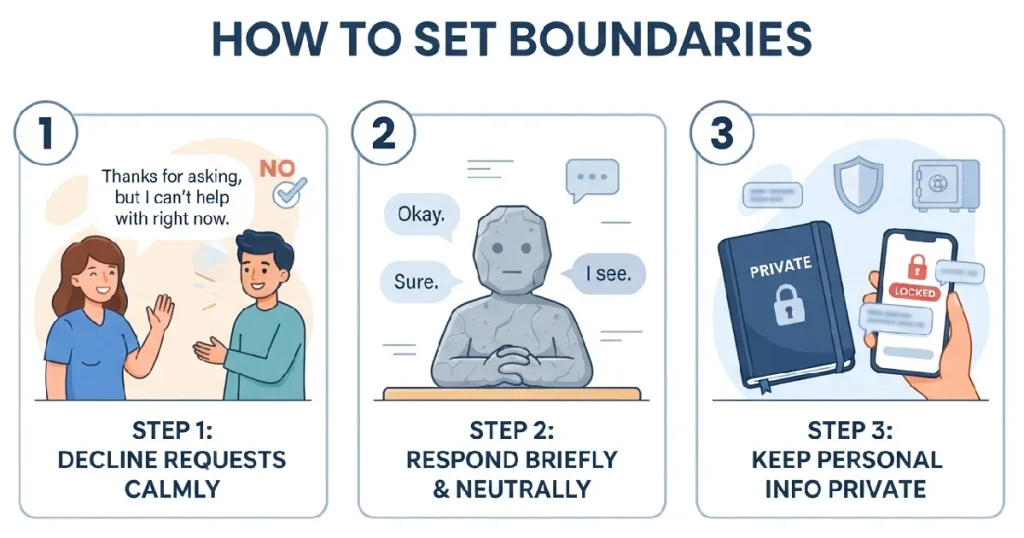
One place to start is the No Litmus Test. Decline a small request with warmth and clarity. “I can’t do tonight.” A secure partner may feel disappointed and still stay respectful. A narcissistic woman often answers with a mood drop, guilt, or a story about how much she does for you. You are not trying to provoke her. You are watching whether your no can exist.
If you still have to interact because of children, work, or a slow exit, consider the Gray Rock Method. Keep your tone flat, brief, and uninteresting. No speeches. No emotional feasts. Narcissistic supply starves when the show has no audience. She may escalate at first. That spike is information, not proof that gray rock “failed.”
A third tool is Off-Site Documentation. Keep dates, screenshots, and short factual notes in a place she cannot open. This is not about winning a debate in the kitchen. It is about protecting your memory from the rewrite. Clinicians who help people spot narcissistic traits and reclaim a clearer sense of self often return to this same point: your mind needs an external anchor when the relationship keeps moving the furniture.
A useful question to ask yourself tonight is this. If a friend described this exact week, would you tell them they were too sensitive, or would you tell them to trust the pattern?
You Can Stop Wiping the Glass
You began this looking for the loud person at the table. You may have been sitting beside someone who never needed volume. She needed the story. She needed you uncertain enough to keep earning a peace that never quite arrived.
Seeing weaponized empathy for what it is does not make you harsh. It makes you accurate. The fogged windshield was never proof that you cannot drive. It was the method.
You now have names, tests, and a way to keep the facts from dissolving. That is not a small thing.
The fog was never your mind. It was the method.
My Closing Remarks
I have sat with people who spent years defending a partner everyone else called generous. They were not foolish. They were loyal to a version of her that performed well in public and went missing at home. Once they could see the fog as a tactic rather than a personality quirk, they stopped arguing with the weather. They started looking for the door. That moment is quiet. It is also the first honest rest many of them have had in a long time. You are allowed to believe what your body already knows.
More Related Stories for You
- If you are rebuilding trust, honesty, and steadier communication after emotional chaos, these successful marriage tips can help you practice care that does not require a performance.