
 Nicole Adkins
The calm, capable people you admire aren’t wired differently. They just built a different system.
Key Points:
- Naturally successful people rely on structured habits and repeatable systems, not hidden talent or luck.
- The calm confidence you see in high performers comes from neural automation, not a special stress-immune brain.
- You can build the same operational framework starting this week, using five concrete, science-backed steps.
Contents
Table of Contents
We have a habit of pointing at the calm ones and calling them lucky. We watch a colleague finish the hard project without drama, or a friend change careers without falling apart, and we decide they were built differently. The label we reach for is naturally successful. It is a comforting story. It also keeps you stuck.
Someone might think their coworker is simply more gifted. But what they do not see is the same wake time, the same Sunday review, and the same rule that meetings do not start before 10. Someone might think a friend has thicker skin under pressure. But what they do not see is a shutdown ritual that keeps the day from leaking into the night. Someone might think they themselves are behind because effort still feels loud. What they do not see is that ease is often the last stage of practice, not the first proof of talent.
Naturally successful people are not luckier or more immune to stress. They trained specific behaviors until those behaviors stopped charging a high fee in willpower. What you see as ease is practiced design. The brain can turn a demanding task into something closer to automatic once the same sequence is repeated in a stable setting.
That is why slogans like “just be yourself” fail so many of us. If your mind needs structure, “be yourself” is not freedom. It is fog. Vague motivation does not help a brain that works better with rails. You do not need a new personality. You need a design your nervous system can actually run.
The Illusion of Naturally Successful People
You have probably met the person who makes progress look almost rude in its quietness. They send the update before you panic. They look rested in the week you feel frayed. Your mind writes a simple explanation: they have it and you do not.
That story is popular because it protects you from a harder truth. If success is a gift, you are off the hook. If success is learned, you have to face the unglamorous work of building it.
In my practice, I have sat with plenty of capable people who felt late to a party they thought required a special invitation.
They were not missing talent. They were comparing their private effort with someone else’s public smoothness. Left unexamined, that myth does more than bruise your confidence. It trains you to wait for a version of yourself that is never going to arrive.
How High Performers Handle Stress Without a Special Gene

High performers are not walking around with a stress-proof gene. They feel pressure in the same body you do. Heart rate still climbs. Sleep still suffers when the load is ugly. The difference is not immunity. The difference is a frame that holds the load.
Your prefrontal cortex is the part of the brain that handles planning, focus, and self-control. It is powerful and it is limited. Ask it to reinvent your whole day from scratch, every morning, and it burns fuel on choices that should have been decided last month. People who look naturally successful often look that way because they stopped spending that fuel on the same 20 small decisions.
Research on the neural basis of habit formation helps explain the shift. When you repeat a behavior in a consistent context, the brain can move it off the crowded “must think hard” desk and toward more automatic processing. The task still happens. It simply costs less attention. From the outside, that lower cost looks like talent.
Think of a well-worn path on a hillside. The first walks are slow. You hunt for footing. You slip. Over time the ground itself changes. A groove appears. Then walking that line stops feeling like a project. People watching from the road only see the easy descent. They do not see the groove.
You do not have a talent shortage. You have an unfinished path.
The myth of the stress-immune person also hides cognitive load, which is simply how much mental effort you are using at once. High-functioning people still hit overload. They just build operational frames that keep too many open loops from landing on the same hour. A written plan, a closed evening, a default calendar. Boring tools. Strong effect.
The Execution Gap Between Ambition and Daily Action
Ambition is cheap. Action that repeats is not. The execution gap is the space between what you intend in a burst of feeling and what your Tuesday actually contains.
Decision fatigue sits right in that gap. After too many choices, the quality of your next choice drops. Your executive function, the set of mental skills that help you start tasks, switch between them, and stay on track, gets tired like a muscle. A day with no defaults asks that muscle to flex from breakfast onward. By late afternoon the plan you loved at 7 a.m. feels optional.
This is why structured routines protect more than mood. They protect the prefrontal cortex from early exhaustion. The person who looks naturally successful often has fewer live decisions by noon. Not because life is simpler. Because yesterday already answered today’s small questions.
Motivation will not save you here. Motivation is a spike. Spikes fade. The more reliable engine is the cue-routine-reward loop: a trigger in your environment, a behavior you run, and a payoff that tells the brain to file it for next time. Coffee, then the first 25 minutes on the one task that matters. Shutdown list, then the laptop closes. Same cue. Same routine. Same small reward of completion. After enough reps, you stop holding a meeting with yourself about whether you feel inspired.
Most people in this situation do not realize they are trying to win a systems problem with a feeling. Feelings fluctuate. A cue can stay put.
Comparison Fatigue Is Not a Motivation Problem
Then there is the other tax. You measure your unfinished inside against someone else’s polished outside. Social comparison is the habit of ranking yourself against other people. It is human. It is also a fast way to burn out when the feed is a highlight reel and your life is a draft.
You see the promotion, the calm photo, the easy caption. You do not see the missed dinner, the panic before the talk, or the three ordinary years that looked like nothing. Clinical work on social comparison has long shown how easily this contrast distorts mood and self-worth. You are not weak for feeling it. You are responding to a rigged display.
Failure gets distorted in the same way. A setback starts to look like proof you were never the type. In a built model of success, a setback is structural data. The sequence failed. The cue was unclear. The load was too high for the current groove. That framing is not sugar. It is usable. You can change a system. You cannot change a verdict that says you are permanently behind.
When Maya Stopped Waiting to Feel Naturally Successful
Maya, 34, a marketing lead, spent two years convinced her director Jordan was naturally successful. Jordan answered quickly, ran clean meetings, and seemed to absorb pressure without noise. Maya stayed late, ran on caffeine, and treated every delay as evidence she lacked the right wiring. Then she covered Jordan’s calendar for a week. The magic collapsed into a design. Same wake time. Same 45-minute deep-work block before messages. Same Friday review. Same written end-of-day list with three lines, never twelve. Maya did not copy Jordan’s personality. She copied three structures and put them on her own calendar. Within two months the frantic story about being “not that type” got quieter. The work did not become easy overnight. It became repeatable. Repeatable is what easy is made of.
Build Quiet Success With the Groove Method
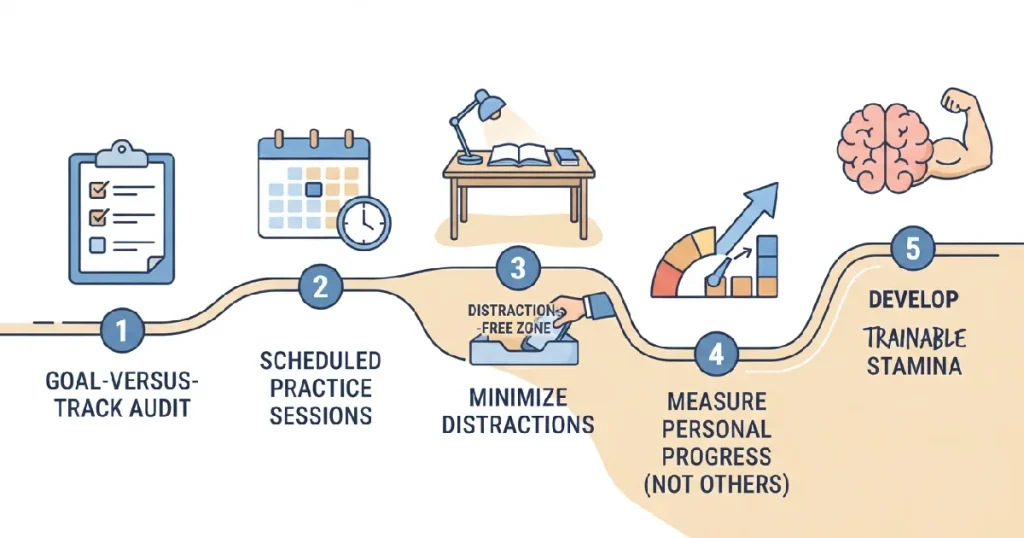
One place to start is a simple five-part design. Call it the Groove Method. It turns “I want to be more like the calm people” into moves you can make this week.
1. The Success Audit
Write the long-term goal in one sentence. Then write the physical tracks that already exist to carry it: calendar, notes app, weekly review, a person who asks you what got done. If the goal has no track, it is still a wish. Wishes do not carve grooves.
2. Date-and-Block Anchoring
Bind the next ambitious idea to a real due date and a blocked hour. Not “soon.” A Tuesday. A start time. When the idea has no date, your mind treats it as optional weather. Consider doing this the same day the idea appears, while the heat is still on.
3. Friction Design
Change the room so the right action is the easy action. Phone in another room during the first work block. One notebook open, not seven tabs. A chair that is only for the hard task. Environmental psychology keeps showing that space is not decoration. Space is a set of cues. Reduce choice overload and you reduce the argument in your head.
4. Your Execution Score
Stop using other people as the measuring stick. Track the percentage of schedule blocks you actually started. That is your metric. Not their title. Not their vacation photos. A useful question to ask yourself is, “Did I run the block I promised, even if the output was imperfect?”
5. Stamina as a Trainable Capacity
Cognitive stamina is not a fixed trait. Neuroplasticity is the brain’s ability to rewire through repeated experience. Treat focus like a muscle group. Add a little more time, then recover. Work on the neuroscience of a growth mindset points to a simple shift: effort is not evidence you lack talent. Effort is the training signal. Progressive overload, used kindly, is how the groove gets wider.
The next time you catch yourself calling someone naturally successful, try this instead. Name one visible result. Then guess one invisible repeat that could have produced it. You will often be closer to the truth than the luck story ever was.
The Permanence of Built Success
Luck can open a door. Luck cannot keep walking the same hill after the mood leaves. A learned operating system compounds. Each month the path is a little clearer. Each year the cost of starting drops. That is a competitive edge luck cannot copy, because luck does not repeat.
Go back to the person you watch with a mix of admiration and sting. The presentation. The promotion. The calm. You do not need their childhood or their nerves. You need a groove of your own, cut by ordinary reps in a stable frame. The swan still paddles. You just stop confusing a quiet surface with a life that required no work.
Natural is just practiced, seen from far away.
My Closing Remarks
I used to reserve the word gifted for people whose effort never showed. It made my own messy process feel like a defect. What changed me was not a burst of confidence. It was watching calm people up close and finding repetition where I had invented magic. If you feel late, I do not read that as proof you missed the talent lottery. I read it as a sign you have been starring in someone else’s highlight reel. Build one boring track this week. Protect it. Let the path get easier the only way paths ever do, by walking them again.
More Related Stories for You
- The same skills that make progress look quiet at work also change how you speak, repair, and stay present in your closest relationships.
About The Author