
 Sara Carmen
It isn’t the silence that breaks you. It’s the biological storm hiding underneath it.
Key Points
- Stonewalling in a relationship is not a choice to be cruel. It’s a measurable, involuntary shutdown of the nervous system that both partners misread as rejection.
- Couples who habitually stonewall during conflict rank among the most reliable predictors researchers have ever found for future divorce.
- Once you learn to spot the physical signs of shutdown early, you can turn a hopeless standoff into a repairable moment, sometimes within twenty minutes.
Contents
Table of Contents
Most of us have sat in a room with someone we love while a conversation simply stops existing. Not because the topic ended, but because something behind their eyes flipped off like a switch. We call it the silent treatment and assume it’s a punishment, a cold power move meant to make us suffer. You already know this moment because you’ve lived inside it.
Your chest tightens. Your voice climbs, then shrinks. You ask one more time, softer now, hoping the quiet will crack. It doesn’t.
Someone watching from the outside might think your partner simply doesn’t care enough to answer. But what they don’t see is a body in genuine physiological distress, jaw locked, pulse hammering, mind scrambling for an exit that isn’t there.
Someone might think staying quiet during a fight is the mature move. But what they don’t see is a nervous system so flooded that words have actually stopped forming in any coherent way.
Someone might assume the talking partner is “the healthy one” in this scene. But what they don’t see is that partner slowly building their own private panic, a fear of abandonment that convinces them nothing they say will ever land.
Here’s the truth that changes everything: what looks like a decision to withdraw usually isn’t a decision at all.
What Stonewalling in a Relationship Actually Is, Biologically
Psychologists call this reaction flooding, or more precisely, diffuse physiological arousal. In plain terms, it means the body’s threat response has taken over so completely that rational thought becomes nearly impossible.
When flooding hits, your partner’s heart rate has likely spiked past 100 beats per minute, sometimes closer to 160. Their body is releasing cortisol and adrenaline as if facing a physical attack, even though the “threat” is just a conversation about the electric bill.
Researchers John Gottman and Robert Levenson at the University of Washington spent decades wiring couples to heart monitors during real arguments. They discovered that once a person’s heart rate crossed that threshold, their capacity to listen, empathize, or solve problems essentially disappeared. The Gottman Institute now lists stonewalling as one of four communication patterns most likely to predict divorce, alongside criticism, defensiveness, and contempt.
This matters because most couples treat stonewalling like a personality flaw. It isn’t. It’s a survival reflex, and understanding that difference changes how you respond to it.
Stonewalling in a Relationship Is a Biological Fire, Not a Character Flaw
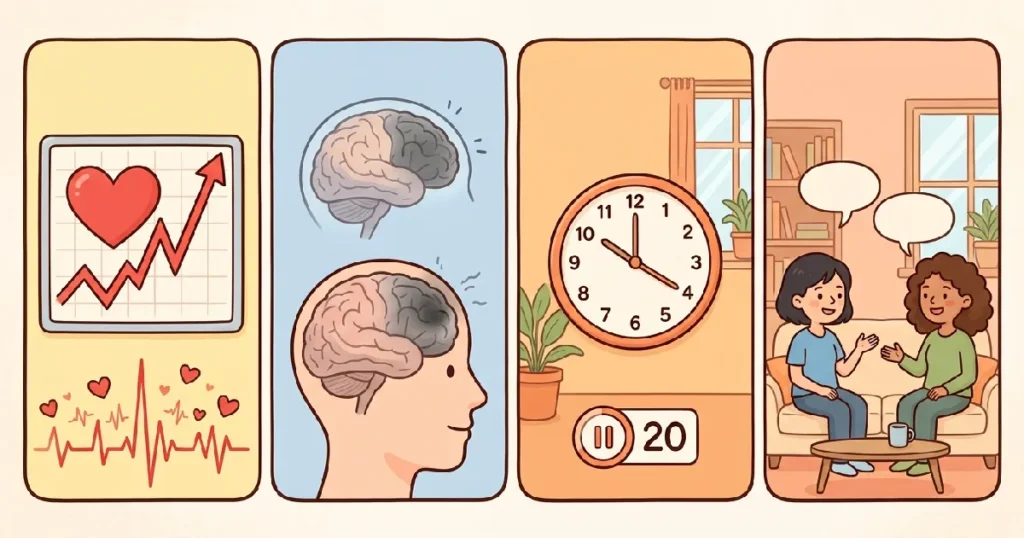
Think of your partner’s nervous system like the circuit breaker in an old house. When too much current runs through the wires at once, too many words, too much perceived criticism, too much emotional voltage, the breaker trips to protect the wiring from burning out.
Stonewalling is that trip. It isn’t cruelty. It’s protection.
During flooding, the prefrontal cortex, the part of the brain responsible for empathy, language, and complex reasoning, essentially goes offline. Research summarized by the American Psychological Association confirms that acute stress redirects the body’s resources away from higher-order thinking and toward pure survival functions instead.
That means two flooded nervous systems cannot think clearly at the same time. Trying to force a calm, logical conversation while you’re both biologically panicking is a bit like trying to hold a debate during a fire drill. Nobody hears a word.
The 20-Minute Rule That Can Save a Stonewalling Relationship
You cannot simply decide to calm down. The body needs real time to metabolize stress hormones, typically a minimum of 20 minutes, according to stress-recovery research described by the National Institute of Mental Health.
This is where most couples get it wrong. One partner storms off. The other assumes the conversation, and sometimes the relationship, is finished for good.
What’s actually needed isn’t a wall. It’s a door.
A wall shuts communication down permanently, punishing your partner with silence that never resolves. A door closes for a set period, then reopens on purpose, with both people knowing exactly when. The difference isn’t in the silence itself. It’s in the promise attached to it.
Couples who never learn this distinction end up rehearsing the same fight for years, never realizing that the pause itself isn’t the problem. The absence of a plan for the pause is.
The Physical Toll Silent Treatment Takes on Both Partners

Most people assume the damage from stonewalling is purely emotional. That’s only half the story.
Most people in this situation don’t realize that chronic conflict avoidance produces measurable wear on the body itself. Longitudinal research summarized by Harvard Health Publishing has linked repeated stonewalling episodes to neck rigidity, tension headaches, and cardiovascular hyperreactivity, meaning the heart and blood vessels respond to stress with exaggerated spikes long after the argument itself has ended.
But here’s what almost nobody tells couples in therapy.
The partner doing the pursuing doesn’t stay anxious forever. Chronic anxiety without resolution eventually exhausts the body’s own stress response too. Over time, this partner can slide into what some couples’ therapists describe as a collapsed pursuer, someone who stops chasing not because they’ve healed, but because they’ve gone numb. In my practice, this shift is often mistaken for peace. It isn’t. It’s exhaustion wearing peace’s clothing.
Consider Elena and Marcus, a composite of many couples I’ve worked with over the years. Every time Elena brought up their credit card debt, Marcus would go quiet, jaw tight, eyes fixed on his phone. Elena would raise her voice, then plead, then eventually just stop trying.
Within a year, she described feeling “numb” around him, not calm, just tired of hoping. Once they learned that Marcus’s silence was flooding rather than rejection, and once they built a structured pause into their money talks, Elena’s anxiety finally eased and Marcus felt safe enough to speak instead of shut down.
Cardiovascular strain, chronic muscle tension, and disrupted sleep aren’t dramatic exaggerations here. They’re the documented, physical cost of a communication pattern most couples assume is “just emotional.”
Why Stonewalling in a Relationship Before Marriage Predicts Trouble Later
This pattern rarely waits for a wedding date to show up.
Couples preparing for marriage often avoid the conversations that matter most, debt, sexual expectations, boundaries with in-laws, precisely because those topics feel too risky to survive. Left alone, small disagreements quietly turn into criticism, and criticism eventually curdles into contempt. Stonewalling at this stage doesn’t behave like a normal disagreement. It behaves like a warning flare for the relationship’s entire future.
Gottman’s follow-up studies found that couples who shut down during premarital conflict discussions were significantly more likely to face marital dissolution in the years that followed, a pattern consistent with broader findings tracked by the CDC’s research on chronic stress and cardiovascular health as well.
Learning to manage the urge to stonewall before marriage isn’t a nice extra skill to have. It’s the exact tool required to survive the conversations that determine whether a marriage lasts at all.
Now What? Turning the Wall Into a Door

Understanding the biology behind stonewalling is only half the work. The other half is building a system so you don’t have to think clearly in the exact moment your brain has gone offline.
The Door Pact. One place to start is agreeing, in a calm moment rather than a heated one, on a specific phrase either of you can say when flooding starts. Something like, “I need the door, not the wall.” This signals a temporary pause with a promise to return within an agreed window, usually 20 to 30 minutes.
The Body Check. Consider learning your own early warning signs, a tight jaw, a racing pulse, the urge to leave the room, before flooding fully takes over. Catching it at 80 beats per minute is far easier to manage than catching it at 130.
The Return Ritual. The next time a pause ends, try reopening with something softer than where you left off, such as, “I want to finish this. Can we try again?” rather than diving straight back into the original accusation.
A useful question to ask yourself this week: when you go quiet, are you protecting the relationship, or are you protecting yourself from a feeling you haven’t named yet? Sitting with that question honestly, even for five minutes, often reveals more than another argument ever could.
Your New Way to Read the Silence
Picture that same room again, the one where the conversation stopped existing. Your partner’s eyes go distant. Their jaw sets. The air goes quiet in a way that used to feel like abandonment.
You now know what that silence actually is. The circuit breaker didn’t fail. It did exactly what it was built to do, protecting an overwhelmed system from burning out completely.
That doesn’t excuse a wall that never opens. But it does mean the silence was never the goodbye you feared. It was a signal, waiting for someone to finally read it correctly.
That’s not the end of the conversation. That’s where the real one finally begins.
My Closing Remarks
Nobody stonewalls because they stopped loving you. They stonewall because their body hit a wall their heart never asked for. I’ve watched partners weep with relief just hearing that a shutdown wasn’t rejection. That relief doesn’t fix everything overnight, but it’s usually the first honest exhale a couple takes in months. Start there. The rest becomes possible from that single breath.
More Related Stories for You
- If you’re ready to move from surviving conflict to building something stronger, this guide on successful marriage tips offers practical next steps.
About The Author