
 Sara Carmen
When attraction collides with professional boundaries, a hidden crush often appears as warmth, restraint, and a confusing pattern of approach and retreat.
Key Points
- The clearest Signs a Coworker Likes You appear as a repeated pattern of attention, proximity, and personal curiosity rather than one isolated gesture.
- Workplace attraction can create a push-pull pattern because desire and fear of rejection, gossip, or HR consequences operate at the same time.
- You can read the situation more accurately by watching for consistency while protecting your professional boundaries.
Contents
Table of Contents
The Psychology of an Office Crush: Why Fear Freezes Modern Coworkers
We have all seen it happen. A colleague remembers the smallest detail about your weekend, laughs at your ordinary joke, and appears beside you whenever a meeting ends. Then the next day they become formal and distant. You are left wondering whether you imagined the connection.
Someone might think, “They are simply friendly.” But what they do not see is the repeated timing: the instant replies, the extra eye contact, and the way this person seems especially alert when you enter the room.
Someone might think, “They are just a supportive teammate.” But what they do not see is that the support becomes unusually personal. They notice your mood, defend your ideas, or find reasons to help you when no one else is watching.
Someone might think, “If they liked me, they would ask me out.” But what they do not see is the pressure many professionals feel around workplace dating. A direct advance can create awkwardness, gossip, a complaint, or a serious power imbalance when one person has authority over the other.
Research on workplace romance has long pointed to repeated contact, similarity, and opportunity as conditions that can increase attraction. Pierce, Byrne, and Aguinis described this process as a movement from repeated exposure to interpersonal attraction and then to romantic interest. In plain language, spending time with someone allows familiarity to grow, especially when you also admire how they think and work. You can read the original workplace-romance model in the Journal of Organizational Behavior.
A 2023 Society for Human Resource Management survey reported that 27 percent of U.S. workers were currently involved in or had previously experienced a workplace romance. The same research found that many employees favor clear workplace guidelines rather than a total ban. That matters because a coworker may not be avoiding you. They may be trying to manage real professional risk. Read more about the findings from SHRM’s workplace romance research.
The central idea is simple: a coworker who likes you but hides it may show strong attraction in small moments while carefully avoiding a clear declaration.
But attraction is not proof of intention.
The safest way to interpret these signs is to look for a consistent pattern across time, settings, and communication channels. The first sign often appears when other people are present.
10 Clear Signs a Coworker Likes You Romantically but Will Not Admit It
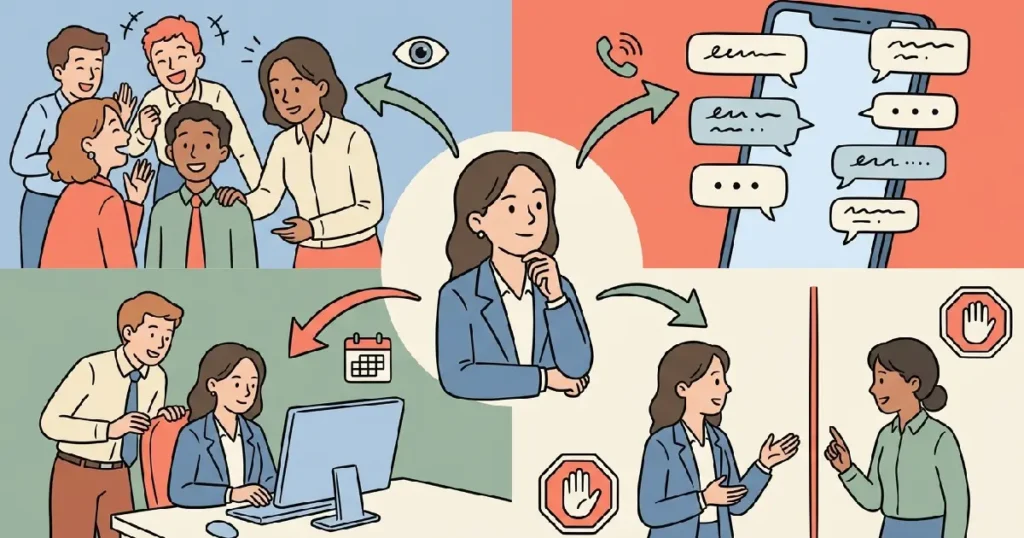
1. They look at you first when the group laughs
When a team laughs, notice where this coworker’s attention goes immediately afterward. Do they look at you to check your reaction? Do they hold your gaze for a moment longer than necessary? Do they seem pleased when you laugh at something they said?
This may reflect a social-attention response. We naturally monitor the reactions of people whose opinions matter to us. A coworker with romantic feelings may be especially interested in whether you find them funny, intelligent, or socially appealing.
For example, Daniel tells a story during lunch. Everyone laughs, but his eyes move straight toward you. When you smile, his shoulders relax. When you do not react, he becomes quieter.
One glance means very little. Repetition means more. If you are consistently the person they search for during shared humor, it may be one of the stronger nonverbal signs a coworker likes you.
2. They become unusually responsive on Slack or Teams
A hidden crush can create a digital trail. This person may reply quickly to your messages, use more expressive emojis with you, or continue a work conversation after the practical issue has already been solved.
Digital communication gives someone a buffer. They can show enthusiasm while maintaining a professional explanation for every interaction. A quick response may simply mean they are efficient, so compare their behavior with how they communicate with everyone else.
Pay attention to tone. Do they ask follow-up questions that are not required for the task? Do they remember your preferences? Do they send you a message about a small shared joke but avoid saying anything personal in person?
In hybrid work, these details matter because digital communication has become part of how coworkers form social bonds. Still, responsiveness alone is not romantic evidence. It becomes meaningful when it appears alongside other signs.
3. They create reasons to be physically near you
A coworker who likes you may repeatedly choose the seat near yours, walk with you after a meeting, or stop by your desk without a clear operational reason. They may join a project you are working on or volunteer for a task that places you together.
Psychologists sometimes refer to this as propinquity, meaning closeness and repeated contact. Familiarity can increase comfort and attraction because the brain has more opportunities to notice shared interests and positive qualities.
Imagine that Maya keeps appearing in the kitchen when you take a break. She asks one work question, then stays for ten minutes discussing a podcast you mentioned last week. She does not do this with every colleague.
The important question is not, “Did they stand near me once?” Ask instead, “Do they repeatedly engineer innocent overlap?” Structural proximity gives a fearful person contact without the emotional risk of a direct invitation.
4. Their compliments shift from professional to personal

A friendly coworker may praise your presentation or reliability. A coworker with a crush may notice your new haircut, the color you are wearing, or the change in your voice when you are tired.
This shift suggests selective attention. It means they are noticing you beyond your professional role. They may also disguise the compliment as teasing so they can retreat if you do not respond warmly.
“You look different today. In a good way,” they might say before quickly returning to a discussion about deadlines.
A personal compliment is not automatically inappropriate or romantic. Context matters. Consider whether the comment is respectful, specific, and part of a larger pattern of curiosity. If the remarks become sexual, intrusive, or uncomfortable, the issue is no longer whether they like you. Your comfort and workplace safety come first.
5. They protect your reputation in group settings
A coworker who likes you may defend your idea in a meeting, correct an unfair misunderstanding, or help reduce the pressure when your workload becomes unreasonable. They may advocate for you even when you are not present.
This can be an act of service. In attraction, people often invest time, attention, and social energy in someone they value. At work, romantic interest may hide inside the role of the dependable teammate.
Suppose your proposal is criticized unfairly. Before you respond, Priya points out the data supporting your recommendation and redirects the conversation toward the evidence. Later, she checks whether you are all right but does not make the moment dramatic.
Support can also reflect genuine friendship or strong professional respect. Look for selectivity. Is this person equally protective of everyone, or do they spend unusual effort safeguarding your peace and standing?
6. They alternate between warmth and distance
Hot-and-cold behavior can be confusing. One day your coworker is engaged, playful, and attentive. The next day they avoid eye contact and speak to you with stiff formality.
This pattern may reflect approach-avoidance conflict. That term describes wanting closeness while also wanting to escape the perceived danger connected to it. The person moves toward you when attraction feels rewarding, then pulls back when fear of rejection, gossip, or professional consequences becomes stronger.
This does not excuse manipulative behavior. It also does not prove romantic interest. Stress, mood, workload, or social anxiety can create the same pattern.
The key is to notice whether the withdrawal follows a particularly personal moment. Did they become distant after a long conversation, a compliment, or visible chemistry? If so, fear may be shaping the interaction.
That is not weakness. That is wiring.
7. They remember details you mentioned only once
A coworker may recall your sister’s exam, your favorite restaurant, or the appointment you had last Tuesday. Memory is not proof of attraction, but attention makes memory more likely.
When someone is interested in you, they may give your words greater mental priority. They are not merely hearing information. They are building a private map of what matters to you.
Consider the difference between “How was your weekend?” and “Did your mother enjoy the birthday dinner you mentioned?” The second question shows specific recall.
Most people in this situation do not realize how much emotional weight small memories can carry. You may feel seen before you have any clear evidence of romance. That feeling is real, but it still deserves careful interpretation.
8. Their body language changes around you

Watch for a cluster of behaviors: turning their torso toward you, mirroring your posture, smoothing their clothing, smiling quickly when you enter, or becoming more animated during conversation.
These are examples of nonverbal synchrony and self-presentation. Nonverbal synchrony means bodies begin to match during comfortable interaction. Self-presentation means a person becomes more aware of how they appear to someone whose opinion matters.
Body language is highly dependent on culture, personality, neurodivergence, and context. A naturally expressive person may behave this way with everyone. A quiet person may show attraction through stillness and focused attention rather than animated gestures.
Body language should support your interpretation, not control it. Patterns of behavior are more reliable than a single blush, glance, or nervous movement.
9. They try to learn about your relationship status indirectly
A coworker may ask whether you are dating, comment on your plans for the weekend, or mention that you seem popular. They may ask mutual colleagues about you rather than approaching the subject directly.
Indirect questions can function as low-risk information gathering. The person wants to know whether you are available, but they also want plausible deniability.
A teasing comment such as “So, is there someone waiting for you after work?” could be harmless conversation. It becomes more suggestive if they repeatedly return to your dating life while revealing little about their own.
You can answer only as much as feels appropriate. You do not owe a coworker private information to help them manage their curiosity.
10. They show focused interest but avoid crossing your boundary
The most telling sign may be the combination of attraction and restraint. They look for time with you, respond warmly, and seem personally invested, yet they do not pressure you, touch you without consent, or make your work situation uncomfortable.
This is where the common advice about office crushes needs a correction. Romantic interest is not measured only by boldness. In a professional setting, restraint may reflect maturity, anxiety, or awareness of unequal consequences.
Research from SHRM has also found that coworkers view relationships differently when power differences are involved. Relationships between peers generally receive more acceptance than relationships involving a supervisor or subordinate. You can review related findings in SHRM’s discussion of workplace relationship guidelines.
Respectful restraint is a positive sign of character. But it does not create an obligation for you to make the first move.
Friendly Teammate vs. Hidden Crush: The Pattern Matters More Than the Signal
The clearest insight is not one of the ten signs. It is the difference between attention and consistency.
A kind coworker may buy coffee for the whole team. A socially anxious coworker may avoid eye contact with everyone. A helpful colleague may defend your idea because they value good work. Any single behavior can have several explanations.
Think of attraction as a weather pattern rather than a single raindrop. One warm interaction tells you the air changed for a moment. Repeated warmth across meetings, messages, and ordinary workdays gives you better information.
In my clinical writing and work with relationship concerns, I often see people treat ambiguity as a puzzle they have to solve perfectly. That pressure can make every emoji feel like evidence. It can also pull you into emotional investment before the other person has communicated clearly.
Here is a composite example. Lena worked with Omar on a long-term project, and he always remembered details about her life. He made eye contact when the team laughed, defended her proposal, and sent quick messages that sometimes continued after work questions ended. After one especially personal conversation, he became distant for several days. Lena stopped trying to decode him and began judging the pattern by one standard: did the interaction remain respectful, consistent, and safe for her career? She later invited him to a brief coffee outside work, with no pressure and no secrecy. Omar admitted he liked her but had been afraid of making work uncomfortable. They checked the company policy, agreed to keep professional boundaries, and decided not to continue dating because their reporting relationship created too much risk.
The resolution was not romance. It was clarity.
The Digital Trail and the Fear of Workplace Consequences

Workplace attraction now moves through calendars, video calls, project channels, and private messages. That creates more opportunities for connection but also more records of communication.
A coworker may feel safer sending a thoughtful message than making a personal comment in a conference room. At the same time, they may worry that a message could be misunderstood or forwarded. This is one reason a hidden crush can look emotionally intense but behaviorally cautious.
A useful distinction is between private warmth and secretive pressure. Private warmth respects your freedom and your reputation. Secretive pressure asks you to hide the connection, respond immediately, or accept special treatment.
Workplace romance becomes more sensitive when one person supervises the other, controls assignments, influences pay, or evaluates performance. If that power difference exists, a direct invitation may place you in an uncomfortable position even when the person believes they are being respectful.
A coworker’s fear may explain mixed signals. It does not require you to wait indefinitely or become their emotional interpreter.
What to Do When a Coworker Likes You but Hides It
Use the pattern test. For the next week, notice whether the signs occur with consistency and whether they are different from this person’s behavior with other colleagues. Write down observable actions rather than conclusions. “Replied within five minutes and asked a personal follow-up question” is more useful than “He definitely likes me.”
Protect the professional frame. Keep sensitive conversations in appropriate channels and avoid secret meetings that could create confusion. If the person supervises you, reports to you, or affects your career, consider the power difference before responding to any romantic energy.
Try a low-risk clarity statement. If you are interested and the situation is appropriate, you might say, “I enjoy talking with you. I also want to keep work comfortable, so I prefer to be direct. Are you interested in meeting for coffee outside work?” This gives the other person a clear opening without turning the workplace into a dramatic stage.
Choose your boundary before you need it. If you are not interested, a warm but firm response can help: “I value working with you, but I want to keep our relationship professional.” If the behavior continues or becomes uncomfortable, document what happened and consult your manager, HR department, or workplace policy.
A useful question for the next 24 hours is: “Do I want this person, or do I want relief from uncertainty?” Those are different needs. The first may call for a respectful conversation. The second may call for stronger emotional distance.
My Closing Remarks
I have learned that the most painful part of a hidden workplace crush is rarely the attraction itself. It is the amount of mental space ambiguity consumes. You replay a look, measure a reply, and postpone your own peace while waiting for someone else to become brave. My honest view is bold: chemistry is not a commitment, and mixed signals are not a relationship. You deserve warmth that can survive clarity. Let the pattern inform you, but let your boundaries lead you.
You do not need to decode every glance to trust what you need.
More Related Stories for You
- Learn how relationship secrecy can affect trust.
About The Author