
 Nicole Adkins
Your racing mind doesn’t need an hour of silence. It needs five honest minutes and the right technique.
Key Points
- Mindfulness for stress doesn’t require a meditation cushion or a spare hour, just five focused minutes and the right technique.
- Your nervous system can shift from panic to calm faster than you’d expect, once you know which switch to flip.
- These five science backed tricks work in real time, whether you’re mid meltdown at your desk or wide awake at 2 a.m.
Contents
Table of Contents
We’ve all had that moment. You’re sitting at your desk, or in the school pickup line, or staring at an inbox that refuses to empty, and suddenly your chest tightens for no obvious reason. Your thoughts start looping: What if I mess this up? What if they’re upset with me? What if I can’t keep up? That spiral doesn’t need a real crisis to start. A slow Tuesday afternoon works just fine.
You don’t have an hour for meditation. You barely have five minutes between meetings.
Here’s the good news: you don’t need more than that.
Mindfulness for stress isn’t about clearing your mind completely or reaching some peaceful blank state. It’s an intentional pause, a deliberate interruption of the mental noise, long enough for your body to remember how to calm itself down. Below are five real time tricks and four ways to fit them into a day that already feels full.
The Biology of the Spiral: How Quick Shifts Lower Cortisol Levels
When stress hits, your body doesn’t wait for permission. The sympathetic nervous system, the part of you wired for emergencies, floods your bloodstream with cortisol and adrenaline. Your heart rate climbs. Your breathing turns shallow and high in your chest.
This is the fight or flight response. It evolved to help you outrun predators, not survive a passive aggressive email from your boss.
The problem is your brain often can’t tell the difference between a real threat and a perceived one. Your nervous system works a bit like a smoke detector. It doesn’t weigh evidence or check for flames. It just screams the moment it senses smoke, whether that smoke comes from a house fire or slightly burnt toast.
Here’s where mindfulness works like a manual override switch. When you slow your breathing or intentionally focus your attention, you activate the parasympathetic nervous system, the “rest and digest” branch that lowers your heart rate and eases muscle tension. You don’t have to wait for the stress response to burn itself out. You can flip the switch yourself.
That’s not a personality flaw. That’s biology doing exactly what it was built to do.
Do this consistently, and something bigger starts happening. Your brain has a quality called neuroplasticity, meaning it can rewire itself based on repeated experience. Regular short mindfulness sessions appear to reduce the reactivity of the amygdala, the brain’s alarm center responsible for detecting threats. Five minutes today can make tomorrow’s stress feel a little smaller.
This isn’t just a nice theory. A study on five-minute mindfulness exercises found measurable improvements in mental health outcomes among healthcare workers, a group that knows a great deal about chronic stress. Five minutes, done consistently, moves the needle.
5 Real-Time Mindfulness Tricks to Defuse Stress Instantly
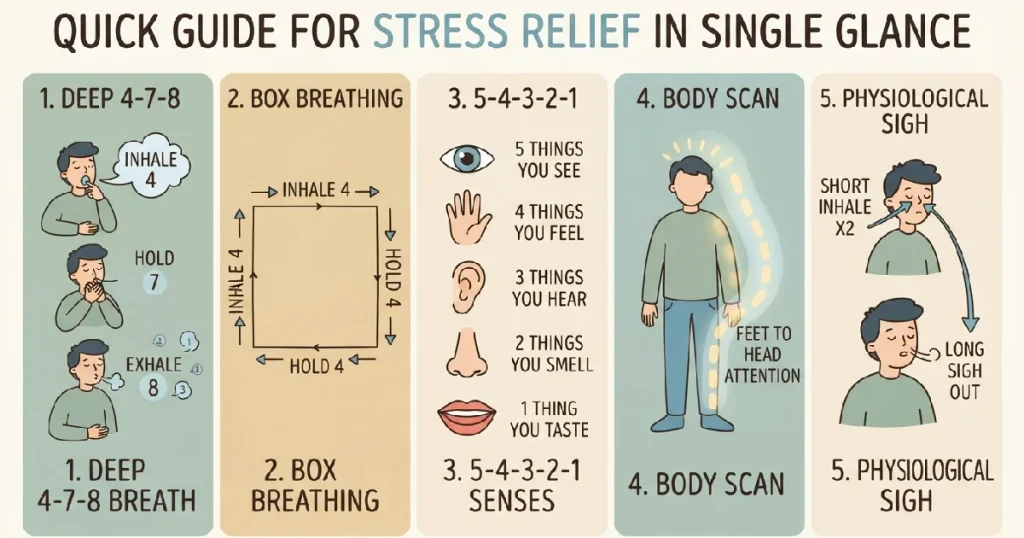
These aren’t abstract wellness ideas. They’re 5-minute mindfulness tools you can use the second your chest starts to tighten. Pick one and try it right now if you need to.
The 4-7-8 Breathing Cycle
This technique slows a racing heart rate by forcing a long, controlled exhale.
- Inhale through your nose for 4 seconds
- Hold your breath for 7 seconds
- Exhale audibly through your mouth for 8 seconds
- Repeat for 4 rounds
The extended exhale signals safety to your vagus nerve, the main communication line between your brain and your internal organs. Your body takes that signal seriously.
Tactical Box Breathing (4×4)
Used by military personnel and surgeons before high stakes moments, box breathing restores cognitive control fast.
- Inhale for 4 seconds
- Hold for 4 seconds
- Exhale for 4 seconds
- Hold empty for 4 seconds
Repeat this pattern for one full minute. The even rhythm gives your prefrontal cortex, the part of your brain responsible for rational decision making, something predictable to hold onto instead of the threat loop.
The 5-4-3-2-1 Sensory Grounding Method
This is one of the most effective grounding techniques for anxiety because it forces your attention out of your head and into the room around you.
- Name 5 things you can see
- Name 4 things you can physically touch
- Name 3 things you can hear
- Name 2 things you can smell
- Name 1 thing you can taste
Rumination, the mental habit of replaying the same worry over and over, cannot survive when your senses are fully occupied elsewhere.
The 2-Minute Mental Body Scan
Stress hides in your body long before you consciously notice it.
- Start at your feet. Just notice.
- Move slowly through your calves, thighs, and stomach
- Check your shoulders and jaw, the two spots where most people carry tension without realizing it
- Release a little more with every exhale
This rebuilds interoceptive awareness, your internal sense of what’s happening inside your own body, which stress tends to quietly shut off.
SKY “Sip-In” Breathwork
This one sounds strange the first time. It works anyway.
- Take a short, sharp inhale through your nose
- Immediately follow it with a second, smaller inhale to top off your lungs
- Release everything with one long, audible sigh through your mouth
This mimics your body’s natural sighing reflex, which resets your breathing rate faster than a single slow breath and instantly loosens a tight chest.
How to Fit Mindfulness Into a Packed Schedule: 4 Habit-Stacking Tips

Here’s the differentiator most stress advice gets wrong: you don’t need to find new time for mindfulness. You need to borrow time you’re already spending.
Every day is full of small transitions you move through on autopilot: walking to your car, waiting for coffee to brew, standing in an elevator. These moments already exist. Habit stacking simply means attaching a mindfulness practice to something you already do, so it doesn’t require a new time block or a new source of guilt.
Transition-Anchor Mindfulness
Pick one physical transition you make daily, like starting your car or walking from your desk to the break room. Every time you do it, take three slow breaths before moving on. Your body starts to associate that transition with a small reset.
The No-Screen Mindful Lunch
Give the first five minutes of any meal to your senses alone. Notice the texture, temperature, and smell of your food before you pick up your phone. This one shift creates real daily anxiety relief because it interrupts the constant multitasking that keeps your nervous system on alert.
Pre-Meeting Box Reset
Make this non-negotiable: before opening your inbox or joining a call, spend sixty seconds on box breathing. No exceptions, even when you’re running late. Especially when you’re running late.
Habit-Stacked Domestic Chores
Washing dishes, showering, or grinding coffee beans can double as a sensory anchor if you let them. Notice the water temperature. Notice the sound of the grinder. Your hands are already busy. Your mind can join them.
Maria’s Two-Minute Reset
Maria manages a team of twelve and used to walk into every meeting with her jaw already clenched. She started using the Pre-Meeting Box Reset, sixty seconds, no exceptions, before every single call. Within two weeks, her assistant noticed she seemed calmer walking into rooms that used to wreck her afternoon. Maria didn’t change her schedule. She just stopped skipping the sixty seconds she already had.
Overcoming Common Roadblocks: “My Mind Won’t Stop Racing”
Most people quit mindfulness after a few tries because their mind keeps wandering, and they assume that means they’re doing it wrong.
Here’s the reframe: noticing that your mind has drifted is the mindfulness. That moment of catching yourself is the exact skill you’re building, not a sign of failure.
A quiet mind was never the actual goal. According to Mayo Clinic’s guide on mindfulness exercises, the practice is about observing your thoughts without judgment, then gently returning your focus, over and over, for as long as it takes. Most people in this situation don’t realize that a busy mind and a successful mindfulness practice are not opposites. They’re the same thing, happening at the same time.
Conclusion: Your Next 5-Minute Reset
You don’t need a lifestyle overhaul to feel less wired. You need one small, repeatable habit that fits into the life you already have.
In my practice, the clients who stick with this are never the ones who try to meditate for an hour. They’re the ones who pick one trick, box breathing, the body scan, whatever fits, and use it on a Tuesday when nothing dramatic is even happening.
Pick one from this list. Use it today, on purpose, before you actually need it.
Next time your internal smoke detector goes off over burnt toast, you’ll already know exactly which switch to flip.
My Closing Remarks
I’ve watched clients white knuckle their way through hour long meditation apps and give up within a week, convinced they’d failed at something everyone else finds easy. They hadn’t failed. They’d just been handed the wrong tool for their actual life. Five minutes, used consistently, will always beat sixty minutes you never find. Start smaller than feels impressive. That’s usually where the real change lives.
More Related Stories for You
- If today’s practice felt useful, you might enjoy building a fuller mindfulness practice that extends beyond the five-minute reset.
About The Author