
 David Wall
Your Nervous System Has Been Running Emergency Protocols For Months. These Nine Practices Teach It How To Stand Down.
Key Points
- The most effective self care practices for mental health don’t start with your thoughts. They start with your body, your breath, and your biological rhythms.
- Real emotional resilience comes from micro-habits you practice daily, not weekend retreats you take twice a year.
- When you regulate your nervous system first, your mind follows. These nine strategies work because they align with how your brain and body actually heal.
Contents
Table of Contents
You’re Exhausted in a Way Sleep Doesn’t Fix
You set your alarm with the best of intentions. You go to bed early. You drink the water. You even downloaded a meditation app three months ago and used it twice.
And yet, you still wake up with a low hum of anxiety vibrating somewhere behind your ribs. You still feel like your emotional reserves are at 12 percent by noon. You still snap at the people you love most, then lie in bed replaying it at midnight.
You are not lazy. You are not broken.
You are running on a nervous system that has forgotten how to rest, even when your body is still.
Here is what most conversations about self-care get wrong: they focus on what you do to feel better in the moment. A bath. A glass of something warm. A canceled plan. And those things matter. But they are band-aids on a system-level problem.
The self care practices for mental health that actually transform how you feel are not about comfort. They are about regulation. They work at the level of your biology, your gut, your circadian rhythm, and the neural pathways that decide whether you feel safe or under threat before you even open your eyes in the morning.
According to research from the National Institute of Mental Health, consistent daily habits that address both body and mind are more predictive of long-term mental wellness than any single intervention. A 2022 study published in Nature Mental Health found that lifestyle-based interventions targeting sleep, movement, nutrition, and social connection produced measurable reductions in anxiety and depressive symptoms across diverse populations.
What follows are nine practices grounded in neuroscience and clinical psychology. They are specific. They are doable. And they are built for real life, not for someone with unlimited free time and a personal chef.
Let’s start where everything starts: your breath.
1. Regulate Your Nervous System in Real Time With Neurowellness Breathing

Most people think of relaxation as something passive. You sit still. You try to quiet your mind. You fail. You feel worse.
But your autonomic nervous system, the part of your brain that controls your stress response, doesn’t respond well to passive instructions. It responds to physical signals. Specifically, it responds to breath patterns.
The physiological sigh is a breathing technique studied by neuroscientist Dr. Andrew Huberman at Stanford University. It consists of two quick inhales through the nose followed by one long, slow exhale through the mouth. This specific pattern activates the parasympathetic nervous system, which is your body’s built-in brake pedal. It reduces cortisol. It slows your heart rate. And it works in under 30 seconds.
This is not “take a deep breath.” This is a manual override for your fight-or-flight response.
The next time you feel your chest tighten during a difficult conversation or a stressful email, try this before you respond. You are not just calming down. You are training your nervous system to shift states on command.
That’s not weakness. That’s wiring.
2. Replace Screen Time With a “Digital Sunset” for Better Sleep and Mood
You already know screens before bed are bad. Knowing hasn’t changed your behavior. So let’s reframe the problem.
Your brain’s master clock, located in the suprachiasmatic nucleus of the hypothalamus, uses light signals to determine when to produce melatonin (the hormone that initiates sleep) and when to suppress it. Blue light from screens sends a direct signal: stay alert. When that signal fires at 11 PM, your circadian rhythm gets confused. Sleep quality drops. Anxiety rises. Emotional regulation weakens.
The fix is not willpower. It’s architecture.
Create a non-negotiable 60-minute pre-bed window. No phone. No laptop. No tablet. Replace those screens with circadian-friendly activities: dim amber lighting, a physical book, stretching, or conversation. Think of it as a digital sunset, a deliberate signal to your brain that the day is ending.
In my practice, I have watched this single habit produce more improvement in mood stability than weeks of talk therapy alone. Not because therapy doesn’t work, but because sleep is the biological foundation everything else is built on.
3. Practice Chrono-Rest: The Kind of Rest Your Brain Needs While You’re Awake
Here’s something most people miss entirely: your brain needs structured rest during the day, not just at night.
Chrono-rest refers to intentional periods of waking cognitive recovery. This is different from napping. It’s different from scrolling social media on a break. It is sitting in complete silence, eyes closed, with no input, for approximately 10 minutes.
Why does this work? Your brain has a default mode network (DMN), a set of interconnected regions that become active when you stop focusing on external tasks. This network is responsible for self-reflection, memory consolidation, and emotional processing. When you never give it space to activate, cognitive load accumulates. Decision-making deteriorates. Emotional reactivity increases.
Think of your brain like a browser with 47 open tabs. Chrono-rest is the act of closing them, not all at once, but enough to let the system breathe.
Schedule one 10-minute micro-break during your workday. Close the door. Close your eyes. Let your brain do nothing. It is doing more than you think.
4. Feed Your Mood Through the Gut-Brain Axis With Precision Psychobiotics
Your gut produces roughly 90 percent of your body’s serotonin. Read that again.
The gut-brain axis is a bidirectional communication highway between your gastrointestinal tract and your central nervous system. When your gut microbiome, the community of trillions of bacteria living in your digestive system, is out of balance, it sends inflammatory signals to the brain. Those signals manifest as anxiety, low mood, irritability, and brain fog.
Psychobiotics is the term researchers use for specific probiotics and dietary strategies that positively affect mental health through the gut. According to a review published by Harvard Health, diets rich in fermented foods, fiber, and anti-inflammatory nutrients are consistently associated with lower rates of depression and anxiety.
The actionable version: start incorporating targeted fermented foods like kimchi, kefir, sauerkraut, or miso into your daily meals. Consider adaptogen-based functional beverages containing ashwagandha or lion’s mane, which early research links to reduced cortisol and improved cognitive performance.
You cannot think your way out of inflammation. But you can eat your way toward a calmer brain.
5. Use Your Body to Release What Your Mind Can’t Process
Consider a client I’ll call Maya. She came to therapy articulate, organized, and completely stuck. She could describe her anxiety in exquisite detail. She could trace its origins. She understood the cognitive patterns maintaining it.
But understanding didn’t make it stop. Her shoulders were locked up near her ears. Her jaw was clenched. Her breathing was shallow and fast, all day, every day.
Maya didn’t need more insight. She needed somatic release.
Somatic therapy is a body-first approach to healing emotional stress. The idea, supported by the work of researchers like Dr. Bessel van der Kolk, is that trauma and chronic stress are stored in the body, not just the mind. When cognitive processing hits a wall, the body offers another path.
Practical somatic practices include body-scan meditation, where you systematically notice and soften tension from head to toe. Progressive muscle relaxation, where you deliberately tense and release each muscle group. Intuitive movement, where you let your body move freely without choreography or structure, literally shaking off adrenaline.
If you have been “doing the work” mentally and still feel trapped in your stress, this is the door most people walk past. Try walking through it.
6. Protect Your Energy With a “No List” and Boundary Automation
Here is a question worth sitting with: how much of your daily exhaustion comes from things you never wanted to do in the first place?
True self-care is not only restorative. It is protective. It prevents energy depletion before it starts. And one of the most effective tools for this is what I call the “No List.”
A No List is a physical, written document that codifies your boundaries. Not in the abstract. In the specific. Examples: No work emails after 6 PM. No phone during meals. No saying yes to social invitations out of guilt. No Sunday evening conversations about Monday morning problems.
The purpose of the No List is to reduce decision fatigue, the psychological phenomenon where the quality of your decisions degrades after making too many of them. Every time you have to decide in the moment whether to hold a boundary, it costs energy. The No List makes the decision in advance, so you don’t have to.
Write yours tonight. Post it where you’ll see it. Let it do the heavy lifting your willpower shouldn’t have to.
7. Heal Loneliness Through Social Well-Being and Collective Rituals

Self-care culture has an isolation problem.
So many mental health strategies are designed for one person, alone, in a quiet room. And while solitude has its place, human beings are neurobiologically wired for connection. The absence of meaningful social contact activates the same brain regions as physical pain. Loneliness is not just uncomfortable; it is a health risk on par with smoking 15 cigarettes a day, according to the American Psychological Association.
But “be more social” is not helpful advice when you are depleted.
The better strategy is to embed yourself in structured collective rituals. Not party invitations. Not draining networking events. But reliable, low-pressure group activities where connection happens as a byproduct.
Join a local walking group. Attend a weekly book club. Show up at a community garden. The key is consistency and low stakes. You don’t need to perform. You just need to be present among others who are also just showing up.
Social well-being is not a luxury add-on to your self care practices for mental health. It is foundational.
8. Reset Your Brain With Therapeutic Micro-Doses of Nature
You do not need a three-day camping trip to benefit from nature exposure. You need five minutes and a doorstep.
The concept of nature micro-dosing refers to brief, intentional periods of sensory immersion in natural environments. Step outside in the morning, without sunglasses and without your phone, for 5 to 10 minutes. Let natural light hit your retinas. Feel the air on your skin. Listen.
This practice does two things simultaneously. First, morning light exposure calibrates your circadian rhythm by signaling your suprachiasmatic nucleus to suppress melatonin and initiate cortisol’s natural waking curve. Second, it activates what researchers call “soft fascination,” a state of effortless attention that allows your prefrontal cortex to recover from cognitive overload.
A 2019 study published in Frontiers in Psychology found that just 20 minutes of contact with nature significantly reduced cortisol levels, with benefits measurable even at shorter durations.
Tomorrow morning, before you check your inbox, step outside. No agenda. Just light and air.
Your stressed brain is waiting for permission to slow down. Give it something green.
9. Build Emotional Literacy With Micro-Journaling
Most people abandon journaling because it feels overwhelming. Writing pages about your feelings after an already exhausting day can feel like asking a marathon runner to sprint the last mile.
Micro-journaling solves this by shrinking the task to something almost absurdly small, but psychologically potent.
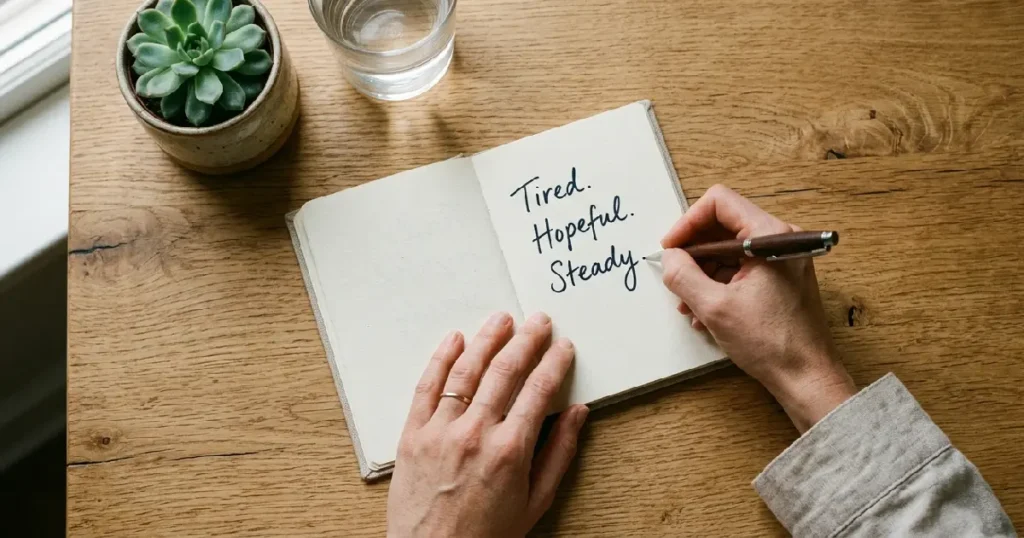
Use the 3-Word Check-In. Twice a day, morning and evening, write exactly three words that describe your current emotional state. That’s it.
“Tired. Anxious. Hopeful.”
“Flat. Disconnected. Hungry.”
“Calm. Grateful. Restless.”
What you are building is emotional literacy, the ability to accurately identify and name your internal experience. Research in affective neuroscience has shown that the simple act of labeling an emotion (a process called “affect labeling”) reduces activity in the amygdala, your brain’s threat detection center. Naming it tames it.
Over time, patterns appear. You notice that your anxiety peaks on Sundays. You realize “restless” shows up every time you skip your morning walk. You begin to see yourself with clarity instead of confusion.
Three words. Twice a day. That’s your minimum effective dose of self-awareness.
What to Try This Week: Your Nervous System Reset Toolkit

You don’t need to implement all nine practices tomorrow. That would be its own form of self-sabotage. Instead, consider starting with one or two practices that spoke to something you recognized in yourself.
The Morning Light Reset: Before you touch your phone tomorrow, step outside for five minutes of unfiltered morning light. Notice what shifts in your body.
The Breath Override: The next time stress rises, use the physiological sigh: two quick nasal inhales, one long mouth exhale. Practice it three times today so it’s available when you need it.
The 3-Word Check-In: Set two alarms on your phone, one for morning, one for evening. When they go off, write three words. Nothing more.
A useful question to ask yourself at the end of each day: “Did I do something today that my nervous system needed, or only what my to-do list demanded?”
These self care practices for mental health are not about perfection. They are about creating small, reliable points of contact between you and your own well-being. Think of each practice as a stitch in a net. No single stitch holds you. But together, they form something strong enough to catch you when you fall.
You Were Never Meant to Run on Empty
Remember that hum of anxiety you woke up with this morning? The one that sleep didn’t touch? That exhaustion you couldn’t explain?
You now have a map for it. You understand that your nervous system needs active regulation, not just passive rest. You know that your gut is talking to your brain, that morning light resets your internal clock, that three words on a page can quiet an overactive amygdala.
You have nine new ways to meet yourself where you are. Not with judgment. Not with another impossible to-do list. But with the kind of care your body and brain were actually built to receive.
Self-care is not selfish. It is not soft. It is the infrastructure that holds everything else in your life together.
Start small. Start now. Start before you feel ready.
Because readiness is not something you wait for. It’s something you build, one breath at a time.
My Closing Remarks
I’ll be honest with you. I spent years telling my own clients to “practice self-care” without fully understanding what that meant beyond the obvious. It wasn’t until I started regulating my own nervous system, standing outside in the morning light like some kind of barefoot scientist, and writing my own three-word check-ins that I realized how disconnected I had been from my own body. The irony of a psychologist who forgot to check in with himself is not lost on me. What I know now, deeply and personally, is that these practices are not extras. They are the foundation. If you take nothing else from this article, take this: you deserve to feel safe in your own skin, and that starts with the smallest possible step you can take today.
More Related Stories for You
- If you want to deepen your daily grounding routine, you may find value in exploring how a consistent mindfulness practice can become the anchor that holds all of these habits together.
About The Author