
 Nicole Adkins
Your love story deserves a financial foundation strong enough to hold it. These nine strategies turn money from a source of conflict into a shared superpower.
Key Points
- Making intentional financial moves to make before marriage is the single most overlooked form of relationship protection, and research shows it directly predicts long-term satisfaction.
- True financial partnership is not about merging everything or splitting everything 50/50. It is about designing a system that fits your actual lives, not someone else’s template.
- The couples who talk about money before the wedding are not unromantic. They are the ones still holding hands ten years later.
Contents
Table of Contents
The Conversation You Keep Postponing
You are lying in bed next to the person you plan to spend your life with. You have talked about where you want to live. You have debated baby names. You have even agreed on a dog breed.
But there is a folder on your phone you have never opened together. It holds your student loan balance, your credit score, and a subscription to a streaming service you forgot existed three years ago.
You are not hiding it, exactly. You just have not found the right moment.
Here is the uncomfortable truth: that moment will not arrive on its own. And every week you wait, the financial gap between where you are and where you need to be gets a little wider. Not because your situation is bad. But because the absence of a shared plan quietly becomes a plan of its own.
And it is usually not a good one.
Why Money Is Really About Trust
Most people assume that financial conflict in relationships is about numbers. It is not. It is about what those numbers represent: safety, control, freedom, values, fear.
A landmark study published in Family Relations found that disagreements about money are the single strongest predictor of divorce, outpacing conflicts about children, in-laws, and even intimacy. The researchers noted that financial arguments tend to be more intense, last longer, and take more time to recover from than any other type of couple conflict.
Why? Because money is never just money. Your relationship with spending, saving, and debt was shaped long before you met your partner. It was built in your childhood kitchen, in the way your parents whispered or shouted about bills, in the moment you first felt the sting of not having enough or the relief of having more than you expected.
When you and your partner sit down to talk about finances, you are not just comparing spreadsheets. You are comparing entire emotional histories.
That is why the financial moves to make before marriage are not just logistical tasks. They are acts of intimacy. Each one is an invitation to say: “I trust you enough to let you see the full picture.”
The couples who accept that invitation tend to build something remarkably strong. The ones who avoid it often discover, too late, that love alone cannot pay the mortgage.
The 9 Financial Moves That Build an Unshakable Foundation
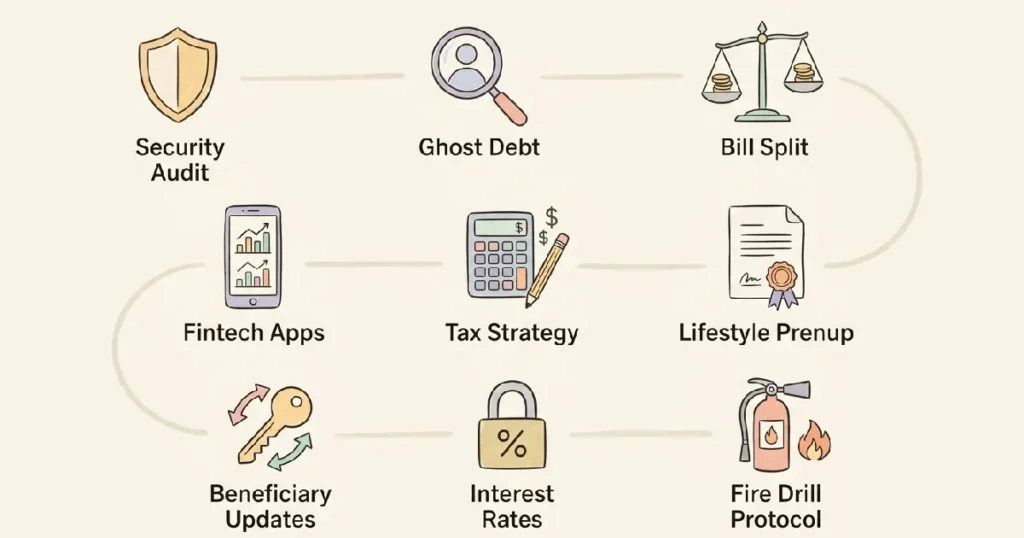
Think of your shared financial life like the wiring inside the walls of a house. Nobody sees it. Nobody talks about it at the housewarming party. But when it is done right, everything works. And when it is done carelessly, the whole structure is at risk.
These nine moves are your wiring job. Do them before you move in together emotionally or legally, and you will be building on solid ground.
1. Run a Full Financial Security Audit
Before you merge a single dollar, protect what you already have.
Start by clearing out dormant payment apps like old Venmo or Splitwise accounts you have not touched in years. These forgotten digital footprints are a real identity theft risk. Then lock down your personal accounts with two-factor authentication. Hardware security keys like Yubikeys or app-based authentication tools add a layer of protection that simple passwords cannot match.
Finally, use a service like Rocket Money to audit your subscription footprint. You would be surprised how many couples discover they are paying for three overlapping streaming services and two gym memberships neither of them uses.
This is not paranoia. This is basic financial hygiene. You would not move into a new apartment without changing the locks. Do not walk into a marriage without securing your accounts.
2. Expose and Isolate “Ghost Debt”
This is the move most couples skip, and it is the one that causes the most damage later.
Ghost debt is any financial obligation that is not immediately visible. It includes student loans with income-driven repayment plans that change drastically when you file taxes jointly. It includes the informal “handshake” loan your partner’s parents gave them three years ago that nobody wrote down. It includes credit card balances tucked away in accounts you do not share.
I have worked with couples who discovered, six months into marriage, that one partner carried $40,000 in debt the other knew nothing about. The debt itself was manageable. The betrayal of not knowing was not.
Sit down together and disclose everything. Calculate each person’s individual debt-to-income ratio. Keep high-interest balances structured individually so one partner’s credit capacity is not quietly dragged down by the other’s obligations.
This is not about judgment. It is about building a shared map that matches reality.
3. Stress-Test Your Bill Split (And Ditch the 50/50 Myth)
Here is what no one tells you about splitting expenses down the middle: it only works when both partners earn the same amount. Which almost never happens.
Consider a couple I will call Jenna and Marcus. Jenna earns $95,000. Marcus earns $52,000. They split rent and groceries 50/50 because it “seemed fair.” Within a year, Marcus was quietly drowning. He stopped buying things he needed. He felt ashamed asking Jenna to cover dinner. Resentment crept in, not because either of them was selfish, but because the system was broken.
When they switched to a proportional model, contributing to shared expenses based on a percentage of income (roughly 65/35), something shifted. Marcus could breathe. Jenna did not feel taken advantage of. The tension dissolved.
Try running a proportional trial for three months before the wedding. Track it. Talk about it. And while you are at it, agree on a personal spending threshold. What is the maximum amount either of you can spend without a conversation? $100? $300? There is no right number. But there needs to be a number.
4. Deploy a “Joint-Light” Financial System
You do not need to merge bank accounts to build financial transparency. In fact, many financial therapists now recommend a hybrid model, especially before marriage.
Here is how it works: both partners keep their individual checking and savings accounts. Then you link those accounts through an open-banking app like Monarch Money, Tandem, or Copilot. These tools let you track shared expenses, visualize combined spending patterns, and set joint savings goals without legally combining assets.
Think of it as a financial dashboard for your relationship.
This approach preserves your pre-marital banking history, which matters for credit and loan applications. It also gives both partners full visibility into the financial picture without the anxiety of “losing” their individual accounts.
Set up separate high-yield digital sub-buckets for shared goals like the wedding fund, honeymoon savings, or a future down payment. Automate contributions. Watch the progress together. It turns saving from a chore into a shared project.
5. Strategize for the Marriage Tax Penalty

Getting married changes your tax situation. Sometimes for the better. Sometimes not.
The so-called marriage penalty occurs when two similar incomes combine and push a couple into a higher tax bracket than they would occupy individually. It does not affect every couple, but when it hits, the surprise can be significant.
Before the wedding, run a dummy joint tax return using your current incomes. Free tools and a good CPA can help you model what your combined liability will look like. Then coordinate your retirement contributions. Maximizing workplace 401(k) allocations is one of the most effective ways to manage your joint adjusted gross income.
Also evaluate your health savings strategy. Transitioning to a family HSA plan can yield superior tax deductions depending on your situation.
This is not about gaming the system. It is about walking into your marriage with open eyes instead of an unexpected tax bill in April.
6. Draft a “Lifestyle Prenup”
Let me be direct: prenuptial agreements are not a sign of distrust. They are a sign of maturity.
But beyond the traditional prenup, consider what I call a lifestyle prenup. This is a documented agreement that covers the less obvious assets most people forget about.
Do you hold cryptocurrency or digital asset keys? List them. Does your partner have equity compensation or stock options from their employer? Document it. Is one of you building a side business or early-stage startup? Define how that business equity will be treated if it grows during the marriage.
One of the most sophisticated elements to consider is a sunset clause. This is a provision that allows certain asset protection terms to adapt or dissolve after a set number of years, say five or ten years of marriage. It acknowledges that your financial lives will evolve and builds flexibility into the agreement.
Consult a family law attorney who specializes in prenuptial planning. The cost is modest. The clarity is priceless.
7. Realign Asset Ownership and Beneficiaries
This one is mundane, and that is exactly why people skip it.
When was the last time you checked the beneficiary designations on your 401(k) from that job you left four years ago? Many people still have an ex-partner, a college roommate, or even a parent listed as the primary beneficiary on retirement accounts and life insurance policies.
Conduct a full beneficiary audit. Update every account to reflect your current wishes.
While you are at it, update your digital estate. Designate your partner as a legacy contact for Apple, Google, and your password management system. If something happens to you, they need to be able to access critical information without a legal battle.
Finally, have a conversation about how future real estate purchases will be titled. Joint Tenancy means equal ownership with right of survivorship. Tenants in Common allows different ownership percentages. The right choice depends on your situation, but the wrong choice is not choosing at all.
8. Lock In Favorable Interest Rates Now
Interest rates do not care about your wedding date. But they absolutely affect your financial future.
If you have built up joint emergency savings, park them in a high-yield savings account or money market fund now. Rate environments shift, and locking in competitive yields protects your purchasing power.
If either partner carries variable-rate debt, whether credit cards or adjustable-rate loans, explore refinancing into fixed-term options. Variable rates feel manageable until they are not.
And here is a detail that trips up many couples: do not close old credit cards in a pre-wedding cleanup frenzy. The length of your credit history is a significant factor in your credit score. Closing a card you have had for ten years shortens your credit timeline and can quietly damage the score you have spent years building.
Keep old accounts open. Use them occasionally. Let them work for you in the background.
9. Establish a “Financial Fire Drill” Protocol
Every couple needs a plan for when things go wrong. Not if. When.
Designate one partner as the lead bill manager, the person who ensures payments are made on time, tracks due dates, and monitors account activity. But keep all financial decisions 50/50. Administration and decision-making are two different things.
Build what I call a “Black Box” file. This is an encrypted shared drive or secure folder that contains every insurance policy, account number, login credential, and legal document your household depends on. If one partner is suddenly unable to manage finances due to illness, travel, or emergency, the other can step in without panic.
Finally, define your hardship boundaries in advance. What specific financial triggers would justify tapping into emergency savings? A job loss? A medical bill over a certain amount? Having these thresholds agreed upon before a crisis means you will not be making high-stakes decisions under emotional pressure.
That is not pessimism. That is partnership at its most mature.
Your Next Three Steps

You have just read through nine moves. That can feel overwhelming. So let me simplify.
Step one: Schedule “The Money Date.” Pick a specific evening this week. Open a bottle of something you both enjoy. Pull up your accounts. Start with Move 1 or Move 2. You do not need to cover everything in one sitting. You just need to start.
Step two: Name your shared financial fear. Ask each other: “What is the money scenario that scares you most?” Maybe it is debt. Maybe it is losing independence. Maybe it is repeating a parent’s mistakes. Naming the fear takes away most of its power. According to research on affect labeling from UCLA, simply putting a feeling into words reduces its intensity in the brain.
Step three: Automate one joint savings goal this month. Even $50 a month into a shared high-yield sub-account changes the dynamic. It turns “we should save” into “we are saving.” The psychological difference between those two statements is enormous.
One conversation will not fix everything. But one conversation will change the trajectory.
The Strongest Marriages Are Built on Shared Truth
Remember that folder on your phone? The one with the numbers you have been meaning to share?
You do not need to open it perfectly. You do not need to have all the answers. You just need to be willing to sit next to the person you love and say, “Here is where I am. Where are you?”
That question, asked with honesty and without shame, is more romantic than any proposal. Because it says: I want to build something real with you. Not a fantasy. Not a performance. A life.
The financial moves to make before marriage are not about money. They are about trust, made visible.
And the couples who make that trust visible, before the rings, before the vows, before the first joint tax return? They are the ones who last.
Your future together is not something that happens to you. It is something you build. Start building.
My Closing Remarks
In my years of working with couples, I have learned something that still surprises people: the partners who fight the least about money are not the ones who have the most of it. They are the ones who talked about it earliest and most honestly. I have watched couples with six-figure incomes implode over hidden credit card debt, and I have watched couples earning modest wages build extraordinary stability because they chose transparency over comfort. If this article made you a little uncomfortable, good. That discomfort is the exact feeling that precedes growth. Do not wait for the perfect moment. The perfect moment is the one where you are brave enough to begin.
More Related Stories for You
- If this article resonated with you, you might also find value in learning about building a complete financial plan before your wedding.
About The Author