
 Nicole Adkins
The signs are subtle at first, but the damage they leave behind is anything but small.
Key Points
- Narcissistic personality traits rarely announce themselves. They arrive dressed as charm, confidence, or a bad mood you’ve learned to excuse.
- Left unchecked, these narcissistic personality traits slowly rewrite your sense of reality until self-doubt starts to feel like your default setting.
- You’ll learn exactly which behaviors deserve your attention, why they work so well on smart and capable people, and what to do about it starting today.
Contents
Table of Contents
Most of us have sat across from someone we love and quietly wondered if we were the problem. We replay the conversation in our heads. We soften our own memory of what happened. We tell ourselves everyone has a bad day, that love means giving people the benefit of the doubt.
You know this feeling if you’ve lived it.
The exhaustion isn’t from one fight or one hard week. It’s from years of small moments that never quite added up to a name. You’ve been blamed for things you didn’t do. You’ve apologized for feelings you were never allowed to have in the first place. And somewhere along the way, you stopped trusting your own read of the room.
That fog has a cause. And it isn’t your memory.
Narcissistic Personality Disorder vs. Everyday Narcissistic Traits: What’s the Difference
Here’s something I can say with confidence after years of sitting with people in exactly this kind of confusion: what you’re noticing has a name, and it isn’t a character flaw in you.
Clinical narcissism, formally known as Narcissistic Personality Disorder, is a real diagnosis. It requires a licensed clinician, a specific set of criteria, and a pattern that shows up across nearly every part of a person’s life.
But most of the damage done in marriages, families, and workplaces doesn’t come from someone who meets that full clinical picture. According to a well-known 2018 review by researchers Zlatan Krizan and Anna Herlache, narcissism actually exists on a spectrum rather than as a single on-off switch. Someone can carry heavy narcissistic traits, entitlement, a hunger for admiration, a paper-thin tolerance for criticism, without ever meeting the threshold for a formal disorder.
That distinction matters, because it closes a trap a lot of survivors fall into. You don’t need a diagnosis to be hurt. You don’t need a label to justify how tired you are.
But here’s what no one tells you.
The most damaging narcissistic personalities usually aren’t loud or obviously cruel. They’re charming. They’re competent at work. Friends describe them as “so much fun.” That mask is exactly what makes narcissistic personality traits so easy to miss, because the outside world keeps rewarding the very qualities that are quietly wearing you down at home.
Psychologists sometimes describe this as the boiling frog effect. The water heats up so gradually that by the time it’s unbearable, you’ve already adjusted your entire definition of normal. Most people in this situation don’t realize how many red flags they’ve been quietly excusing, one small joke or one dismissed boundary at a time, until years have passed.
7 Narcissistic Personality Traits You Should Never Ignore
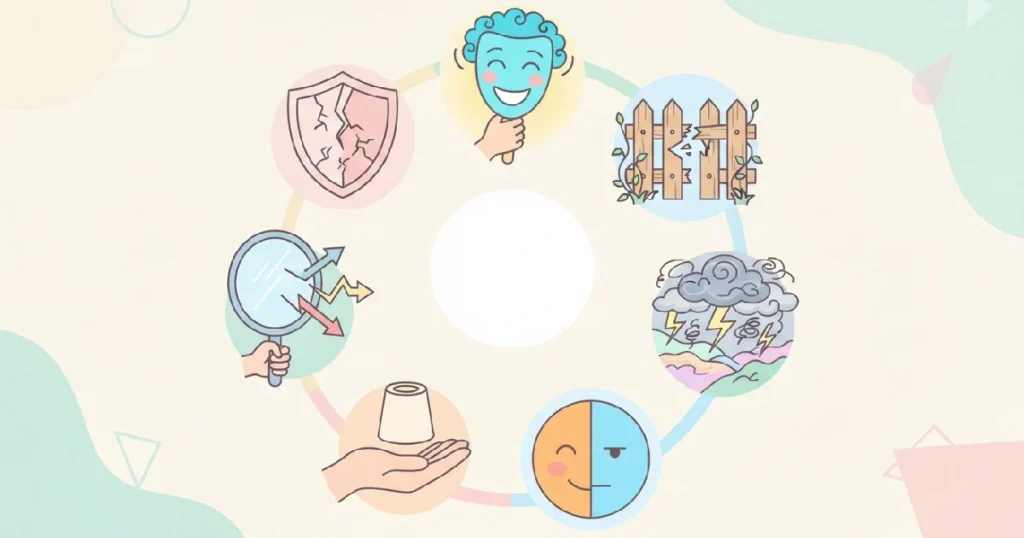
Some of these will feel painfully familiar. That recognition is the beginning of clarity, not proof that you overreacted.
1. Hostility Disguised as Playful Sarcasm
The comment lands with a laugh attached, so it takes you a second to feel the sting. “Wow, you actually finished something for once.” A joke, technically. But you noticed the timing, and so did everyone else in the room.
This is one of the most common narcissistic personality traits because it’s nearly impossible to call out without looking oversensitive. The insult does its work, then hides behind humor for cover. Push back, and you get the classic line: “It was just a joke, relax.”
That’s the trap. Every jab quietly tests how much disrespect you’ll tolerate before pushing back. The less you push, the sharper the next one gets.
2. The Systematic Destruction of Personal Boundaries
You said you needed the weekend to yourself. They showed up anyway and called it a surprise. You asked them to stop reading your messages. They called it “just checking in because they care.”
None of these moments look like abuse on their own. That’s the design. Boundary violations rarely start big. They start with a five-minute delay in respecting a “no,” or a comment about how dramatic your rules sound.
Each small crossing trains you to expect less privacy and less say over your own life. By the time boundaries matter most, you’ve already half-forgotten you were allowed to set them.
3. Manufacturing Chaos to Disrupt Existing Harmony
Things were calm for a week, and somehow that felt like a warning sign. Then a rumor started, an old argument resurfaced out of nowhere, or plans changed at the last possible moment for no real reason.
People with strong narcissistic traits often struggle to tolerate long stretches of peace they don’t personally control. Calm means they’re not the center of the emotional weather in the room. So they manufacture a small crisis, shift a goalpost, or stir a little gossip, just enough to put everyone back on edge.
You end up scanning every quiet moment for the next disruption. That kind of hypervigilance is exhausting in a way that’s hard to explain to anyone who hasn’t lived inside it.
4. Severe Emotional Splitting: Black-and-White Thinking
One week you’re the best thing that’s ever happened to them. The next, after one small disagreement, you’re selfish, cold, or “just like everyone else who’s let them down.”
Psychologists call this splitting: a defense in which a person can’t hold both good and bad qualities about someone in their mind at the same time. You’re either flawless or worthless, with almost no room in between.
The speed of that switch is what makes it so disorienting. You’re not imagining the whiplash between being idolized and being discarded overnight. That instability is the pattern itself, not a misunderstanding on your end.
But the trait most people miss completely isn’t about anger at all. It’s about warmth that never quite lands where it should.
5. Weaponized Cognitive Empathy Without Emotional Connection
They know exactly what to say when you’re hurting. The words sound almost scripted, perfectly timed, deeply reassuring. Yet somehow their actions never quite match the comfort in their voice.
This is what psychologists call cognitive empathy: the ability to understand what someone else is feeling and thinking, without actually feeling it alongside them. It’s a skill, not a sentiment. Highly capable narcissistic individuals use it to read your vulnerabilities and reflect back exactly what you need to hear, which is what makes the connection feel so real even when it isn’t.
Loving someone like this can feel like pouring warmth into a cup with a hole in the bottom. No matter how much you give, it never fills, and after a while, you start to believe the problem is your pouring.
The Narcissistic Supply Trap Behind Your Trauma Bond
Here’s a piece of the picture most explanations of narcissism leave out entirely.
The reason you stayed hooked wasn’t weakness. It was behavioral conditioning. Psychologists call it intermittent reinforcement, a term borrowed from learning theory describing how unpredictable rewards create the strongest and hardest to break habits.
Think of a slot machine. If it paid out every single time, you’d get bored fast. But an unpredictable payout, sometimes warmth, sometimes cruelty, keeps you pulling the lever far longer than a machine that never paid out at all. A narcissistic partner or boss who is occasionally warm isn’t being inconsistent by accident. That unpredictability is exactly what keeps your nervous system waiting for the next good moment, which is the mechanical engine behind what many people call a trauma bond.
6. Zero Accountability and Defensively Externalizing Blame
“I’m sorry you feel that way” is not an apology. It’s a redirection, one that quietly makes your feelings the problem instead of their behavior.
A genuine apology names the specific action, acknowledges the harm, and doesn’t ask for anything in return. What you’re getting instead is a narrative rewrite, one where you somehow end up comforting them for upsetting you.
Over time, this pattern trains you to distrust your own perception of events. You start rehearsing your own apology before you’ve even figured out what actually happened.
7. Extreme Hypersensitivity to Minimal Criticism
You mention, gently, that a deadline was missed or a comment stung. What follows isn’t a conversation. It’s rage, or days of icy silence that make the whole house hold its breath.
This reaction has a clinical name: narcissistic injury, a term the psychoanalyst Heinz Kohut used to describe the intense threat a person feels when their inflated self-image meets even mild external feedback. The reaction is wildly out of proportion to the input that triggered it.
The lopsided rule becomes obvious fast. Their comfort matters more than your honesty, every single time.
If you recognized three or four of these traits in someone close to you, you’re not overreacting. You’re finally seeing clearly.
Maria’s Story: When Confidence Quietly Disappears
Maria was the most organized person in her office, the one colleagues went to for calm advice. At home, her husband’s comments always arrived wrapped in a laugh, always followed by “you know I’m kidding.” She stopped mentioning her promotion after the last time she brought it up earned her three days of silence.
A year in, she started keeping a mental list of everything she might have done wrong that week, just in case he brought it up first. It took a friend gently naming the pattern out loud before Maria even considered that the problem wasn’t her memory. Today she still works in that same office, but she keeps a written log of what’s actually said at home, and she no longer apologizes for things she can’t quite explain.
How to Protect Yourself From Narcissistic Personality Traits Starting Today

Once you can name the pattern, the next question is what to do with your energy. A few field-tested strategies can help you regain solid ground.
Try the grey rock method. This means making yourself as uninteresting and emotionally flat as an actual grey rock during conversations with a difficult person. Skip the reaction they’re fishing for. Give short, boring, factual answers instead of your usual warmth. As explains in its guide to the grey rock method, the goal is to stop feeding the emotional response a manipulative person needs from you, not to punish them. If you want to hear what that sounds like in a real conversation, this short video breaks the technique down in plain terms.
Retire the urge to J.A.D.E. That stands for Justify, Argue, Defend, or Explain. Every boundary you explain becomes new material for a manipulator to pick apart. A simple “that doesn’t work for me” carries more protection than a three-paragraph justification ever will.
Keep a reality log. Write down what was actually said, with a date and time, right after it happens. This isn’t about building a court case. It’s about giving your own memory something solid to lean on when gaslighting, a form of manipulation that makes you doubt your own perception, tries to talk you out of what you just lived through.
One honest caveat: grey rocking is a short-term shield, not a long-term plan. It takes real emotional labor to stay flat around someone who wants a reaction from you. If safety, finances, or children are involved, these tools work best alongside a proper safety plan, not instead of one.
Moving Forward: Reclaiming Your Life After Narcissistic Abuse
Recognizing these narcissistic personality traits doesn’t fix the relationship, and it isn’t supposed to. It fixes your vision.
The fog you’ve been living in has a cause, and that cause was never your sensitivity or your memory. It was someone else’s pattern, playing out exactly as designed.
For a long time, you thought the problem was how you were pouring. It never was. The cup had a hole in it long before you arrived, and it was never yours to fix.
You get to decide what happens next, whether that means new boundaries, more distance, or walking away entirely. Either way, you’re no longer doing it blind.
My Closing Remarks
In my practice, the moment clients stop asking “what’s wrong with me” and start asking “what pattern am I actually looking at” is the moment real healing begins. I’ve watched that shift happen in a single conversation. You don’t need to diagnose anyone to trust what you’ve lived through. You just need permission to believe your own eyes again. Consider this your permission slip, and give yourself credit for reading this far instead of looking away.
More Related Stories for You
- If a spouse is the source of this pattern in your life, this guide on how to deal with a narcissist husband walks through what steady, practical support looks like day to day.
About The Author