
 Nicole Adkins

Chemistry gets the credit, but a few quiet behaviors decide whether love still feels safe five years from now.
Key Takeaways
- The most telling qualities of a good partner show up in small moments: how someone responds when you name a hurt, share a win, or say no.
- Contempt, rather than conflict itself, is the strongest breakup predictor in John Gottman’s decades of couple research.
- A steady partner can feel oddly flat at first if unpredictability taught you to read anxiety as attraction.
Quick answer: The qualities of a good partner are steady, observable behaviors. Think kept promises, respect during conflict, fast repair after fights, daily responsiveness, and support for your growth. Feelings fluctuate. These habits stay measurable, which is why they predict relationship health better than chemistry does.
Contents
Table of Contents
Three months in, they still text back fast. Good restaurants, easy banter, plans made on time. Then you mention something small that stung, and the room goes cold. You spend two days replaying the conversation, editing your feelings down to something easier to hear.
That editing is the tell. John Bowlby’s attachment theory, later applied to adult romance by Hazan and Shaver, explains why. An unpredictable partner keeps your attachment system on alert, and that alert can pass for butterflies. Steadiness gets misread as a lack of spark.
What follows trades adjective lists for evidence. You get ten behaviors you can check, the research behind them, and four small tests you can run this month without turning dating into a job interview.
Safety First: 4 Qualities of a Good Partner You Can Verify
Ask what makes a good partner in a relationship and most answers arrive as adjectives: kind, loyal, patient. In my counseling work, I watch behaviors instead, because emotional safety leaves a paper trail. These four habits surface within weeks. You can check all four without a single deep talk about values.
1. They keep small promises at a boring rate

Track micro-commitments for two weeks: “I’ll call after work,” “I’ll book it tonight.” Reliable partners land around nine out of ten. They flag a miss before you have to chase it, and warm excuses for chronic lateness still count as misses. The small-promise rate is my cleanest early read on follow-through when stakes get real.
2. They repair quickly, and the apology changes something
Gottman’s lab calls these moves repair attempts. Any bid to lower tension counts, from a joke to a plain “I’m sorry, let me try again.” Repairs work because they interrupt the flooded, fight-or-flight state that blocks listening. Watch for one within a day or two, then watch the same trigger next week.
3. They stay respectful while angry
Eye-rolling, mockery, scorekeeping: Gottman’s research ranks contempt as the strongest predictor of divorce. Stable couples keep roughly five positive exchanges for every negative one during conflict (Gottman & Levenson, 1992). Anger is workable. Contempt corrodes.
4. They own their part without a counter-charge
Listen to the first sentence after you raise an issue. “I got defensive, that’s on me” opens repair. “Well, you do the same thing” is defensiveness dressed as fairness, and it blocks repair. One edge case: the instant apologizer who repeats the behavior monthly, since speed of sorry means little until behavior moves.
Growth Signals: 3 Signs of a Good Partner Who Makes You More Yourself
Safety keeps a relationship calm. These three habits help you grow inside it, and researchers can measure each one. The direction matters: support should point toward your stated goals, never a makeover they want.
5. They turn toward your bids for connection
A bid is any small reach for attention: a sigh, a meme, “look at this.” In Gottman’s newlywed research, couples still married six years later had turned toward bids 86% of the time. Couples who divorced averaged 33%. A quick “give me five minutes” still counts, and you can sample this on any ordinary evening.
6. They support the person you’re becoming
Psychologists call it the Michelangelo phenomenon. Partners who treat you as your ideal self help you grow into it (Drigotas et al., 1999). Test it with a goal that offers them nothing, like a solo trip or a career pivot. Enthusiasm is data, and so is faint discouragement, which the same research links to drifting from your own goals.
7. They celebrate your wins with full attention
Shelly Gable studies capitalization: how couples respond to each other’s good news. Engaged, active-constructive replies (“Tell me everything, how did it feel?”) build more closeness than polite praise. How a partner handles your promotion tells you as much as how they handle your worst day. Watch the eyes and the follow-up questions.
Under Pressure: 3 Qualities to Look for in a Partner When Life Gets Hard
Flu season, canceled flights, a scary invoice: stress strips the performance away. The qualities of a good life partner surface here, in the unglamorous middle of ordinary problems. None of these require heroics; they show up in logistics.
8. They take “no” without a tax
Decline one small request and watch the aftermath. Sulking, withdrawal, and quiet scorekeeping are penalties that train you to self-censor. A good partner can feel disappointed and still honor the boundary. The feeling is human; the penalty is the flag.
9. They keep updating their map of you
Gottman calls this a love map: knowing your current stresses, allies, and dreams. People change jobs, friendships, and fears, so a map drawn in month one expires. Partners with stale maps end up saying “you’ve changed” as an accusation. Curious follow-up questions, asked months apart, show the map is being redrawn.
10. They act like a teammate when plans collapse
Watch what happens when you’re sick or the trip falls apart. Teammates notice tasks and pick them up. “Just tell me what to do” sounds helpful but hands you the mental load too: managing, remembering, assigning. Shared effort without supervision is the behavior to watch, because it decides whether year seven feels like partnership or parenthood.
The Chemistry Trap: When Ideal Partner Qualities Feel Boring at First
Behavioral science has known for decades that unpredictable rewards hold attention harder than steady ones. Psychologists call it intermittent reinforcement. Slot machines run on it, and so do mixed signals. That hook can outlast actual liking, which is why “I can’t explain it” is a common line in my office.
If your history runs anxious, a calm partner may register as flat. The qualities of a good partner can get filtered out in week one. Attachment theory calls a reliable partner a secure base: steadiness that frees you to explore life. In practice, I often see attraction grow as safety builds and the body stops scanning for threats.
Consider giving a steady person three to five dates before ruling on sparks. Here is how intensity differs from interest:
| Signal | Love bombing | Healthy slow burn |
|---|---|---|
| Pace | Commitment talk within weeks | Interest that builds with knowledge |
| Your “no” | Guilt, pressure, or sulking | Plans adjust, warmth holds |
| Conflict | Charming apologies, repeat offenses | Repair plus changed behavior |
| Between dates | You feel anxious, keep checking | You feel calm, live your life |
What to Do Next: Four Field Tests for Partner Qualities
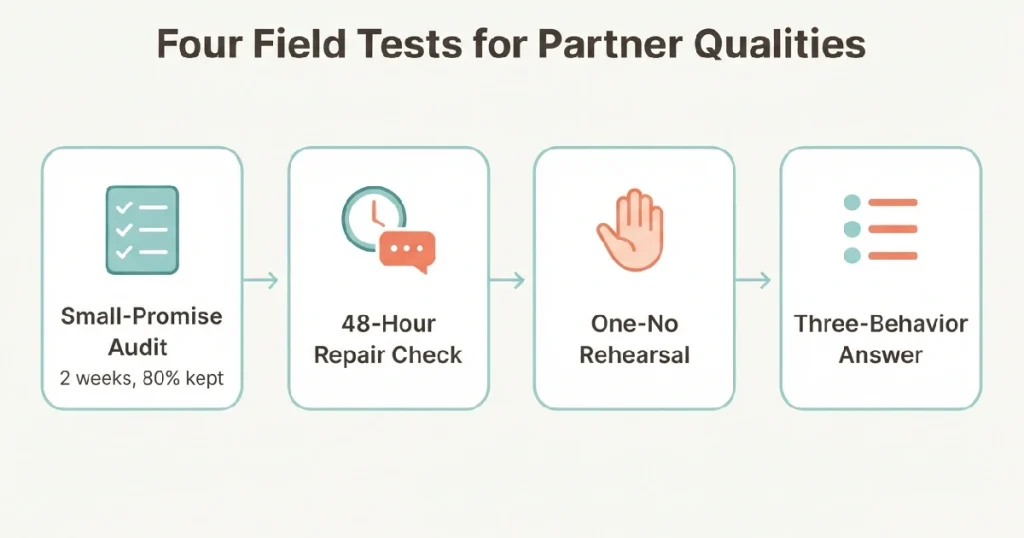
Run these gently, because the goal is honest evidence. One test per week keeps dating human.
The Small-Promise Audit
For two weeks, log every small promise as kept, late, or missed. Around 80% kept or better gives you a reliable base. If the pattern sags, try: “I’ve noticed weeknight plans slip; can we promise only what we’re sure of?” A partner who tightens their word is showing you quality one in real time.
The 48-Hour Repair Check
After minor friction, open the door once: “I’ve felt off since Tuesday, and I’d like to talk it through.” Then watch. Engagement within a day or two, with some ownership, is a green flag. Stonewalling or a blame reversal is the red flag that previews every future fight.
The One-No Rehearsal
Decline something small and observe the temperature. “Saturday doesn’t work for me; how does next weekend look?” Warmth that survives your no is worth more than any grand gesture. If a tax arrives, believe it early, while leaving is still cheap.
The Three-Behavior Answer
Write your “what are you looking for in a relationship partner” answer as three observable behaviors instead of adjectives. Mine: “Someone who repairs after fights, keeps small promises, and stays kind under stress.” Say it on dates. It filters faster than any checklist and doubles as your own scorecard.
Frequently Asked Questions
Can these qualities be learned, or are they fixed?
Repair, responsiveness, and accountability respond well to practice and couples therapy. Contempt and punishing boundaries run deeper. Judge the trend over three to six months, never a single good week.
What’s a good answer to “what are you looking for in a relationship partner?”
Name three observable behaviors: “Someone who follows through, fights fair, and repairs fast.” Behavior-based answers screen for character; adjectives screen for vibes.
Is it normal for a healthy relationship to feel boring at first?
It can feel quiet after years of uncertainty. Give calm a few dates; several clients report the spark arriving once ease replaces vigilance. Anxiety signals activation; it says little about compatibility.
Back to that cold room at month three. You no longer need to replay the conversation for two days. You know what to watch next: whether a repair arrives within 48 hours, whether the same trigger goes differently a week later, whether your no costs you anything. The qualities of a good partner turn rumination into observation, and observation into a decision you can trust.
Choose the love you can verify on an ordinary Tuesday.
My Closing Remarks
Early in my career, I coached people to chase sparks. These days I ask about Tuesdays: who texts back, who owns the mess, who stays kind at midnight with a sink full of dishes. If this list gives you permission to want steadiness without shame, it has done its job. You are allowed to outgrow the chase, and calm is a preference worth trusting.
More Related Stories for You
I went deeper on modern non-negotiables, from phone boundaries to shame-free money talks, in the qualities to look for in a partner before you commit.
About The Author



It’s an awesome article in support of all the web visitors;
they will get benefit from it I am sure.
Everything is very open with a clear clarification of the issues.
It was definitely informative. Your website is very helpful.
Thanks for sharing!