
 Elena Garcia
Ever stood in front of your closet, fully dressed, and still felt like something was… off? Maybe too much going on, or maybe too plain, like you forgot a step. I’ve been there more times than I’d like to admit, and honestly, most of us have. Getting dressed shouldn’t feel like solving a math problem, but weirdly enough, a little bit of math is exactly what fixes it.
That’s where the 7 rule comes in, and no, it’s not another restrictive fashion “law” designed to make you feel bad about your wardrobe choices. It’s actually the opposite. This is a simple, flexible counting method that’s been quietly circulating through styling circles and TikTok fashion corners, helping people stop overthinking their outfits and start trusting their instincts again.
I started experimenting with this formula a while back, mostly out of curiosity, and I’ll be honest, it changed how quickly I get dressed in the morning. It’s not about rigid perfection. It’s about balance, and once you see it, you can’t unsee it.
In this guide, I’m walking you through exactly what the 7 rule means, where it likely comes from, what actually counts as an “item,” and how to apply it to real outfits, casual or formal. By the end, you’ll know how to style an outfit with more confidence and a lot less second-guessing.
Understanding What Is the 7 Rule in Fashion
At its core, the 7 rule in fashion suggests that a well-balanced outfit typically includes around seven visible elements, no more, no less. That includes your clothing pieces, your shoes, and your accessories combined. It’s less a strict law and more a sensory checkpoint your eyes naturally respond to.
The concept isn’t brand new. Stylists and editors have referenced similar counting principles for years, often tracing back to old-school fashion editorial standards where “polished” looks were quietly built using layered, countable elements. It resurfaced recently in a more digestible, viral format, and outlets like Elle have broken down how this modern version works for everyday dressing.
So why seven specifically? Visual psychology plays a role here. Research on perception has long suggested that humans process groupings of five to nine items most comfortably before a scene starts to feel cluttered or “busy” to the eye. Seven sits right in that sweet spot. It’s enough to look intentional and layered, but not so much that it overwhelms your silhouette or distracts from your face.
Think of it as one of several reliable outfit balancing techniques, not a replacement for personal style, but a scaffold that supports it.
The Ultimate Counting Guide: What Actually Counts
This is usually where people get stuck, so let’s simplify it. Not everything you’re wearing counts as a separate “item,” and understanding this distinction is what makes the rule actually useful.
Clothing staples count individually: a top, bottoms, a dress, or a jacket each represent one item. If you’re wearing a dress instead of a top-and-bottom combo, that’s simply one count, not two, which naturally frees up room elsewhere.
Footwear always counts as its own item, whether it’s sneakers, boots, heels, or sandals. Shoes carry visual weight, so skipping them in your count defeats the purpose.
Accessories are where the nuance lives. Bags, belts, hats, sunglasses, and jewelry each count separately, but with one caveat experienced stylists follow: a stack of thin rings or delicate layered necklaces typically counts as one grouped item, not five. This is one of the more overlooked fashion rules for accessorizing, and it’s the difference between counting technically correct and counting practically correct.
Step-by-Step Application With Real Examples
Reading the rule is one thing. Actually applying it while getting dressed is where it clicks. Let’s walk through two real scenarios.
Denim Shorts + Crop Top + Layered Basics

This casual daytime combo works because it hits seven naturally: denim shorts (1), a crop top (2), a light button-up worn open as a layer (3), sneakers (4), a crossbody bag (5), sunglasses (6), and one delicate necklace (7). It feels put-together without trying too hard, and it’s endlessly repeatable through spring and summer with small color swaps.
Slip Dress + Blazer Evening Look
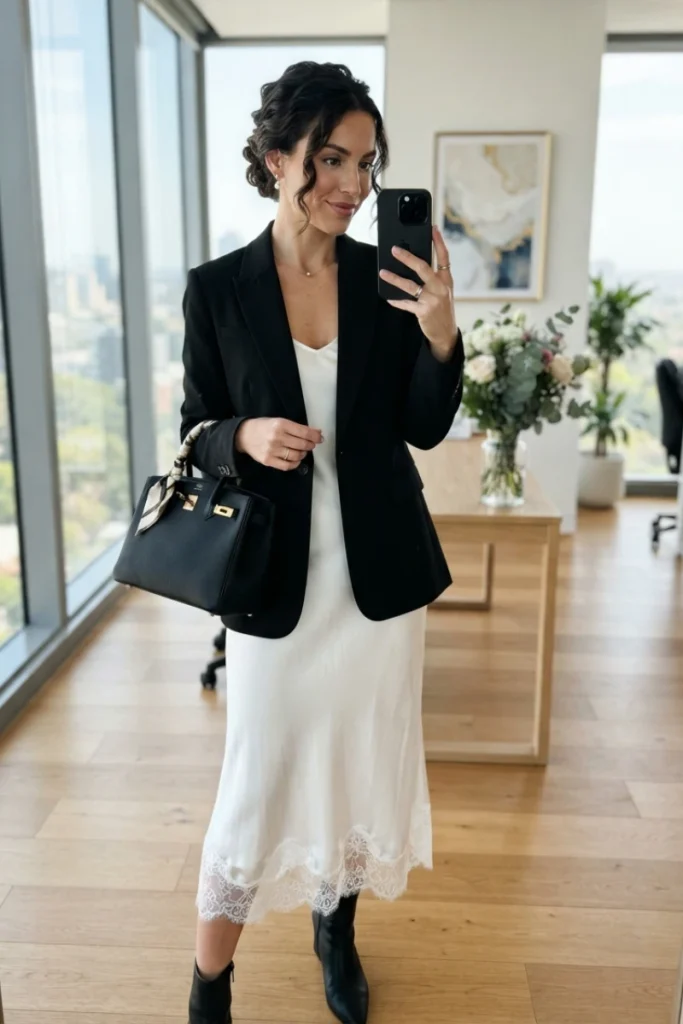
For something dressier, try a slip dress (1), a tailored blazer (2), heeled sandals (3), a clutch (4), drop earrings (5), a thin bracelet (6), and a bold lip as your finishing “accessory” moment (7). Yes, makeup can occasionally act as your seventh visual element in more formal styling, especially when jewelry is minimal.
As a quick visual checklist, ask yourself: clothing pieces, shoes, bag, jewelry, and one styling detail like a hat or sunglasses. If you land near seven, you’re set.
Common Mistakes to Avoid With This Rule
Even a simple formula can get misapplied, so let’s clear up the most common slip-ups I see (and occasionally still make myself).
The biggest one is miscounting matching sets. A two-piece set, like a matching skirt and top, should typically count as one cohesive item, not two, since it reads as a single visual block to the eye. Counting it as two artificially inflates your total and throws off the balance.
Another mistake is ignoring hidden layers. A cropped cardigan or an underlayer camisole might feel invisible to you, but visually, it adds weight and texture others notice. If it’s visible at all, even slightly, it counts.
Finally, don’t treat this as gospel. This method is one of many helpful capsule wardrobe formulas and minimalist fashion tips, meant to guide, not restrict. Some of the most iconic outfits in fashion history broke every counting rule imaginable. It’s okay if six feels more “you,” or if eight works better with your body type and proportions.
Final Thoughts
The 7 rule in fashion isn’t about achieving some mathematically perfect outfit every single day. It’s about giving yourself a quiet, reliable reference point when your brain feels too tired to make one more decision. On the days when everything in your closet suddenly feels wrong, this simple count can pull you back to center.
I’ve found that once you internalize this rhythm, you stop needing to count consciously. Your eye just knows when something’s missing, or when you’ve added one accessory too many. That’s the real win here, not perfection, but intuition built through repetition.
So the next time you’re getting dressed and something feels slightly off, pause and count. You might be surprised how often the answer really is just one earring away from balance.
More Related Stories for You
- If you’re building out your everyday wardrobe with this formula in mind, you might also enjoy these fashion tips for teenage girls this summer, packed with easy, seasonal outfit ideas.
About The Author