
 Elena Garcia
The smallest style choices carry the heaviest emotional weight, and once you see why, getting dressed stops feeling like a daily test.
Key Points
- Simple fashion tips for ladies work because they reduce decision fatigue, not because they limit creativity.
- The way you dress quietly shapes how you think, move, and speak, a phenomenon researchers call “enclothed cognition.”
- A small wardrobe shift this week can rewire your morning mood faster than any motivational quote.
Contents
Table of Contents
You’re Standing in Front of Your Closet Again
You’re standing in front of your closet at 7:42 a.m. The hangers are full. You have nothing to wear. You try on three things, peel them off, and end up in the same soft black top you’ve worn twice this week. You feel a small, familiar sting of defeat before the day has even started.
That sting isn’t about clothes. It’s about the quiet pressure of trying to look “put together” in a life that rarely gives you the time to figure out what that even means.
Here’s what no one tells you.
The reason simple fashion advice keeps surfacing in magazines, on Pinterest, and across every style blog isn’t because it’s lazy or obvious. It’s because the simplest tips are doing something much deeper than helping you match a belt to a bag. They’re rebuilding the part of your brain that decides who you are each morning.
The Hidden Psychology Behind What You Wear
Most fashion content treats clothing as decoration. Psychology treats it as communication, first with yourself, then with everyone else.
In 2012, researchers Hajo Adam and Adam Galinsky coined the term enclothed cognition, which is just a fancy way of saying that the clothes you wear influence how you think and behave. Their study showed that people performed better on attention tasks when wearing a lab coat they believed belonged to a doctor. The fabric didn’t change. The meaning did.
This is why a soft sweater can make you kinder to your kids. Why a sharp blazer can make you push back in a meeting. Why your “good jeans” feel like armor on hard days.
The American Psychological Association has noted that daily clothing choices are tied to mood regulation, self-perception, and even social confidence. What you wear isn’t surface. It’s a small, repeated message your brain receives before your first cup of coffee.
And when that message is chaotic, your day starts behind.
Why “Simple” Is the Most Misunderstood Word in Fashion
Most women hear “simple” and think “boring.” That’s the trap.
Simple, in style, doesn’t mean plain. It means edited. It means you’ve removed the noise, the doubt, the twenty almost-right pieces, so the things you actually love can finally breathe. Simple is the difference between a cluttered desk and a clean one. Same desk. Different mind.
In my fifteen years writing about how women relate to their clothes, the pattern is almost always the same. The women who feel most stylish aren’t the ones with the biggest wardrobes. They’re the ones who’ve made a thousand tiny, confident decisions about what they will and won’t wear, so the morning no longer asks them to decide again.
That’s not vanity. That’s mental peace dressed up as fashion.
The Five Simple Fashion Tips for Ladies That Quietly Change Everything

Here’s where the surface advice usually stops. Let’s go further.
1. Build a “Two-Minute Outfit” Formula
The claim: You need one repeatable outfit equation you can assemble in under two minutes on a bad day.
This is your safety net. Something like: dark straight-leg jeans, a fitted neutral top, one structured layer, one piece of gold jewelry. That’s it. Same formula, different pieces, infinite outfits.
A 2021 piece in Psychology Today discussed how decision fatigue drains willpower throughout the day. By the time you’ve debated five outfits, your brain has already spent energy it needed for the actual hard things waiting for you.
So what: When you remove morning guesswork, you protect the version of yourself who shows up at 3 p.m. for your kids, your boss, or yourself.
2. Dress for the Body You Have Today, Not the One You’re Negotiating With
The claim: Clothes that fit your current body make you look thinner, taller, and calmer than clothes one size too small.
Tight waistbands don’t motivate change. They create a low background hum of discomfort that follows you through every meeting and every meal. Your body reads that hum as stress.
So what: Buy for the Tuesday version of you, not the fantasy version. Comfort is not the opposite of style. It’s the foundation of it.
3. Find Your Three Colors and Stop Apologizing for Them
The claim: Most women look their best in a small palette of three to five colors. Wearing them on repeat isn’t repetitive. It’s signature.
Think of the women whose style you quietly admire. You can probably name their colors. That’s not an accident. It’s a choice they made and stopped re-litigating.
So what: Pick the colors that make strangers say “you look well-rested” and build forward from there. Everything else is a distraction.
4. Treat Tailoring Like Skincare
The claim: A $15 hem on a $30 pair of pants will outperform a $300 pair that doesn’t fit.
This is the tip almost no one acts on, because it requires one extra errand. But the women who look expensive aren’t wearing expensive clothes. They’re wearing clothes that fit them at the shoulder, the waist, and the hem.
So what: One trip to the tailor this month is worth more than three new purchases. Start with the piece you almost wear but never quite do.
5. Use the “Reach Test” Before You Buy
The claim: If you wouldn’t reach for it on a normal Wednesday, don’t bring it home.
Most regret purchases are aspirational. The sequined top for a party you don’t go to. The blazer for the job you used to have. Beautiful, unworn, quietly guilt-inducing.
So what: Style isn’t about owning the right things. It’s about owning the things you actually use.
The Insight Almost No One Writes About
Here’s the part the other articles skip.
Simple fashion tips work because they’re not really about fashion. They’re about reducing the number of times each day you ask yourself, “Am I doing this right?” Every outfit decision is a tiny referendum on your worth, your age, your body, your taste. Multiply that by 365 mornings and you understand why so many women feel quietly exhausted by their own closets.
When you simplify your wardrobe, you’re not lowering your standards. You’re lowering the volume of the inner critic who’s been narrating your reflection since you were twelve.
That’s not a style upgrade. That’s a nervous system upgrade.
Think of your closet like a beach ball you’ve been holding underwater. Every piece you don’t love, every item you keep “just in case,” is pressing back up against you. The relief isn’t in finding the perfect outfit. It’s in letting the ball float.
Meet Lina, Who Stopped Hating Her Mornings
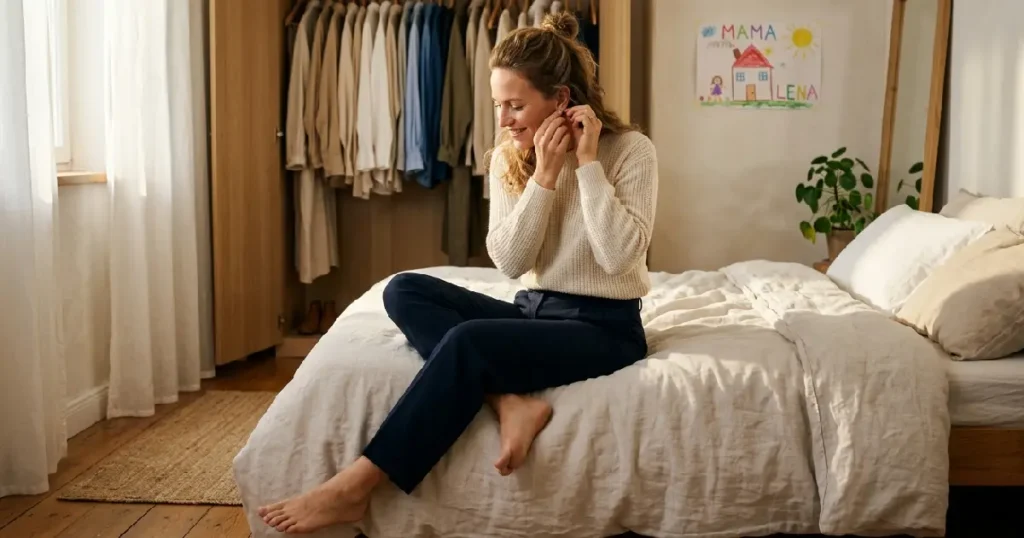
Lina is 38, a marketing manager, and a mom to a six-year-old. She told me she’d cried in her closet three times in one month. Not over anything dramatic. Just the quiet frustration of feeling invisible in her own clothes.
We didn’t reinvent her wardrobe. We pulled out the things that fit, in colors she actually liked, and put everything else in a bin in the garage for thirty days. She built one formula: high-waisted jeans, a cream or black knit, gold hoops, white sneakers or ankle boots.
Three weeks later, she texted: “I haven’t thought about what to wear in eleven days. I forgot what that felt like.”
She didn’t become a different woman. She just stopped fighting the one she already was.
Now What? Four Small Moves to Try This Week
The Closet Audit (20 Minutes)
Take out everything you haven’t worn in a year. Don’t donate yet. Just move it to a separate space. Notice how the remaining closet feels lighter, and how much faster you dress for the next seven days. Vogue’s wardrobe editing guides are useful here if you want a starting structure.
The Uniform Experiment
Pick one outfit formula and wear a version of it every day for one week. Notice how much mental space opens up. Notice how few people comment, because no one is watching as closely as you fear.
The Compliment Journal
For two weeks, write down every outfit that earned you a genuine compliment, including from yourself in the mirror. Patterns will emerge. Those patterns are your style, not the one a magazine tried to assign you.
The One-Tailor Promise
Choose one item this month, just one, that almost fits. Take it in. Then notice the difference in how you stand when you wear it. Confidence often hides in a quarter-inch of fabric.
A useful question to ask yourself: “If I never bought another piece of clothing, would my current closet still let me feel like myself?” If the answer is no, the issue isn’t quantity. It’s clarity.
You’re Standing in Front of Your Closet Again, But Something Has Shifted
It’s 7:42 a.m. The hangers are fewer. The choices are louder in a good way. You reach for your formula, add the earrings you always reach for, and you’re out the door in four minutes flat.
You didn’t become more disciplined. You became more honest about what makes you feel like you.
That’s what simple fashion tips for ladies are really offering. Not a new look. A quieter mind.
And a quieter mind, it turns out, is the most stylish thing you can wear.
My Closing Remarks
I’ll be honest with you. For years I thought my closet was the problem. It wasn’t. The problem was that I kept buying clothes for a woman I thought I should be, and ignoring the one I actually was. The day I stopped doing that, getting dressed stopped feeling like a small daily grief. If you take nothing else from this article, take this: your style is already inside you. The work isn’t finding it. It’s clearing enough space so it can finally show up.
More Related Stories for You
- For wisdom that ages beautifully, see our guide on styling tips and fashion for women over 60.
About The Author